
Results
-
 £64.95
A Disney Spectacular
Includes: Be Our Guest; Beauty and the Beast; Bella Notte (This is the Night); Bibbidi-Bobbidi-Boo; A Spoonful of Sugar; Under the Sea; A Whole New World.
Estimated dispatch 7-14 working days
-
 £54.99
Aladdin's Theme - Alan Mencken - Roland Kernen
Aladdin's Theme (A Whole New World) by Alan Menken/Tim Rice. Arranged by Roland Kernen for Brass Band. Score and parts.
Estimated dispatch 5-14 working days
-
 £53.99
Aladdin (Brass Band - Score and Parts) - Menken & Rice - Bernaerts, Frank
A Whole New World from Walt Disney's motion picture Aladdin. Duration: 4.00
Estimated dispatch 7-14 working days
-
 £64.95
DISNEY SPECTACULAR (Brass Band) - Richards, Goff
Includes: Be Our Guest (Beauty & the Beast); Beauty & the Beast; Belle Notte (Lady and the Tramp); Bibbidi-Bobbide-Bo (Cinderella); A Spoonful of Sugar (Mary Poppins); Under the Sea (Little Mermaid); A Whole New World (Aladdin)
Estimated dispatch 7-14 working days
-
 £25.95
Hymn for Africa - Peter Meechan
Part of the Brass Band Aid SeriesBrass Band Aid is a Charitable Organisation formed by members of Stanhope Silver Band, based in the North of England. From an original aim to raise awareness of the Make Poverty History campaign in their local area, a brass band CD recording was planned. The initiative took on a whole new dimension when the collection of local bands performing on CD were then joined by, what is now known as, The Brass Band Aid Celebrity Band, made up of many of the top brass musicians in the country.Following the success of this initial project the Celebrity Band has come together again to record a new CD - "Into Africa". This is a compilation of pieces especially written for the recording by some of the most esteemed brass band writers of today. 'Hymn for Africa' is one such piece, generously contributed by Peter Meechan in support of the ongoing work of the charity."Hymn for Africa is inspired by the the release of Nelson Mandela in the early 1990's and the effect it had upon not only South Africa, but all over the continent of Africa, as well as the World as a whole. The fact that one man can achieve this with peace and great dignity will always be an inspiration, not only to me, but many, many millions of humans around the globe.sense of dignity and peace the composer . A simple 8 bar melody, first heard on an unaccompanied flugel horn at the beginning, is the basis of the composition. A drone is then added, before a chorale, and finally a rousing climax when the percussion and full band enter. The piece ends at it began, with a peaceful, unaccompanied, flugel solo." (Peter Meechan).All sets sold raise money for Brass Band Aid - a charity The Music Company has continued to actively support since 25.
In Stock: Estimated dispatch 3-5 working days
-
 £35.00
Carol of the Bells (Brass Band - Score and Parts) - Littlemore, Phillip
This popular Christmas piece was composed by Mykola Leontovych around 1916. It is based on a Ukrainian folk chant known as 'Shchedryk', a New Year's carol. However, it was not until after the composer's death in 1921 that it was first introduced to Western audiences, when the Ukrainian National Choir included it on their tour of Europe and the Americas that same year. The film composer John Williams incorporated it into the score for the 1990 film Home Alone and he is credited for bringing it to a wider audience still, although it had been released on Christmas albums by a number of popular artists before that. This transcription for brass band has been adapted from the arrangement by Robert Prizeman, who created it for Libera, the world famous boys choir that he both founded and directs. Their unique, enchanting and, some say, heavenly sound delights audiences throughout the world through extensive concerts, recording and TV broadcasts. This brass band transcription introduces this skilled choral arrangement to a new genre and a whole new audience as well. Duration: 3.00
Estimated dispatch 7-14 working days
-
£29.95
The Land of the Long White Cloud (Score Only)
Dating from 1979, The Land of the Long White Cloud (Aotearoa) was Philip Sparke's first test-piece. It was commissioned by the New Zealand Brass Band Association for their 1980 National Championships (their centenary year) and set for the European Brass Band Championships, the same year, at the Royal Albert Hall in London. Aotearoa was the name given to New Zealand by its Polynesian settlers whose first sight of the islands was a long, flat cloud lying low over the land. The work has no specific programme although many have seen pictures of the surging ocean in the opening bars. A faster dance-like section leads to a slow, haunting solo for soprano cornet; this is taken up by the whole band before earlier material returns. The dance-like tune is, this time, given a fugal treatment and the opening bars return to close the work.Philip Sparke was born in London and studied composition, trumpet and piano at the Royal College of Music, where he gained an ARCM. It was at the College that his interest in bands arose. He played in the College wind orchestra and also formed a brass band among the students, writing several works for both ensembles.At that time, his first published works appeared - Concert Prelude (brass band) and Gaudium (wind band). A growing interest in his music led to several commissions, his first major one being this featured piece for the Centennial Brass Band Championships in New Zealand - The Land of the Long White Cloud. He has written for brass band championships in New Zealand, Switzerland, Holland, Australia and the UK, including three times for the National Finals at the Royal Albert Hall.In September 2000, he was awarded the Iles Medal of the Worshipful Company of Musicians for his services to brass bands and in 2005 Music of the Spheres won the National Band Association/William D. Revelli Memorial Band Composition Contest. In 2011, he received the BUMA International Brass Award for his contribution to brass music.His conducting and adjudicating activities have taken him to most European countries, Scandinavia, Australia, New Zealand, Japan, Taiwan, South Korea, Canada and the USA. In May 2000, he took the major step of becoming a full-time composer by founding his own publishing company, Anglo Music Press. The company is devoted to publishing his brass band, concert band, fanfare band and instrumental publications as well as recordings dedicated to his latest works.
Estimated dispatch 7-14 working days
-
 £89.95
Partita (Score and Parts)
Partita was written in 1989 to a commission from Eikanger/Bjrsvik Musikklag (Norway) who were European Champions at the time.There are three movements.1 The first movement is almost a miniature concerto for band. It opens with a relentless quaver passage in the basses, which builds until the whole band is involved. Horns and baritones are first to take centre-stage in close harmony and the euphoniums and basses follow them. These forces combine to introduce the cornets that have a 10-part fanfare to themselves before the trombones interrupt. The opening quaver figure returns, somewhat ominously, and, after the full band recalls previous material, brings the movement to a close.2. Starts with a cornet solo over a pulsating accompaniment after which the band builds to a noble tune on the trombones. The full band takes over and brings back the opening cornet tune with which the soloist, with the aid of a euphonium counter-melody, quietly ends the movement, leading directly into:3. A sparkling vivo, which opens with the fanfare-like figures throughout the band until a solo cornet, emerges with an acrobatic tune. The whole band takes this up until horns; baritones and trombones introduce an energetic second subject, which leads to a full band climax in the form of a jubilant chorale. This died away to reintroduce the opening fanfare against a new theme from the trombones, which eventually leads back to a recapitulation. We are then thrown headlong into a 12/8 presto, which hurtles to a coda, which recalls the opening themes.
Estimated dispatch 7-14 working days
-
 £44.95
Partita (Score Only)
Partita was written in 1989 to a commission from Eikanger/Bjrsvik Musikklag (Norway) who were European Champions at the time.There are three movements.1 The first movement is almost a miniature concerto for band. It opens with a relentless quaver passage in the basses, which builds until the whole band is involved. Horns and baritones are first to take centre-stage in close harmony and the euphoniums and basses follow them. These forces combine to introduce the cornets that have a 10-part fanfare to themselves before the trombones interrupt. The opening quaver figure returns, somewhat ominously, and, after the full band recalls previous material, brings the movement to a close.2. Starts with a cornet solo over a pulsating accompaniment after which the band builds to a noble tune on the trombones. The full band takes over and brings back the opening cornet tune with which the soloist, with the aid of a euphonium counter-melody, quietly ends the movement, leading directly into:3. A sparkling vivo, which opens with the fanfare-like figures throughout the band until a solo cornet, emerges with an acrobatic tune. The whole band takes this up until horns; baritones and trombones introduce an energetic second subject, which leads to a full band climax in the form of a jubilant chorale. This died away to reintroduce the opening fanfare against a new theme from the trombones, which eventually leads back to a recapitulation. We are then thrown headlong into a 12/8 presto, which hurtles to a coda, which recalls the opening themes.
Estimated dispatch 7-14 working days
-
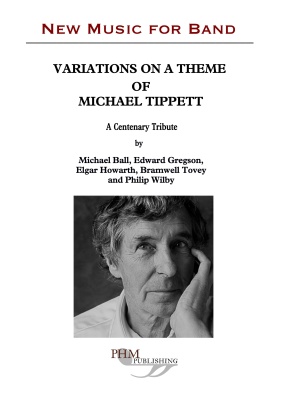 £95.00
Variations on a Theme of Michael Tippett (Brass Band - Score and Parts)
A Centenary Tribute by Michael Ball, Edward Gregson, Elgar Howarth, Bramwell Tovey and Philip WilbyThis unique 'pice d'occasion' arose out of a telephone conversation in 2004 with Alan Wycherley, who was the soprano cornet player of the Foden's Richardson Band at the time. He indicated that the band would like to include an original birthday tribute for Edward Gregson (60) and Elgar Howarth (70) in its concert at the 2005 RNCM Festival of Brass in Manchester. I have been Artistic Director of Manchester's Festival of Brass since it was established in 1990 as a BBC Radio 3 series, As the centenary of the birth of Sir Michael Tippett fell on 5 January 2005, I devised this collective work as a way of embracing all three anniversaries in a novel way.The idea of joint compositions is not a new one in the classical music world. In the 1860s, Verdi was joined by a number of his contemporaries in a Requiem Mass for Rossini. In this country there have been a number of orchestral examples over the past fifty years, but never before for the brass band. Although Tippett composed only one work for brass band, Festal Brass with Blues, his orchestral works and operas are full of idiomatic brass writing. The theme I chose for this celebration is one of Tippet's most memorable miniatures featuring wind and brass. In the opera Midsummer Marriage it marks the entry of the Ancients. It is also included in the orchestral Suite in D (1948), for the Birthday of Prince Charles.I invited five of the leading contemporary voices in brass band music to add their own creative perspectives to the little Tippett theme, with it's characteristic rhythms, embellishments and modality - the Lydian mode. Each contribution was designed to fit into a tonal and formal template to give the whole work a flow and continuity. In Danse des Amis, Bramwell Tovey has composed a jazzy, humorous variation. Inspiration came from Tippett's love of jazz and, more personally, from the characteristically syncopated gait of the distinguished music critic John Amis, who Tovey once observed leaving a performance of Tippett's opera King Priam before the end. Incidentally, that performance was conducted by Elgar Howarth.We hear Edward Gregson in lyrical mode. His Midsummer Song is redolent of the sound world of Tippett's opera A Midsummer Marriage and it ends with a brief reference to a favourite of Gregson's, Tippett's Concerto for Orchestra. Michael Ball provides a brief moment of light, airy activity bringing to mind perhaps Tippett's love of Shakespearian fantasy, especially The Tempest. Elgar Howarth juxtaposes a slowed down version of the processional theme with distant recollections of fanfares from King Priam. Philip Wilby has rounded the tribute off with a spectacular fugue. During its inexorable progress Wilby ingeniously introduces the two other birthday references - the three-note musical signature that Elgar Howarth includes in much of his music and the characteristic theme which begins Edward Gregson's substantial work for brass an organ The Trumpets of the Angels. An elaborated reprise of Tippett's little theme is followed by a dynamic coda.- Paul HindmarshDuration: 13.00
Estimated dispatch 7-14 working days
 View Music