
Results
-
 £85.00
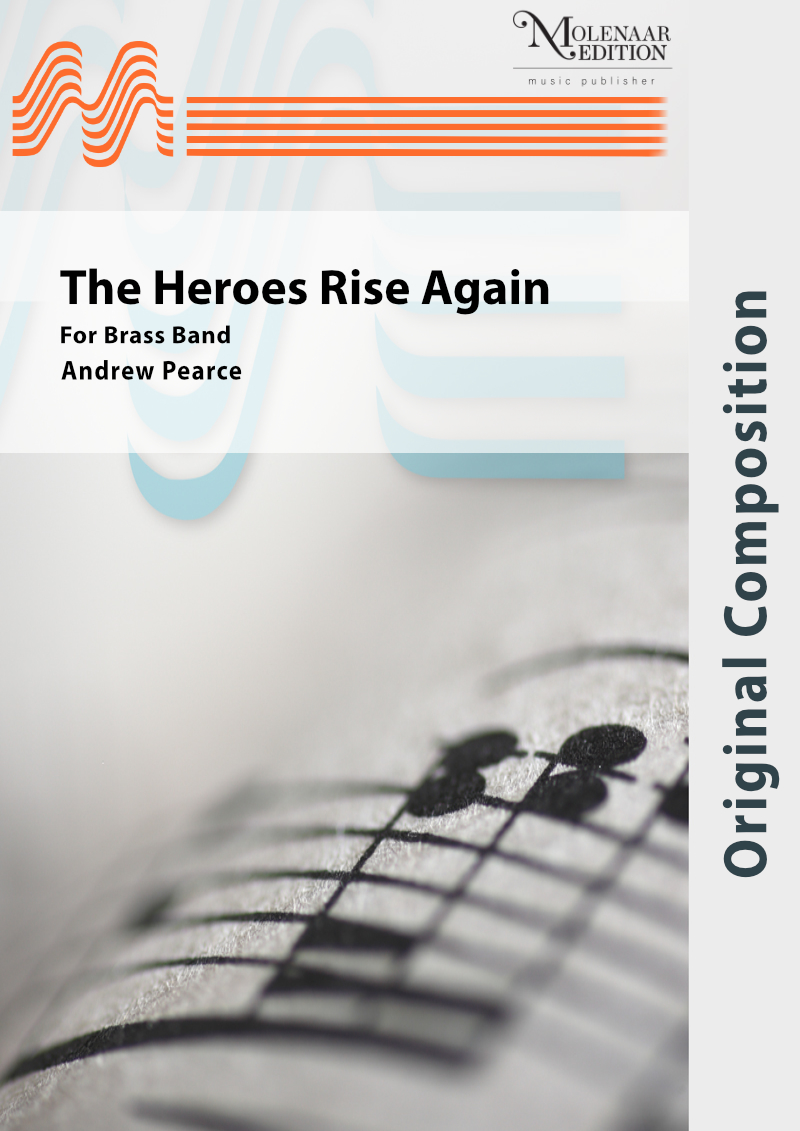
The Heroes Rise Again - Andrew Pearce
As the title suggests, the piece is heroic and olympic in feel. One might imagine an Olympic Games opening ceremony where the athletes assemble to compete on the world stage. The Heroes Rise Again is an exciting and memorable piece that your band will love performing and is sure to give a tingle down the spine, leaving your audience wishing for more as they whistle the tune out the door!
Estimated dispatch 10-14 working days
-
 £30.00
My Little Welsh Home - Traditional
A beautiful arrangement by Tim Paton of a Welsh song by W S Gwynne Williams. Created in memory of his mother, Tim has produced a wonderful version for brass band and has also included an optional vocal solo or unison choir line.Comments from the arranger:I have arranged [My Little Welsh Home] in memory of my mother. [She] was born, Doreen Davies, on 27th November 1918, in Haverfordwest, Pembrokeshire, a small town in South West Wales. She had a beautiful voice, and met my father, Bill Paton, during World War II, whilst she was singing in a troop concert at the County Theatre in her home town, and my father was the MC.Throughout her life, my mother and father entertained, and she was singing right up until the final months of her life. She spent many years in Weston-super-Mare, Somerset, a seaside town in South West England, and it was here that she passed away on 20th September 2004. During the last several months of her life, she often referred to the song My Little Welsh Home:Here are the words.I am dreaming of the mountains of my homeOf the mountains where in childhood I would roamI have dwelt 'neath southern skiesWhere the summer never diesBut my heart is in the mountains of my homeI can see the little homestead on the hillI can hear the magic music of the RhyllThere is nothing to compareWith the love that once was thereIn the lonely little homestead on the hillI can see the quiet churchyard down belowWhere the mountain breezes wander to and froAnd when God my soul will keepIt is there I want to sleepWith those dear old folks that loved me long agoLooking at the words, I can see why it meant so much to her. Haverfordwest is at the foot of the Preseli Mountains, and her home and church were at the top of a hill. My mothers' ashes were taken back to her own little Welsh home, and laid to rest in the grounds of the church where she had been Christened, Confirmed and Married.Look and Listen (Score-reading digital sound-sample):
In Stock: Estimated dispatch 3-5 working days
-
 £84.95
A Day in the Life of a Knight (Brass Band - Score and Parts) - Lawrence, Phil
Here we have a most descriptive piece of writing - a story through music. A fantastic 1st section test piece and championship concert work:The opening scene would depict standing on the battlements of a castle hearing the thundering hoofs of our brave Knight's horse miles in the distance. His arrival is expected, and his reputation is known across many lands. Today, he is to joust amongst mere mortal knights and compete for the hand of the fair (and local) Princess.He vanquishes all competitors and wins the day. The scene moves to evening and court where reception and dance is to be held for our winning knight. Both Knight and Princess become centre of attention during the dance. Their eyes only for each other.At last, the Knight has a chance to be a lone with his Princess as they steal away from the celebrations to a star lit rampart above the castle gardens, where the Knight declares his ever-lasting love and pledges his life and of honour to her. He asks her hand, meanwhile monks pray in the below chapel hoping for union. She say's yes. It is announced in court, then blown from the battlements.Day breaks; he is brought word of evil doings back in his own land. He leaves word to the Princess that he will be back soon to take her hand. The trouble back home was a rouse to get him away from the Princes so one of the vanquished, a dark knight in yesterdays joust, has summoned a dragon to kidnap the princess for his own.As the truth of the deception reaches our Knight he quickly returns to face the varlet that has taken his Lady. This time tis no joust, but a fight to the death with the dark knight and dragon. Our champion proves his best once again and wins the day and the hand of his Princess forever!- Phil LawrenceSuitable for 1st Section Bands and aboveDuration: 11.15
Estimated dispatch 7-14 working days
-
 £89.99
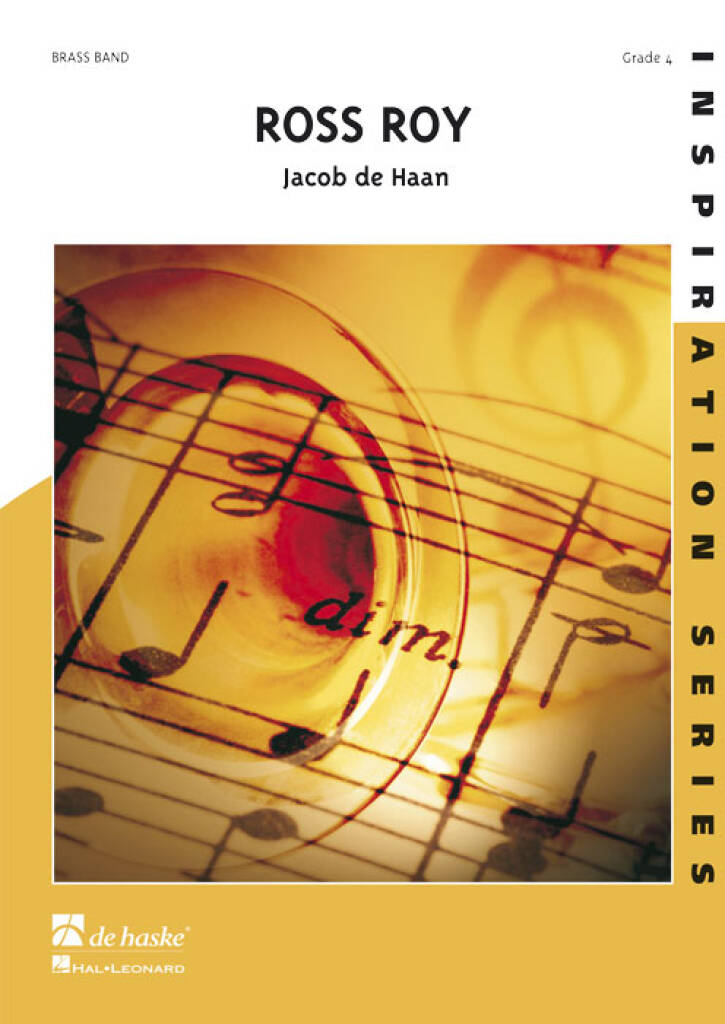
Ross Roy - Jacob de Haan
In this composition, Jacob de Haan sees the "Ross Roy" as a metaphor for the years spent at school (a monument in time), where one's personality is formed. So, the opening theme the artist calls the Ross Roy theme initially has monumental characteristics.The rhythmic motion, which strides along in the lower register and percussion at the beginning of the next section is typical of "Tempo di Marcia". This movement, accompanied by repetitions of sound, is a metaphor for the structure and discipline in school. This is the introduction to a march theme, symbolic of "passing through" the classes up to the final examinations.Then, the Ross Roy theme is dealt with again, now in aplayful, humorous variation. As if the composer is saying there should also be time for a smile in school. The same theme can be heard in major key and a slower tempo in the following section, expressing pride and self-confidence. This is also the introduction to the expressive middle section that represents love, friendship and understanding.We then return to the march theme in a slightly altered construction. The oriental sounds, constituting the modulation to the final theme, are symbols of the diversity of cultures in the school. The characteristic final theme first sounds solemn, but turns into a festive apotheosis. It is no coincidence that the final cadence is reminiscent of the close to a traditional overture, for the school years can be considered the "overture" to the rest of one's life.
Estimated dispatch 5-14 working days
-
 £115.60
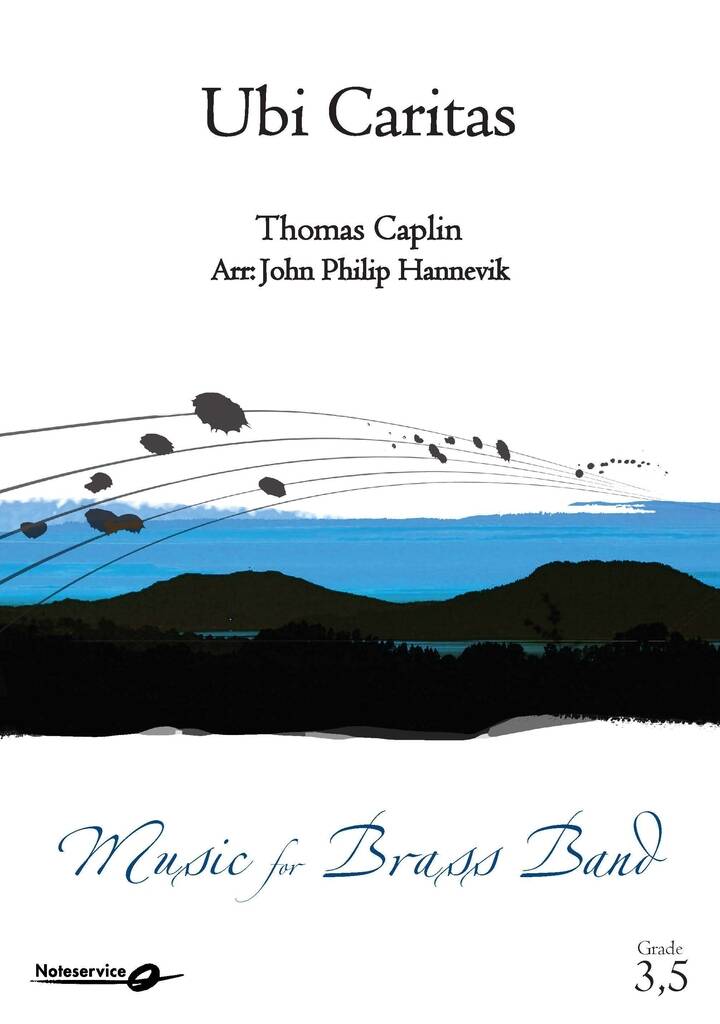
Ubi Caritas - Thomas Caplin - John Philip Hannevik
Thomas Caplin is a Swedish professor of choral conducting. He works at the Inland Norway University of Applied Sciences in Hamar. He composed this beautiful opus for choir based on the ancient text Ubi caritas.The text is often used during Maundy Thursday, describing Jesus washing the feet of his disciples: Where charity and love are, there God isIn this arrangement, a smaller group of players are soloists. The arrangement will work well if the group can be placed on a gallery or at the back of the concert hall.
Estimated dispatch 5-14 working days
-
 £33.62
Les Chasseresses from 'Sylvia' (Brass Band) Delibes arr. Rob Bushnell
Clement Philibert Leo Delibes was a French composer, best known for his ballets and operas, including works such as Lakme (with its famous "Flower Duet"), Coppelia and Sylvia (both key works in the development of modern ballet). The latter started as a play, Aminta, by the Italian poet Torquato Tasso, which Delibes set to music. It was then adapted for the Paris Opera with rehearsals starting in August 1875. The premiere took place on 14 June 1876 and was the first ballet to be shown at the newly-built Opera Garnier. Whilst the scenery and costumes were created by top artists and designers (Cheret and Lacoste), it was Delibes's music that shown thrown, being said to have saved the production, preventing the ballet from drifting into obscurity.Sylvia is said to be one of the first modern ballets, with Tchaikovsky remarking to composer Sergei Taneyev upon its ingenuity: "... the first ballet, where the music constitutes not only the main, but the only interest. What charm, what elegance, what richness of melody, rhythm, harmony." Although Swan Lake, a contemporary to Sylvia, is considered one of the best ballets there is, Tchaikovsky preferred Sylvia to his own work, saying Swan Lake was "poor stuff in comparison". Tchaikovsky said to Taneyev, "I was ashamed. If I had known this music early then, of course, I would not have written Swan Lake". The music to Sylvia, rather than setting only the mood, also sets the action and is noted for its use of leitmotifs - Delibes was an admirer of Wagner - and more dominant use of brass and wind. The most famous piece from this ballet is the Pizzicati in the third act.Act I of the ballet takes place in sacred wood, where creatures are worshipping before Eros when Sylvia arrives with her huntresses to mock the god of love. Aminta, a lowly shepherd and infatuated with Sylvia, protects the deity and Sylvia is wounded by Eros's arrow. The hunter Orion kidnaps Sylvia, whilst Eros revives Aminta. Act II takes place in Orion's Island cave, where Sylvia tries to bribe Orion with jewels and wine. Unsuccessful, she appeals to Eros for help, who arrives and takes her to the temple of Diana (where the final act takes place). Orion and Aminta fight, Sylvia and Orion cause the goddess of the hunt, Diana, to be outraged, smiting Orion and denying the love of Aminta and Sylvia. Eros shows Diana a vision, which changes her mind and the couple finally come together.This brilliant and lively fanfare that introduces the huntresses in the first act is arranged here for the UK-style brass band, with alternative parts for horns in F and bass-clef lower brass. The piece has been lowered by a tone compared to the original. A recording of the original composition can be found here https://youtu.be/6yoGrUH38PI?si=0L0bFa1qXnYNvkR3 Duration: Approx. 3.10 minutes Difficulty Level: 1st Section + This PDF download includes the full score and parts. Includes alternative parts for soloist in Eb, horns in F and lower brass in bass clef. Sheet music available at www.brassband.co.uk (UK) or https://satradecentral.org (USA) Instrumentation: Soprano Cornet Eb Solo Cornet Bb Repiano Cornet Bb 2nd Cornet Bb 3rd Cornet Bb Flugel Horn Bb Solo Horn Eb 1st Horn Eb 2nd Horn Eb 1st Baritone Bb 2nd Baritone Bb 1st Trombone Bb 2nd Trombone Bb Bass Trombone Euphonium Bb Bass Eb Bass Bb Timpani Percussion - Triangle, Cymbal & Bass Drum
In Stock: Estimated dispatch 1-3 working days
-
 £33.62
Sunset (Cornet Solo with Brass Band) David Robb
Sunset was written in June 2023 as a graduation present for the composer's son Callum and is dedicated to him. It portrays an older father (the composer) reminiscing about the love, respect and pride he has for his grown-up son and all that he has achieved and worked for. Sunset is lyrical and song-like in style. A soaring solo line is accompanied by a mainly homophonic background which should support, but never overpower the soloist. The tutti sections feature the melody accompanied by flowing scalic figures which portray the passing of time. The piece ends with an ad lib cadenza section where the soloist can really put their own mark on the music. To view a video of Dominic Longhurst and Victoria Brass performing the solo please visit www.youtube.com/watch?v=nzYwOvlqaYU PDF download includes score and parts. Sheet music available from: UK - www.brassband.co.uk USA - https://satradecentral.org Difficulty Level: 4th Section + Length: 4.10 minutes Instrumentation: Cornet Soloist Bb Soprano Cornet Eb Tutti Solo Cornet Bb Repiano Cornet Bb 2nd Cornet Bb 3rd Cornet Bb Flugel Horn Bb Solo Horn Eb 1st Horn Eb 2nd Horn Eb 1st Baritone Bb 2nd Baritone Bb 1st Trombone Bb 2nd Trombone Bb Bass Trombone Euphonium Bb Bass Eb Bass Bb Timpani Suspended Cymbal Glockenspiel
In Stock: Estimated dispatch 1-3 working days
-
£29.50
So Amazing - Traditional - Jonathan Mead
'So Amazing', is a beautiful new hymn tune arrangement from the pen of Welsh Composer Jonathan Mead. The music would create a lovely moment in a concert, where the audience would have time for reflection. The title comes from the words that are often associated with this tune, 'Love so amazing, so divine,'. The tune used, is also well known in the brass band world as, 'The Water is wide'. The music is lovely to play as well as listen to. A must for any Concert Programme.
In Stock: Estimated dispatch 1-3 working days
-
 £24.50
Christmas Lullaby - French Traditional - Lynda Nicholson
Based upon the French Christmas Carol, 'Whence Is That Goodly Fragrance?', this moving arrangement by Lynda Nicholson really allows a band to show off their soft and lyrical playing. In a time where Christmas concerts are awash with the traditional and festive tunes we all know and love, this item gives the chance for something beautiful and different. Giving moments for all sections of the band to enjoy, the big climax near the finale is a great way to treat your audience to something new this year.
In Stock: Estimated dispatch 1-3 working days
-
 £89.99
Ross Roy (Brass Band - Score and Parts) - De Haan, Jacob
In this composition, Jacob de Haan sees the "Ross Roy" as a metaphor for the years spent at school (a monument in time), where one's personality is formed. So, the opening theme the artist calls the Ross Roy theme initially has monumental characteristics.The rhythmic motion, which strides along in the lower register and percussion at the beginning of the next section is typical of "Tempo di Marcia". This movement, accompanied by repetitions of sound, is a metaphor for the structure and discipline in school. This is the introduction to a march theme, symbolic of "passing through" the classes up to the final examinations.Then, the Ross Roy theme is dealt with again, now in a playful, humorous variation. As if the composer is saying there should also be time for a smile in school. The same theme can be heard in major key and a slower tempo in the following section, expressing pride and self-confidence. This is also the introduction to the expressive middle section that represents love, friendship and understanding.We then return to the march theme in a slightly altered construction. The oriental sounds, constituting the modulation to the final theme, are symbols of the diversity of cultures in the school. The characteristic final theme first sounds solemn, but turns into a festive apotheosis. It is no coincidence that the final cadence is reminiscent of the close to a traditional overture, for the school years can be considered the "overture" to the rest of one's life.Duration: 9:20
Estimated dispatch 7-14 working days
 View Music
 Listen to MP3