Results
-
 £37.40
World War III (Brass Band) Joe Galuszka
This descriptive work for brass band by Joe Galuszka depicts the horrors of war. War is all around us. Every day, another life is lost. Myanmar, Sudan, Ethiopia, Ukraine, Colombia, Afghanistan, Somalia, Syria and Yemen. As time goes on, more and more countries are brought to the end of what is a diplomatic struggle - in where war seems to be the only option. 'War! Terror! Panic! captures the tumultuous and relentless nature of war. With driving rhythms, aggressive brass fanfares, and thundering percussion, the listener is immersed in the chaos of battle. Dissonance and clashing harmonies depict the discord that pervades war and takes us on a journey through the terror and panic that comes with the brutality of conflict. Remembrance (For Those That We Have Lost) provides a poignant and reflective interlude, allowing the audience to contemplate the human cost of war. Mournful melodies and expressive solos for trombone, euphonium and glockenspiel, convey the depth of sorrow and loss, serving as a powerful reminder of the toll war takes on individuals and communities. The final movement, Hymn for Peace and Hope is a testament to the enduring human spirit and the yearning for harmony - dissonance and conflict gradually give way to consonance and resolution. We celebrate the human capacity for unity and the triumph of peace over strife, as we imagine a world at piece. To listen to an audio demo of the work please visit https://on.soundcloud.com/Udt1AWRThgwuWnQv5 Duration: Approx. 5.00 mins Difficulty Level: 2nd Section + PDF download includes parts and score. Sheet music available from www.brassband.co.uk (UK) or www.cimarronmusic.com (USA) Instrumentation: Soprano Cornet Eb Solo Cornet Bb Repiano Cornet Bb 2nd Cornet Bb 3rd Cornet Bb Flugel Horn Bb Solo Horn Eb 1st Horn Eb 2nd Horn Eb 1st Baritone Bb 2nd Baritone Bb 1st Trombone Bb 2nd Trombone Bb Bass Trombone Euphonium Bb Bass Eb Bass Bb Timpani Percussion 1-3
In Stock: Estimated dispatch 1-3 working days
-
£105.00
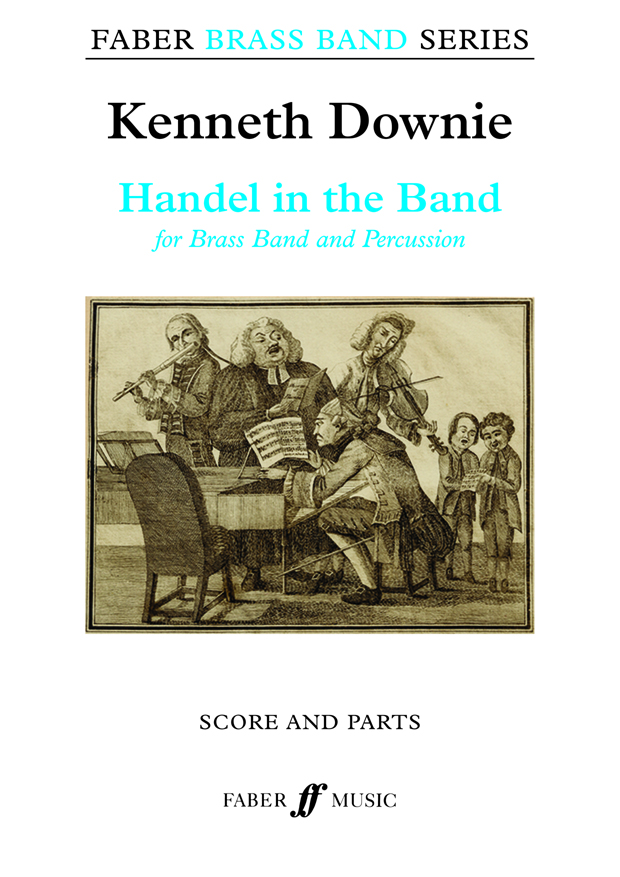
Handel in the Band - Kenneth Downie
Handel in the Band is a virtuoso set of symphonic variations on one of Handel's best known keyboard dances, the Sarabande from his Suite in D minor, HWV 437, based on the Spanish traditional dance La Folia. Kenneth Downie's work was commissioned by Brass Band Treize Etoiles, for performance at the 2013 Swiss National Brass Band Championships, where it was conducted by James Gourlay. The title is a reference to Percy Grainger's popular Handel in the Strand, and is indicative of the witty and theatrical nature of the music, which is more playful than conventional competition pieces and as such offers different challenges to brass bands as well as being thoroughly entertaining for audiences. Kenneth Downie is one of the most respected and experienced brass band composers. His music has been widely performed and published throughout the brass band world since the 1960s. Handel in the Band has been selected as the set work for the Championship Section final of this year's National Brass Band Championships of Great Britain, which takes place at the Royal Albert Hall, London, on 6th October 2018.
In Stock: Estimated dispatch 1-3 working days
-
 £10.00
The Once and Future King
DescriptionThe Once and Future King is a suite of three movements; each movement was inspired by an Arthurian legend. The first movement, 'Tintagel', concerns the famous Cornish promontory said to be the birthplace of King Arthur. In Arthur's time, Tintagel was part of the court of King Mark of Cornwall and the music imagines a visit by the King of the Britons to his Cornish neighbour and the place of his birth, reflecting the ceremony and drama of such an occasion; the music is strongly antiphonal, contrasting the more strident fanfares of the cornets and trombones with the warmth of the saxhorns and tubas.The second movement, 'Lyonesse', takes its inspiration from the mythical land which once joined Cornwall to the Isles of Scilly. One legend claims that after the disastrous battle of Camlan where Arthur and Mordred were both killed, the remnants of Arthur's army were pursued across Lyonesse to Scilly, whereupon Merlin cast a spell to sink Lyonesse behind them and drown the pursuers. Some say the bells of the 140 churches inundated that day can still be heard ringing. All the material in this movement derives from two short motifs heard in counterpoint at the very beginning, which are intentionally dissonant and bitonal in character.The final movement, 'Badon Hill', takes its title from the legendary site of Arthur's last battle with the Saxons and is a lively toccata based on the medieval secular song L'Homme Armee ('The Armed Man'). The music uses a number of medieval devices including "hocketing" (passing melody from one voice to another). The actual site of Badon Hill is unknown but it has been associated with Badbury Rings in Dorset and a lot of evidence now points towards the town of Bath. Arthur's victory at Badon Hill was the last great victory for Celtic Britain over the Saxon invaders, but in the end only set the conquest back by a few decades. Arthur himself was dead by then, betrayed and defeated by his nephew Mordred, but it is said that Arthur only sleeps and will return in a time of dire need - hence the legend that Arthur's dying words were: Bury me in Britain, for I am the Once and Future King.Performance NotesWhere space and practicality permits the opening movement should be played with cornets and trombones standing behind the band facing the audience; they should retake their seats for the second and third movements.PercussionConcert Bass Drum (ideally NOT Kit/Pedal Bass Drum), Suspended Cymbal, pair of Clash Cymbals, Glockenspiel, Snare Drum, Tambourine, 2 x Timpani (Eb-G, Bb-D), 2 x Tom-toms, Triangle, Tam-Tam* (only if available), Tubular Bells *(only if available).MutesBaritones, all cornets and trombones will require metal straight mutes; all trombones and cornets will require cup mutes.*The Once and Future King was set as the test-piece for the 3rd section of the Swiss National Championships in 2007. The score was then slightly revised in July 2008, the main alteration being the exclusion of the tubular bells part for the Regional Championships of Great Britain in 2009. Some parts which were optional (or cued on other instruments) at the request of the Swiss Brass Band Association were restored to their original octaves and instruments. In 2015 the tubular bells part was restored in the optional Percussion 3 part; all parts in Percussion 3 are optional, although some are cued in the percussion 1 & 2 parts (and the cues should be played if only two players are available).Listen to a preview and follow along with the score below!
Estimated dispatch 7-14 working days
-
 £30.00
Exegesis - Tim Paton
An exciting, original composition for brass band by Tim Paton. A complex work which entwines melodic lyricism amidst contemporary harmonies and scoring. A tour de force of Tim's creativity and a rewarding challenge for the performers and audience.Tim comments: The term exegesis is applied to a study which works out the meaning of something, an interpretation of a series of events, a comparison of ideas within a given medium, for example, "Biblical exegesis". This brass band piece is a musical exegesis.Section one is made up of three main themes, and although these themes are tonal within themselves, there is a sense that they are trying to understand one another. From the very beginning of this section, there is an element of bi-tonality and dissonance.The middle section is ponderous, where we hear elements of these three themes. It could be called the 'thinking section'.Section three almost interrupts this middle section, with fanfares displaying a realisation, still containing bi-tonality, but in harmony! We are soon led in to a hymn like celebration, followed by a determined, militaristic section for the percussion. Finally, the fanfares which opened this third section, reappear, taking us to a final conclusion.
In Stock: Estimated dispatch 3-5 working days
-
 £43.05
Oubliette - Lucy Pankhurst
Lucy Pankhurst has created a highly immersive solo for Tuba/Eb Bass with brass band accompaniment, aiming and succeeding in showing the lyrical and technical diversity of the tuba, demanding virtuoso brilliance and clarity in performance.Dedicated to tuba player Edd Leech, Oubliette raises the bar for tuba repertoire.Set includes score, brass band parts and solo parts for Eb Bass (TC) and Tuba (BC). Solo with piano accompaniment available separately.Programme notes from the composer, Lucy Pankhurst:From the French word oublier, meaning 'to forget', an oubliette was a form of dungeon used in the 14th century. A small, windowless room where someone is locked away to be forgotten and left to go mad.I initially chose this title for the piece as the Tuba is often forgotten as a solo instrument, when its versatility in performance should be celebrated. Oubliette showsThe work begins with desolate and sparse accompaniment with lamenting solo lines. The soloist has already been cast into the oubliette at this point and is beginning to wake from a somnolent state. Reality is blurred through the darkness of the chamber - the only entrance is a hatch in the ceiling, far out of reach.Memories are confused by countless hours of solitude - hallucinations and paranoia tainting reality. Gradually, the soloist remembers images from the past and gains confidence and strength. Long forgotten by the captors, or presumed dead in the chamber, the entrance hatch suddenly opens to allow another prisoner inside. The soloist seizes the opportunity for escape and a short battle ensues. Sword and fist fighting, perilous leaps over the entrances to more dungeons and fierce battle cries are futile, as the soloist suddenly realises they are alone in the oubliette once more and the skirmish was nothing but another dream.The piece concludes with unaccompanied soloist in the low register, sinking deeper into the shadows of the windowless prison; are they accepting their fate, or merely lying in wait for another chance of escape, if one will ever come . . .
In Stock: Estimated dispatch 3-5 working days
-
Postman Pat - Bryan Daly - Len Jenkins
The original music for the phenomenally successful Postman Pat series was composed by Bryan Daly (who sadly died in January 2012) and included not only the well-known theme tune "Postman Pat & His Black and White Cat", but also the tuba solo "Walking in Greendale", both of which are now available, arranged for brass, from Wobbleco Music. The theme tune was originally sung by Ken Barrie and was released as a single in the UK where it reached number 44 in the charts in July 1982. The Postman Pat TV series and the later Postman Pat SDS TV series continue to delight and entertain children not least because of the instantly recognizable theme tune. What is less well known is that Bryan was also one of the most sought-after session-musician guitar players of the 1960's and 1970's, a first-call studio musician for the likes of Burt Bacharach, and his performances grace numerous classic hit recordings that have remained radio staples to this day. This "twin-pack" contains 2 arrangements: one of which follows faithfully the original theme and is generally A4 in size, and another which is a march/fete edition and is slightly easier to play. They are printed back-to-back and by folding the parts in half, the march/fete edition becomes lyre-ready.
-
Le Canal En Octobre - Frederic Paris - Len Jenkins
The tune that forms the basis of this arrangement for brass band was recommended to us by a good friend who plays concertina and melodeon in the traditional English Folk genre. Its delightfully simple melody is based on a French Schottische composed by Frederic Paris and is frequently played at folk music sessions where it is instantly recognised and internationally known. As a folk tune used for dancing, the piece would consist of Tune A and Tune B which would each be repeated several times in succession. In this arrangement for brass, that basic order of the melodies has been varied, and includes a brief foray into a minor key to maintain audience interest. It is not a difficult piece and should be within the capabilities of a fourth section band. However, it is recognised that not every brass band possesses a Marimba, and that part can be played on a Glockenspiel, with appropriate adjustment to fit the available range of the instrument.
-
 £100.00
Handel in the Band (Brass Band - Score and Parts)
Handel in the Band is a virtuoso set of symphonic variations on one of Handel's best known keyboard dances, the Sarabande from his Suite in D minor, HWV 437, based on the Spanish traditional dance La Folia. Kenneth Downie's work was commissioned by Brass Band Treize Etoiles, for performance at the 2013 Swiss National Brass Band Championships, where it was conducted by James Gourlay. The title is a reference to Percy Grainger's popular Handel in the Strand, and is indicative of the witty and theatrical nature of the music, which is more playful than conventional competition pieces and as such offers different challenges to brass bands as well as being thoroughly entertaining for audiences.Kenneth Downie is one of the most respected and experienced brass band composers. His music has been widely performed and published throughout the brass band world since the 1960s.Handel in the Band was selected as the set work for the Championship Section final of the 2018 National Brass Band Championships of Great Britain, which took place at the Royal Albert Hall, London, on 6th October 2018.Duration: 15.00
Estimated dispatch 7-14 working days
-
£19.99
Handel in the Band (Brass Band - Score Only)
Handel in the Band is a virtuoso set of symphonic variations on one of Handel's best known keyboard dances, the Sarabande from his Suite in D minor, HWV 437, based on the Spanish traditional dance La Folia. Kenneth Downie's work was commissioned by Brass Band Treize Etoiles, for performance at the 2013 Swiss National Brass Band Championships, where it was conducted by James Gourlay. The title is a reference to Percy Grainger's popular Handel in the Strand, and is indicative of the witty and theatrical nature of the music, which is more playful than conventional competition pieces and as such offers different challenges to brass bands as well as being thoroughly entertaining for audiences.Kenneth Downie is one of the most respected and experienced brass band composers. His music has been widely performed and published throughout the brass band world since the 1960s.Handel in the Band was selected as the set work for the Championship Section final of the 2018 National Brass Band Championships of Great Britain, which took place at the Royal Albert Hall, London, on 6th October 2018.
Estimated dispatch 7-14 working days
-
 £65.00
AN ELGAR PORTRAIT - D.Price
This work was composed in commemoration of the 150th Anniversary of the birth English Composer Sir Edward Elgar. The suite is in three movements: 'Introduction', 'Elegy' and 'March', each of which have been inspired by three of Elgar's most celebrated works; Chanson de Matin, Nimrod ('Variation IX' from the Enigma Variations) and Pomp and Circumstance No.1.'Introduction' - Hollybush HillHollybush Hill is the name of one of the peaks of the Malvern Hills in Worcestershire. The Malverns were a favourite walking area for Elgar and his wife, and their panoramic views inspired much of Elgar's music.'Elegy' - BroadheathBroadheath is the small village at the foot of the Malvern Hills where Elgar was born (and lived at various times throughout his life). Elgar is buried not far from Broadheath at St Wulstan's in Little Malvern. 'March' - Worcester CathedralMany of the Worcestershire ensembles and music festivals played an important role in Elgar's early musical education. He was heavily involved in The Three Choirs Festival and either conducted or played in many of the light orchestras and vocal groups that performed at venues across Worcester. A statue of Elgar overlooks the Cathedral at the end of Worcester High Street.An Elgar Portrait has been used regularly as an own-choice test-piece for Section 4 bands, and was also selected as the set work for the Swiss National Championships in 2007 as well as the Pontins Championships in 2008. The composer has slightly reworked this piece for the Section 4 Final of the National Brass Band Championships of Great Britain 2020 and it's this version that should be performed at the contest. If bands currently have an older version in their libraries, please contact us directly for more information.
In Stock: Estimated dispatch 3-5 working days