
Results
-
 £44.95
Powerhouse (Brass Band - Score and Parts) - Downie, Kenneth
Spirit divine, come as of old. So begins the song by Brindley Boon, and that phrase becomes the message of this piece, and an important motif in the music. It appears at the very beginning of the work and recurs at important points during the piece. The theme of the need for spiritual power is further underlined by the use of the hymns Show your power, Wonder-working power and the very old chorus Send a new touch of power on my soul, Lord.The composer first heard Boon's song Spirit Divine when it was sung by Parkhead Songsters in the Sunday morning meeting at his home Corps of Greenock Citadel. They were visiting for the weekend from Glasgow, and were conducted by Songster Leader Walter Chalmers, himself a beautiful lyric tenor soloist. They sang it in a moving fashion, unaccompanied, and such was the impact that, at the conclusion, many people went to the mercy seat. It made a huge impression on the young composer. It was the first time that Downie discovered the enormous power of music in worship. It also serves as a reminder to us all that young people of a tender age are very capable of grasping deeply significant events happening around them. This music was written for the 2020 UK Territorial Youth Band course.
Estimated dispatch 7-14 working days
-
 £55.00
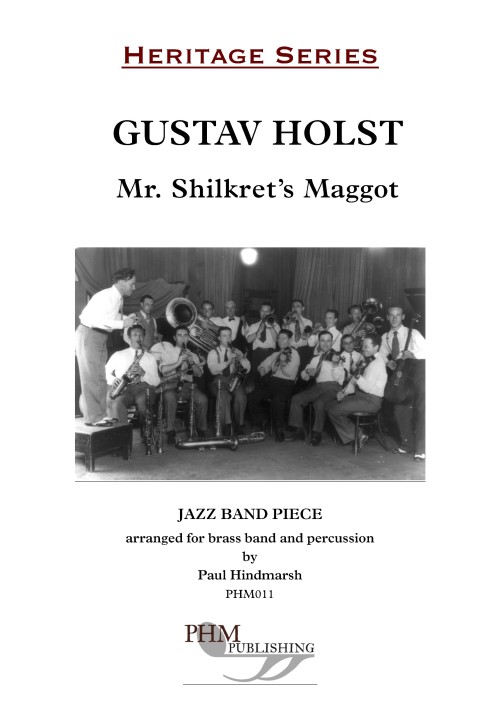
Mr Shilkret's Maggot (Brass Band - Score and Parts) - Holst, Gustav - Hindmarsh, Paul
This short piece was composed in 1932 during a visit Gustav Holst was making to the USA. He was invited by the band leader Nathaniel Shilkret to contribute to a series of piece for concert jazz band based on a folk song. Rather than using a traditional tune, Holst invented one of his own in folk song style and therefore the piece was not performed. Holst considered various titles for the piece including Mr. Shilkret's Dump, Folly and Maggot. On the manuscript he described it as a Jazz Band Piece. When the composer's daughter Imogen re-scored the piece for the English Chamber Orchestra to record under her direction in 1967, she changed decided to use the title Capriccio.Her re-orchestration involved removing the saxophone quartet, adding cor anglais and a second bassoon and changing cornet parts to trumpets. She retained the harp, extensive percussion, piano and celesta. My brass band version is based on the composer's manuscript, held at the British Library. It retains the composer's cornet parts, re-voices the woodwinds and strings, and places keyboards and harp onto glockenspiel, marimba, vibraphone and xylophone.I have selected the title Mr. Shilkret's Maggot for my scoring of Jazz Band Piece, which was first performed by The Cory Band, conducted by Philip Harper, at the Royal Northern College of Music Brass Band Festival, 29 January 2017.- Paul HindmarshDuration: 5.30
Estimated dispatch 7-14 working days
-
 £44.95
Trombone Concerto (Trombone Solo with Brass Band - Score only) - Wiffin, Rob
My Trombone Concerto was commissioned by Brett Baker following an earlier piece I had written for him called Shout! It was composed in Spain in the summer of 2010. Once I started writing I realised that this concerto was inevitably going to draw on my own experiences as a trombone player. The first movement was really a matter of getting the right thematic ideas and balancing the tutti and solo passages so, for formal structure, I studied the Gordon Jacob Trombone Concerto. There is a lyrical section preceding the first Allegro that owes much in spirit (but not in the actual music) to The Eternal Quest, Ray Steadman-Allen's Salvation Army solo. The slow movement seemed determined to come out in the vein of a Richard Strauss song. I wanted to write something ineluctably 'cantabile' as we trombone players rarely get a chance to play the melody. There is a brief allusion to that wonderful moment when the trombone gets to sing above the orchestra in Sibelius' seventh symphony. Arthur Wilson, that great exponent of the singing style in trombone-playing and my teacher at college died in the summer of 2010 so it seemed appropriate to dedicate this movement to him. The last movement is the lightest of the three in style and is slightly jazz-inflected, hopefully providing some fun for the soloist. While wanting to test the instrument I did not set out with the intention of making the concerto difficult but there are undoubtedly challenges of technique, range and style to be met by the soloist.- Rob Wiffin
Estimated dispatch 7-14 working days
-
£87.95
Trombone Concerto (Trombone Solo with Brass Band - Score and Parts) - Wiffin, Rob
My Trombone Concerto was commissioned by Brett Baker following an earlier piece I had written for him called Shout! It was composed in Spain in the summer of 2010. Once I started writing I realised that this concerto was inevitably going to draw on my own experiences as a trombone player.The first movement was really a matter of getting the right thematic ideas and balancing the tutti and solo passages so, for formal structure, I studied the Gordon Jacob Trombone Concerto. There is a lyrical section preceding the first Allegro that owes much in spirit (but not in the actual music) to The Eternal Quest, Ray Steadman-Allen's Salvation Army solo.The slow movement seemed determined to come out in the vein of a Richard Strauss song. I wanted to write something ineluctably 'cantabile' as we trombone players rarely get a chance to play the melody. There is a brief allusion to that wonderful moment when the trombone gets to sing above the orchestra in Sibelius' seventh symphony. Arthur Wilson, that great exponent of the singing style in trombone-playing and my teacher at college died in the summer of 2010 so it seemed appropriate to dedicate this movement to him.The last movement is the lightest of the three in style and is slightly jazz-inflected, hopefully providing some fun for the soloist.While wanting to test the instrument I did not set out with the intention of making the concerto difficult but there are undoubtedly challenges of technique, range and style to be met by the soloist.- Rob Wiffin
Estimated dispatch 7-14 working days
-
 £49.95
Mountain Day (Brass Band - Score and Parts) - Himes, William
Mountain Day was inspired by the composer's firsthand experiences walking, hiking, biking and skiing the majestic Rocky Mountains of Colorado, USA.The soaring and noble opening theme is in fact a musical representation of what a mountain silhouette might look like when traced on a musical staff. This overture features four continuous sections with virtually all of the themes having come to the composer's mind while in the Colorado Rockies:dawn - a slow unfolding of sun on the mountainsascent - a joyful and energetic hiking tunesummit vista - an expanded version of the opening themedescent - a lyrical walking tune, bursting with fulfilment and the love of lifeThis work was commissioned in 2014 by the Western State Colorado University - Colorado Brass Band for their 40th anniversary in honour of Mr. John Kincaid, conductor emeritus, mentor and friend.
Estimated dispatch 7-14 working days
-
 £50.00
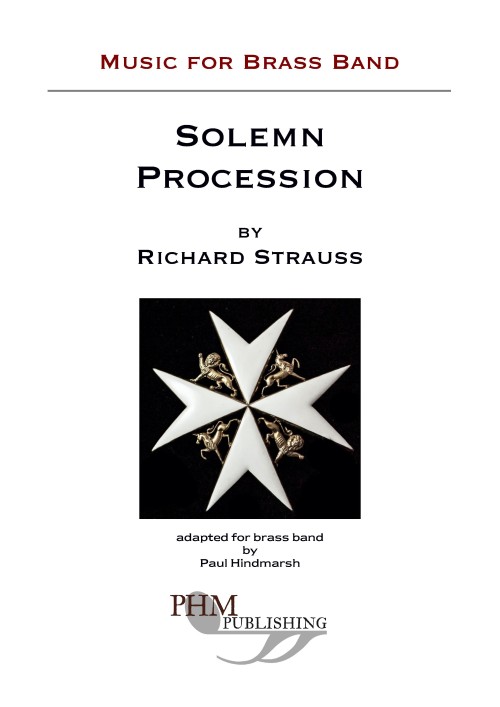
Solemn Procession (Brass Band - Score and Parts) - Strauss, Richard - Hindmarsh, Paul
Richard Strauss (1864 - 1949) was a famous conductor and composer when he wrote Feierlicher Einzug der Ritter des Johanniter-Ordens (Solemn Entrance of the Knights of the Order of Saint John) in 1909. One of only a handful of his works written exclusively for winds, Strauss composed Feierlicher Einzug for the investiture ceremonies of the Order of St. John, a Christian military order that was founded in Jerusalem in 1023 to care for poor, sick, or injured pilgrims journeying to the Holy Land.Strauss scored Feierlicher Einzug (TrV 224) for a large ensemble of fifteen trumpets, four horns, four trombones, two tubas and timpani. He saw enough potential in its stately character and majestic conclusion to produce a version for symphony orchestra with organ and it has been arranged for a variety of brass ensembles with or without organ since then.This version for British style brass band was adapted from the original in 1990 by Paul Hindmarsh for the exclusive use of Besses o' th' Barn Band, of which he was then the musical director. Now that the music of Richard Strauss published in his lifetime is in the public domain, Solemn Procession, as it has been rendered in English, can be enjoyed by all brass bands and their audiences.- Paul HindmarshDuration: 6.00
Estimated dispatch 7-14 working days
-
 £59.95
Sinfonietta - Saints and Devils (Brass Band - Score and Parts) - Wiffin, Rob
Saints and Devils is a challenging three movement work:Dance with the Devil (4.30)A Glimpse of Paradise (4.45)Reyes Magos (3.45)I wrote it when I was living in Spain where the Catholic culture is still much more prevalent than in the UK. The first two movements are a transition from dark to light; Dance with the Devil is aggressive and occasionally macabre whereas A Glimpse of Paradise is serene.The first and final parts of the second movement were originally written for a sequence in the Royal Military Tattoo 2000, played under the John Magee poem High Flight - 'Oh I have slipped the surly bonds of Earth ............ Put out my hand, and touched the face of God'- with videos of eagle owls in flight dramatically projected onto the buildings of Horse Guards in Whitehall, London.The last movement, Reyes Magos, is the joyous fiesta of the Three Kings. In Spain, January 6th, rather than Christmas Day, is the main day of present-giving, marking the Epiphany, the arrival of the Kings from the Orient at the Nativity. Saints and Devils is technically and expressively demanding but is written within the realms of tonal language.- Rob WiffinDuration: 13.00
Estimated dispatch 7-14 working days
-
 £35.00
Carol of the Bells (Brass Band - Score and Parts) - Littlemore, Phillip
This popular Christmas piece was composed by Mykola Leontovych around 1916. It is based on a Ukrainian folk chant known as 'Shchedryk', a New Year's carol. However, it was not until after the composer's death in 1921 that it was first introduced to Western audiences, when the Ukrainian National Choir included it on their tour of Europe and the Americas that same year. The film composer John Williams incorporated it into the score for the 1990 film Home Alone and he is credited for bringing it to a wider audience still, although it had been released on Christmas albums by a number of popular artists before that. This transcription for brass band has been adapted from the arrangement by Robert Prizeman, who created it for Libera, the world famous boys choir that he both founded and directs. Their unique, enchanting and, some say, heavenly sound delights audiences throughout the world through extensive concerts, recording and TV broadcasts. This brass band transcription introduces this skilled choral arrangement to a new genre and a whole new audience as well. Duration: 3.00
Estimated dispatch 7-14 working days
-
 £94.99
The Devil's Bridge (Brass Band - Score and Parts)
The "Teufelsbr?cke" (devil's bridge) is a very old bridge connecting the G?schenen and Andermatt valleys in the canton of Uri, central Switzerland. Legend has it that in the 13th century the people of Uri made a pact with the devil to build a bridge across the canyon. When the people only delivered a goat in payment of the soul demanded by the devil he was angry and decided to knock down the bridge. An old woman painted the sign of a cross on the rock the devil was intending to destroy the bridge with and the devil, unable to lift it, disappeared forever. The rock remains to this day at the northern entry of the Gotthard tunnel. 11:45
Estimated dispatch 7-14 working days
-
 £24.95
Prelude and Capriccio (Cornet Solo with Brass Band) - Gregson, Edward
A condensed score is included with this workGregson wrote his Prelude and Capriccio in 1972. It exists in two versions: one for cornet and band and the other for cornet or trumpet and piano.The work began life in the early sixties, the Capriccio being composed when the composer was 17. A Prelude was added to complete the work, which lasts for approximately 8 minutes. The Prelude is reflective in character and uses long melodic lines over undulating chromatic harmony. The music reaches a climax before a brief reprise of the opening. The Capriccio is somewhat jazzy in its opening syncopated rhythms, but has a more lyrical middle section before a finale exploiting the virtuoso character of the instrument.
Estimated dispatch 7-14 working days
 View Music