
Results
-
 £42.50
The Way We Were
Regret, things past, former friends, in a word, memories... are what this music conjures up.
Estimated dispatch 7-14 working days
-
 £78.20
The Rocketeer - James Horner - Roland Smeets
Before Titanic,James Horner was not above composing scores for cartoonish family films, and many of those that brought him on their production board owe him greatly. The Rocketeer entails the story of a young pilot during World War II who happens upon a rocket pack that allows him to fly. The film is based on the tradition of old film serials that left theater-goers hanging with "To be continued," and aside from modern production, it is old fashioned and innocent fun. Horner's score begins and ends with the brilliant "Main Title," which is so moving it was used in previews for later films that did not yet have finished scores. Most of th Rocketeersoundtrack elicits the adventure and lifting spirit of the film and reveals how Horner incorporates rich instrumentals in the tiniest crevices. Even when the film involves danger, as in "Jenny's Rescue," the composer takes care when it is hardly even required. Instead of some "duh-duh-duhs," he brings on a full, stunning orchestra and when he overdoes it, it is in a jolly way -- he never exhausts his medium. That is what separates him from inferior composers, and what makes a nice film like The Rocketeer extra nice. It is a soundtrack worth listening to.
Estimated dispatch 5-14 working days
-
 £27.20
What a Wonderful World - E. Weiss - Willy Hautvast
To the surprise of everybody the Heineken commercial featuring the men in the moon made its way to the top 20 of the National Hitparade (Satchmo's old success!!).
Estimated dispatch 5-14 working days
-
 £57.50
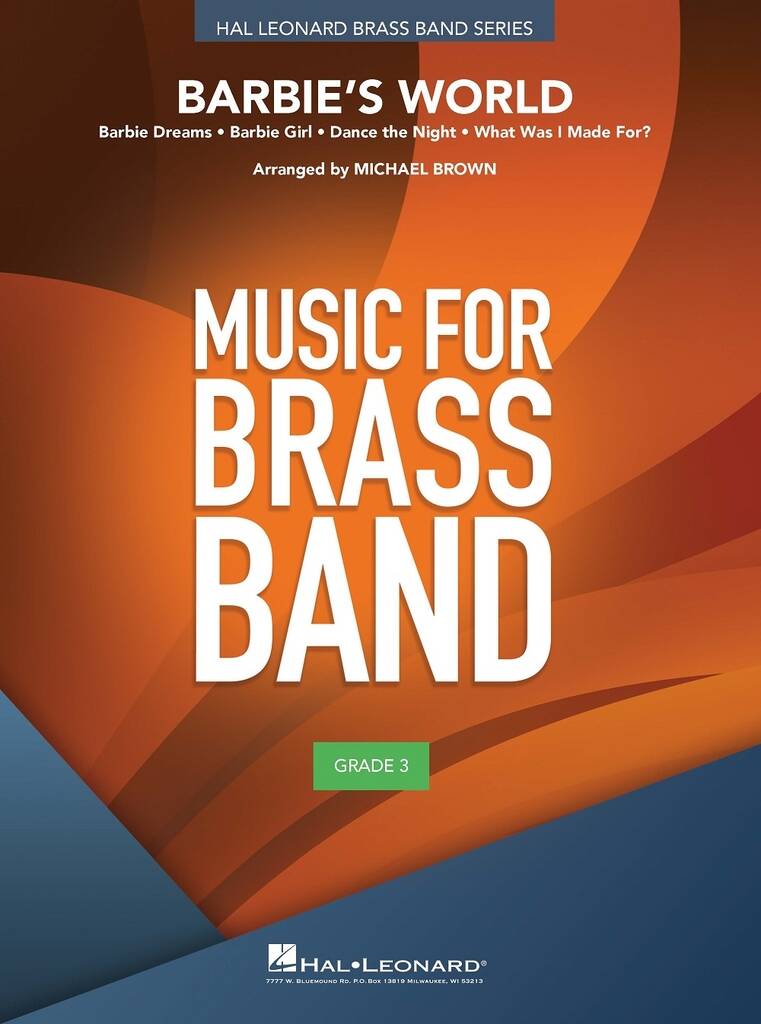
Barbie's World - Michael Brown
From the blockbuster movie Barbie comes the equally sensational soundtrack album featuring an all-star lineup of performers and songwriters. This upbeat and entertaining medley for brass band includes: Barbie Dreams Barbie Girl What Was I Made For? Dance the Night.
Estimated dispatch 5-14 working days
-
 £44.95
The Present Age (Brass Band - Score and Parts) - Condon, Leslie
The present age' is almost a stock term familiar to Salvationists, stemming from the much-used verse - 'To serve the pres ent age .... ', which has expressed a purpose throughout Salvation Army history. It is, however , the present age of the late 1960's and 70's which claims the composer 's attention in this attempt to express in music the background against which the modem young Christian has to work. One pictures him with all the dash and impetuosity of youth setting out to 'turn the world upside down'. We here share with him reactions of his hearers, disappointments within himself, and a series of cameos depicting what kind of a world it is that he has pledged to win for Christ.
Estimated dispatch 7-14 working days
-
£22.50
The Present Age (Brass Band - Score only) - Condon, Leslie
The present age' is almost a stock term familiar to Salvationists, stemming from the much-used verse - 'To serve the pres ent age .... ', which has expressed a purpose throughout Salvation Army history. It is, however , the present age of the late 1960's and 70's which claims the composer 's attention in this attempt to express in music the background against which the modem young Christian has to work. One pictures him with all the dash and impetuosity of youth setting out to 'turn the world upside down'. We here share with him reactions of his hearers, disappointments within himself, and a series of cameos depicting what kind of a world it is that he has pledged to win for Christ.
Estimated dispatch 7-14 working days
-
 £80.00
The Unfortunate Traveller (Brass Band - Score and Parts) - Holst, Imogen - Hindmarsh, Paul
Imogen Holst (1907-1984) submitted The Unfortunate Traveller (1929) as her final work as a student portfolio at the Royal College of Music, where her composition teacher was Gordon Jacob. The title was taken from Thomas Nashe's famous 1594 picaresque novel of the same title. The Suite was first performed on 12 February 1933 at her Majesty's Theatre, Carlisle, by the St. Stephen's Band, with the composer conducting. Te concert was given in memory of Holst's uncle, Dr. H.A. Lediard. Holst had been impressed with the band's performance of his A Moorside Suite at the 1928 National Brass Band Championships (The Crystal Palace, South London) and was keen to work with them. Writing in Imogen Holst, a life in music, Christopher Grogan indicates that it was Gustav Holst's suggestion to include his daughter's work in the programme, quoting Imogen Holst's remarks made in interview to The Daily Mail as follows: "....it is the first time, so far as I know, that a woman has conducted a brass band at a public concert....It has been a delight to rehearse the St. Stephen's Band. It was their performance at the Crystal Palace Festival that inspired me to write this Suite, which I have dedicated to them."Imogen Holst accompanied her father to the Crystal Palace in 1928 to hear the performances of A Moorside Suite, and was so excited by the played and, audibly, by her father's music that she decided to write a brass band piece for her final examination. Te result was The Unfortunate Traveller (1929). However, it was not possible for her to present a brass band work for examination. She arranged it for string orchestra so that it could be played before she left the RCM in July 1930. Following the premiere of the original in 1933, the manuscripts did not resurface until 1969 Imogen found them among her late mother's effects. Although she requested score and parts be destroyed, they ended up in the possession of Manchester composer John Golland, who marked up the score presumably with the intention of creating a new performing edition. The original scoring reveals a lack of experience with what can be a tricky medium.With the agreement of the Holst Foundation, a revised edition, with additional percussion, was prepared in 2011 since when the work has been fortunate to travel round the world as a concert and contest piece. The original includes drums in the March only. The title was taken from Tomas Nashe's famous 1594 picaresque novel of the same title. Several Morris Dance tunes are introduced during the course of the four short movements, including Bonnie Green Garters, Shepherd's Hey, The Rose and The Wind Blaws Cauld. Quirky twists and turns of harmony and spirited rhythms that remind us how much Imogen Holst loved tradition English dance music.In September 2025, I made a performing edition of the composer's arrangement for string orchestra. The manuscript lacks the final movement, which I arranged in a similar style, ie. without extending the upper ranges. Making this edition raised some issues regarding the accuracy of my band version and some of the solutions I used to smooth out the voicing. I have used the composer's second thoughts to refine my performing edition and to correct a textual errors.- Paul HindmarshDuration: 10.00
Estimated dispatch 7-14 working days
-
£40.00
The Unfortunate Traveller (Brass Band - Score only) - Holst, Imogen - Hindmarsh, Paul
Imogen Holst (1907-1984) submitted The Unfortunate Traveller (1929) as her final work as a student portfolio at the Royal College of Music, where her composition teacher was Gordon Jacob. The title was taken from Thomas Nashe's famous 1594 picaresque novel of the same title. The Suite was first performed on 12 February 1933 at her Majesty's Theatre, Carlisle, by the St. Stephen's Band, with the composer conducting. Te concert was given in memory of Holst's uncle, Dr. H.A. Lediard. Holst had been impressed with the band's performance of his A Moorside Suite at the 1928 National Brass Band Championships (The Crystal Palace, South London) and was keen to work with them. Writing in Imogen Holst, a life in music, Christopher Grogan indicates that it was Gustav Holst's suggestion to include his daughter's work in the programme, quoting Imogen Holst's remarks made in interview to The Daily Mail as follows: "....it is the first time, so far as I know, that a woman has conducted a brass band at a public concert....It has been a delight to rehearse the St. Stephen's Band. It was their performance at the Crystal Palace Festival that inspired me to write this Suite, which I have dedicated to them."Imogen Holst accompanied her father to the Crystal Palace in 1928 to hear the performances of A Moorside Suite, and was so excited by the played and, audibly, by her father's music that she decided to write a brass band piece for her final examination. Te result was The Unfortunate Traveller (1929). However, it was not possible for her to present a brass band work for examination. She arranged it for string orchestra so that it could be played before she left the RCM in July 1930. Following the premiere of the original in 1933, the manuscripts did not resurface until 1969 Imogen found them among her late mother's effects. Although she requested score and parts be destroyed, they ended up in the possession of Manchester composer John Golland, who marked up the score presumably with the intention of creating a new performing edition. The original scoring reveals a lack of experience with what can be a tricky medium.With the agreement of the Holst Foundation, a revised edition, with additional percussion, was prepared in 2011 since when the work has been fortunate to travel round the world as a concert and contest piece. The original includes drums in the March only. The title was taken from Tomas Nashe's famous 1594 picaresque novel of the same title. Several Morris Dance tunes are introduced during the course of the four short movements, including Bonnie Green Garters, Shepherd's Hey, The Rose and The Wind Blaws Cauld. Quirky twists and turns of harmony and spirited rhythms that remind us how much Imogen Holst loved tradition English dance music.In September 2025, I made a performing edition of the composer's arrangement for string orchestra. The manuscript lacks the final movement, which I arranged in a similar style, ie. without extending the upper ranges. Making this edition raised some issues regarding the accuracy of my band version and some of the solutions I used to smooth out the voicing. I have used the composer's second thoughts to refine my performing edition and to correct a textual errors.- Paul HindmarshDuration: 10.00
Estimated dispatch 7-14 working days
-
 £79.95
Lost Village of Imber, The - Christopher Bond
The village of Imber on Salisbury Plain had been inhabited for over one thousand years when it was evacuated in 1943 to make way for military training in the Second World War. At the time, with preparations for the Allied invasion of Europe underway, most villagers put up no resistance, despite being upset, with the belief that they'd return once the war had concluded. To this day, Imber and its surrounding land remain a military training ground. The villagers never returned, and just the shell of what was once a community remains. Structured in three movements, it is on this very real story that the work is based, setting out the series of events of 1943 in chronological order. The first movement, On Imber Downe, portrays a sense of jollity and cohesiveness - a community of individuals living and working together before news of the evacuation had broken. Sounds of the village are heard throughout, not least in a series of percussive effects - the anvil of the blacksmith; the cowbell of the cattle and the bells of the church. The second movement, The Church of St. Giles, begins mysteriously and this sonorous, atmospheric opening depicts Imber in its desolate state and the apprehension of residents as they learn they have to leave their homes. Amidst this is the Church, a symbol of hope for villagers who one day wish to return, portrayed with a sweeping melodic passage before the music returns to the apprehension of villagers facing eviction around their sadness at losing their rural way of life. In complete contrast, the third movement, Imemerie Aeternum, portrays the arrival of the military, complete with the sounds of the ammunition, firing and tanks - sounds which were all too familiar to those living in the surround areas. To close, the Church of St. Giles theme returns in a triumphant style, representing the idea that the church has always been, even to this day, a beacon of hope for the villagers and local community - both the centrepiece and pinnacle of a very real story. The work was commissioned by Bratton Silver Band in celebration of the band's 160th Anniversary, with funding from the Arts Council National Lottery Project Grants Fund and the Brass Bands England Norman Jones Trust Fund.
Estimated dispatch 10-14 working days
-
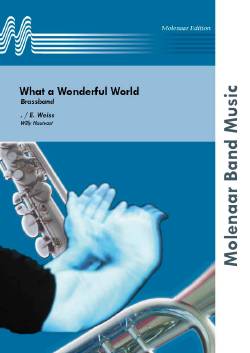 £27.00
What a Wonderful World - E. Weiss/Willy Hautvast
To the surprise of everybody the Heineken commercial featuring the men in the moon made its way to the top 20 of the National Hitparade (Satchmo's old success!!).
Estimated dispatch 10-14 working days
 View Music