
Results
-
 £95.00
Concertante (Piano Solo with Brass Band - Score and Parts)
This work was written in 1966, when I was a student at the Royal Academy of Music in London. It was the first major work to be written for this combination. The Concertante is unashamedly romantic in idiom and is cast in three movements: Prelude, Nocturne and Rondo.The Prelude is in sonata form with a contracted recapitulation. There are two main themes, the first announced after the opening flourish on piano. The second theme is lyrical in character and the interplay between these two themes forms the main focus of the movement.The pensive Nocturne opens with an introduction from the band which contains hints of the two main ideas to follow. The solo piano announces the main theme, which has a slightly 'blues' character in its flattened third and seventh notes of the scale. The band enters with the chorale theme already heard in the introduction. Eventually the first theme returns, this time from piano and band and building to a powerful climax before subsiding to a peaceful ending.The Rondo is full of energetic rhythms and changing time patterns. The main theme is 'giocoso' in character and in the first episode there is more than a hint of the tune 'Onward Christian Soldiers' in what amounts to a good humoured parody. Before the final coda there is a long piano cadenza underlying the virtuoso element of the work.The work had a number of public performances leading up to a memorable one in the Royal Albert Hall in 1989 as part of the Gala Concert that used to be held after the National Brass Band Championship in the Royal Albert Hall. That year, the 'centre band' in the massed bands concert were the GUS Band (then known for sponsorship reasons as 'Rigid Containers Group Band'!) conducted by my great friend and champion, Bramwell Tovey, with myself as the soloist.- Edward GregsonDuration: 18.00
Estimated dispatch 7-14 working days
-
 £19.95
Mythical Tales (Brass Quintet)
Mythical Tales (2012) is a ten minute work in three movements which represents three of the most popular folk stories or indeed in the case of the first movement, true stories, in Welsh culture.I. Owain GlyndwrOwain Glyn Dwr was born around the 1350s into an Anglo-Welsh gentry family. His estates provided him with a modest power base in north-east Wales. After a number of disputes, he proclaimed himself prince of Wales in September 1400.Glyn Dwr led several battles with the English, although he was never captured. Over the next few years punitive measures were enacted to keep control of Wales, but these were matched by many acts of Welsh rebellion - among them the capture of Conwy Castle in April 1401. In June 1402, at the Battle of Pilleth on Bryn Glas Hill, Glyn Dwr led his troops to victory over an English army. By now Glyn Dwr was leading a national revolt. In 1404, he led a march towards Wocester, but failed, with the English capturing parts of Wales. He died defending his country.II. MyfanwyMyfanwy was the most beautiful woman in Powys, but she was vain and liked nothing better than to be told how beautiful she was. Many handsome men would court her, but she would not show interest because they couldn't sing and play to her, reflecting her true beauty.Luckily, a penniless bard, Hywel ap Einion was in love with Myfanwy, and one day plucked up the courage to climb up the hill to the castle with his harp, to sing and play to her. He's allowed in to play for her, and while he's playing and complimenting her on her beauty she can neither listen nor look at any other man. Because of this Hywel believes that she has fallen in love with him. But his hopes are dashed when a richer, more handsome and more eloquent lover comes along. The music of the second movement portrays the despair and upset that Hywel must have felt.III. Battle of the DragonsMany centuries ago when dragons roamed the land, a white ice dragon descended on a small village and decided to live there, not knowing that a red fire dragon was already living nearby.Six months later the red dragon awoke to find a huge white dragon wrapped around his village that he cared for. He could tell that his people were ill from the cold. The Land was bare; nothing was able to grow not even the pesky dandelions. The people were starving. The people longed for the red dragon to free them from the icy misery, so that their life and land could return to the sunny and warm climate that it was once before.The red fire dragon challenged the white ice dragon to a single combat fight at the top of the cliff the next day. The people of the village watched in terror awaiting their fate. The red dragon beat the white dragon, and the crowd cheered with joy as the red dragon roared with triumph. The mayor of the village declared that the land should always fly a flag with the symbol of a Red dragon on it. The flag's background should be half green and half white; the green to represent the lush green grass of the land and the white to represent the ice. This way no one would ever forget what happened.
Estimated dispatch 7-14 working days
-
 £74.95
Variations on an Enigma (Score and Parts)
Variations on an Enigma was commissioned by Howard Snell for the Desford Colliery Band and first performed by them in Gillingham, Dorset, England in September 1986.The 'Enigma' is a short snatch of a phrase taken from a well-known brass band test piece - a phrase which caught the imagination of the composer who took it as the basis of a sort of concerto for band with each section featured in turn. First the cornets have their turn, with a 'moto perpetuo', and they are followed by the horns and flugel whose variation is delicate and decorative. Trombones follow, each having there own tune in turn and then combining them together. Euphoniums and baritones have an expressive funeral march which is interrupted by percussion and basses who share a rhythmic, syncopated variation. A climax is reached and this is followed by a fugue (based on the theme) against which snatches of the preceding variations appear. The fugue heralds what turns out to be the theme on which all the variations are based, appearing in full at last, whose first five notes are derived from the 'enigma' theme. The piece ends with an emphatic final statement by the timpani.
Estimated dispatch 7-14 working days
-
 £37.95
Variations on an Enigma (Score Only)
Variations on an Enigma was commissioned by Howard Snell for the Desford Colliery Band and first performed by them in Gillingham, Dorset, England in September 1986.The 'Enigma' is a short snatch of a phrase taken from a well-known brass band test piece - a phrase which caught the imagination of the composer who took it as the basis of a sort of concerto for band with each section featured in turn. First the cornets have their turn, with a 'moto perpetuo', and they are followed by the horns and flugel whose variation is delicate and decorative. Trombones follow, each having there own tune in turn and then combining them together. Euphoniums and baritones have an expressive funeral march which is interrupted by percussion and basses who share a rhythmic, syncopated variation. A climax is reached and this is followed by a fugue (based on the theme) against which snatches of the preceding variations appear. The fugue heralds what turns out to be the theme on which all the variations are based, appearing in full at last, whose first five notes are derived from the 'enigma' theme. The piece ends with an emphatic final statement by the timpani.
Estimated dispatch 7-14 working days
-
 £74.95
Platform to the Heavens (Brass Band - Score and Parts)
The piece takes its inspiration from the mountain ranges from one of my favourite countries, Switzerland.I have visited the Swiss Alps on many occasions and I am still taken back by its sheer awesome beauty with every visit. This commission gave me the opportunity to pay homage to this wonderful landscape and paint my own musical picture of it.The piece opens with what I imagine daybreak would be like at one of its many peaks. With the sun growing behind the mountain range, the piece builds from a single note to a huge climatic chord revealing Mother Nature's creation.Then at rehearsal figure 'C' the tempo changes dramatically as we fly through the many slopes of the mountains as if on a manic skiing expedition, revealing the many dangers within the Swiss Alps.The twists, turns and climaxes begin to die away as we enter rehearsal figure 'M' - nightfall over the mountains. As the sun disappears, the sky darkens to reveal the beautiful starlit sky above the mountain range. This middle section starts with the various cadenzas that serve as echoes around the Alps. It then leads to a lyrical solo at rehearsal figure 'O' as the moonlight illuminates the icy mountain peaks. A final cadenza to conclude this section highlights the end of nightfall as the sun starts to rise again.This recapitulation from the opening, signals a new dawn as the sun rises above the snowy peaks once again. The music at this point in its slightly altered state highlights the dawn of a new day in the Alps. The fast manic ski ride follows which takes the piece to its grand finale conclusion.The idea behind the title of this piece is that the Swiss Alps are so beautiful and vast; I can only imagine that they could be a platform connecting the earth to the heavens above.Paul Lovatt-Cooper
Estimated dispatch 7-14 working days
-
£34.95
Over the Horizon (Soprano Cornet Solo)
Soprano Cornet Solo with Brass BandOver the Horizon (2017), whilst both harmonically and compositionally a simple endeavour, is a spine-tingling beautiful melody for soprano cornet. Based on the painting seen in the sleeve notes of Steve Stewart's album of the same name, the work takes its inspiration from the open expansiveness of the ocean, glistening in the moonlight as four people sit quietly - two parents, a boy, and a girl. A feeling of heartfelt longing throughout the work which is developed both melodically and texturally by soloist and accompaniment; perhaps reflecting the desire to know indeed what is over the horizon. The longing intensifies with a climatic section of grandeur - a feeling of longing which arguably isn't resolved until that all-important - and high - last note.Over The Horizon was written for and commissioned by Steve Stewart and Cory Band in Spring 2017.
Estimated dispatch 7-14 working days
-
 £39.95
Impulse (Brass Band - Score and Parts)
This work represents a brief, musical study of the practical expression of faith by Salvationists. Why do we do what we do? The beginning of the piece reflects the busyness and drive of those who feel called to Rescue the perishing (S.A.S.B. 927). Motivated by compassion, there is a constant, insistent urgency to accomplish this mission, and referenced is Albert Orsborn's song Except I am moved with compassion (S.A.S.B. 626). From here, the piece builds to a climactic, full statement of Rescue the perishing.
Estimated dispatch 7-14 working days
-
 £30.00
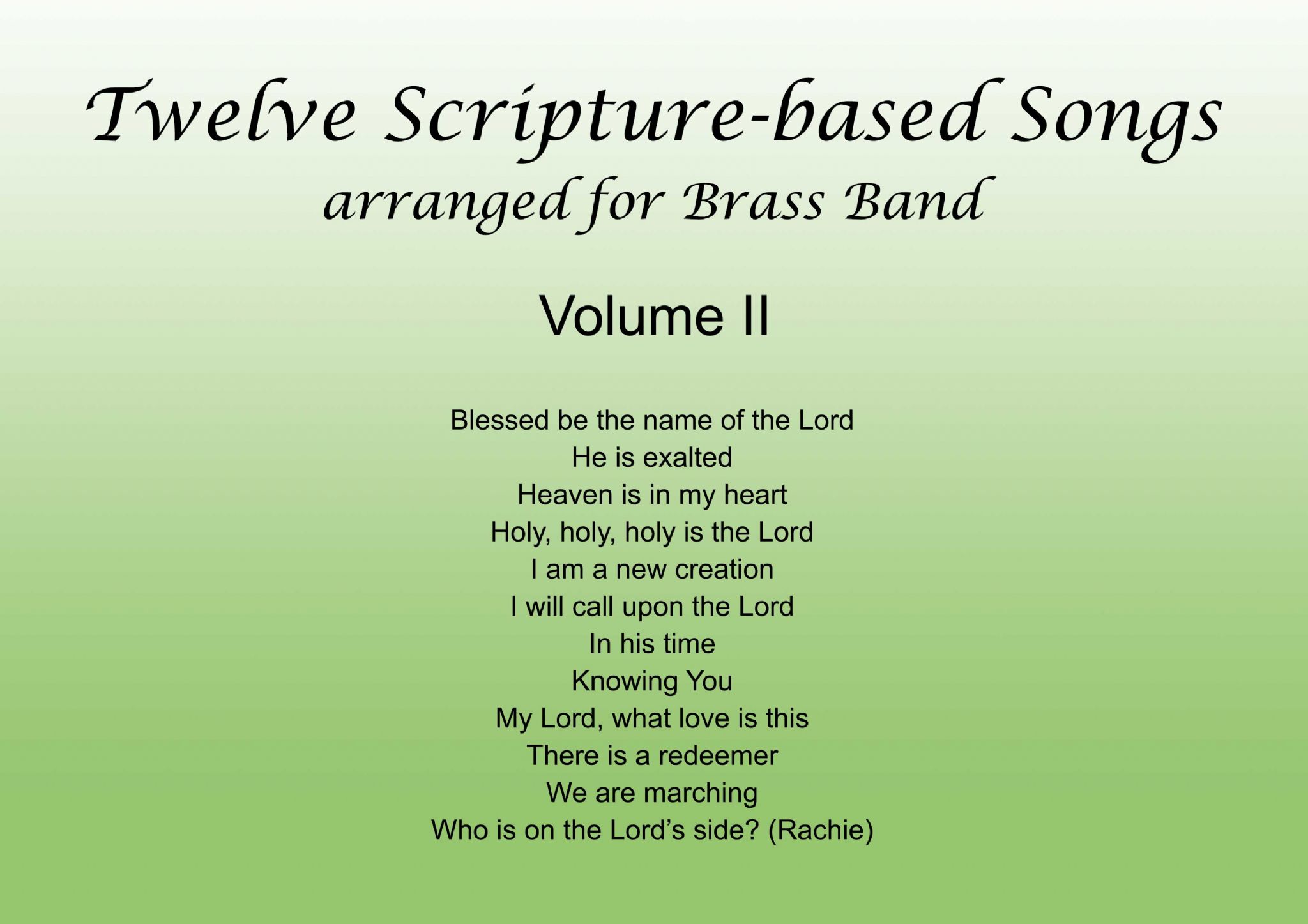
Twelve Scripture-Based Songs Volume II
Twelve scripture-Based Songs arranged for Brass Band (Volume II) are packaged and marketed in complete sets which include a full score and a set of master parts. It is intended that these parts be used as 'masters', for the purpose of photocopying a quantity of parts to accommodate the precise instrumentation needs of the band for which this has been purchased. Blessed be the name of the LordHe is exaltedHeaven is in my heartHoly, holy, holy is the LordI am a new creationI will call upon the LordIn his timeKnowing YouMy Lord, what love is thisThere is a redeemerWe are marchingWho is on the Lord's side? (Rachie)
Estimated dispatch 7-14 working days
-
 £55.00
Triumph Series Brass Band Journal, Numbers 1343 - 1346, November 2022
1343: March - Spreading the Word (Ian Clarke)This lively march features the songs Look, ye saints! the sight is glorious (S.A.S.B. 227), When we walk with the Lord (S.A.S.B. 690), I want to tell what God has done (S.A.S.B. 852), and makes reference to the old chorus When I remember that he died for me I'll never go back any more.1344: Prelude on 'Anstasis' (Sam Creamer)The Greek word anstasis translates to resurrection and particularly refers to the resurrection of Jesus Christ. The popular worship song O praise the name (Anstasis) forms the basis of this prelude. While the theme of this work is most applicable for Easter use, it could well find its place in programme and worship repertoire all year round.1345: Flugel Solo - The old rugged cross (Eiliv Herikstad)This Flugel Horn Solo (also playable by Cornet) includes chords on the soloist part so that the soloist can have improvisational freedom, or can play the written out solo.1346: March - Showers of blessing (Zachary Docter)This energetic march uses Gary Rose's melody Showers of blessing (STTL Vol.24, Pt.1).
Estimated dispatch 7-14 working days
-
 £29.95
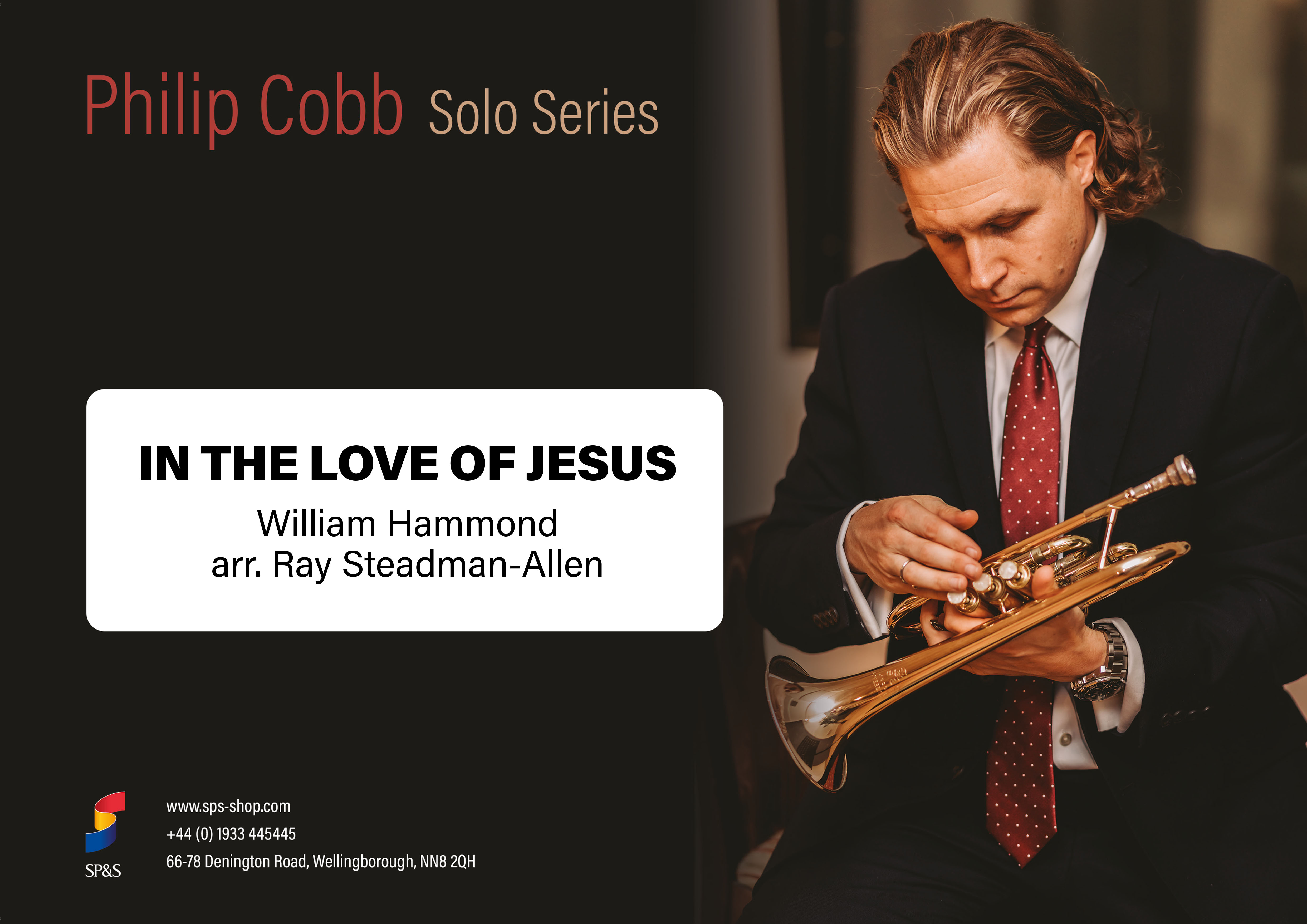
In the Love of Jesus (Cornet Solo with Brass Band - Score and Parts)
There are some pieces of music that evoke a sense of belonging, not only for the message it conveys, but the association of what it represents. In the Love of Jesus, by William Hammond and Ivy Mawby, the song brings an emotive response to words of commitment and devotion to Jesus. The melodic line starts with a somewhat hypnotic charm and expands into a beautifully shaped line of music.Duration: 3.30
Estimated dispatch 7-14 working days