
Results
-
 £44.95
Clapp!!!! - Paul McGhee
Clapp!!!! was originally written in 2006 whilst studying at the Royal Welsh College of Music and Drama and was written for two players at one piano. The music uses rhythmic phasing with each rhythm assigned its own tone cluster -...
Estimated dispatch 5-7 working days
-
 £84.95
Concerto for Tenor Horn - Gareth Wood
Gareth Wood's Concerto for Tenor Horn was commissioned by the Welsh Amateur Music Federation at T Cerdd-Music Centre Wales, with additional funding from the Arts Council of Wales and the PRS Foundation. The work was written for tenor horn soloist...
Estimated dispatch 5-7 working days
-
 £94.95
Euphonium Concerto - Karl Jenkins
This work was given its world premiere by euphonium soloist David Childs and the BBC Concert Orchestra conducted by Owain Arwel Hughes in St David's Hall Cardiff during the last night of the 2009 Welsh Proms. Jenkins stated, "As is...
Estimated dispatch 5-7 working days
-
 £29.95
Meditation - Paul McGhee
Meditation was originally written in 2005 for piano as an Erik Satie pastiche exercise whilst the composer was studying at the Royal Welsh College of Music and Drama. It was scored for brass band in 2007 for the wedding ceremony...
Estimated dispatch 5-7 working days
-
 £29.95
Men of Harlech - Welsh Traditional - Gareth Wood
Men of Harlech is a song and military march which describes events during the seven-year-long siege of Harlech Castle between 1461 and 1468. Commanded by Constable Dafydd ap Ieuan, the garrison held out in what is the longest-known siege in...
Estimated dispatch 5-7 working days
-
£59.95
LORD IS KING, The (Brass Band Set) - Ray Steadman-Allen
Ray Steadman-Allen was for many years the driving force in Salvation Army music. His publication list of both brass and vocal works can be measured literally by the hundred. 'The Lord is King' is arguably his crowning achievement of over twenty major works for brass band. Although described as a suite, the work is more symphonic in conception and scale as well as being formidable to perform. The work is based on the Welsh hymn tune 'Llangollen' to which the hymn 'The Lord is King, I own His power' are associated. The three movements derive inspiration from the lines 'My joy, my toil, my craftman's skill, all have their place, and serve His will' found in verse five of the hymn.
Estimated dispatch 7-14 working days
-
 £39.95
Calon Lan - Eric Ball
Eric Ball originally made this duet arrangement with piano accompaniment for inclusion in our album Czardas (order code 0078) and it was later transcribed for brass band by Eric Wilson (who was named after the composer!). The Welsh tune is handled in turn by the duettists, one embellishing while the other carries the melody. The accompaniment parts are not difficult making this delightful, somewhat nostalgic, piece ideal for bands of all abilities.
Estimated dispatch 7-9 working days
-
 £39.95
David of the White Rock (Score and Parts) - Elgar Howarth
Welsh melody featuring the flugel horn.
Estimated dispatch 7-9 working days
-
 £77.00
General Series Brass Band Journal, Numbers 2250 - 2253, December 2024
2250: Prelude on 'Rhosymedre' (Ralph Vaughan Williams trs. Douglas Engle)The English composer Ralph Vaughan Williams' work Three Preludes (founded on Welsh Hymn Tunes) was published for the organ in 1920. This is a transcription of the second movement of that work. The words associated with the hymn tune are by Samuel Crossman, My song is love unknown (S.A.S.B. 149), and vividly depict the events of Holy Week. The music is gentle and solemn and would be appropriate for a Good Friday service or as a moment of repose in a concert. 2251: Hosanna Shuffle (Sam Creamer)The half-time shuffle groove is a popular feel developed by alternative rock/pop bands of the 1980s. It marries elements of rock and swing styles together to form a new and infectious feel - Hosannah Shuffle being written as a tribute to this fusion of musical styles. Contrary to a swing style, shuffle brings the pulse back onto the beat while maintaining the swung quaver rhythms to create a rock-type rhythmic drive. 2252: Everlasting Love (Keith Manners)This piece was written for the London North East Music School in 2004. The theme of the week was 'Making a stand for Christ', reminding the school that it only takes one person to make such a stand before others follow. The music starts with a lone Solo Cornet playing the melody of Graham Kendrick's song Such Love (S.A.S.B. 199). One by one, other parts join in with the theme.2253: Festival March (Michael Cooper)This piece represents the first published brass composition of Bandmaster Michael Cooper, who is the Bandmaster at Brisbane City Temple Corps. This imposing festival march features the tunes I want to be a soldier (T.B. 683), Lift up the banner (T.B. 90) and My Jesus, I love thee (T.B. 506). These tunes depict the idea that spiritual warfare is an essential component of one's faith, success of which is articulated in the final verse of My Jesus, I love thee (S.A.S.B. 878).
Estimated dispatch 7-14 working days
-
 £45.00
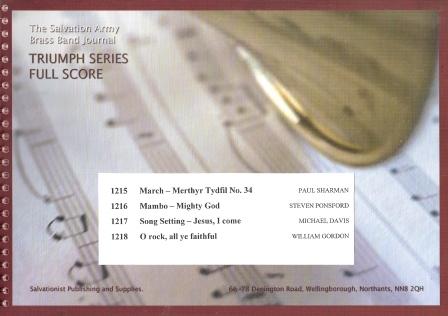
Triumph Series Band Journal July 2011 Numbers 1215 - 1218
No. 1215 March - Merthyr Tydfil No.34 (Paul Sharman)This march was written at the request of Bandmaster Howard Roberts to celebrate the 125th anniversary of Merthyr Tydfil Corps, corps number 34 in The Salvation Army. The tunes used have obvious Welsh connections wit 'Cwm Rhonnda' and 'Aberystwyth' being featured. 'Aberystwyth' was written by Joseph Parry who lived in Merthyr Tydfil for a while.No. 1216 Mambo - Mighty God (Steven Ponsford)Based on words from Isaiah 9, 'Mighty God' is a song of worship and assurance by Chris Bowater and helen and Mark Johnson. This arrangement will afford bands the opportunity to engage the audience into a lively segment of praise.No. 1217 Song Setting - Jesus, I come (Michael Davis)A setting of George C Stebbins' beautiful melody 'Out of my bondage'.No. 1218 O rock, all ye faithful (William Gordon)The Christmas carol 'O come, all ye faithful' is arranged here in a 'rock' style and includes references to other well known Christmas carols.
Estimated dispatch 7-14 working days