
Results
-
 £74.60
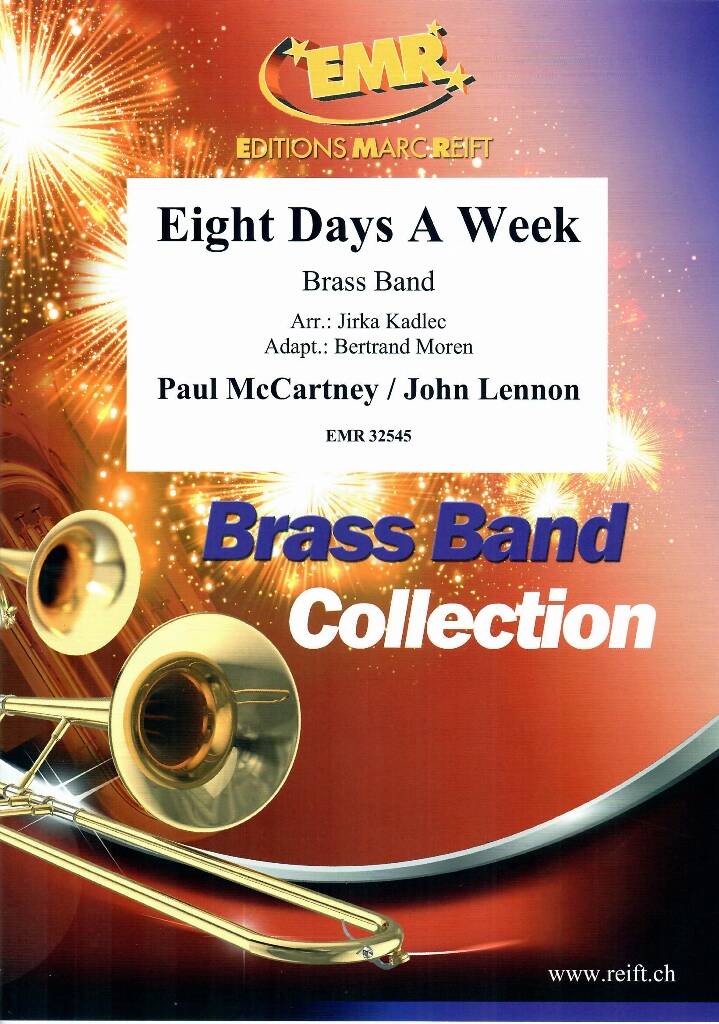
Eigth Days A Week - John Lennon - Jirka Kadlec
Estimated dispatch 5-14 working days
-
 £41.20
 -
 £154.99
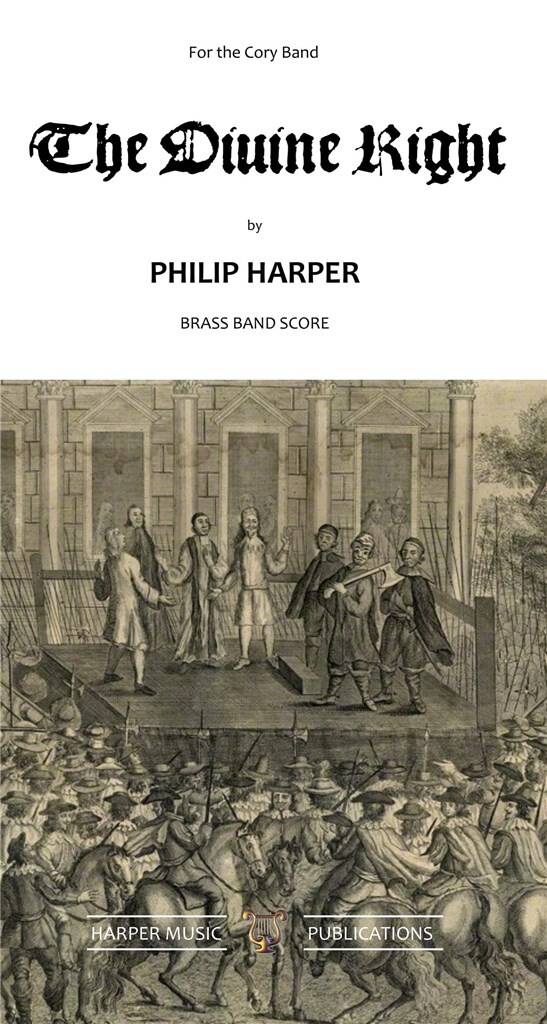
The Divine Right - Philip Harper
At the time of composing this piece, the Arab Spring was sweeping through the Middle East. It seemed that almost every week a new countrys people had risen up against the regimes and dictatorships which had prevailed for generations, leaving manynations at a defining crossroads in their history. There were so many possible ways ahead: so many hopes, yet so many uncertainties.My music is a depiction of these revolutionary times, and several musical themes are in turn presented, discussed, considered, fought over, altered, rejected or accepted. Most nations have had, or probably will have, their own Arab Spring, including my own, the United Kingdom. Events of 17th Century Britain provide the context for this piece, particularly those following the execution of the tyrant King Charles I on30 January 1649. The regicide was in part due to Charless steadfast belief in the Divine Right of Kings, and led to a tumultuous interregnum, where England stood at its own defining crossroads.The music begins turbulently, before King Charles appears and is led to the gallows outside Banqueting House in central London where he is brutally decapitated. From the assembled crowd rose, according to one observer, a moan as I never heard before and desire I may never hear again.The music descends to emptiness. The musical argument which follows is not strictly programmatic, but a number of musical themes are all thrown into the melting pot, representing ideas such as: religion; military force; reasoned Parliamentary debate; and the chattering,irrepressible voice of the people. Additionally, there are some quotations from the music of royalist composer Thomas Tomkins (1572-1656), who was often in tune with the feeling of the times. This defining episode in Englands history was brought to a close with the Restoration of the monarchy in 1660, and as the exiled King Charles II rode back into London the diarist John Evelyn wrote: Never was so joyful a day seen in this nation. I stood in the Strand and beheld it, and blessed God.At the end of the piece the bells ring out, and the musical appearance of the King has transformed from turbulent to triumphant. Philip Harper, 2013
Estimated dispatch 5-14 working days
-
£39.00
Rudolf er rod pa nesen - Johnny Marks - Arne Bendiksen - Jan Utbult
"Rudolph, the Red-Nosed Reindeer" is a song written by Johnny Marks based on the 1939 story Rudolph the Red-Nosed Reindeer published by the Montgomery Ward Company. Gene Autry's recording hit No. 1 on the U.S. charts the week of Christmas 1949.The song was first sung by crooner Harry Brannon on New York City radio in early November 1949, before Gene Autry's recording hit No. 1 in the U.S. charts during Christmas 1949. Autry's version of the song also holds the distinction of being the only chart-topping hit to fall completely off the chart after reaching No. 1. The official date of its No. 1 status was for the week ending January 7, 1950, making it the first No. 1 song of the 1950s.
Estimated dispatch 7-14 working days
-
 £77.00
General Series Brass Band Journal, Numbers 2250 - 2253, December 2024
2250: Prelude on 'Rhosymedre' (Ralph Vaughan Williams trs. Douglas Engle)The English composer Ralph Vaughan Williams' work Three Preludes (founded on Welsh Hymn Tunes) was published for the organ in 1920. This is a transcription of the second movement of that work. The words associated with the hymn tune are by Samuel Crossman, My song is love unknown (S.A.S.B. 149), and vividly depict the events of Holy Week. The music is gentle and solemn and would be appropriate for a Good Friday service or as a moment of repose in a concert. 2251: Hosanna Shuffle (Sam Creamer)The half-time shuffle groove is a popular feel developed by alternative rock/pop bands of the 1980s. It marries elements of rock and swing styles together to form a new and infectious feel - Hosannah Shuffle being written as a tribute to this fusion of musical styles. Contrary to a swing style, shuffle brings the pulse back onto the beat while maintaining the swung quaver rhythms to create a rock-type rhythmic drive. 2252: Everlasting Love (Keith Manners)This piece was written for the London North East Music School in 2004. The theme of the week was 'Making a stand for Christ', reminding the school that it only takes one person to make such a stand before others follow. The music starts with a lone Solo Cornet playing the melody of Graham Kendrick's song Such Love (S.A.S.B. 199). One by one, other parts join in with the theme.2253: Festival March (Michael Cooper)This piece represents the first published brass composition of Bandmaster Michael Cooper, who is the Bandmaster at Brisbane City Temple Corps. This imposing festival march features the tunes I want to be a soldier (T.B. 683), Lift up the banner (T.B. 90) and My Jesus, I love thee (T.B. 506). These tunes depict the idea that spiritual warfare is an essential component of one's faith, success of which is articulated in the final verse of My Jesus, I love thee (S.A.S.B. 878).
Estimated dispatch 7-14 working days
-
 £33.62
Miserere mei, Deus (Brass Band) Gregorio Allegri arr. Espen Haukas
Miserere mei, Deus was composed by the Italian composer Gregorio Allegri (1582-1652) during the 1630s for use in the Sistine Chapel during matins, as part of the exclusive Tenebrae service on Wednesday and Friday of the Holy Week. The Miserere is written for two choirs, one of five and one of four voices, and is generally accepted to be one of the finest examples of Renaissance polyphony to survive to the present day. Tutti choirs sing a simple version of the original Miserere chant; one voice then, spatially separated, sings an ornamented "commentary" on this. The comment-part is left out in this arrangement due to its meaning with text, though monotonous in tune. The introduction is added by the arranger to set the right atmosphere before the original chant is played. The brass choirs are meant to be placed opposite each other in a church or large hall. To view a video of Norges Nasjonale Brassband performing the piece please visit www.youtube.com/watch?v=YrJU3lwYD9U PDF download includes score and parts. Sheet music available from: UK - www.brassband.co.uk USA - www.solidbrassmusic.com Difficulty Level: 4th Section + Instrumentation: Brass Choir 1: Solo Cornets (incl. Repiano) Horn in Eb Tenor Trombones in Bb Euphoniums Basses in Bb Timpani Brass Choir 2: Soprano Cornet in Eb 2nd Cornets in Bb 3rd Cornets in Bb Flugelhorn Horns in Eb Baritones Bass Trombone Basses in Eb
In Stock: Estimated dispatch 1-3 working days
-
 £34.95
By Water and the Word - Jonathan Bates
DURATION: 4'00". DIFFICULTY: 4th+. 'By Water and the Word' was composed for 2020 Brass Band Summer School in memory of it's long-standing course administrator Philip Biggs, who passed away in 2019. Aside from his work with BBSS, Philip was also the renowned administrator for the National Youth Brass Band of Great Britain where my first opportunities as a writer of brass music were presented. It's a certainty to say that without Philip's work at the head of this organisation, there's zero chance I would be able to do what I do today as a musician, and for that it was a huge honour to write this short work in his memory. Under Maestro Bramwell Tovey, each course would conclude with an encore of The Day Thou Gavest (St. Clements) and one of the most used hymn tunes throughout the week was The Church's One Foundation (Aurelia). Since then, these two tunes have become synonymous with the NYBBGB and in turn Philip's life & work, so I felt it fitting to combine these two wonderful sacred melodies into a new work paying homage to those memories. .
In Stock: Estimated dispatch 1-3 working days
-
Galloping Home (The theme from TV's Black Beauty) - Dennis King - Len Jenkins
"The Adventures of Black Beauty" was a British children's television drama series produced by London Weekend Television and shown by ITV in the United Kingdom between 1972 and 1974. The theme tune, "Galloping Home", written by Denis King and performed by the London String Chorale, was released as a single and peaked at number 31 in the UK charts in the week of 2 February 1974. It was later used at the climax of the first series of Absolutely Fabulous, with Edina Monsoon dreaming of running through a field as Black Beauty does in the series' title sequence. The piece has been arranged for both Full Brass Band and Brass Ensemble, in this case a Quintet with optional percussion. Both arrangements are well within the capabilities of most bands.
-
You're My World - Umberto Bindi, Gino Paoli, Carl Sigman - Len Jenkins
"You're My World" is a ballad originally recorded in 1963 as "Il Mio Mondo" ("My World") by Umberto Bindi, who co-wrote the Italian-language version with Gino Paoli. Although the original Italian version was not a hit, even in Italy, the song came to the attention of UK record producer George Martin, who commissioned an English version to be recorded by his protegee Cilla Black. The English lyrics were written by Carl Sigman. Cilla's recording at Abbey Road Studios was made with Johnny Pearson conducting his orchestra and The Breakaways providing background vocals. Her road manager and future husband Bobby Willis also sang on the track. "You're My World" reached No. 1 in Britain on the chart dated 30 May 1964 and remained there for a total of four weeks, one week more than Cilla's preceding single "Anyone Who Had A Heart" (Also available as a Brass arrangement from Wobbleco Music). Although Cilla returned to the UK Top Ten eight times, "You're My World" was her final No. 1 hit. Two quite different arrangements are available; one for Full Brass Band and one for Brass Quintet with optional Glockenspiel. Both attempt to retain the style of the original recording.
-
 £38.95
Unity Series Band Journal - Numbers 538 - 541, February 2025
538: For Christ alone (Morgan Juel Stavik)This gentle and delicate march takes its title from the chorus of Fred Fry's song (S.A.S.B. 960).539: Calling Today! (Noel Jones)The words for this three-verse arrangement were written by Fanny Crosby, with music composed by George Cole Stebbins. While the song doesn't feature in the current Salvation Army Song Book, it was included in both the 1955 and 1986 editions. This arrangement was prepared during the pandemic, where people were encouraged to make contact by telephone as much as possible, and certainly welcomed phone calls from so many friends. Thinking of the calls, led to the words of this song.540: When the saints go marching in (Thomas Mack)This arrangement was written for the service celebrating the life of Irma Long at the request of her daughter. Irma, a gentle and kind woman, was a soldier for 70 years, 40 of which were at Corry Corps, Pennsylvania, USA, where she was also a songster, a pre-school Sunday School teacher, and corps treasurer. She drove the country roads from her village to Corry five times a week, even during the hard snow and ice of winters, so that she and her three daughters could attend corps activities. 541: There is sunshine (Wilfried Weiland)This work introduces a new composer to our band journals. Wilfried Weiland was the Band master at Berlin Central Corps and a member of the German Staff Band for several years. Although this is Wilfried's first published contribution with The Salvation Army, he has had several brass pieces published in the United Kingdom and abroad. The arrangement was originally written in July 2022 for the 25th anniversary of the Naumburg Corps, Germany. The reggae genre, employed here, has not been featured within our journals before but suits the style of a brass band well.
Estimated dispatch 7-14 working days
 View Music