
Results
-
£60.99
Ammerland - Jacob de Haan
Ammerland brings you a vivid impression of this enchanting region by the Zwischenahner Lake (Germany)! The rural landscape of Ammerland combines fields covered with yellow rape blossoms, lush meadows, seemingly endless country roads and an exquisite lake. Let yourself be lured away on a short musical trip to beautiful Ammerland. Enjoy nature, the lake and the brilliant colours of a unique landscape.
Estimated dispatch 5-14 working days
-
 £54.99
Heb je even voor mij - Klaas van der Woude
Since his first successes in the 1990s the amiable popular singer Frans Bauer has grown into a megastar in the Netherlands. In Germany, too, he has a great number of fans. Although he is derided by many because of his schmalzy style, Frans Bauer sells CDs galore, attracts full houses everywhere and can be viewed in his own reality soap on television. In 2004 he was even awarded a Gouden Harp (Gold Harp), which is the most important prize within Dutch music. It is presented to artists and composers who have promoted Dutch light music in their own unique way during their career. The cheery singalong Heb je even voor mij (Got a Minute for Me) is a great top hit: a winner in everypub and at parties. This arrangement by Klaas van der Woude willput the musicians as well as the audience in a happy mood.
Estimated dispatch 5-14 working days
-
 £60.99
Karma Chameleon - George O'Dowd - Peter Kleine Schaars
Encourage by his role model, David Bowie, British singersongwriter George Alan O'Dowd reinvented himself as a dazzling and stylishly unique artist known as Boy George. Boy George founded the group Culture Club, which had several worldwide hits during the 1980's. One of his biggest hits was Karma Chameleon, which Peter Kleine Schaars has used to create this dazzling arrangement for concert band.
Estimated dispatch 5-14 working days
-
 £60.99
A Baroque Triptych - Robert van Beringen
In his own distinctive style, Robert van Beringen has composed a very unique fantasy on three themes by the famous Baroque composers Johann Sebastian Bach and George Friedrich Handel. Van Beringen used Bach's chorale Brich an, o schones Morgenlicht ('Break forth, O Beauteous Heavenly Light') from his Christmas Oratorio and the recitative Behold, a Virgin shall conceive, and bear a son, and shall call his name Emmanuel, God with Us from Handel's Messiah. A perfect way to say Merry Christmas in music!
Estimated dispatch 5-14 working days
-
 £30.00
Janacek's 'Taras Bulba' - Janacek
Comments from Tim Paton, the arranger of Janacek's 'Taras Bulba': "I will never forget the day in 1967 when I was introduced to the music of Leos Janacek, a Czech composer born in 1854, who died in 1928. Janacek was little known in Britain until the 1960's, when the conductor Charles Macherras introduced his unique music. I heard a recording of Macherras conducting the Pro Arte Orchestra in a performance of Janacek's "Sinfonietta".It was in 1969 that I first heard Janacek's Symphonic Rhapsody, "Taras Bulba".Janacek's music is exciting, powerful, emotive, impassioned and unpredictable.I have taken the first and third movements of this piece, and adapted them for Brass Band, which was at times extremely difficult, but rewarding. It sometimes took up to an hour to be satisfied that a mere several bars had been reproduced to convey the composer's intentions.The Death of AndriThe Cossaks, under the leadership of Taras Bulba, are fighting against the Poles in the 17th century. Taras's son Andri seeks to rescue his love, a Polish princess, from a city which is being besieged by the Cossaks. Having found her, he throws in his lot with the Poles, but is finally captured by his father, who executes him as a traitor before riding off again to battle.Prophesy and Death of Taras BulbaTaras himself is finally captured and condemned to be nailed to a tree and burned alive. As the flames creep around him, Taras has the satisfaction of seeing histroops escape, and as he dies, sees a vision of his country freed at last.This is incredibly descriptive music. The mood is constantly changing, creating feelings of love and anger, celebration and melancholy, despair and triumph.This Brass Band EditionThe duration of the original symphonic rhapsody, three movements, is approximately 23 minutes. I chose the first and third movements, so the Brass Band edition is approximately 14 minutes. The main reason is twofold: Being realistic about the demands this music would place on the stamina of the brass player; Keeping the piece less than 15 minutes, so that, if desired, it could be used on the contest platform.Two unique qualities of Janacek's music had to be taken into account when preparing this brass band version. His compositional technique was individual, at times not sticking to traditional expectations, in both form and orchestration. I imagined what the genius himself would have said looking at my work, and how to tackle a particular section to emulate his original intentions. This was particularly the case when dealing with high woodwind and violin parts, the use of tremolo in string parts, and the orchestral harp.Percussion: Janacek included timpani, side drum, cymbals, triangle and tubular bells. For reasons stated previously, I have also included xylophone and glockenspiel. I have also added the gong in a couple of places to enhance the dramatic effect of the music.
In Stock: Estimated dispatch 3-5 working days
-
£83.00
A Bournemouth Suite - Benjamin Tubb
Bournemouth Suite was written by Benjamin Tubb in 2005, when the composer was just 17 years of age. After spending many school holiday weeks with his grandparents in the coastal town of Bournmouth, it was obvious that these experiences would make a great basis for a composition.This testpiece is split into three separate movements: Balloon Ride, The Pier at Night and The BIC. Each movement has its own unique character, although there are ideas shared by all three throughout, one of which is the opening syncopation.Balloon RideThe First movement, Balloon Ride, describes a journey on "The Bournemouth Eye", a tethered hot air balloon that takes you up 500 feet. It's located in the middle of the town centre, which enables you to see surrounding countryside for up to 20 miles! The movement begins rather ominously as the balloon raises from the ground which leads into a more lively section caharacteresed by the repeating quavers in the lower brass and woodblock. The movement ends in much the same way as it started - signalling the return to terra firma.The Pier At NightDuring the summer there are several large firework displays in the town centre. The second movement, The Pier At Night descirbes an evening spent on the beach in deckchairs watching the montage of colours in the night-time sky. With demanding solos for horn and cornet, as well as exposed playing spread throughout the band, this slow movement will really test a band's expressive and lyrical playing.The 'BIC'The Bournemouth INternational Centre, also known as "The BIC" is one of Bournemouth's most visited attractions, and regularly hosts shows such as 'Riverdance' and pantomimes. Inside is a world of entertainment and the centre itself is just a stone's throw from both "The Bournemouth Eye" and the Pier. The 3rd movement has been written to describe the buzz of activity surrounding the BIC, and the entire works ends with the same syncopated motif from the beginning.A Bournemouth Suite was set as the 'set-test' at the Pontins Brass Band Championships 2009.
Estimated dispatch 7-14 working days
-
 £33.20
Away in a Manger (Brass Band) Murray arr. Fendall Hill
This unique arrangement by Fendall Hill of Away in a Manger brings together two beloved melodies of the cherished Christmas carol, seamlessly intertwining the popular American setting known as "Mueller" with the gentle strains of "Cradle Song", the tune favoured across Britain, Ireland, and the British Commonwealth. First introduced to American audiences by James R. Murray in Dainty Songs for Little Lads and Lasses (1887), the Mueller melody - often mistakenly attributed to Martin Luther - has become the most recognised version of the carol in the United States. Complementing this is the lyrical Cradle Song, composed by William J. Kirkpatrick and published in Around the World with Christmas (1895), offering a tender counterpoint to Murray's setting. To view a rolling score video featuring Sovereign Brass's CD recording please visit: www.youtube.com/watch?v=58r_xRY7OM0 Difficulty Level: 4th Section + PDF download includes parts and score. Sheet music available at www.brassband.co.uk (UK) or https://satradecentral.org (USA) Instrumentation: Soprano Cornet Eb Solo Cornet Bb Repiano Cornet Bb 2nd Cornet Bb 3rd Cornet Bb Flugel Horn Bb Solo Horn Eb 1st Horn Eb 2nd Horn Eb 1st Baritone Bb 2nd Baritone Bb 1st Trombone Bb 2nd Trombone Bb Bass Trombone Euphonium Bb Bass Eb Bass Bb Timpani Percussion 1-3
In Stock: Estimated dispatch 1-3 working days
-
 £59.03
Caprice (Euphonium Solo with Brass Band) Andrew Batterham
VIEW SCORE PDF Caprice was written for Matthew van Emmerik, to showcase his virtuosity in an engaging piece of concert music. The work is in theme and variation form, with the primary material being the theme from the last of Paganini's Ventiquattro Capricci per violino solo, a collection of 24 caprices for solo violin. This theme has been the inspiration for similar works by many composers since it was first published, including Liszt, Brahms, Rachmaninov, Benny Goodman and Andrew Lloyd Webber. In this work, the famous theme is treated to a more contemporary approach. The first variation, Capricious, relies on motor rhythms and jagged dialogues between the soloist and the band. It is couched in an organic scale reminiscent of the Phrygian mode. The second variation, Sad, is in direct contrast, acting as a traditional ballad and allowing the soloist to explore the expressive side of the instrument. The third variation, Energetic, is a micro set of variations in itself, designed to display the soloist's innovative technique and stamina. Each section is more challenging than the last, until the work concludes with a whirlwind dance at breakneck speed. Like all of Batterham's recent work, the musical language of Caprice draws upon classical, jazz, funk and ska elements to create a unique sound where anything can happen, and probably will. This arrangement was made possible through Matt's instigation and generosity. To view a video of Matthew van Emmerik performing the version with brass band please visit www.youtube.com/watch?v=D0hsvux_a5o To view a video of Fletcher Mitchell performing the version with piano please visit www.youtube.com/watch?v=NOZ6KRldDVo Sheet music available from: UK - www.brassband.co.uk USA - www.solidbrassmusic.com Instrumentation: Euphonium Soloist Soprano Cornet Eb Solo Cornet Bb Repiano Cornet Bb 2nd Cornet Bb 3rd Cornet Bb Flugel Horn Bb Solo Horn Eb 1st Horn Eb 2nd Horn Eb 1st Baritone Bb 2nd Baritone Bb 1st Trombone Bb 2nd Trombone Bb Bass Trombone Euphonium Bb Bass Eb Bass Bb Percussion 1-3
In Stock: Estimated dispatch 1-3 working days
-
 £36.89
March - The Stewards (Brass Band) Dave Collins
This rousing march by Dave Collins is a dedication to the remarkable group of volunteers - the unsung heroes - who, each year, organise and run the iconic Whit Friday brass band contests. They ensure that the heritage and tradition of this uniquely special event is not lost, preserving its ongoing and continued success. BrookWright is offering a 25% discount for bands who perform this march at the Whit Friday Contest. To claim the discount, please send a scan or photo of your band's adjudication card after the event to [email protected] Whit Friday, 'The Greatest Free Show on Earth', is synonymous with the brass band tradition. Its importance in the annual calendar to the players, supporters and spectators is vital to the Tameside and Saddleworth community. However, this mighty contest simply could not take place without the willing volunteers who dedicate their services year after year to keep this unique banding tradition going.Traditionally, on Whit Friday Morning, Hail! Smiling Morn (Roud #1346), also known as Praise Ye the Lord, is heard across the Saddleworth villages. This is where I have taken my inspiration, and the entire march is built upon quotes and references of this joyous work.The Stewards has many traditional elements drawing on the vast repertory of well-known marches, as well as some untraditional techniques and harmonies. The work aims to be a good test for the bands in its performance, but also fun and entertaining for the players and audiences alike - featuring a cheeky cornet solo, thunderous bass feature, and lyrical euphonium melodies, before concluding with a triumphant quote from the original source material.To you all who perform or hear this work, the stewards of the brass band tradition, HAIL! To view a follow-the-score video featuring Tredegar Town Band performing the work please visit www.youtube.com/watch?v=-CNgqvc534s PDF download includes score and parts, and comes in both A4 size and A5 landscape parts for marching purposes. A single page A5 conductor reduced score is also included. Sheet music available from: UK - www.brassband.co.uk USA - www.solidbrassmusic.com Difficulty Level: 3rd Section + Instrumentation: Soprano Cornet Eb Solo Cornet Bb Repiano Cornet Bb 2nd Cornet Bb 3rd Cornet Bb Flugel Horn Bb Solo Horn Eb 1st Horn Eb 2nd Horn Eb 1st Baritone Bb 2nd Baritone Bb 1st Trombone Bb 2nd Trombone Bb Bass Trombone Euphonium Bb Bass Eb Bass Bb Cymbals Side Drum Bass Drum
In Stock: Estimated dispatch 1-3 working days
-
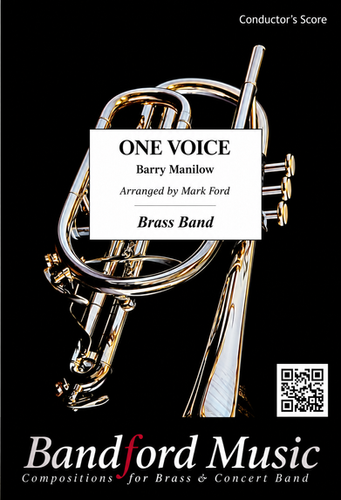 £33.20
One Voice (Brass Band) Barry Manilow arr. Mark Ford
Originally released in 1979 as the title track of Barry Manilow's sixth studio album, One Voice has become an enduring anthem for unity and social courage. It is a stirring ballad that reminds us how a single, brave voice can ignite a chorus of solidarity and lead the way toward positive change. Expertly crafted for brass band by Mark Ford, this setting captures the intimate, soaring spirit of the original while leveraging the unique textures of the brass band. The piece begins with a delicate, lyrical flugel horn solo, representing the 'single voice' of the title. As the arrangement progresses, the rest of the ensemble joins in, building from a gentle accompaniment into a magnificent, wall-of-sound finale that is sure to leave your audience inspired. To view a rolling score video of the work please visit https://youtu.be/RcQ5xbnyNjs Duration: Approx. 3.15 minutes Difficulty Level: 4th Section + This PDF download includes the full score and parts. Sheet music available at www.brassband.co.uk (UK) or https://satradecentral.org (USA) Instrumentation: Soprano Cornet Eb Solo Cornet Bb Repiano Cornet Bb 2nd Cornet Bb 3rd Cornet Bb Flugel Horn Bb Solo Horn Eb 1st Horn Eb 2nd Horn Eb 1st Baritone Bb 2nd Baritone Bb 1st Trombone Bb 2nd Trombone Bb Bass Trombone Euphonium Bb Bass Eb Bass Bb Timpani Glockenspiel Percussion
In Stock: Estimated dispatch 1-3 working days
 View Music