
Results
-
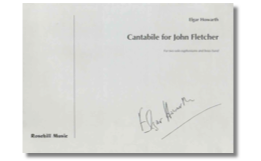 £39.95
Cantabile for John Fletcher
This duet for two euphoniums and brass band is a heartfelt tribute to John Fletcher, the renowned tuba player whose life was tragically cut short.
Estimated dispatch 7-9 working days
-
 £39.95
Dashing away with the smoothing iron - Ray Steadman-Allen
The composer writes... A lighthearted arrangement of an old folk song. The style is generally bright with a short, slower change of pace in the middle. En route there are a couple of quotations which got into the music almost unbidden: a fragment of one of Mozart's horn concerti and 'A-hunting we will go'. '... a splendid concert piece for advanced tuba players.' WINDS Autumn 2008 Duration: c.3:00 Also available with piano or concert band.
Estimated dispatch 7-9 working days
-
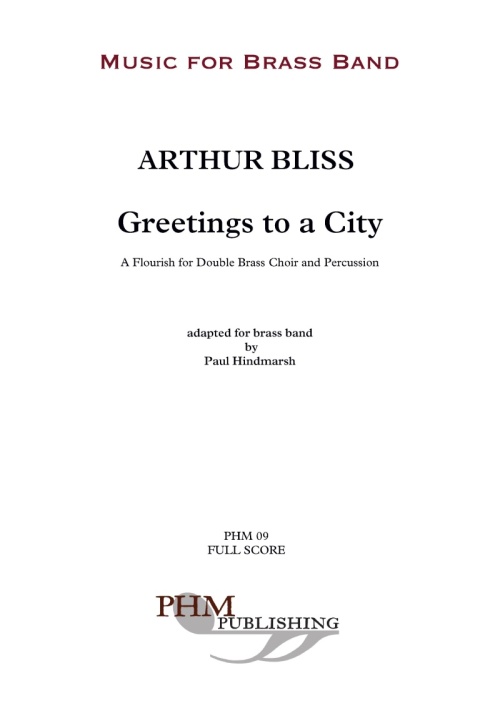 £50.00
Greetings to a City (Brass Band - Score and Parts)
Sir Arthur Bliss (1891 - 1975) was a significant composer and pillar of the British musical establishment. Although Born in London, his father was from the United States and both countries were important in his life and career. A pupil of Stanford at the Royal College of Music, Bliss travelled to the United States with his father in 1923, taking a prominent part in Elizabeth Sprague Coolidge's Pittsfield Music Festival, as well as undertaking some teaching and conducting. In 1925 he married Trudy Hoffman and they returned to the UK early in 1926. Bliss's most influential scores were his ballets and film scores. In 1953 Sir Arthur was appointed Master of the Queen's Music, after which he added a steady stream of fanfares and ceremonial works to his list of works. In 1960 he was commissioned by the American Wind Symphony of Pittsburgh, which requested for festive work to feature on an extensive European tour, including a performance in London.Bliss scored Greetings to a City for antiphonal brass, a choir each of 2 trumpets, 2 horns and three trombones, with tuba and percussion. This adaptation for brass band instruments retains an element of antiphony, emphasing the contrast between the fanfare instruments (cornets and trombones) and the horns and tubas. Greetings to a City is cast in three connected sections, with extended fanfare episodes separated by a short lyrical interlude.- Paul HindmarshDuration: 6.00
Estimated dispatch 7-14 working days
-
£35.00
Darkwood (Score Only)
Born in the Vale of Evesham, Worcestershire, Dan took a keen interest in music from an early age playing tuba and trombone with his local brass band. After leaving school he embarked on a 10 year career as a hotelier integrating it with a developing career as a freelance musician playing double bass, sousaphone and bass saxophone with big bands including the internationally Pasadena Roof Orchestra.In 2003, he enrolled in the Band Musicianship course at Salford University where he studied composition and arranging with Prof. Peter Graham. Dan's first test-piece An Elgar Portrait was selected as the 4th Section set work at the Swiss National Brass Band Championships in 2007 and again at the Pontins Championships the following year. He then went on to write the test-piece New World Sketches which was set as the 2nd Section test-piece for the British Regional Contests in 2009.In 2009, Dan became Composer in Association with the Cory Band, helping them with their winning programmes at several Brass in Concert Championships. In 2012 he became the Arranger in Association with Black Dyke Band and has been involved with many of the band's exciting projects including his arrangement of Recycled for the ground breaking multimedia campaign - Danger Global Warming Project and the band's collaboration with British composer Tolga Kashif in 2012 for his Olympic Anthem Let Your Light Shine.In 2015, Dan had a number of major works performed at International contests which included Realms of Asgard: Yggdrassil - a new test-work commissioned by Jaren Hornmusikkforening to be used as their choice work at the Norwegian Brass Band Championships, Ocean of Storms - an exciting new work for Grimethorpe Colliery Band's Brass in Concert programme and his test-piece Visions which was used as a 4th Section National Finals test-piece.Dan is currently working full time at the University of Salford, lecturing in Composition and Arranging. He continues to work as a freelance composer working with a number of leading soloists, brass and wind bands around the world.
Estimated dispatch 7-14 working days
-
£40.00
Magee's Patrol - Harper, P
Designed as a first-half finisher, Magee's Patrol is a traditional brass band patrol. It starts quietly, becomes gradually louder then, after a fortissimo statement of the tune begins to decrescendo. One by one the players exit the stage leaving just a lone tuba player to take the final applause. Simple but very effective.3rd section +
In Stock: Estimated dispatch 1-3 working days
-
 £43.00
Blue Bombazine (Eb Bass Solo with Brass Band - Score and Parts) - Johns, Terry
The word Bombazine is derived from the obsolete French word Bombasin. Largely made in the Norwich area, Bombazine is a twilled fabric made of silk used mainly in dress making and popular in England in the reign of Elizabeth I. The image and feel of warm, smooth, opulent silk is aptly suited to a solo feature for tuba. Wing Commander Duncan Stubbs and the RAF Music Service commissioned Blue Bombazine for solo tuba and brass in 2014, for Senior Aircraftman Jonathan Gawn and the RAF Central Band. It was first performed at The Royal Northern College of Music in Manchester, on the 11th April 2015 at the British Festival of Wind Bands. The music is written in the jazz idiom with a testing solo part. It is available with brass band accompaniment or for ten brass with tuba solo. Duration: 5.00. Suitable for 1st Section Bands and above
Estimated dispatch 7-14 working days
-
 £40.00
Fanfare for a New Era (Brass Band - Score and Parts) - Gregson, Edward
Fanfare for a New Era is the most substantial of Edward Gregson's fanfares and was the result of a private commission by Lady Sheila Stoller to celebrate the opening in April 2017 of the Stoller Hall at Chetham's School of Music, Manchester. Gregson dedicated it to Sir Norman Stoller, who donated the funding for the new concert hall. The Fanfare was designed to fill the whole space, with separate brass choirs - trumpets, horns, trombones and tuba - playing their own music. A solo trumpeter playing 'on high' announces first the four horns and timpani, who enter with a stately measure. Next the herald trumpeter ushers in trombones, tuba and drums, with a faster dance. Finally, the remaining three trumpets amplify the peeling of bells. All four elements then come together, surrounding the audience with a 'joyful noise' of festive brass and percussion.Duration: 3.00
Estimated dispatch 7-14 working days
-
£14.00
Fanfare for a New Era (Brass Band - Score only) - Gregson, Edward
Fanfare for a New Era is the most substantial of Edward Gregson's fanfares and was the result of a private commission by Lady Sheila Stoller to celebrate the opening in April 2017 of the Stoller Hall at Chetham's School of Music, Manchester. Gregson dedicated it to Sir Norman Stoller, who donated the funding for the new concert hall. The Fanfare was designed to fill the whole space, with separate brass choirs - trumpets, horns, trombones and tuba - playing their own music. A solo trumpeter playing 'on high' announces first the four horns and timpani, who enter with a stately measure. Next the herald trumpeter ushers in trombones, tuba and drums, with a faster dance. Finally, the remaining three trumpets amplify the peeling of bells. All four elements then come together, surrounding the audience with a 'joyful noise' of festive brass and percussion.Duration: 3.00
Estimated dispatch 7-14 working days
-
 £94.95
Dances and Arias (Brass Band - Score and Parts) - Gregson, Edward
This work was commissioned by Boosey & Hawkes Band Festivals (with funds provided by the Arts Council of Great Britain) for the National Brass Band Championships of Great Britain, held at the Royal Albert Hall, London, on 7th October 1984.Dances and Arias is in one continuous movement, but as the title suggests is a series of alternating fast and slow sections as follows: Dance - Aria I - Dance (scherzo) - Aria II - Dance. The opening dance is energetic and introduces a four-note motif (on trombones) which is the basis for much of the melodic material in the work. Throughout, there is a continuous process of thematic cross-reference and transformation.The first aria unfolds a long melody on solo cornet, eventually continued by all the solo cornets, and dissolving into a shimmering harmonic background (muted cornets, horns and baritones) over which is heard a brief self-quotation on solo tuba. This leads into the second dance, a frenetic scherzo, followed by the second aria, in the style of a lament (solo euphonium, followed by two flugel horns). This builds to a powerful climax which subsides, leaving the percussion to introduce the final toccata-like dance. It transforms material from the opening before a coda brings the music to a triumphant close. The large percussion section is an integral part in the work and uses a wide variety of instruments including timpani, glockenspiel, vibraphone, xylophone, tubular bells, tom-toms, snare drum, bongos and tam-tam.The work is dedicated to my brother and sister.- Edward GregsonDuration: 14.00
Estimated dispatch 7-14 working days
-
 £44.95
Dances and Arias (Brass Band - Score only) - Gregson, Edward
This work was commissioned by Boosey & Hawkes Band Festivals (with funds provided by the Arts Council of Great Britain) for the National Brass Band Championships of Great Britain, held at the Royal Albert Hall, London, on 7th October 1984.Dances and Arias is in one continuous movement, but as the title suggests is a series of alternating fast and slow sections as follows: Dance - Aria I - Dance (scherzo) - Aria II - Dance. The opening dance is energetic and introduces a four-note motif (on trombones) which is the basis for much of the melodic material in the work. Throughout, there is a continuous process of thematic cross-reference and transformation.The first aria unfolds a long melody on solo cornet, eventually continued by all the solo cornets, and dissolving into a shimmering harmonic background (muted cornets, horns and baritones) over which is heard a brief self-quotation on solo tuba. This leads into the second dance, a frenetic scherzo, followed by the second aria, in the style of a lament (solo euphonium, followed by two flugel horns). This builds to a powerful climax which subsides, leaving the percussion to introduce the final toccata-like dance. It transforms material from the opening before a coda brings the music to a triumphant close. The large percussion section is an integral part in the work and uses a wide variety of instruments including timpani, glockenspiel, vibraphone, xylophone, tubular bells, tom-toms, snare drum, bongos and tam-tam.The work is dedicated to my brother and sister.- Edward GregsonDuration: 14.00
Estimated dispatch 7-14 working days
 View Music