
Results
-
 £38.95
Unity Series Band Journal February 2013 Numbers 402 - 405
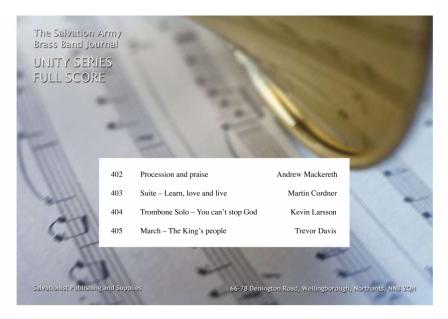
No.402 Procession and praise (Andrew Mackereth)Written for an event at Belfast Citadel in November 2011, the tunes included were chosen by the youthful participants themselves!No.403 Suite - Learn, love and Live (Martin Cordner)Written for one of the bands at the 2011 Belfast Temple Music School, the three movements of this suite feature the songs 'Come Fill my cup', 'Such love' and 'Running over' respectively.No.404 Trombone Solo - You can't stop God (Kevin Larsson)Kevin Larsson has take one of his father's tunes and arranged it in the style of a Cuban bolero with the instruction that it is played at 100 beats per minute, or slower!No.405 March - The King's people (Trevor Davis)This march was written for the 125th anniversary of Loughborough Corps and is based on the song 'Come, people of the risen King' which was a particular favourite of the corps.
Estimated dispatch 7-14 working days
-
 £89.95
Trombone Concerto (Trombone Solo with Brass Band - Score and Parts) - Gregson, Edward
The Gregson Trombone Concerto was originally written in 1979 to a commission from Bedfordshire Education Service, for a new work for Michael Hext, winner of the first BBC Young Musician of the Year competition. This version for brass band was commissioned by Nicholas Childs, Music Director of the Black Dyke Band, specially for Brett Baker, the then principal trombone of the band. He has recorded it on the Doyen label with the Black Dyke Band.The work falls into three main sections, played without a break, but conforming to the traditional pattern of concerto structure. After a slow introduction, containing most of the motivic and rhythmic ideas used in the work, there follows the main fast section which is itself divided into three parts and concludes with a fierce climax (timpani and gong). The slow and rather intense middle section is linked to a cadenza for the soloist, at first unaccompanied but leading to accompanied references to earlier material. The final section is a scherzo which ends dramatically with a re-statement of the opening slow introduction. A brisk coda concludes the work. The interval of a fourth (and its augmented form) provides melodic and harmonic unity for the work, whilst the tonal juxtaposition between E minor and B flat major throughout the concerto is an important element of the structure.The writing for trombone is virtuosic, encompassing the whole range of the instrument, but it also exploits the rather beautiful lyrical sound of which this instrument is capable.
Estimated dispatch 7-14 working days
-
 £44.95
Trombone Concerto (Trombone Solo with Brass Band - Score only) - Gregson, Edward
The Gregson Trombone Concerto was originally written in 1979 to a commission from Bedfordshire Education Service, for a new work for Michael Hext, winner of the first BBC Young Musician of the Year competition. This version for brass band was commissioned by Nicholas Childs, Music Director of the Black Dyke Band, specially for Brett Baker, the then principal trombone of the band. He has recorded it on the Doyen label with the Black Dyke Band.The work falls into three main sections, played without a break, but conforming to the traditional pattern of concerto structure. After a slow introduction, containing most of the motivic and rhythmic ideas used in the work, there follows the main fast section which is itself divided into three parts and concludes with a fierce climax (timpani and gong). The slow and rather intense middle section is linked to a cadenza for the soloist, at first unaccompanied but leading to accompanied references to earlier material. The final section is a scherzo which ends dramatically with a re-statement of the opening slow introduction. A brisk coda concludes the work. The interval of a fourth (and its augmented form) provides melodic and harmonic unity for the work, whilst the tonal juxtaposition between E minor and B flat major throughout the concerto is an important element of the structure.The writing for trombone is virtuosic, encompassing the whole range of the instrument, but it also exploits the rather beautiful lyrical sound of which this instrument is capable.Duration: 16.00
Estimated dispatch 7-14 working days
-
 £42.95
Blue Jeans (Trombone Solo with Brass Band - Score and Parts) - Wiffin, Rob
In 2008 the trombonist, Chris Jeans, was invited to be a featured soloist at a British Trombone Society event. He contacted Stan Kitchen at Studio Music Company to see if he had any new material for trombone. Stan then got in touch with me, as I had already written a piece for another trombone player, Brett Baker. This piece, Shout! was programmed for the same event so we needed to find something new for Chris.The title 'Blue Jeans' came to my mind, thus linking a blues-style piece with the obvious reference to Chris's surname. I spoke to Chris and he liked the sound of it so then I had to go away and write a solo to match the title!I managed to get a version with piano accompaniment done in time for Chris to perform at the trombone event and have now had a chance to complete the band version.Chris is a great chap, a good friend and a wonderful trombone player so I hope people enjoy listening to this solo that bears his name.- Rob WiffinDuration: 3.30
Estimated dispatch 7-14 working days
-
 £60.00
Fantastic Polka (Trombone Solo with Brass Band - Score and Parts) - Pryor, Arthur - Wilkinson, Keith M.
Arthur Pryor is remembered primarily for his 12 years as the amazing trombone soloist with The Sousa Band. However, he was also a prolific composer and conductor, forming his own band following his years with Sousa. He wrote many trombone solos designed to dazzle audiences with his virtuosity.This brass band version was prepared at the request of The Black Dyke Band, musical director Nicholas J Childs, for a recording project with Ian Bousfield, principal trombone of the Vienna Philharmonic, titled Pryor Engagement. It has also been recorded by Brett Baker with Brass Band of the Western Reserve, musical director Keith M Wilkinson, on the CD Slides Rule!
Estimated dispatch 7-14 working days
-
 £88.00
Bass Trombone Concerto (Bass Trombone Solo with Brass Band - Score and Parts) - Brubeck, Christopher
"As a bass trombonist, I spent many years of my adolescence playing in youth orchestras, engaging in musical daydreams. I would visualize myself jumping up from the back of the orchestra to unleash improvisations much to the conductor's horror. The resultant three-movement, thirteen-minute work has enjoyed a robust life with performances by notable orchestras all around the world. Happily, the concerto works well as a recital piece, with many accomplished college players having won concerto competitions performing it. Jazz elements were inescapable, and realizing my old nightmare/dream, quite a bit of the trombone solo is meant to be improvised. I made a recording of the concerto with the London Symphony Orchestra, which was included on a CD called Bach to Brubeck released on Koch International Classics. Having already become popular as a bass trombone work with orchestra accompaniment, renowned British Bass Trombonist and publisher Roger Argente suggested he release a special Brass Band arrangement of my concerto. Roger knew the piece well because years ago he played the European premiere of the concerto with the Royal Philharmonic Orchestra at the Royal Albert Hall." - Chris Brubeck. Duration: 13.00. Suitable for 1st Section Bands and above.
Estimated dispatch 7-14 working days
-
 £76.99
Tango for Joe (Trombone Solo with Brass Band - Score and Parts) - Sparke, Philip
Tango for Joe was written for Joe Alessi, principal trombone of the New York Philharmonic. He gave the official premiere with the Brass Band of Battle Creek on 3rd December 2022 at the W K Kellogg Auditorium in Battle Creek, Michigan.Opening with an (optional) unaccompanied recitative for the soloist, Tango for Joe then develops into a slow and sensuous tango, exploring the lyrical properties of the trombone. The opening of this theme is then taken up by the full band but is soon interrupted by a highly decorated version of the melody by the soloist. A further cadenza-like passage then leads to a faster 'tango nuevo' which makes up the majority of the work.A long introduction by the band builds to the first entry of the soloist, who plays the main tango melody over a rhythmic accompaniment. This is taken up briefly by the band but the soloist enters again with his own variation on the theme. After a bridge passage featuring a brief 'question and answer' exchange between the instruments, the soloist then plays a new version of the opening slow tango theme over rhythmic interpolations. After a climax, the soloist presents a long and elaborate cadenza accompanied only by a solo cajon or drum kit. This eventually leads to a repeat of the main theme and , after a short second cadenza, the piece ends with a flourish for band and soloist.Duration: 8.45
Estimated dispatch 7-14 working days
-
 £44.95
Trombone Concerto (Trombone Solo with Brass Band - Score only) - Wiffin, Rob
My Trombone Concerto was commissioned by Brett Baker following an earlier piece I had written for him called Shout! It was composed in Spain in the summer of 2010. Once I started writing I realised that this concerto was inevitably going to draw on my own experiences as a trombone player. The first movement was really a matter of getting the right thematic ideas and balancing the tutti and solo passages so, for formal structure, I studied the Gordon Jacob Trombone Concerto. There is a lyrical section preceding the first Allegro that owes much in spirit (but not in the actual music) to The Eternal Quest, Ray Steadman-Allen's Salvation Army solo. The slow movement seemed determined to come out in the vein of a Richard Strauss song. I wanted to write something ineluctably 'cantabile' as we trombone players rarely get a chance to play the melody. There is a brief allusion to that wonderful moment when the trombone gets to sing above the orchestra in Sibelius' seventh symphony. Arthur Wilson, that great exponent of the singing style in trombone-playing and my teacher at college died in the summer of 2010 so it seemed appropriate to dedicate this movement to him. The last movement is the lightest of the three in style and is slightly jazz-inflected, hopefully providing some fun for the soloist. While wanting to test the instrument I did not set out with the intention of making the concerto difficult but there are undoubtedly challenges of technique, range and style to be met by the soloist.- Rob Wiffin
Estimated dispatch 7-14 working days
-
£87.95
Trombone Concerto (Trombone Solo with Brass Band - Score and Parts) - Wiffin, Rob
My Trombone Concerto was commissioned by Brett Baker following an earlier piece I had written for him called Shout! It was composed in Spain in the summer of 2010. Once I started writing I realised that this concerto was inevitably going to draw on my own experiences as a trombone player.The first movement was really a matter of getting the right thematic ideas and balancing the tutti and solo passages so, for formal structure, I studied the Gordon Jacob Trombone Concerto. There is a lyrical section preceding the first Allegro that owes much in spirit (but not in the actual music) to The Eternal Quest, Ray Steadman-Allen's Salvation Army solo.The slow movement seemed determined to come out in the vein of a Richard Strauss song. I wanted to write something ineluctably 'cantabile' as we trombone players rarely get a chance to play the melody. There is a brief allusion to that wonderful moment when the trombone gets to sing above the orchestra in Sibelius' seventh symphony. Arthur Wilson, that great exponent of the singing style in trombone-playing and my teacher at college died in the summer of 2010 so it seemed appropriate to dedicate this movement to him.The last movement is the lightest of the three in style and is slightly jazz-inflected, hopefully providing some fun for the soloist.While wanting to test the instrument I did not set out with the intention of making the concerto difficult but there are undoubtedly challenges of technique, range and style to be met by the soloist.- Rob Wiffin
Estimated dispatch 7-14 working days
-
 £51.00
Atlantic Zephyrs (Trombone Solo with Brass Band - Score and Parts) - Simons, Gardell - Wilkinson, Keith M.
Soloist, composer and teacher Gardell Simons (1878 - 1945) achieved national prominence as trombone soloist with the Sousa Band. He later successfully made the transition to the orchestral world and became principal trombone in the Cleveland Orchestra as well as being professor of trombone at the Curtis Institute Of Music in Philadelphia.This solo dates from 1915 and describes the soft, gentle breezes of Summer. Maybe the atmosphere surrounding the many outdoor concerts in which the composer performed were his inspiration. This brass band arrangement was prepared at the request of Brett Baker for his visit to perform with Brass Band Of The Western Reserve, musical director Dr Keith M Wilkinson, in May 2010.
Estimated dispatch 7-14 working days
 View Music