
Results
-
£69.95
Moor of Venice (Dramatic Overture) (Score and Parts)
Shakespeare, in his tragedy ' Othello, the Moor of Venice,'? tells a tale of treachery and deceit which culminates in the murder of the chaste Desdemona by her demented husband. The Overture re-tells the story in the form of a character study of the Mo
Estimated dispatch 7-14 working days
-
£32.95
Moor of Venice (Dramatic Overture) (Score Only)
Shakespeare, in his tragedy ' Othello, the Moor of Venice,'? tells a tale of treachery and deceit which culminates in the murder of the chaste Desdemona by her demented husband. The Overture re-tells the story in the form of a character study of the Mo
Estimated dispatch 7-14 working days
-
 £45.00
The City in the Sea (Euphonium Solo with Brass Band - Score and Parts)
An atmospheric, dramatic and haunting depiction of the tragedy of Dunwich, the medieval city engulfed by the remorseless forces of nature.Duration: 16.30
Estimated dispatch 7-14 working days
-
 £64.95
A Tale of Hope - Steven Ponsford
The piece tells the story of Chicago lawyer and Presbyterian church elder Horatio Gates Spafford. In 1873, the Spafford family planned a vacation to England, but last-minute business demands prevented Horatio from sailing with them. Tragedy struck when the ship...
Estimated dispatch 5-7 working days
-
 £74.95
A Tale of Hope (Brass Band - Score and Parts) - Ponsford, Steven
The piece tells the story of Chicago lawyer and Presbyterian church elder Horatio Gates Spafford. In 1873, the Spafford family planned a vacation to England, but last-minute business demands prevented Horatio from sailing with them. Tragedy struck when the ship collided with an iron sailing vessel while crossing the Atlantic, killing 226 people, including all four of Spafford's daughters. His wife, Anna, survived the tragedy, and upon arriving in Cardiff, Wales, she sent a telegram to Spafford that simply read "Saved alone." Shortly afterwards, as Spafford travelled to meet his grieving wife, he was inspired to write the hymn It Is Well with My Soul as his ship passed near where his daughters had died. The hymn was subsequently set to music by fellow American Philip Bliss, with the tune named after the ship on which Spafford's daughters died, Ville du Havre.Composer Steven Ponsford has chosen to portray this story in a substantial composition for brass band. Much of the early music is turbulent, reflecting the long voyage, and then the disaster that claimed Spafford's daughters. After a darker 'Grave' section, the hymn It Is Well With My Soul softly emerges, with the piece ending on a note of optimism and hope.Duration: 11.30
Estimated dispatch 7-14 working days
-
 £31.95
A Tale of Hope (Brass Band - Score only) - Ponsford, Steven
The piece tells the story of Chicago lawyer and Presbyterian church elder Horatio Gates Spafford. In 1873, the Spafford family planned a vacation to England, but last-minute business demands prevented Horatio from sailing with them. Tragedy struck when the ship collided with an iron sailing vessel while crossing the Atlantic, killing 226 people, including all four of Spafford's daughters. His wife, Anna, survived the tragedy, and upon arriving in Cardiff, Wales, she sent a telegram to Spafford that simply read "Saved alone." Shortly afterwards, as Spafford travelled to meet his grieving wife, he was inspired to write the hymn It Is Well with My Soul as his ship passed near where his daughters had died. The hymn was subsequently set to music by fellow American Philip Bliss, with the tune named after the ship on which Spafford's daughters died, Ville du Havre.Composer Steven Ponsford has chosen to portray this story in a substantial composition for brass band. Much of the early music is turbulent, reflecting the long voyage, and then the disaster that claimed Spafford's daughters. After a darker 'Grave' section, the hymn It Is Well With My Soul softly emerges, with the piece ending on a note of optimism and hope.Duration: 11.30
Estimated dispatch 7-14 working days
-
 £45.00
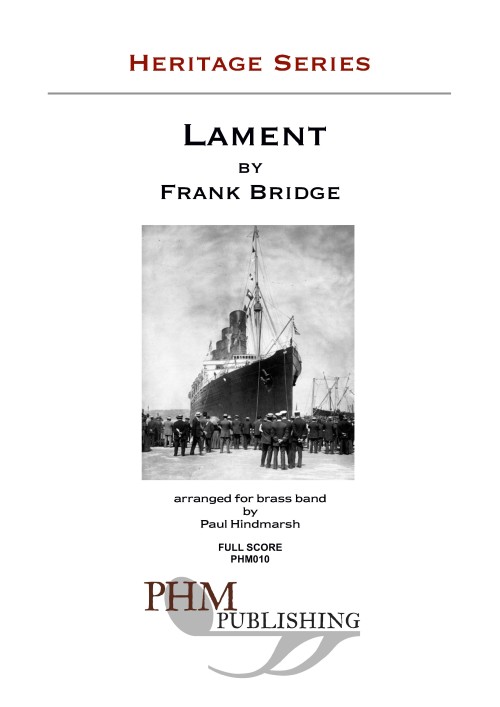
Lament (Brass Band - Score and Parts) - Bridge, Frank - Hindmarsh, Paul
The English composer Frank Bridge (1879 - 1941) did not take an active part in the First World War. However, he was devastated by the slaughter on the western and the eastern fronts, especially the loss of so many of his musicians friends and colleagues. Writing in 1963, his former pupil Benjamin Britten confessed that 'a lot of my feelings about the First World War which people seemed to see in the War Requiem came from Bridge. He had written a piano sonata in memory of a friend killed in France and though he didn't encourage me to take a stand for the sake of a stand, he did make me argue and argue and argue. His own pacifism was not aggressive, but typically gentle'.Bridge composed this Lament for string orchestra on 14 June 1915, in memory of Catherine Crompton, who drowned when the Cunard liner Lusitania was torpedoed by a German submarine on 7 May, 1915. According to figures researched by Liverpool historian Kevin Roach (www.lusitania.net), 1201 men, women and children lost their lives out of the 1962 people aboard. Ninety-four children died, including Catherine, her twin brother Paul and four other siblings. Paul Crompton, Snr. (44), a British businessman working in Philadelphia, his wife Gladys (40) and the family nanny were also drowned. How Bridge's dedication came about is uncertain. The music critic Edwin Evans, who knew Bridge well, has written that the Catherine was a young friend. It is also possible that he came across the family photograph which was published in many newspapers in the wake of the tragedy. By that time, Bridge was greatly distressed by the war as a whole. It seems perfectly in keeping with his pacifist leanings and the strength of his reaction, that this poignant and deeply touching 'war memorial' should mourn a child who he did not know, rather than one of the thousands of young men who fell in battle.Through the musical tears of this melancholy lullaby, Bridge may have regarded the death of young Catherine Crompton as symbolic of the loss of so many innocent lives in wartime. His response to this personal tragedy was characteristically spontaneous and utterly sincere. It is one of his most effective miniatures, poignant yet restrained in its lyrical beauty, with a compelling directness and simplicity of construction.This brass band transcription is pitched one tone lower than the original for string orchestra.- Paul HindmarshDuration: 5.00
Estimated dispatch 7-14 working days
-
 £23.00
King Lear Fanfare (Brass Band - Score and Parts) - Debussy, Claude - Wilson, Duncan
King Lear is a tragedy by William Shakespeare. Lear descends into madness bringing tragic consequences for all. Based on a mythological pre-Roman Celtic king, the play has been widely adapted for the stage and motion pictures, with the title role coveted by many of the world's most accomplished actors. Its first known performance was in 1607, George Bernard Shaw wrote, "No man will ever write a better tragedy than Lear". Originally orchestrated for 2 flutes, 4 horns, 3 trumpets, timpani, side drum, 2 harps, and strings, Debussy wrote five minutes of incidental music for a production of King Lear, produced at the Theatre Mogador Paris in 1904. Duration: 1.30. Suitable for 4th Section Bands and above.
Estimated dispatch 7-14 working days
-
 £89.95
Four Etudes (Brass Band - Score and Parts) - Gregson, Edward
This work was written during August and September 2016. In it, I wanted primarily to explore the elements of timbre, rhythm, texture and colour. The first three tudes (or studies) are based on a set of piano pieces I composed in 1982, whilst the last, the longest of the set, was composed specially. My reference point was the Four tudes for orchestra of 1928 by Stravinsky, a work I have always admired, and of which the first three also happen to be based on a set of earlier pieces, in his case for string quartet, with the last being a re-arrangement of a work for pianola. I have also borrowed the titles he gave to the individual studies as they seemed to fit the mood of my pieces.However, the exception is the final study, where instead of the exuberant mood of his colourful portrayal of Madrid, mine was influenced by the terrible human tragedy that was unfolding in Aleppo at the time I was writing it, and thus reflects the violence and barbarism of those events; yet towards the end it does offer a glimmer of hope for humanity with a return to the Canticle (Song) of the first study, and concludes quietly with the chords and bells that began the work. The titles of the tudes are Canticle, Dance, Excentrique, and Aleppo. Like Stravinsky's, the set is relatively short, lasting around 8 minutes.The Four tudes were commissioned by Black Dyke Band and were written specially for the recording marking the conclusion of my year as Composer-in-Residence. The concert premiere will be given by Black Dyke Band, conducted by the composer, at the RNCM Festival of Brass in January 2017.- Edward GregsonDuration: 8.00
Estimated dispatch 7-14 working days
-
 £37.95
Four Etudes (Brass Band - Score only) - Gregson, Edward
This work was written during August and September 2016. In it, I wanted primarily to explore the elements of timbre, rhythm, texture and colour. The first three tudes (or studies) are based on a set of piano pieces I composed in 1982, whilst the last, the longest of the set, was composed specially. My reference point was the Four tudes for orchestra of 1928 by Stravinsky, a work I have always admired, and of which the first three also happen to be based on a set of earlier pieces, in his case for string quartet, with the last being a re-arrangement of a work for pianola. I have also borrowed the titles he gave to the individual studies as they seemed to fit the mood of my pieces.However, the exception is the final study, where instead of the exuberant mood of his colourful portrayal of Madrid, mine was influenced by the terrible human tragedy that was unfolding in Aleppo at the time I was writing it, and thus reflects the violence and barbarism of those events; yet towards the end it does offer a glimmer of hope for humanity with a return to the Canticle (Song) of the first study, and concludes quietly with the chords and bells that began the work. The titles of the tudes are Canticle, Dance, Excentrique, and Aleppo. Like Stravinsky's, the set is relatively short, lasting around 8 minutes.The Four tudes were commissioned by Black Dyke Band and were written specially for the recording marking the conclusion of my year as Composer-in-Residence. The concert premiere will be given by Black Dyke Band, conducted by the composer, at the RNCM Festival of Brass in January 2017.- Edward GregsonDuration: 8.00
Estimated dispatch 7-14 working days
 View Music