
Results
-
£34.95
COVENANTERS, The (Brass Band Set) - Kenneth Downie
In 1638, many members of the Presbyterian Church of Scotland signed a document called the National Covenant. By doing so, they were declaring that they acknowledged only Jesus Christ as the spiritual head of their church, and not any king or queen. This had become necessary because the Stuart kings believed in the Divine Right of Monarchs and saw themselves as head of the church. In the previous year, Charles I had forcibly introduced the Book of Common Prayer, invoking the wrath of the common people who faced the threat of torture, transportation or execution if they did not use the new liturgy and worship at their local church. The net result of this was that many met illegally in the countryside or in barns and large houses. These meetings became known as 'conventides' and many took place in the south-west of the country. Anyone caught attending was at risk of execution by the muskets of the dragoons who were employed in the area for that specific purpose. This music was written to honour the bravery and loyalty of these Christians to their faith, in the face of extreme danger, in the hope that it will inspire us also to be faithful. There are overtones of military threat, secrecy and solidarity. An old pentatonic tune is used, which the composer heard as a boy being sung to the words The Lord's My Shepherd.
Estimated dispatch 7-14 working days
-
 £29.95
Judd: California
In retirement, Emil Soderstrom moved to California and honoured his new home with this light-hearted but demanding march. The composer has said that the motif given to the upper cornets in the second strain stands for 'Ca-li-for-nia'! His love of startling chromatic passages is evident in the 'break up' strain of the trio section which is marked by a sudden key change and a fragment of the song Sunshine in my soul today, a reference to the Californian weather.
Estimated dispatch 7-14 working days
-
 £34.50
The Wanderer - Hymn Tune Arrangement
ABOUT THIS PIECE: Written for the Haydock Band in memory of their late president, Stan Gardner, this is a beautifully simple take on the hymn tune: Stella. The title comes from the words of often sung to this hymn, written by John Lingard: 'Pray for the wanderer, pray for me'. Before the whole hymn is heard, the band play a repeated melody that evokes feelings of movement. There is an interplay between new and old melody, before a rousing rendition of the hymn by forte band. The arrangement concludes with the opening melody disappearing into the distance - a musical representation of the arranger's sentiments written at the top of the score: 'May God bless your onward journey, dear friend'. ENSEMBLE: Standard British Brass Band WHEN YOU BUY THIS PRODUCT, YOU GET: High-quality printed score and parts LEVEL: 1 LISTEN: DURATION: 5-minutesEXAMPLE SCORE: Click here LEVEL GUIDE: Level 1- Accessible to all Level 2 - c. UK third section and higher Level 3 - c. UK second section and higher Level 4 - c. UK first section and higher Level 5 - c. UK championship section level
Estimated dispatch 5-7 working days
-
 £76.00
Yellow - Coldplay/Dean Jones
This popular song written by Chris Martin and his group Coldplay, was recently given a very new lease of life with an orchestral arrangement. The music brings new meaning and sentiments to the already successful song, and it is hoped this is version for Band will provide great rewards for both player and listener alike.
Estimated dispatch 10-14 working days
-
 £34.95
Tasman Bay - Dan Price
Tasman Bay was commissioned to commemorate the 160th anniversary of the Nelson City Brass Band in New Zealand. Cast in the form of a brisk concert opener, the work takes its name from the bay in New Zealand's South Island...
Estimated dispatch 5-7 working days
-
 £30.00
Barking Mad - Jock McKenzie
The New Orleans Brass Band sound is now something that is heard and seen throughout the world. Originally repertoire was played to serve civic & church duties and was often spiritual in content mixed with more than a hint of jazz. These days, almost 'anything goes' with music arranged and composed for the idiom. Despite this, many 'staple' musical characteristics prevail - a hint of the blues in melody & harmony and a funky, swinging rhythmic drive for both dancing and marching. Barking Mad uses these ingredients to present a brassy, shackles off, in-yer-face musical number.
-
 £36.30
She's Out of My Life - Tom Bahler
A lovely flugel solo arrangement of this well known song, made famous by the late Michael Jackson.It's arranger, Jon Bennett, has truly captured the beauty of the melody and through his scoring he has given the soloist and accompaniment the opportunity to bring the piece to life.A great new addition to your concert programme, not just because of its current relevance in the music world, but even moreso because of the way in which the music has been crafted for brass band.
In Stock: Estimated dispatch 3-5 working days
-
 £60.00
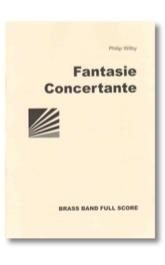
Fantasie Concertante (Score only) - Philip Wilby
This exciting new concerto is a welcome addition to the repertoire of french and tenor horn players alike. Like the 18th-Century Serenade form there are five movements, arranged symmetrically around a slow movement - Soliloquy - which separates movements entitled Burlesque (two) and Valse Caprice (three) respectively. The first and last movements share common material of a more symphonic stature, and the concerto ends with a brisk fugato. The solo horn is (in the band version) accompanied by a quintet of solo players (two cornets, euphonium, trombone, and tuba) who provide the lion's share of the counterpoint and contrast with the main body of musicians who provide musical punctuation in the more sonorous tutti sections. The first movement, Don Quixote's Dream, contains references to Cervantes' famous hero, the Spanish nature of his stories, and the ambling gait of his horseback adventures.
Estimated dispatch 7-9 working days
-
 £74.00
Fantasie Concertante (Parts only) - Philip Wilby
This exciting new concerto is a welcome addition to the repertoire of french and tenor horn players alike. Like the 18th-Century Serenade form there are five movements, arranged symmetrically around a slow movement - Soliloquy - which separates movements entitled Burlesque (two) and Valse Caprice (three) respectively. The first and last movements share common material of a more symphonic stature, and the concerto ends with a brisk fugato. The solo horn is (in the band version) accompanied by a quintet of solo players (two cornets, euphonium, trombone, and tuba) who provide the lion's share of the counterpoint and contrast with the main body of musicians who provide musical punctuation in the more sonorous tutti sections. The first movement, Don Quixote's Dream, contains references to Cervantes' famous hero, the Spanish nature of his stories, and the ambling gait of his horseback adventures.
Estimated dispatch 7-9 working days
-
 £39.95
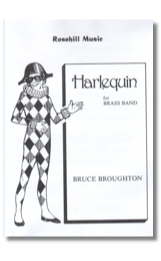
Harlequin (Score and Parts) - Bruce Broughton
Harlequin is the most popular of the comic servant characters from the Italian commedia dell'arte who, although a slow thinker, was acrobatic and nimble - he would never perform a simple action when the addition of a cartwheel or backflip would spice up the movement! These characteristics are aptly portrayed musically in Bruce Broughton's mini concert overture. Originally published for brass band in 1984, this popular work coveys all the hustle, bustle, and agility of the character in a finely crafted musical structure. Ideal as a concert opener or encore it is sure to delight audiences and provide players with an exciting new addition to their repertory. Duration: 2:30
Estimated dispatch 7-9 working days
 View Music