
Results
-
 £42.00
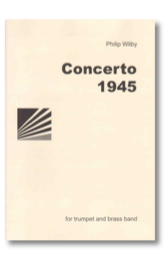
Concerto 1945 (Score only) - Philip WIlby
At a time when we are being encouraged to survey the recent past, its title aims to catch a flavour of that spirit of optimistic vision which coloured the British psyche at the end of the Second War, at once heroic, elegiac, and confident. The concerto's three movements are arranged in a circular pattern around a reflective slow movement. At the heart of that movement is a Cadenza, marked to be played off-stage, where the soloist is surrounded and supported by an additional group of fanfare players. By contrast, the outer movements are energetic and brisk, at times heroic, and at times virtuosic. Also available with piano accompaniment.
Estimated dispatch 7-9 working days
-
 £54.00
Concerto 1945 (Parts only) - Philip WIlby
At a time when we are being encouraged to survey the recent past, its title aims to catch a flavour of that spirit of optimistic vision which coloured the British psyche at the end of the Second War, at once heroic, elegiac, and confident. The concerto's three movements are arranged in a circular pattern around a reflective slow movement. At the heart of that movement is a Cadenza, marked to be played off-stage, where the soloist is surrounded and supported by an additional group of fanfare players. By contrast, the outer movements are energetic and brisk, at times heroic, and at times virtuosic. Also available with piano accompaniment.
Estimated dispatch 7-9 working days
-
£40.00
Elemental - Harper, P
The opening number in Cory Band's 2015 'Four Elements' themed Brass in Concert programme, this piece sets out a mysterious introduction transporting us back to the time of the Greek Philosophers, after which it presents short musical depictions of Fire, Air, Water and Earth. Designed to start your concert with a bang.Championship SectionDuration 4 minsListen to Cory BandCourtesy of World of Brass
In Stock: Estimated dispatch 1-3 working days
-
£45.00
The Rings of Saturn - Harper, P
This piece attempts to convey the vastness of time, space and the universe, and mankind's miniscule and fleeting existence within it. It features lyrical solos for solo cornet, repiano and flugel horn, placed spatially in the performance space.Click here to listen to a short excerpt2nd Section +Duration 5 mins
In Stock: Estimated dispatch 1-3 working days
-
£22.50
The Rings of Saturn (Score) - Harper, P
This piece attempts to convey the vastness of time, space and the universe, and mankind's miniscule and fleeting existence within it. It features lyrical solos for solo cornet, repiano and flugel horn, placed spatially in the performance space.Click here to listen to a short excerpt2nd Section +Duration 4 mins
In Stock: Estimated dispatch 1-3 working days
-
£50.00
Vectis Isle - Broadbent, D
VECTIS ISLE is the Roman name for the Isle of WrightSTATELY OSBORNEOsborne House was the summer residence of Queen Victoria. Music of fanfares and pageantry in 3/4 time, with a central delicate minuet section, before returning to the original fanfares and stately themes.PICTURESQUE CALBOURNECalbourne is a pretty, tiny country village with its feature of an old water mill. The music is pastorale in style. 6/8 rhythms with a free and easy waltz section.THE OLD CHURCH AT GODSHILLThis movement links directly from the second, but may be played on its own if desired. Godshill is a quaint but beautiful village of thatched cottages by an old church.SANDOWN HOLIDAYSThis final movement is intended to portray the happy atmosphere of this pleasant seaside resort, with just a moment or two to laze on the fine beaches under an afternoon sun before the final allegro concludes this suite.Duration 14 and a half mins
In Stock: Estimated dispatch 1-3 working days
-
 £89.95
Christmastime (Brass Band - Score and Parts)
Taking the form of an overture, this piece contains passing references to many well-known festive songs, and features Hark! the herald angels sing (C.C. 38), The first Nowell (C.C. 86), Have yourself a merry little Christmas (C.C. 115) and O come, all ye faithful (C.C. 61).There are a lot of notes in this music. Keep it light throughout and make the most of every opportunity to play quietly. In sections D and E, The first Nowell is presented in 2/2 time. Getting used to this unusual presentation of the melody may take careful rehearsal.
Estimated dispatch 7-14 working days
-
 £70.00
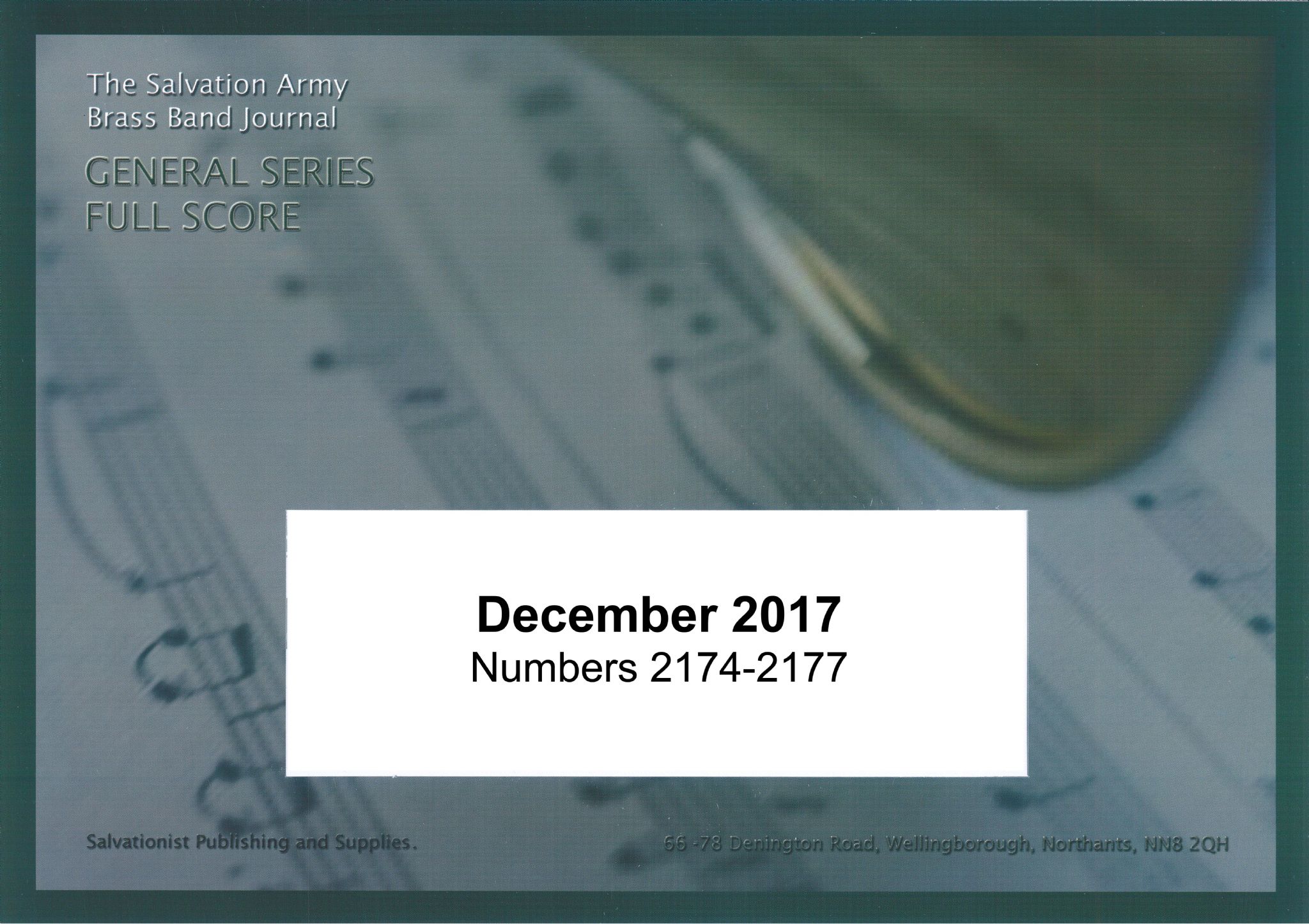
General Series Band Journal December 2017 Numbers 2174-2177
Festival March - Stowmarket 125 (Steven Ponsford)This festival march is traditional in style, abounds in energy and features the lesser known chorus 'In that city built four square' which the corps at Stowmarket have featured through the years.At the cross (Paul Sharman)This meditation was originally written for the Disciples of the Cross commissioning and features 'To thy cross, I come Lord', 'At the cross where I first saw the light' and other melodic references to 'The Cross of Christ' are also found within.Flugel Horn Solo How deep the fathers love (Andrew Mackereth)The beautiful contemporary song has been set in a developed Flugel Horn Solo which should have an instant appeal to both soloist and band.Evry time I feel the spirit (Dean Jones)The classic spiritual is given an up-tempo feel and has been featured by the International Staff Band in recent programmes.
Estimated dispatch 7-14 working days
-
 £89.99
Penlee (Brass Band - Score and Parts)
2013 Finals of the National Brass Band Championships of Great Britain - 3rd SectioTo some, the tragic story of the Penlee lifeboat, Solomon Browne, would need no introduction, and to some the pain felt is still very much a reality. The composer, born just a few weeks before that fateful night on the 19th December 1981, has created this work as a musical homage to the bravery of the souls who lost their lives and has dedicated it to their memory.Penlee was commissioned by the Cornwall Youth Brass Band using funds bequeathed by Michael Pickett. The first performance was given by the Cornish Youth Brass Band, conducted by Ian Porthouse, at St. Michael's Church, Newquay, on 30th December 2008.Penlee has been voted into the Classic FM Hall of Fame 2011 at No.106. Not only is it the first time a brass work has been featured in the Hall of Fame, but it was also the highest new entry.The work has subsequently been recorded by the Leyland Band, conducted by Jason Katsikaris, on the CD entitled Penlee.Suitable for Advanced Youth/3rd Section Bands and aboveDuration: 13:30
Estimated dispatch 7-14 working days
-
 £60.00
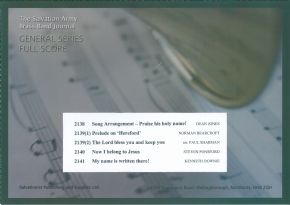
General Series Band Journal December 2014 Numbers 2138 - 2141
No. 2138 Song Arrangement - Praise his holy name! (Dean Jones)Dr Keith Hampton's song has been popular with choral groups for the best part of two decades. In this arrangement for band, Dean Jones has kept close to the original vocal version.No. 2139(1) Prelude on 'Hereford' (Norman Bearcroft)The beautiful tune of Hereford was written in 1872 by Samuel Sebastian Wesley and is often associated with the words of his grandfather, Charles Wesley; 'O thou who camest from above'.No. 2139(2) The Lord bless you and keep you (arr. Paul Sharman)Nik and Emma Pears have written this lovely setting of familiar words, which has been arranged as a benediction for band by Paul Sharman.No. 2140 Now I belong to Jesus (Steven Ponsford)This beautiful, descriptive arrangement of the well-loved song has an imaginatively extended ending, with long notes and rich harmonies, to give the impression of time stretching out into eternity.No. 2141 My name is written there! (Kenneth Downie)This setting of General Albert Orsborn's lovely song was inspired by a Corps retreat based on the theme 'The Calvary track'. The music provides a fitting commentary on the lyrics of the song.
Estimated dispatch 7-14 working days
 View Music