
Results
-
£29.95
JUST LIKE HIM (Cornet Solo with Brass Band Set) - Terry Camsey
This solo was written at the request of David Daws and The International Staff Band. David liked the solo 'Kim' by Allan Street and wanted a solo in similar style. It requires musicianship beyond mere technique and calls for keen interpretive skills. Built around 'He giveth more grace' and an arrangement of 'There is a name I love to hear', there is plenty of scope, in a variety of styles, for the soloist's artistry to show through.
Estimated dispatch 7-14 working days
-
£29.95
BEFORE THE CROSS (Cornet Solo with Brass Band Set) - Edward Gregson
Written at the request of David Daws for his solo album The Sound of David Daws, this meditation for cornet and brass band uses the composer's own song Before the cross (originally published in The Musical Salvationist, April 1965), the first lines of which are Before the cross I stand in fear and wonder, and see that all my sirs on Thee are laid. The song was written at an early stage of the composer's career, just before commencing study at The Royal Academy of Music, London. After a brief introduction the melody is heard twice, first played by the soloist, then on Euphonium and Flugel Horn with the soloist adding ornate counterpoint before taking up the melody once again, this time leading to a quiet and reflective conclusion.
Estimated dispatch 7-14 working days
-
 £25.00
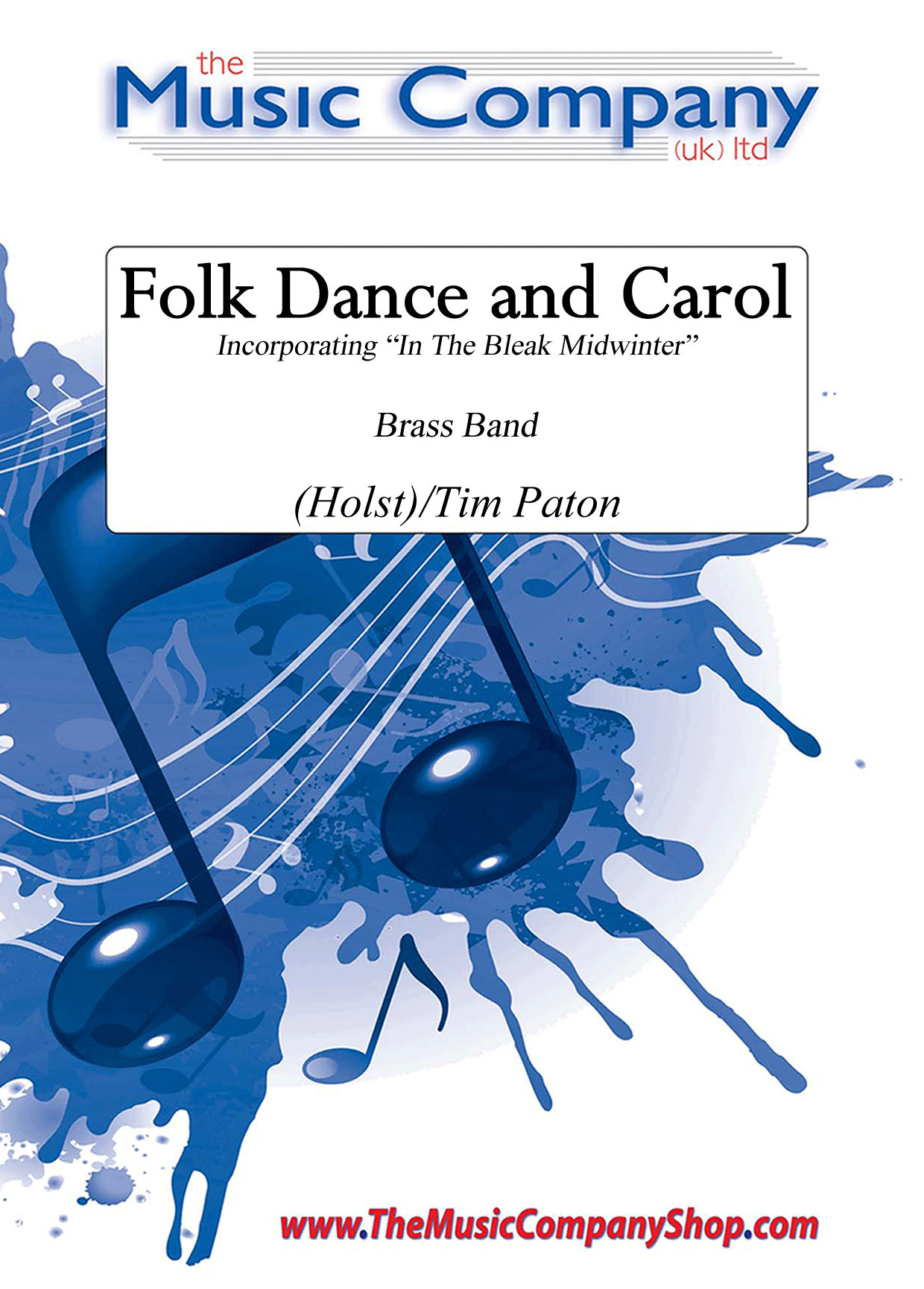
Folk Dance and Carol (brass band) - Tim Paton
A festive, musical cocktail by Tim Paton for brass band, bringing together a folk-feel dance motif and a familiar carol, to create the atmosphere of a village celebration.Opening with a lively Jig, where the music joyfully dances around the band, the piece then settles to offer the tranquility of Gustav Holst's beautiful melody In the Bleak Mid-Winter.This peacefulness is soon overtaken by the reintroduction of the dance motif, finishing off the musical celebration with the dance and the carol mingling together.A very nice addition to Christmas repertoire, presenting a little bit of tradition amidst some lovely, imaginative scoring.Also available for concert band.
In Stock: Estimated dispatch 3-5 working days
-
 £22.22
A Joyous Fanfare (Brass Band) Andrew Wainwright
A Joyous Fanfare is a short majestic concert prelude that captures the essence of celebration and festive spirit. Derived from the original Fanfare of Joy, commissioned by the Burbage Band (Buxton) and conductor Steven Critchlow in 2017, this piece takes inspiration from the beloved carol Joy to the World. Duration: 1.20 minutes Difficulty Level: 3rd Section + This PDF download includes the full score and parts. Sheet music available at www.brassband.co.uk (UK) or www.cimarronmusic.com (USA) Instrumentation: Soprano Cornet Eb Solo Cornet 1&2 Bb Solo Cornet 3&4 Bb Repiano Cornet Bb 2nd Cornet Bb 3rd Cornet Bb Flugel Horn Bb Solo Horn Eb 1st Horn Eb 2nd Horn Eb 1st Baritone Bb 2nd Baritone Bb 1st Trombone Bb 2nd Trombone Bb Bass Trombone Euphonium Bb Bass Eb Bass Bb Timpani Snare Cymbals
In Stock: Estimated dispatch 1-3 working days
-
 £33.33
All Your Anxiety (Brass Band) Edward Joy arr. Jonathan Rowsell
All Your Anxiety is a reflective and expressive work for brass band inspired by Edward Joy's sacred song of the same name. Drawing deeply from the hymn's text and message, the piece explores the tension between human unease and the promise of peace found in faith. The work opens with a distinctive eighth-note figure in the euphonium that immediately establishes an unsettled character. Wide intervallic leaps and atypical slur groupings evoke a sense of fragility and uncertainty, musically portraying the weight of sorrow and care described in the opening verse of the hymn. This motivic material becomes the foundation of the entire arrangement, reappearing in varied forms as counter-melody, accompaniment, and featured solo lines across the ensemble. As the piece unfolds, the music gradually broadens and warms, reflecting the invitation of the text to "come to the cross" and leave one's burdens behind. Moments of lyricism and calm contrast with the earlier unease, leading toward a more settled and hopeful conclusion that mirrors the refrain's assurance: "Never a burden He cannot bear, never a friend like Jesus." To view a video of the Canadian Staff Band playing the piece please visit https://www.youtube.com/watch?v=5Ms8ubug4yA Sheet music available from www.brassband.co.uk or www.satradecentral.org Difficulty Level: 3rd Section + Length: 3.30 minutes Instrumentation: Soprano Cornet Eb Solo Cornet Bb 1st Cornet Bb 2nd Cornet Bb Flugel Horn Bb Solo Horn Eb 1st Horn Eb 2nd Horn Eb 1st Baritone Bb 2nd Baritone Bb 1st Trombone Bb 2nd Trombone Bb Bass Trombone Euphonium Bb Bass Eb Bass Bb Timpani Percussion
In Stock: Estimated dispatch 1-3 working days
-
 £33.35
Away in a Manger (Brass Band) Murray arr. Fendall Hill
This unique arrangement by Fendall Hill of Away in a Manger brings together two beloved melodies of the cherished Christmas carol, seamlessly intertwining the popular American setting known as "Mueller" with the gentle strains of "Cradle Song", the tune favoured across Britain, Ireland, and the British Commonwealth. First introduced to American audiences by James R. Murray in Dainty Songs for Little Lads and Lasses (1887), the Mueller melody - often mistakenly attributed to Martin Luther - has become the most recognised version of the carol in the United States. Complementing this is the lyrical Cradle Song, composed by William J. Kirkpatrick and published in Around the World with Christmas (1895), offering a tender counterpoint to Murray's setting. To view a rolling score video featuring Sovereign Brass's CD recording please visit: www.youtube.com/watch?v=58r_xRY7OM0 Difficulty Level: 4th Section + PDF download includes parts and score. Sheet music available at www.brassband.co.uk (UK) or www.cimarronmusic.com (USA) Instrumentation: Soprano Cornet Eb Solo Cornet Bb Repiano Cornet Bb 2nd Cornet Bb 3rd Cornet Bb Flugel Horn Bb Solo Horn Eb 1st Horn Eb 2nd Horn Eb 1st Baritone Bb 2nd Baritone Bb 1st Trombone Bb 2nd Trombone Bb Bass Trombone Euphonium Bb Bass Eb Bass Bb Timpani Percussion 1-3
In Stock: Estimated dispatch 1-3 working days
-
 £11.11
Be Thou My Vision (Brass Band - Additional Parts) Trad. arr. Andrew Wainwright
A highly evocative arrangement of the popular hymn, also known as Slane. The arranger Andrew Wainwright responds to the ethereal quality of the tune with an exquisite layering of texture. The three-verse setting grows to a glorious climax on the final verse, before dying away to a serene ending. The arrangement was commissioned by the Nebraska Brass Band and its Musical Director Glenn Greet. To view a video of Dallas Brass Band performing the work please visit www.youtube.com/watch?v=mUyDYnOkXuE Sheet music available from: UK - www.brassband.co.uk USA - www.solidbrassmusic.com Difficulty Level: 4th Section + Parts included in this download: Solo Horn F 1st Horn F 2nd Horn F 1st Baritone Bass Clef 2nd Baritone Bass Clef 1st Trombone Bass Clef 2nd Trombone Bass Clef Euphonium Bass Clef Tuba Bass Clef (Bass Eb Part) Tuba Bass Clef (Bass Bb Part) The full brass band set with traditional instrumentation is available here.
In Stock: Estimated dispatch 1-3 working days
-
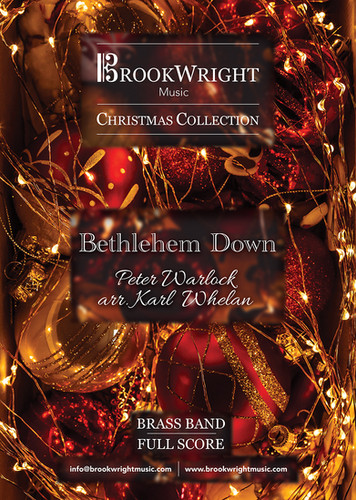 £33.33
Bethlehem Down (Brass Band) Peter Warlock arr. Karl Whelan
Originally composed in 1927 by Peter Warlock with a hauntingly beautiful text by Bruce Blunt, Bethlehem Down is a Christmas carol unlike any other - serene, contemplative, and deeply moving. Written under unconventional circumstances (as an entry in a newspaper competition to fund a festive drinking session), the carol has become a timeless masterpiece of English choral music, celebrated for its emotional depth and harmonic subtlety. This brass band arrangement by Karl Whelan captures the quiet intensity and modal richness of Warlock's original, thoughtfully adapted for the warm, lyrical textures of a full brass ensemble. Flowing inner lines, gentle dissonances, and soft dynamics are carefully preserved, allowing the ensemble to explore a wide expressive range while maintaining the dignity and introspective tone of the piece. Ideal for concerts, church services, or as a moment of reflection within a festive programme, Bethlehem Down offers a powerful contrast to more jubilant seasonal works. A compelling choice for bands seeking a more intimate and profound interpretation of the Christmas story. To view a rolling score video of the work please visit https://www.youtube.com/watch?v=hN4-DBtsSpc Duration: approx. 4.00 minutes Difficulty Level: 3rd Section + PDF download includes parts and score. Sheet music available at www.brassband.co.uk (UK) or www.cimarronmusic.com (USA) Instrumentation: Soprano Cornet Eb Solo Cornet Bb Repiano Cornet Bb 2nd Cornet Bb 3rd Cornet Bb Flugel Horn Bb Solo Horn Eb 1st Horn Eb 2nd Horn Eb 1st Baritone Bb 2nd Baritone Bb 1st Trombone Bb 2nd Trombone Bb Bass Trombone Euphonium Bb Bass Eb Bass Bb Timpani Percussion 1-2
In Stock: Estimated dispatch 1-3 working days
-
 £33.35
Excursion (Brass Band) Christopher Cook
Excursion was the winner of the 2022 BrookWright International Brass Band Composition Competition. The composer Christopher Cook writes: 'In this short and effervescent study for brass band, I wanted to take the listener and players on a journey which moves from a soundworld of bristling, bubbling energy to a triumphant fanfare and finally a moment of repose. The initial fast flurry of notes, highlighted and emphasised by precise elements of percussion, informs the motivic development of the rest of the piece and eventually forms the basis for the textural backdrop to the filmic sounding melody heard around halfway through the piece. The unexpected final passage is intended to be a nod to works for brass band by Paul Patterson and Harrison Birtwistle.' To view a rolling score video of the piece performed by the Royal Northern College of Music (RNCM) Brass Band please visit www.youtube.com/watch?v=rSCrQIv_W2k PDF download includes score and parts. Sheet music available from www.brassband.co.uk Difficulty Level: 1st Section + Instrumentation: Soprano Cornet Eb Solo Cornet Bb Repiano Cornet Bb 2nd Cornet Bb 3rd Cornet Bb Flugel Horn Bb Solo Horn Eb 1st Horn Eb 2nd Horn Eb 1st Baritone Bb 2nd Baritone Bb 1st Trombone Bb 2nd Trombone Bb Bass Trombone Euphonium Bb Bass Eb Bass Bb Timpani Percussion 1-3
In Stock: Estimated dispatch 1-3 working days
-
 £33.33
Hope (Brass Band) Nathanael Watchorn
Hope is a deeply reflective and uplifting work for brass band, shaped by themes of serenity, renewal, and spiritual hope. Composer Nathanael Watchorn revisits a melody and harmonic framework originally conceived for an unrealised project - material that, even at its inception, carried the gentle strength and stillness of a benedictory chorus. Sensing its innate sense of calm and assurance, Watchorn sought to give the music new life through words that would illuminate its emotional core. Those words came from his father, Major Julian Watchorn, whose poetic text - titled Benediction: The Hope of Christ - speaks of grace, love, joy, and the sustaining power found in Christ. The verses provide a clear spiritual lens through which conductors, performers, and listeners alike can experience the music. Whether heard as a musical benediction or a stand-alone concert work, Hope provides a meaningful and deeply moving moment of stillness amid the noise of modern life. To view a video of Regent Hall Band performing the work please visit www.youtube.com/watch?v=489X1cwPYi0&list=RD489X1cwPYi0&start_radio=1 Duration: approx. 3.00 minutes Difficulty Level: 3rd Section + This PDF download includes parts and score. Sheet music available at www.brassband.co.uk (UK) or www.cimarronmusic.com (USA) Instrumentation: Soprano Cornet Eb Solo Cornet Bb 1st Cornet Bb 2nd Cornet Bb Flugel Horn Bb Solo Horn Eb 1st Horn Eb 2nd Horn Eb 1st Baritone Bb 2nd Baritone Bb 1st Trombone Bb 2nd Trombone Bb Bass Trombone Euphonium Bb Bass Eb Bass Bb Timpani Percussion 1-2
In Stock: Estimated dispatch 1-3 working days
 Watch video