
Results
-
 £109.99
Nordic Moods - Tom Brevik
The composer:1st movement: Reflections by the Fjord.Overlooking one of the mighty fjords of Norway, my mind and thoughts are with an old religious Norwegian folk-tune, with words by the famous parson Peter Dass.The majestic fanfare-likeopening reflects the power of God our Father, the choral itself heard for the first time on flugelhorn. The choral is repeated a few times, separated only by some short variations. The movement ends in thriumph, with fanfares and the choral broughttogether.2nd movement: Reflections in the Old Church.In this movement my associations of a summer day, finding myself alone in an old deserted stone church. From the old walls I hear folk songs, perhaps like the ones sung in the church bypoor fishermen and farmers in days gone by. Suddenly the light from the sun breakes through the small circular window above the altar, and a lovely melody is heard, before the original figures take us to the end of the movement.3rd movement:Festive Reflections.Any festive occasion can be reflected in this movement. from the bonfire at midsummer-night to the children celebrating the return of the sun in the northern part of Norway. from the traditional sleigh-riding at Christmas tothe Celebrations of the National Day on the 17th of May each year.
Estimated dispatch 5-14 working days
-
 £104.99
Kefas - Rob Goorhuis
The composition Kefas was written for the brass band 'Apollo' from Grou (The Netherlands), by order of the Unisono Foundation, the organisation for wind music in The Netherlands.The assignment was given on account of earning the Champions Title during the Dutch Brass Band Championships in the year 2001 (4th division). The theme of the composition links the tradition of the village Grou, not to celebrate Sint Nicolaas but Sint Pieter.By this typical Dutch festivity (in December) the holy Nicolaas gives presents to the children. It is a popular custom where young and old participate. Grou is the only place where this is not done by Sint Nicolaas but by Sint Pieter.Apart from that, on the 22th of Februari, a lot of festivities that take place,resemble those of the Sinterklaas celebration. In the composition two Sint Pieter songs are processed, set through bible scenes, wherein in among others the visit of Christ to the house of Peter's Mother-in-law and the calling of Peter are depicted. The title refers to the pronouncement of Christ, where he named Peter the rock on which he shall build his church. The Hebrew word for rock is Kephas. Kefas was premiered in 2003.
Estimated dispatch 5-14 working days
-
 £109.99
Columbus - Rob Goorhuis
Christopher Columbus was born in Genoa in 1451. His father was a wool merchant. Originally he seemed destined to follow in his father's footsteps, and thus sailed the oceans to countries as far apart as Iceland and Guinea. In 1476 his ship was sunk during a battle off the coast of Portugal. Columbus saved his own life by swimming to shore. In 1484 he conceived the idea of sailing to the Indies via a westward sea route, but it was only in 1492 that he was able to realize this plan. On this first voyage he was in command of three ships: the flag-ship, called the Santa Maria, the Pinta, and the Ni?a. From Spain Columbus sailed via the Canary Islands to the Bahamas, whichhe sighted on October 12th 1492. Without being aware of it Columbus discovered the 'New World' he thought he had landed in the eastern part of Asia. The motif from Dvooak's 9th Symphony 'Aus der neuen Welt' forms a little counterfeit history at this point in the composition. After this first voyage Columbus was to undertake another three long voyages to America. These voyages were certainly not entirely devoid of misfortune. More than once he was faced with shipwreck, mutiny and the destruction of settlements he had founded. After Columbus had left for Spain from Rio Belen in 1503, he beached his ships on the coast of Jamaica. The crew were marooned there and it was only after a year that Columbus succeeded in saving his men and sailing back to Spain with them. In the music the misunderstanding about which continent Columbus discovered in his lifetime resounds, for does this part in the composition not contain Asiatic motifs? Poor Columbus! In 1506 the famous explorer died in Valladolid.
Estimated dispatch 5-14 working days
-
 £67.50
Columbus - Thierry Deleruyelle
Columbus is a brilliant and dynamic overture for brass band, with a soft and melodious central passage. In addition to the many American towns that hold the name, Columbus is a European space laboratory that is part of the International Space Station. Launched in 2008 by the American space shuttle Atlantis, it makes it possible to carry out continuous scientific experiments in fundamental physics, life sciences, fluid physics, etc. Several hundred experiments take place within Columbus every year. Commissioned by the Brass Band Bourgueillois, this piece celebrates the 10th anniversary of the launch of the band at the instigation of its conductor, Michael Auclert. The ensemble brings together musicians from the various wind bands of the Bourgueillois region and beyond. Thus, just like the space laboratory that inspired this work, the Brass Band Bourgueillois also serves as a laboratory, albeit a musical one, within a territory that is discovering this ensemble and its original repertoire.
Estimated dispatch 5-14 working days
-
 £72.99
English Dances, Set 1, Op. 27: No. 1 - Sir Malcolm Arnold - Ray Farr
English Dances, Set I, opus 27, is a light classic composition that was written for orchestra by the British composer Malcolm Arnold in 1950. The set contains four dances that continue without pause: the individual movements are indicated by the tempo markings. The work came about at the request of Bernard de Nevers, at the time the head of publisher Alfred Lengnick & Co., who asked Arnold to write a suite of dances as an English counterpart to Dvo ak's Slavonic Dances and Bartok's Romanian Folk Dances. The premiere took place in the spring of 1951, played by the London Philharmonic Orchestra, conducted by Sir Adrian Boult. Following the success of the first set, DeNevers asked the composer to write a second one, which Arnold completed the next year (Op. 33). The Andantino from the first set has been skilfully arranged and orchestrated for brass band by Ray Farr.
Estimated dispatch 5-14 working days
-
£60.99
Aurora Borealis - Morten J. Wallin
Aurora Borealis, more popularly known as the Northern Lights, was a source of superstition in the Middle Ages. This dazzling spectacle, which is accompanied by whispering sounds, put the fear of God into those who didn't know that this was simply one of nature's grand shows. Many heathen attributed the phenomenon to the incomprehensible ways of the gods. Today we know better. Every 11 years, the amount of particles emitted by the sun is at its highest level, as is the case this year. These particles are hurled away from the sun, beyond its magnetic field. A small percentage of these particles are able to penetrate the earth's atmosphere. Once they are here, they begin tocollide and form the beautiful patterns in the night sky which we call the Aurora Borealis.
Estimated dispatch 5-14 working days
-
£42.50
Martini - Jacob de Haan
This swinging march by Jacob de Haan was commissioned by the foundation "Vrienden van de Groningse Politie-muziek" (Friends of the Police Music of Groningen), on occasion of the 950 year anniversary of the "Martini-city" Groningen. The trio in this piece features the anthem of the province of Groningen.
Estimated dispatch 5-14 working days
-
 £129.99
Genetic Code - Thomas Doss
The source of inspiration for this composition was the so-called 'genetic code'. Something which is universal, as almost all organisms on our planet use the same code for their genetic information and therefore speak the same 'language', as it were. The fact that plants, animals, and humans are all subject to the universality of this code fascinates the composer time and time again. Thus, he has chosen a musical motif for this phenomenon, which has been woven through the various musical passages of this work like a genetic thread.Genetic Code was commissioned by the Swiss Brass Band Association to celebrate the 50th anniversary of the Swiss Brass Band Championships, in 2025, and to be the compulsory piece in the Excellence Division that same year.
Estimated dispatch 5-14 working days
-
 £105.00
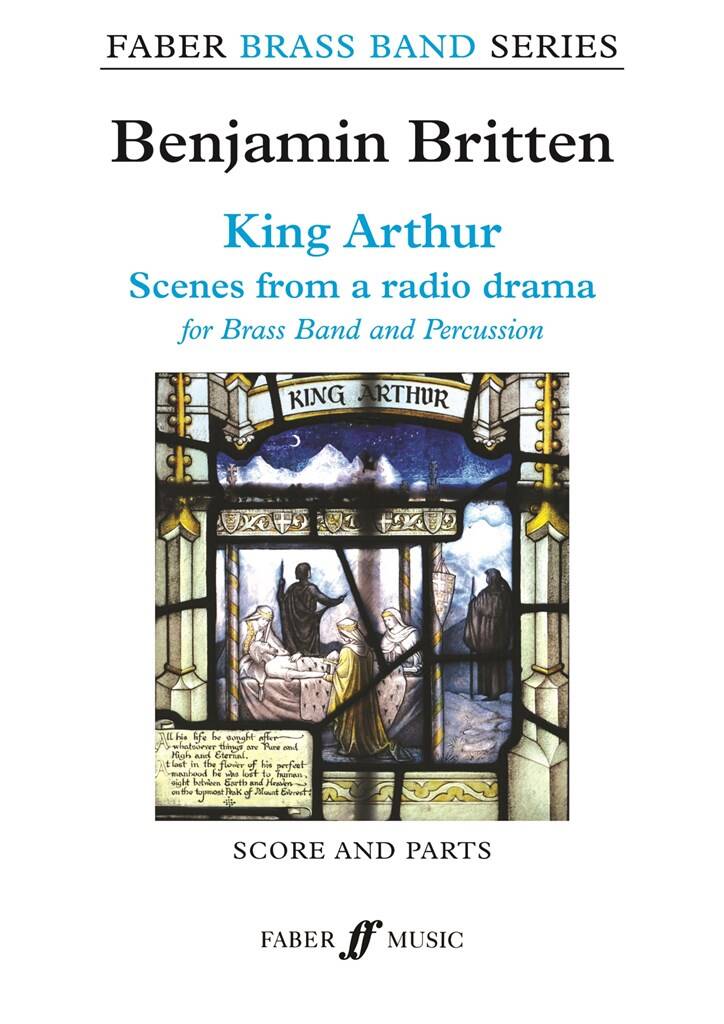
King Arthur - Benjamin Britten
King Arthur was the first of 28 scores Benjamin Britten (1913-1976) composed for radio between 1937 and 1947. It was an ambitious dramatisation of King Arthur's life and times - part pageant, part play, partcantata - written by D.G. Bridson. This colourful suite incorporates the Introduction, a dramatic Wild Dance, some of the music underscoring the scenes for Galahad and The Holy Grail, and two vividbattle scenes, ending with The Final Battle and Apotheosis. King Arthur (scenes from a radio drama) for brass band should not be confused with a much longer orchestral suite which Paul Hindmarsh devised from the same sourcein1995. King Arthur (scenes from a radio drama) will be played by the 20 First Section finalists on 16th September 2018 at this year's National Brass Band Championships of Great Britain.
Estimated dispatch 5-14 working days
-
 £60.99
Latin Dance Party - William Vean
In 'Latin Dance Party' William Vean takes us along to sunny, seemingly care-free places. Happy faces, catchy music, delicious drinks are images that come to mind when listening to this 'feel good' music which will either get you in a dreamy mood or make you want to step out onto the dance floor. To start we hear the first dance of Cuban origin 'Cha Cha Cha', cheerful, romantic, playful dance . The Cha Cha Cha is probably the most popular dance. Then we have the slower 'Bossa Nova' (new wave), a dance developed from the Samba rhythms with strong syncopation. We end with the 'Samba'. Samba is party. The samba is a mix of polka, Cuban habanera and Africanrhythms, born around 1910 in the slums of Rio de Janeiro, and every year the leading dance during the exuberant carnival.
Estimated dispatch 5-14 working days
 View Music