Searching for Wind Band Music? Visit the Wind Band Music Shop
We've found 118 matches for your search. Order by

Results

  • £127.30

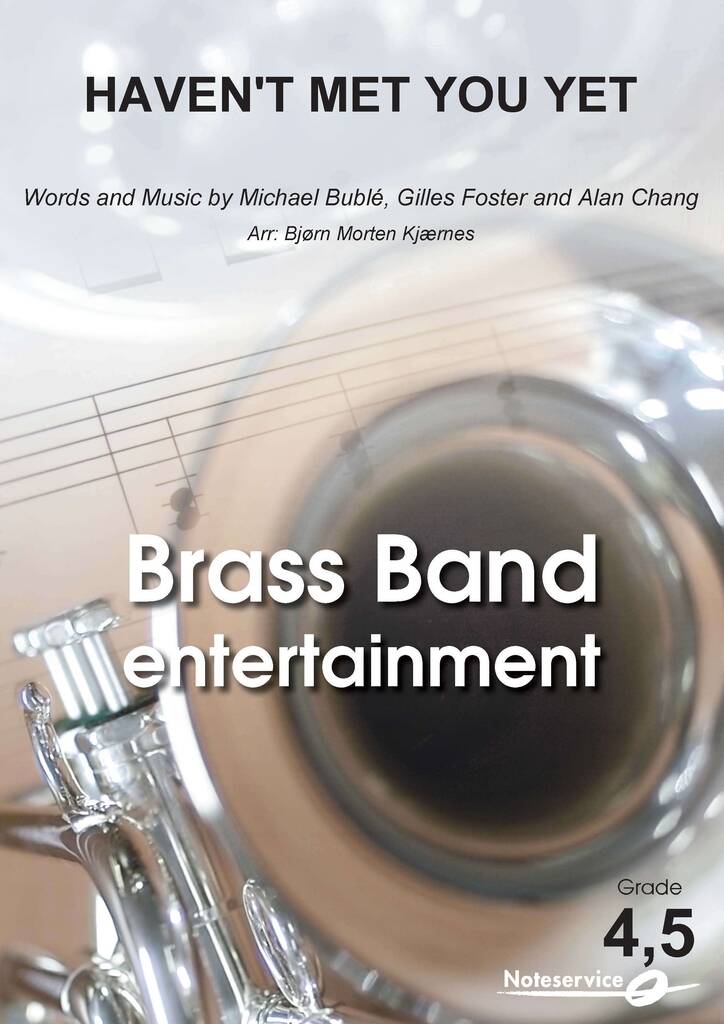
    Haven't Met You Yet - Michael Bublé - Bjørn Morten Kjærnes

    "Haven't Met You Yet" is the first single from Canadian singer Michael Buble's sixth album, Crazy Love, released on August 31, 2009. According to Buble, the single and its official music video are "about everyone's dream of finding a relationship and love." Buble co-wrote "Haven't Met You Yet" with Alan Chang and Amy Foster-Gillies and dedicated it to his then fiancee and now wife, Luisana Lopilato (who appears as his love interest in the music video).2012, Nick Jonas covered the song in the TV series Smash, so this music can also be used in a TV/Movie theme concert.Soloist options:Attached is a vocal lead that can be used with the arrangement. It is then recommended to dampen the melody in the ensemble, especially on the verses. (See list below)There are some performers or groups that can have these bars as solos:9-17 Flugelhorn17-24 Euphonium/Horn37-45 Euphonium45-52 Baritone/Trombone61-69 Horn/ Flugelhorn78-85 Euphonium/Baritone86-95 Flugelhorn107-end Flugelhorn/EuphoniumIf you want to use an instrumental soloist throughout the piece, they can use the vocal lead and transpose it to their instrument. Then the conductor should dampen or remove the above solos in the band.

    Estimated dispatch 5-14 working days
  • £60.99

    Stille Nacht - Franz Xaver Gruber - Jacob de Haan

    Jacob de Haan wrote this arrangement for concert band, fanfare band and brass band and optional male voice choir. The original carol was written by the Austrian composer and organist Franz Gruber (1787-1863). He was asked to write Silent Night) on the 24th of December 1818 by the priest of the Church of St. Nicolas in Oberndorf, who had himself written the text. It is a romantic carol, with nuances of contemporary Austrian folk and Italian pastorale music.

    Estimated dispatch 5-14 working days
  • £54.99

    Because We Believe - Andrea Bocelli - Wim Stalman

    This song was written by David Foster, who has also penned many previous hits which have been performed and recorded by such artists as Celine Dion, Lionel Richie, Madonna and Michael Buble. Because We Believe owes its fame to the performance by Andrea Bocelli during the closing ceremony of the Winter Olympics held in Torino during 2006. Finish any concert with this great anthem and your audience will leave with a great feeling of well-being!

    Estimated dispatch 5-14 working days

     PDF View Music

  • £60.99

    Real-Pop - Kees Vlak

    Real-Pop is an easy five movement suite, with each movement, all in contrasting pop styles, reflecting an aspect of the land of the rising sun - Japan. This entertaining new work is a must for all elementary bands who want to add something a little different to their concert programme.

    Estimated dispatch 5-14 working days

     PDF View Music

  • £45.00

    Andromeda - Dan Price

    Following the popularity of Dan's concert opener Starburst , this sequel provides yet another exciting addition to the concert repertoire, equally at home as a finale or as a concert opener. The work is dedicated to Samantha Harrison and Elland Youth Band, who gave the premiere performance as part of their 2019 European Youth Brass Band programme in Montreaux, Switzerland. Listen: Duration: 00:04:00 Grade: 3/3.5

    Estimated dispatch 5-7 working days

     MP3 Listen to MP3

  • £67.34

    Pyrenean Carol Suite (Brass Band) David Taylor

    This attractive suite for brass band by David Taylor features five traditional carols from the Pyrenees region of Spain, as follows: i. Nadal Tindaire (Jingling Christmas) - Occitan traditional This Occitan Christmas song tells of musical instruments used to celebrate the Nativity - 'fifes and trumpets, timpani and pipes, or you, clear little bells, along with the angels' choir.' ii. Gabriel's Message (Birjina Gaztetto Bat Zegoen) - Basque traditional The most widely-known of the chosen carols, honouring Jesus's mother Mary, this is often sung in its English version, but the melody came from the Basque country. The Basque words were adapted from the Mediaeval song Angelus ad Virginem. Here, we feature the flugel horn. This movement was originally written on its own, with organ accompaniment, for the composer's wife, Diane Scott. iii. El Noi de la Mare (The Child of the Mother) - Catalan traditional A beautiful Catalan carol celebrating the birth of Jesus, telling of the tasty gifts that the singer would bring - 'Raisins and figs and nuts and olives; Raisins and figs and honey and mato [a Catalan dessert cheese traditionally served with honey.]' Here we feature the euphonium. The tune was made famous by guitarist Andres Segovia, who used it as a favourite encore, and by John Rutter, who made a widely-used setting for choir. iv. Paure Satan (Poor Satan) - Occitan traditional This rather unusual carol tells of the pain that Satan is put to by the arrival of the infant Jesus. Its mocking and sarcastic tone is reflected here, where the tuba soloist (as Satan) is given musical trouble throughout by the other parts. At first they conflict with the soloist, then the soloist makes overtures of friendship, which are treated with suspicion followed by contempt. The soloist finally gives in to their accompaniment (or do they?). There are plenty of opportunities for little theatrical touches here, if the tuba player is so inclined! The tuba part in this movement is notably more difficult than the rest of the music, and a number of optional changes have been marked to make the part easier to play, if so desired. The player is also welcome to add suitable extra embellishments to taste if they wish, within the character of the music. v. Fum, Fum, Fum! - Catalan traditional A favourite Catalan Christmas song for centuries, this rousing melody provides a fitting way to round off the suite, with its repeated rhythmic refrain of the nonsense title phrase. It tells of the Nativity, and then it tells of the celebratory feasting and good times that the singers look forward to to honour it. Although the suite is intended to be performed whole, it is also intended for usage with a selection of movements on occasions where a shorter piece is wanted. Suggested formats include a single movement alone (2, 3, and 5 are likely most appropriate), a pair of movements (any of the first four, plus 5), and a suite of three or four movements (1 and 5, plus one or two of 2, 3, or 4 in the middle). It is suggested that a good way to design a 'pick-your-own-suite' from the movements is to think of the earlier movements as introductory to the final movement. To view a rolling score video featuring Kidlington Concert Brass please visit www.youtube.com/watch?v=QIGdul-yxxg PDF download includes score and parts. Sheet music available from: UK - www.brassband.co.uk USA - www.cimarronmusic.com Difficulty Level: 3rd Section + Length: 9.45 minutes Instrumentation: Soprano Cornet Eb Solo Cornet Bb Repiano Cornet Bb 2nd Cornet Bb 3rd Cornet Bb Flugel Horn Bb Solo Horn Eb 1st Horn Eb 2nd Horn Eb 1st Baritone Bb 2nd Baritone Bb 1st Trombone Bb 2nd Trombone Bb Bass Trombone Euphonium Bb Bass Eb Bass Bb Timpani Percussion 1-2

    In Stock: Estimated dispatch 1-3 working days
  • £120.00

    Rhapsody in Black (Bra) - Andi Cook

    The primary inspiration for this work comes from the composer's first encounter with the genre of Symphonic Metal - the opening track of the 2004 Nightwish album 'Once', entitled Dark chest of Wonders. The combination of full orchestra, operatically trained female vocals and the raw power of a Scandinavian metal band was a potent mix that instantly had me hooked.That same dark and powerful sound is one that a brass band can generate, and I've tried to capture that in this composition. Heavy Rock/Metal as a genre is arguably fifty years old now, but symphonic metal is a newer concept, and I feel possibly the one that can bridge the gap between two musical styles very dear to me.Composer Gilbert Vinter had explored through music the connotations that different colours held for him, and his movement Purple from 'Spectrum' gave me an idea for the structure of 'Rhapsody in Black'. Andi Cook explored the different connotations of one colour within his own life, black being an easy choice due to the personal dichotomy of the black leather jacket he wore to the rock club on Friday night and the black suit jacket and tie he wore to the concert hall the next day.To avoid repetition the word 'black' is omitted from the five movement titles, each of which is a different episode. '...as Thunder' is a furious argument between two people - the top and bottom of the band - set against the backdrop of a storm, with lightning flashing outside while barbs, insults, sarcasm, tears and even violence is traded inside. Following that '...Satin and Pearls' is an old black-and-white movie with a wistful character to it as if we're looking back a screen icon with fondness long after their career or even their life has ended. '...as the Raven's Wing.' is deliberately gothic and funereal, hinting at Edgar Allen Poe's similarly named poem, with undertones of death and afterlife. The shift into F/C Minor (band pitch) represents the descent - alive - into the grave that Poe had a paranoid fear of his entire life. Family and friends standing around grieving, oblivious as we're lowered into the earth despite frantic attempts to make ourselves heard. '...and Chrome' is an unashamed motorcycle reference with all its born-to-be-wild, open air, high speed and freedom overtones. In a deliberate contrast to what went before it continues several of the same motifs though this time in the major key. Lastly, we reprise the second movement with '...as the Night Sky' which is simply the feeling of walking home under the summer stars, with someone important - who that is, is left to the listener, but a walk under the stars is always that bit special.There's an old saying that very few things are black and white. I hope this work will prove that even black alone isn't quite as simple as it's often made out....'Rhapsody in Black' is dedicated to the composer's friend and mentor John Roberts, who shares his love of both brass and rock.

    Estimated dispatch 7-14 working days

     PDF View Music

  • £35.00

    strange geometry

    Descriptionstrange geometrywas commissioned by Morgan Griffiths and the Hammonds Saltaire Band for their performance at the Brass in Concert Championships of 2015.As a bit of a space/sci-fi geek, as well as a musician, two events during the summer of 2015 had a particular effect on me. The first was the tragic early death in a plane crash of the famous film composer James Horner. Horner's music, particularly in films like 'Star Trek II: The Wrath of Khan', 'Avatar', 'Apollo 13' and even his debut in Roger Corman's 1980 budget film 'Battle Beyond the Stars', defined for a generation the sound of sci-fi at the cinema. Along with John Williams he created the vocabulary for those who wish to express other-worldly wonder in music and his inventive talent will be much missed in an industry where originality has become something of a dirty word in recent years.The second event was the epic flyby of Pluto by the NASA New Horizons spacecraft. There are many reasons to find this mission inspiring - for example, the scientists and engineers behind it created a craft that has travelled at 37,000 mph for nine years and three billion miles to arrive within seventy-two seconds of the predicted time for the flyby. That they achieved this with such accuracy is an outstanding tribute to humanity's ingenuity and insatiable curiosity. However, the most exciting aspect of the mission was the clear, high resolution pictures of this unthinkably remote and inhospitable world beamed back to mission control. The best previous image of Pluto was an indistinct fuzzy blob - suddenly we could see mountains made of ice, glaciers of methane and carbon monoxide and nitrogen fog - features previously unimagined on a world thought to be a slightly dull ball of cold rock. The BBC's venerable astronomy programme 'The Sky at Night' waxed lyrical about these newly discovered features, referring to "the surprising discoveries of mountains and strange geometry on the surface of this cold distant world".I like to think that Horner would have been as inspired as I have been by this real-life science story, and this piece uses some of the vocabulary of the sci-fi movie soundtrack in a tribute to the memory of a great musician and to the inspirational geeks at NASA who have boldly taken us where no-one has gone before.Note: This work comes with a B4 portrait score. Listen to a preview and follow the music below!

    Estimated dispatch 7-14 working days
  • £95.00

    Variations on a Theme of Michael Tippett (Brass Band - Score and Parts) - Hindmarsh, Paul

    A Centenary Tribute by Michael Ball, Edward Gregson, Elgar Howarth, Bramwell Tovey and Philip WilbyThis unique 'pice d'occasion' arose out of a telephone conversation in 2004 with Alan Wycherley, who was the soprano cornet player of the Foden's Richardson Band at the time. He indicated that the band would like to include an original birthday tribute for Edward Gregson (60) and Elgar Howarth (70) in its concert at the 2005 RNCM Festival of Brass in Manchester. I have been Artistic Director of Manchester's Festival of Brass since it was established in 1990 as a BBC Radio 3 series, As the centenary of the birth of Sir Michael Tippett fell on 5 January 2005, I devised this collective work as a way of embracing all three anniversaries in a novel way.The idea of joint compositions is not a new one in the classical music world. In the 1860s, Verdi was joined by a number of his contemporaries in a Requiem Mass for Rossini. In this country there have been a number of orchestral examples over the past fifty years, but never before for the brass band. Although Tippett composed only one work for brass band, Festal Brass with Blues, his orchestral works and operas are full of idiomatic brass writing. The theme I chose for this celebration is one of Tippet's most memorable miniatures featuring wind and brass. In the opera Midsummer Marriage it marks the entry of the Ancients. It is also included in the orchestral Suite in D (1948), for the Birthday of Prince Charles.I invited five of the leading contemporary voices in brass band music to add their own creative perspectives to the little Tippett theme, with it's characteristic rhythms, embellishments and modality - the Lydian mode. Each contribution was designed to fit into a tonal and formal template to give the whole work a flow and continuity. In Danse des Amis, Bramwell Tovey has composed a jazzy, humorous variation. Inspiration came from Tippett's love of jazz and, more personally, from the characteristically syncopated gait of the distinguished music critic John Amis, who Tovey once observed leaving a performance of Tippett's opera King Priam before the end. Incidentally, that performance was conducted by Elgar Howarth.We hear Edward Gregson in lyrical mode. His Midsummer Song is redolent of the sound world of Tippett's opera A Midsummer Marriage and it ends with a brief reference to a favourite of Gregson's, Tippett's Concerto for Orchestra. Michael Ball provides a brief moment of light, airy activity bringing to mind perhaps Tippett's love of Shakespearian fantasy, especially The Tempest. Elgar Howarth juxtaposes a slowed down version of the processional theme with distant recollections of fanfares from King Priam. Philip Wilby has rounded the tribute off with a spectacular fugue. During its inexorable progress Wilby ingeniously introduces the two other birthday references - the three-note musical signature that Elgar Howarth includes in much of his music and the characteristic theme which begins Edward Gregson's substantial work for brass an organ The Trumpets of the Angels. An elaborated reprise of Tippett's little theme is followed by a dynamic coda.- Paul HindmarshDuration: 13.00

    Estimated dispatch 7-14 working days

     PDF View Music

  • £40.00

    Variations on a Theme of Michael Tippett (Brass Band - Score only) - Hindmarsh, Paul

    A Centenary Tribute by Michael Ball, Edward Gregson, Elgar Howarth, Bramwell Tovey and Philip WilbyThis unique 'pice d'occasion' arose out of a telephone conversation in 2004 with Alan Wycherley, who was the soprano cornet player of the Foden's Richardson Band at the time. He indicated that the band would like to include an original birthday tribute for Edward Gregson (60) and Elgar Howarth (70) in its concert at the 2005 RNCM Festival of Brass in Manchester. I have been Artistic Director of Manchester's Festival of Brass since it was established in 1990 as a BBC Radio 3 series, As the centenary of the birth of Sir Michael Tippett fell on 5 January 2005, I devised this collective work as a way of embracing all three anniversaries in a novel way.The idea of joint compositions is not a new one in the classical music world. In the 1860s, Verdi was joined by a number of his contemporaries in a Requiem Mass for Rossini. In this country there have been a number of orchestral examples over the past fifty years, but never before for the brass band. Although Tippett composed only one work for brass band, Festal Brass with Blues, his orchestral works and operas are full of idiomatic brass writing. The theme I chose for this celebration is one of Tippet's most memorable miniatures featuring wind and brass. In the opera Midsummer Marriage it marks the entry of the Ancients. It is also included in the orchestral Suite in D (1948), for the Birthday of Prince Charles.I invited five of the leading contemporary voices in brass band music to add their own creative perspectives to the little Tippett theme, with it's characteristic rhythms, embellishments and modality - the Lydian mode. Each contribution was designed to fit into a tonal and formal template to give the whole work a flow and continuity. In Danse des Amis, Bramwell Tovey has composed a jazzy, humorous variation. Inspiration came from Tippett's love of jazz and, more personally, from the characteristically syncopated gait of the distinguished music critic John Amis, who Tovey once observed leaving a performance of Tippett's opera King Priam before the end. Incidentally, that performance was conducted by Elgar Howarth.We hear Edward Gregson in lyrical mode. His Midsummer Song is redolent of the sound world of Tippett's opera A Midsummer Marriage and it ends with a brief reference to a favourite of Gregson's, Tippett's Concerto for Orchestra. Michael Ball provides a brief moment of light, airy activity bringing to mind perhaps Tippett's love of Shakespearian fantasy, especially The Tempest. Elgar Howarth juxtaposes a slowed down version of the processional theme with distant recollections of fanfares from King Priam. Philip Wilby has rounded the tribute off with a spectacular fugue. During its inexorable progress Wilby ingeniously introduces the two other birthday references - the three-note musical signature that Elgar Howarth includes in much of his music and the characteristic theme which begins Edward Gregson's substantial work for brass an organ The Trumpets of the Angels. An elaborated reprise of Tippett's little theme is followed by a dynamic coda.- Paul HindmarshDuration: 13.00

    Estimated dispatch 7-14 working days

     PDF View Music