
Results
-
 £76.99
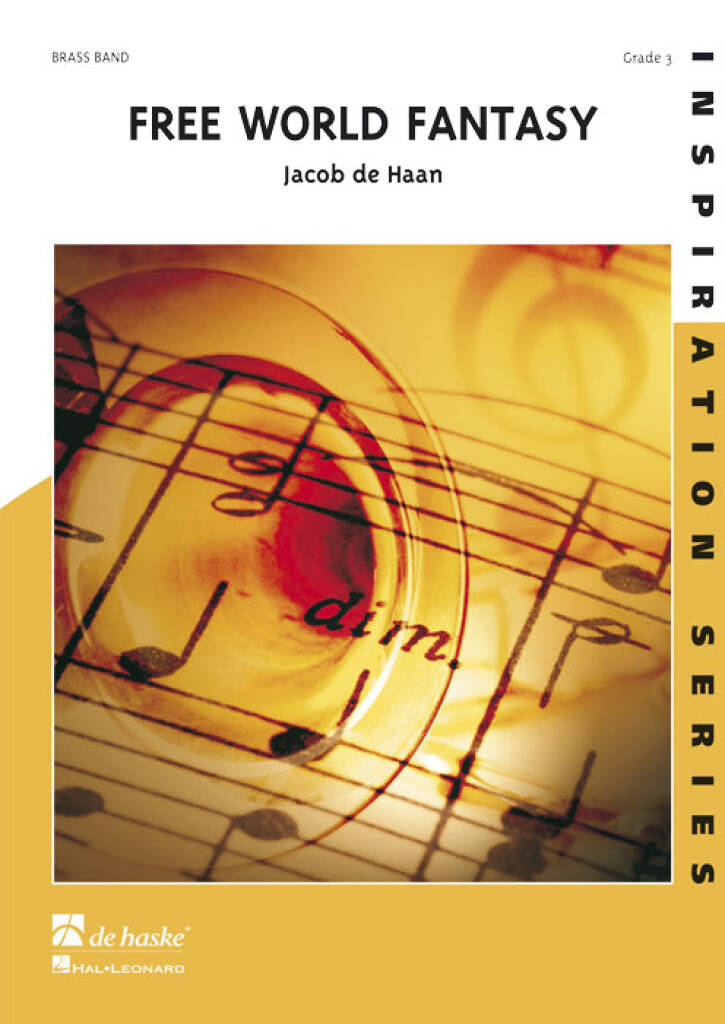
Free World Fantasy - Jacob de Haan
This piece was commissioned by the Dutch province of Groningen for the celebrations commemorating the liberation festivities in 1987. In the composition, the dream of a world without war is symbolized. It is the first composition in a series in which Jacob de Haan combines concert music with pop music in a style, which reminds one of film music. Later compositions in which he has reaped much success with the same formula in style are Oregon, La Storia and Utopia.
Estimated dispatch 5-14 working days
-
 £78.20
The Rocketeer - James Horner - Roland Smeets
Before Titanic,James Horner was not above composing scores for cartoonish family films, and many of those that brought him on their production board owe him greatly. The Rocketeer entails the story of a young pilot during World War II who happens upon a rocket pack that allows him to fly. The film is based on the tradition of old film serials that left theater-goers hanging with "To be continued," and aside from modern production, it is old fashioned and innocent fun. Horner's score begins and ends with the brilliant "Main Title," which is so moving it was used in previews for later films that did not yet have finished scores. Most of th Rocketeersoundtrack elicits the adventure and lifting spirit of the film and reveals how Horner incorporates rich instrumentals in the tiniest crevices. Even when the film involves danger, as in "Jenny's Rescue," the composer takes care when it is hardly even required. Instead of some "duh-duh-duhs," he brings on a full, stunning orchestra and when he overdoes it, it is in a jolly way -- he never exhausts his medium. That is what separates him from inferior composers, and what makes a nice film like The Rocketeer extra nice. It is a soundtrack worth listening to.
Estimated dispatch 5-14 working days
-
 £37.40
World War III (Brass Band) Joe Galuszka
This descriptive work for brass band by Joe Galuszka depicts the horrors of war. War is all around us. Every day, another life is lost. Myanmar, Sudan, Ethiopia, Ukraine, Colombia, Afghanistan, Somalia, Syria and Yemen. As time goes on, more and more countries are brought to the end of what is a diplomatic struggle - in where war seems to be the only option. 'War! Terror! Panic! captures the tumultuous and relentless nature of war. With driving rhythms, aggressive brass fanfares, and thundering percussion, the listener is immersed in the chaos of battle. Dissonance and clashing harmonies depict the discord that pervades war and takes us on a journey through the terror and panic that comes with the brutality of conflict. Remembrance (For Those That We Have Lost) provides a poignant and reflective interlude, allowing the audience to contemplate the human cost of war. Mournful melodies and expressive solos for trombone, euphonium and glockenspiel, convey the depth of sorrow and loss, serving as a powerful reminder of the toll war takes on individuals and communities. The final movement, Hymn for Peace and Hope is a testament to the enduring human spirit and the yearning for harmony - dissonance and conflict gradually give way to consonance and resolution. We celebrate the human capacity for unity and the triumph of peace over strife, as we imagine a world at piece. To listen to an audio demo of the work please visit https://on.soundcloud.com/Udt1AWRThgwuWnQv5 Duration: Approx. 5.00 mins Difficulty Level: 2nd Section + PDF download includes parts and score. Sheet music available from www.brassband.co.uk (UK) or www.cimarronmusic.com (USA) Instrumentation: Soprano Cornet Eb Solo Cornet Bb Repiano Cornet Bb 2nd Cornet Bb 3rd Cornet Bb Flugel Horn Bb Solo Horn Eb 1st Horn Eb 2nd Horn Eb 1st Baritone Bb 2nd Baritone Bb 1st Trombone Bb 2nd Trombone Bb Bass Trombone Euphonium Bb Bass Eb Bass Bb Timpani Percussion 1-3
In Stock: Estimated dispatch 1-3 working days
-
£44.00
Don't Sit Under the Apple Tree - Stept-Brown-Tobias - Bjorn Morten Kjaernes
"Don't Sit Under the Apple Tree (With Anyone Else but Me)" is a popular song that was made famous by Glenn Miller and by the Andrews Sisters during World War II. Its lyrics are the words of two young lovers who pledge their fidelity while one of them is away serving in the war. Originally titled "Anywhere the Bluebird Goes", the melody was written by Sam H. Stept as an updated version of the nineteenth-century English folk song "Long, Long Ago". Lew Brown and Charles Tobias wrote the lyrics and the song debuted in the 1939 Broadway musical Yokel Boy. After the United States entered the war in December 1941, Brown and Tobias modified the lyrics to their current form, with the chorus ending with "...'till I come marching home".In 1942 the song was featured in the film Private Buckaroo as a performance by the Andrews Sisters with the Harry James orchestra and featuring a tap dancing routine by The Jivin' Jacks and Jills. It was featured in the films Twelve O'Clock High (1949), With a Song in My Heart (1952), Kiss Them for Me (1957), A Carol for Another Christmas (1964), In Dreams (1999) and The Master (2012). It also featured in the mini-series The Pacific. You can use the song both on musical concerts, movie concerts or just as a happy jazz tune on your next concert. On the sections (like from bar 25), please work carefully to make a good balance with all parts, and that each chord is balanced. With 4-part harmonies sometimes you need to hold back certain notes to make the accord sound good. If you want to open up for a longer improvisation, you can repeat 65 to 81, but then change the part 2 in bar 80 from Eb to a D on the repeat. The accord will be an F6 instead of F7 (on beat 3 and 4 in bar 80) Have fun and enjoy!
Publisher Closed for Holidays. Est Delivery 13-14th Aug
-
 £79.95
Lost Village of Imber, The - Christopher Bond
The village of Imber on Salisbury Plain had been inhabited for over one thousand years when it was evacuated in 1943 to make way for military training in the Second World War. At the time, with preparations for the Allied invasion of Europe underway, most villagers put up no resistance, despite being upset, with the belief that they'd return once the war had concluded. To this day, Imber and its surrounding land remain a military training ground. The villagers never returned, and just the shell of what was once a community remains. Structured in three movements, it is on this very real story that the work is based, setting out the series of events of 1943 in chronological order. The first movement, On Imber Downe, portrays a sense of jollity and cohesiveness - a community of individuals living and working together before news of the evacuation had broken. Sounds of the village are heard throughout, not least in a series of percussive effects - the anvil of the blacksmith; the cowbell of the cattle and the bells of the church. The second movement, The Church of St. Giles, begins mysteriously and this sonorous, atmospheric opening depicts Imber in its desolate state and the apprehension of residents as they learn they have to leave their homes. Amidst this is the Church, a symbol of hope for villagers who one day wish to return, portrayed with a sweeping melodic passage before the music returns to the apprehension of villagers facing eviction around their sadness at losing their rural way of life. In complete contrast, the third movement, Imemerie Aeternum, portrays the arrival of the military, complete with the sounds of the ammunition, firing and tanks - sounds which were all too familiar to those living in the surround areas. To close, the Church of St. Giles theme returns in a triumphant style, representing the idea that the church has always been, even to this day, a beacon of hope for the villagers and local community - both the centrepiece and pinnacle of a very real story. The work was commissioned by Bratton Silver Band in celebration of the band's 160th Anniversary, with funding from the Arts Council National Lottery Project Grants Fund and the Brass Bands England Norman Jones Trust Fund.
Estimated dispatch 10-14 working days
-
 £44.95
Christmas Truce, The - Jonathan Bates
DURATION: 7'30". DIFFICULTY: 2nd Section+. 'The Christmas Truce' was composed in 2018 for the Strata Brass Band and was used as part of their Christmas programme to mark 100 years since the end of the First World War. On the 24th December 1914, just a few weeks after war broke out, one of the most notable events of the 4-year conflict took place on the front line as the guns from both sides fell silent and soldiers came together on Christmas Eve. This composition for brass band and narrator tells the story of that night, painting a musical picture of the events as they unfolded. Using material from the carols 'In The Bleak Midwinter', 'O Tannenbaum' and 'Silent Night', the music weaves it's way around the events leading upto, during, and directly following the Christmas Truce, before culminating in a grand finale which incorporates the famous "the souls of the righteous are in the hands of God" quote from Eric Ball's 'Resurgam'. . .
In Stock: Estimated dispatch 1-3 working days
-
 £41.14
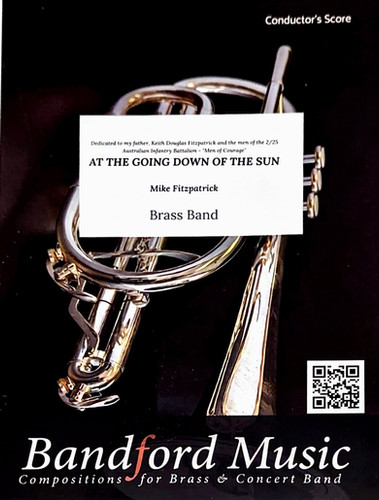
At the Going Down of the Sun (Brass Band) Mike Fitzpatrick
At The Going Down Of The Sun is a deeply moving musical tribute dedicated to the courage, resilience, and ultimate sacrifice of those who have defended the nation of Australia. Inspired by the heroic legacy of the 2/25th Battalion and their storied defense of the Kokoda Track during World War II, this composition serves as a solemn reminder of the immense gratitude owed to its fallen heroes. This piece is born from a legacy of service. It was composed in honor of Keith Fitzpatrick, who enlisted in the AIF on November 28, 1941. Keith served two tours in New Guinea, spending 359 days on the treacherous Kokoda Track. Keith Fitzpatrick lived to celebrate his 100th birthday in 2023, leaving behind a profound legacy through his wife of 67 years, Valda, and three generations of descendants. At The Going Down Of The Sun captures this spirit of endurance and devotion. It is an ideal addition to any program focused on: Anzac Day & Remembrance Day services Military Commemorations Historical Tributes To view a rolling score video of the work please visit www.youtube.com/watch?v=ydO9PKOKTpk Duration: 7.00 minutes Difficulty Level: 3rd Section + This PDF download includes the full score and parts. Sheet music available at www.brassband.co.uk (UK) or satradecentral.org (USA) Instrumentation: Soprano Cornet Eb Solo Cornet 1&2 Bb Solo Cornet 3&4 Bb Repiano Cornet Bb 2nd Cornet Bb 3rd Cornet Bb Flugel Horn Bb Solo Horn Eb 1st Horn Eb 2nd Horn Eb 1st Baritone Bb 2nd Baritone Bb 1st Trombone Bb 2nd Trombone Bb Bass Trombone Euphonium Bb Bass Eb Bass Bb Percussion Tubular Bells
In Stock: Estimated dispatch 1-3 working days
-
£29.95
ANTHEM OF THE FREE (Brass Band Set) - Dean Goffin
Prior to becoming a Salvation Army officer, Dean Goffin was the first Salvationist composer to gain a degree in music composition. This march was originally written for the 4th Brigade Band of the New Zealand Armed Forces (which Goffin conducted during World War Two) and called Bel Hamid before being adapted for Salvation Army use. The march contains the gospel song Ring the bells of heaven (...pealing forth the anthem of the free).
Estimated dispatch 7-14 working days
-
 £29.95
Heroes Of The Combat (Brass Band - Score and Parts) - Coles, Bramwell
Published two years after the end of World War Two, the title of this march projects a dual symbolism of which the composer was so fond, earlier examples being The Flag of Freedom and Victors Acclaimed. The introduction of this march is more extended and subsequent strains demonstrate a trait loved by both Coles and Marshall; the shifting between triple and duple subdivisions of the beat within attractive melodies and accompaniments.
Estimated dispatch 7-14 working days
-
£14.95
Heroes Of The Combat (Brass Band - Score only) - Coles, Bramwell
Published two years after the end of World War Two, the title of this march projects a dual symbolism of which the composer was so fond, earlier examples being The Flag of Freedom and Victors Acclaimed. The introduction of this march is more extended and subsequent strains demonstrate a trait loved by both Coles and Marshall; the shifting between triple and duple subdivisions of the beat within attractive melodies and accompaniments.
Estimated dispatch 7-14 working days
 View Music