
Results
-
£84.99
Utopia - Jacob de Haan
Utopia is the name of a book written by the English author Thomas More and was published in 1516. The title is a word thought up by More himself, after the Greek language, meaning "Nowhereland" and leading to the invention of the words utopian scheme and utopian. Utopia pictured an ideal state on an island far from the inhabited world. This idea was the basis of the composition. It makes one think of Oregon in variety of themes and style. Utopia also exists of a combination of styles that breathe the atmosphere of film music. However, Utopia sounds less American. The slow and stirring middle part for example is closer to the European romanticism: the chord signals in the brasssection remind of Wagner's music.
Estimated dispatch 5-14 working days
-
 £84.99
Pacific Dreams - Jacob de Haan
Pacific Dreams describes the experience of Miguel, a traveling composer from Spain who, feeling somewhat alienated from his homeland, is wandering through an area of Sydney known as The Rocks. At a small outdoor market in a typical street of this oldcolonial neighbourhood, he discovers a print of William DeShazos painting "Pacific Dreams" Portrayed in the painting is the surf of one of the exotic islands in the Pacific. Next, with the impressive Sydney Harbour Bridge looming over the narrowstreets of The Rocks, he envisions sultry Pacific beaches. Suddenly a theme he once composed about the lakes in Japan comes to him. Is it the Asian influences present in cosmopolitan Sydney that bring this theme to mind? Or perhaps the waters aroundSydney, over which he could sail to Tahiti? He is uncertain. Could this same theme be used to create a new composition about his feelings for the metropolis Sydney? How then to work his Pacific Dreams into the mix? Miguel is certainly no fan ofHawaiian music. Mayby he could use the vocabularies of islands like Hawaii and Tahiti, their beautiful vowel combinations being sung ad libitum by a mixed choir.With these ideas and his newly purchased print of "Pacific Dreams", he boards the Metroat Circular Quay. He has a final glimpse of the harbour and the Sydney Opera House as the train races into the ground. On to the hotel! To work! He must compose!Maestoso : Miguel is impressed as he gazes upon the Sydney Harbour Bridge. And yet, hewants to go away from this city. Away, to an exotic island in the Pacific.Steady Rock : In the Rocks, musicians are playing at a square. Miguel basks in the atmosphere but at the same time he is fantasizing about Hawaii and Tahiti.Andante Lamentoso :In his hotel room, Miguel is feeling sad and lonely in this big city. He takes comfort in his "Pacific Dreams".Allegro : Miguel boards the boat that takes him from Darling Harbour to Circular Quay. In his mind he is traveling on to Hawaii. Or is ithome, where the bolero is playing? He is pulled back to reality by the skyline of Sydney.
Estimated dispatch 5-14 working days
-
 £60.99
Minerva - Jan Van der Roost
Minerva by Jan Van der Roost was composed on the commission of the German "Musikverein Braunshausen" on the occasion of the 75th anniversary of the orchestra. The composition, first performed on September 17, 1999, is not a street march but a concert march, just like Mercury and Arsenal. The use and variation of different rhythmic patterns gives the first part of this march a distinctly dynamic character. Two main themes are presented in several instrumental combinations. The theme from the trio, on the other hand, is characterized by a broad melodic approach using large intervals. This theme, wreathed by high woodwinds, is heard one more time after a contrasting newpart, but now in a somewhat slower tempo. The counterpoint in this part refers to the first part of the march. The brilliant ending suits a festive anniversary march!
Estimated dispatch 5-14 working days
-
 £104.99
Cambridgeshire Impressions - Rieks van der Velde
In a four-part composition Rieks van der Velde takes us to the richly varied area surrounding the university city of Cambridge. The Dutch composer was especially inspired by the atmosphere of Cambridgeshire, the county which lies north ofLondon. 1. The Journey. Although on arrival the area looks peaceful and friendly, the ruggedness of its inhabitants and landscape have an unmistakable influence on the music. In the course of the tour, which starts with an Allegromovement, we are shown the vitality, energy and freshness of the Cambridgeshire countryside. Short themes, swift and sudden motifs and rhythmical patterns supported by the drive of percussion instruments give expression to this image. Thefirst part is concluded by two Calmo movements in which the music expresses how the cathedral in the city of Ely comes into sight and is gradually approached. 2. Visit to Ely Cathedral. The famous Norman cathedral church of Ely, whichwas built in 1109, has attracted tourists from all over the world apart from being a place of worship and heritage site. A cornet solo introduces the contemplative mood of the composition at this point. The mystical atmosphere of thecathedral runs through this lyrical part like a continuous thread. 3. The Pub. The thirst caused by this intensive journey makes a visit to the local pub a definite must. These "public houses", which may be open until the earlyhours of the morning, offer all kinds of entertainment. Drinks are served liberally and the atmosphere is lively. 4. The Journey Back. Time has flown: In other words, the moment of departure has come sooner than one would havewished. In a flashback which recaptures elements of the first part of the composition we say goodbye to Cambridgeshire in a fitting manner. Two scintillating final measures bring us abruptly back to the present.
Estimated dispatch 5-14 working days
-
 £69.99
Auld Lang Syne - Menno Haantjes
Whereas 'Auld Lang Syne' may be considered the best-known Scottish song ever, yet at the same time it is an obscure one, for there are but few people who know the complete text by heart. After the familiar 'Should auld acquaintance be forgot .....' many people take their refuge to lyrics like 'rum tee dum ta dee ..... lah, lah, lah ........... for auld lang syne'. Even in Scotland only a handful of persons know the entire text and are able to give a correct rendering of it. The current lyrics have been attributed to the Scottish poet Robert Burns. Burns, however, he did not write the whole poem : after he had heard an old man sing the centuries-old Scotchballad, he wrote it down and added a number of stanzas (1788). Historical research teaches us that the ballad served many purposes, both political and religious. Nowadays, 'Auld Lang Syne' is sung as a Christmas Carol and it is also sung on New Year's Eve at the turning of the year. Apart from that, though, the song is also sung on many other occasions sometimes with different lyrics, which usually have Love, Friendship and/or Parting as their themes, as these go well with the fascinating melody. In this arrangement a low-sounding solo instrument is central. The harmonization in the accompaniment fits in perfectly with the sentiments this song will evoke. Should auld acquaintance be forgot And never brought to mind? Should auld acquintance be forgot. And days of auld lang syne? For auld lang syne, my dear, For auld lang syne, We'll take a cup of kindness yet, For auld lang syne.
Estimated dispatch 5-14 working days
-
 £104.99
Scottish Dances - Peter Martin - Menno Haantjes
Scottish Dances is based on three Scottish traditionals: Cock of the North, The Bonnie Bank's O'Loch Lomond and Marie's Wedding. I. Cock of the North's name is used for multiple things or events. For example for a locomotive to a famous, it seems, delicious liqueur, and rallies to snowboard competitions. Furthermore is "Cock O' the North " a nickname of a famous Duke. (The 4th Duke of Gordon). In this composition Cock of the North (a Jig) is a traditional Scottish bagpipe tune, regularly played on tattoos by Pipe Bands. Not infrequently the drummers sing the text. Auntie Mary, had a canary, Up the leg of her trousers While she was sleeping Iwas peeping Up the leg of her trousers. II. " The Bonnie Bank's O'Loch Lomond " is about a sad story that took place during an revolt against the British. In 1745 Bonnie Prince Charlie had to retreat. Two of his men were captured. One was convicted and executed, while the other was released. The spirit of the executed soldier would arrive in Scotland via the 'low road' (underworld) before his companion, who had still a long way to go. You'll take the high road And I'll take the low road And I'll be in Scotland afore ye But me and my true love will never meet again On the Bonnie Bonnie Banks of Loch Lomond III. In a Scottish wedding, after the official ceremonies, there is often danced. This is called a ceilidh. For this we use traditional Scottish music such as "Marie's Wedding '. Mid dance we go back to the church, where a lovely song in honor of the couple sounds. Marie's Wedding has been recorded by Van Morrison (among many others). Step we gaely, on we go, heel for heel and toe for toe Arm and arm and on we go, all for Marie's wedding
Estimated dispatch 5-14 working days
-
 £74.99
Willow Pattern - Philip Harper
Composed in 2009 for Nicholas Childs and the Black Dyke BandThis piece tells the Willow Pattern legend through music. Several leitmotifs are used both for the different characters and also for some of the important emotions in the tale. Additionally, Knoon-se's part is mainly played by the flugel horn, Changby the euphonium, the Mandarin by the Eb Bass and the Duke Ta-jin by the trombone. The Willow Pattern LegendOnce, in ancient China, there lived a wealthy and powerful Mandarin who had a beautiful daughter, Knoon-se. She had fallen in love with Chang, a humble accountant, which angered her father who imprisoned her in the Pavilion by the river with only theexotic birds for company. She learnt that the Mandarin planned to marry her to the pompous Duke Ta-jin and that the wedding would take place on the day the blossom fell from the willow tree, so she sent Chang a message: "Gather thy blossom, ere it bestolen". The Duke arrived by sea amid great fanfare when the tree was heavy with bud, and nights of magnificent banquets followed. After one such occasion when the Mandarin slept, Chang crept over the crooked fence and tiptoed into the Pavilion to rescueKnoon-se, but as they escaped the alarm was raised. They fled over the bridge with the Mandarin close on their heels brandishing his whip.They managed to escape by boat to a secluded island where they lived happily for a time. Meanwhile, the Mandarin learned of their refuge and, intent on revenge, he ordered his soldiers to kill them. As Knoon-se and Chang slept at night, the men setfire to the pagoda in which they lived and the lovers perished in the flames. However, the Gods, moved by the lovers' plight, transformed their souls into two turtle-doves which rose from the charred remains, soaring above the Earth, symbolising eternal happiness. Willow Pattern is dedicated to the memory of Jean Harper who passed away as I was completing the piece and who was a great collector of porcelain and china-ware. NOTES ON PERFORMANCEMute Requirements:Metal mutes soprano cornet, repiano cornet, 2nd cornets, 3rd cornets (6 in total) Cup mutes all cornets and trombones (10 + 3) Harmon mutes soprano cornet, solo cornets, repiano cornet (6) Percussion Requirements:There are two parts for percussion on the score. The minimum requirements are as follows: 2 players - Timpani, 2 Large tom toms, 2 Wood Blocks, Triangle, Sleigh Bells, Whip, Clash Cymbals, Suspended Cymbal, Hi-hat, Glockenspiel, Xylophone, Tam tam (or susp. cym.) For performances with extra resources, and to achieve closer authenticity, the full requirements are as follows: 3 players - Timpani, 3 Taiko Drums played with thick wooden sticks (or Large tom toms), 2 Wood Blocks, Triangle, Chinese Bells (or Sleigh Bells), Whip, Clash Cymbals, Chinese Cymbals (small clash cymbals approx 12"), Suspended Cymbal, Glockenspiel,Xylophone, Tam tam
Estimated dispatch 5-14 working days
-
 £63.50
Spiral - Marc Jeanbourquin
Marc Jeanbourquin composed 'Spiral' during a music camp, for himself and 9 other fellow musicians. Due to the success of this piece, some years later, he has taken the main theme and developed it, with a kind of tribute to Camille Saint-Saens, one of his favourite composers. The constant changes between the minor and major keys, and between the often changing 2 and 3 feeling, with the occasional 2/4 bar thrown in, do not disrupt the flow of the piece in the slightest; in fact it is what has inspired the title. A percussion interlude, which is broken up by the unregularly occurring meter, brings the piece to a restatement of the original theme, which then ends in a large crescendo. Spiral is perfectly suited to either the opening or the close of any concert.
Estimated dispatch 5-14 working days
-
 £64.30
Zourfaroka - Marc Jeanbourquin
One morning everything went wrong in Zourfaroka. In this forest where thousands of magical beings live, everything sparkles and shines and is full of life. But not this morning, because the terrible troll Potugor has returned. This is the opening text for the musical fairy tale written by Lise Jeanbourquin and set to music by her husband Marc Jeanbourquin. The first part is a warlike setting, showing the preparations of Kirielo and the inhabitants of Zourfaroka for the battle with Potugor. On the way they meet the fairy Xeriole, and this meeting is put to music in the second part. The soloist's role in the first few bars is left to the choice of the conductor. And as in many fairy tales, with fairies, gnomes, and amazing magical creatures, the piece ends in the third part with everyone coming together in song and dance.
Estimated dispatch 5-14 working days
-
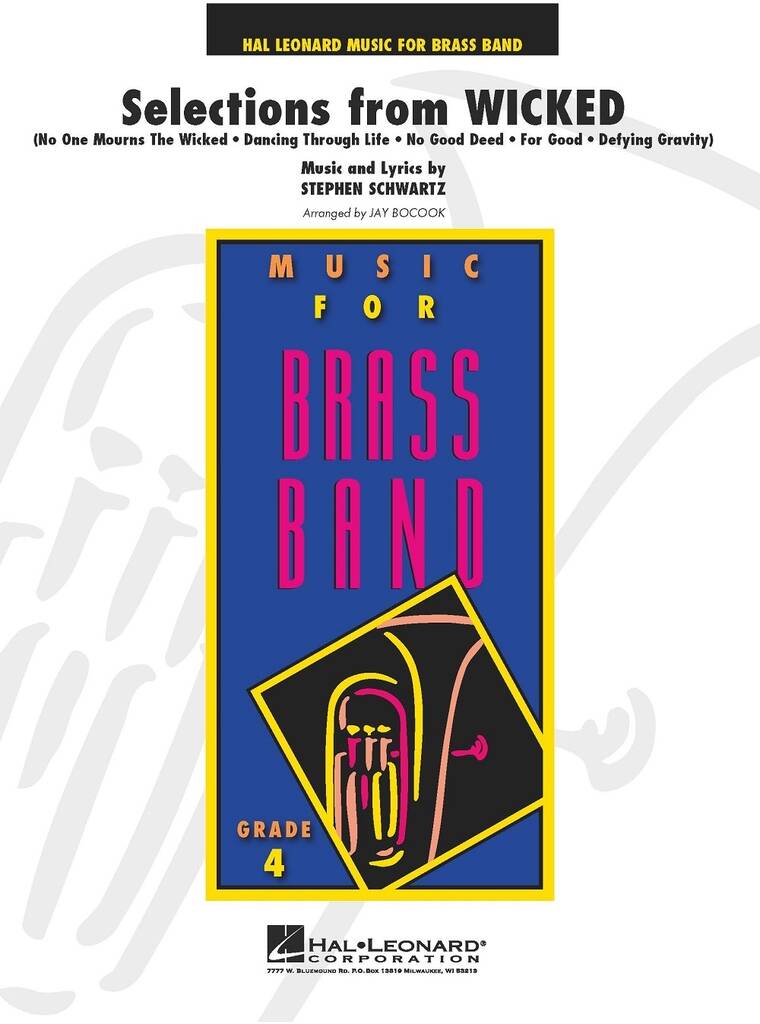 £68.99
Selections from Wicked - Jay Bocook
Rarely has a musical in modern times taken Broadway by storm the way this huge hit from Stephen Schwartz has done. The story line of the Wicked Witch of the West is intriguing and the music is filled with depth and beauty. This powerful medley includes No One Mourns The Wicked Dancing Through Life No Good Deed For Good Defying Gravity.
Estimated dispatch 5-14 working days
 View Music