
Results
-
 £30.00
There and Back - Martyn Brabbins
An original composition for brass band by Martyn Brabbins.This work was created by Brabbins early in his career and combines his creativity and passion for the sounds of brass bands . It is one of two compositions from that era (the other being Here and There) which have now been given a new lease of life and made available to the general public through The Music Company (UK) Ltd.A fast-paced and lyrical piece lasting just over 2 minutes. It's a piece which can work well across a concert programme - giving flourish as an opener and equally effective if placed between longer content.Available here for brass band and also available orchestral wind, brass & percussion.**Brass Band version for purchase/orchestral wind, brass and percussion version for hire only.Listen InFind out more about Martyn Brabbins, listen in to the fascinating podcast presented as part of the British Bandsman's On The Record series:Apple podcasts:apple.co/3ufSsfXSpotify:spoti.fi/3duqoj5Podbean:bit.ly/3k3B75h
In Stock: Estimated dispatch 3-5 working days
-
 £25.00
BA-Rock - Steve Robson
This can definitely be described as a fun piece from Steve Robson, with a bit of clever styling thrown in for good measure!With an initial, melodious theme written in the style of a 'Baroque' composition, it is then recreated in a modern 'Rock' idiom, joining the two extremes and presenting a great little number to brighten your concert programme.Whilst this already demonstrates one instance of its play on words, it's also worth noting that this composition also formed part of the writer's portfolio for his BA degree!Whilst written withfour percussion parts of Timpani, Kit, Tambourine, Glockenspiel & Cow Bell, the tambourine part can be omitted if necessary.
In Stock: Estimated dispatch 3-5 working days
-
 £30.00
Varushkin
Whilst at the RNCM, Thomas Pitfield asked me to write a set of variations on a Russian folk tune, (the same one used by Tchaikovsky in his Serenade for Strings). Pianist Heather Slade-Lipkin said that it sounded like it should be played by a band!! So here it is! A pretty tune, and a good programme filler."The variations are divided into two sections with an interconnecting bridge. Tim Paton subjects his theme to a number of transions, which includes a 'grand waltz' and comic effects". Rodney Newton
In Stock: Estimated dispatch 3-5 working days
-
 £30.00
Neruda - Johann Baptist Georg Neruda
Johann Baptist Georg Neruda was an 18th century Czech violinist and composer. Classical trumpet players include his Concerto in Eb for Trumpet & Strings as one of their favourite solos, which is often performed on an Eb Soprano Trumpet. My son Jon, a fine trumpet and cornet player, has played it often. Soprano Cornet player Simon Morgan asked me if it could be done with a brass band. I have taken the lively 1st movement, and adapted it as a soprano cornet solo. Ideal as a concert item, part of a CD, or part of an entertainment programme."Tim, many thanks for this, a great arrangement and a great solo". Simon Morgan
In Stock: Estimated dispatch 3-5 working days
-
 £105.20
Jyn Erso Theme - Michael Giacchino - Idar Torskangerpoll
After seven soundtracks written by John Williams for the Star Wars. the music for Rogue One A Star Wars Story is composed by Michael Giacchino. Giacchino is one of the leading composers of film music today with soundtracks for "The Incredibles", "Star Trek", Zootropolis", "Inside Out", and TV-series "Lost" as his greatest achievements. With his music to "Rogue One", Giacchino puts his own mark on the new Star Wars movie but with natural influences by "the master" himself John Williams.. Jyn Erso Theme portraits one of the new characters of the "Rogue One" movie. British actress Felicity Jones plays the role of Jyn Erso in "Rogue One"
Estimated dispatch 5-14 working days
-
 £85.00
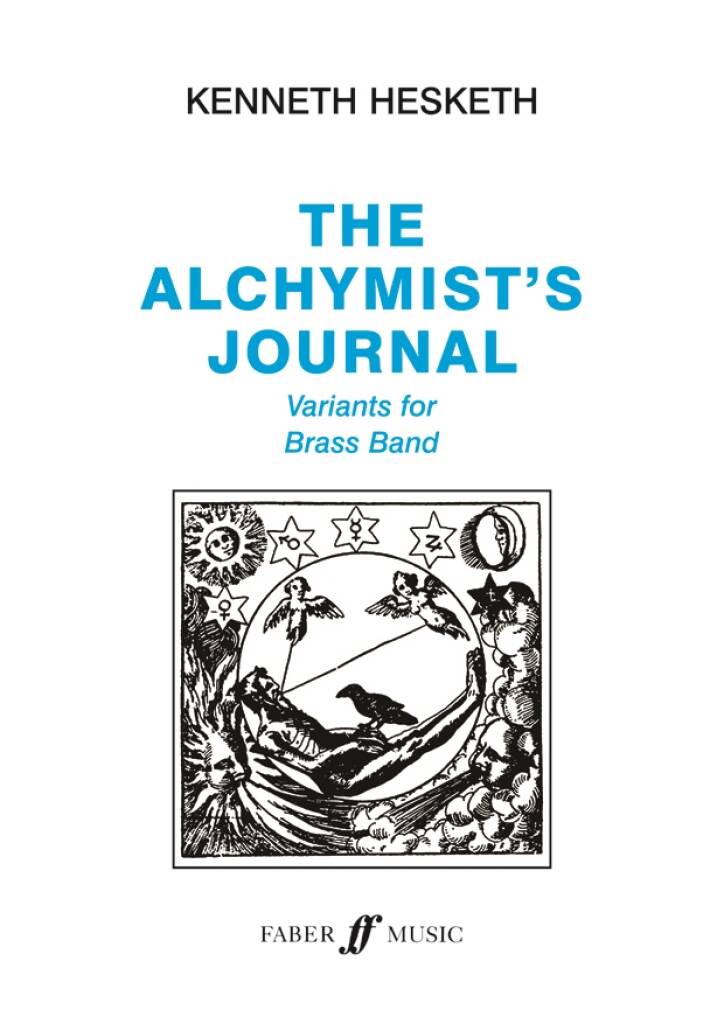
Alchymist's Journal. - Kenneth Hesketh
'The Alchymist's Journal' gets its title from the book of the same name by American author Evan S. Connell. The book fictionalises a number of famous Alchemist's writings, each one developing another's thoughts thuscontinuing one idea but changing it subtly to provide a new view point or way of thinking. This process is, in fact, alchemical as one idea transmutes into another. This idea is parallel to the processes at work within thesevariants. The whole work is constructed from 6 notes (C, A, B flat, E flat, F sharp, E) and is presented in nine different sections, each individual in mood but still based upon the original pitches. This is not a thematic setofvariations, as the themes are developed one at a time from small segments of the six notes. For example, the opening theme is the complete number of pitches, the second theme uses three notes transposed then repeated at theoriginal level, and so on. Harmonically, the six notes can be divided into two triads, A minor and E flat minor - each key beginning and ending the piece respectively. Whilst this is essentially abstract music with noprogramme there is an introduction, menacing scherzo, slow reflective section followed by a recap of the scherzo and final coda. 'The Alchymist's Journal' was commissioned by the Brass Band Heritage Trust at the suggestionof Paul Hindmarsh, to whom the work is dedicated.
Estimated dispatch 5-14 working days
-
 £76.99
Bread and Games - William Vean
'Panem et Circenses', Bread and Games were essential for keeping the citizens of ancient Rome in check. While the bread was meant for the poorest among the Romans, the Games were Popular Pastime Number One for everybody.There were different kinds of games, such as chariot races (especially popular with female spectators), or wild-beast fights, where lions, tigers, bulls or bears were set on one another or even on human beings. Most popular, however, were the Gladiator fights. In 'Bread and Games' William Vean depicts one of the many fights in the antique Colosseum. 1. Entrance of the Gladiators: By powerful bugle-calls the attention of the peoplewas asked for, after which the Gladiators entered the Arena at the sound of heroic marching-music.2.Swordfight: We can hear that the fights were not mere child's play in this part.On the contrary, they were a matter of life and death and were fought accordingly.3.Mercy of the Emperor: Sometimes a wounded gladiator could be fortunate, depending on the mercy of the audience. Waving one's handkerchief meant mercy, a turned-down thumb meant no pardon. The Emperor had the right to take the final decision, but he usually complied with the wish of the majority of the public. 4.Lap of Honour: Gladiators were mainly selected among slaves, convicted criminals, or prisoners of war. Consequently, winning was very important, as it would mean fame, honour and sometimes even wealth. A lap of honour, therefore, was the winner's due reward.
Estimated dispatch 5-14 working days
-
£104.99
Theme Park Fun! - Wilco Moerman
In Theme Park Fun! your orchestra pays a visit to an amusement park. During your visit, you will experience some spectacular rides and attractions this theme park offers. The uniqueness of Theme Park Fun! is the interplay between music and(moving) images. Animations and illustrations support the visual composition (downloadable after ordering a set, on www.gobelinmusic.com).Part 1: The Entrance & Parade [with animation]The opening of the park is a fact. A day fullof fun and pleasure awaits! You and the other visitors will be confronted with all the rides, attractions and adventures the theme park has to offer. Which ride shall we do first?! There is so much to do and experience on this day in the park! Aparade of colorful floats and park figures is passing by.Let the fun begin!Part 2: The Haunted House [with animation]The only ride in the park that is not related to fun, is the Haunted House. Here visitors will be challengedto visit a house full of ghosts, creepy figures and other ominous things. The clock strikes twelve, there is no turning back. Ghosts are whispering, yelling, screaming... Fortunately it is almost one oclock, so we can leave this creepy placequickly.Part 3: The Swinging Galleon [with illustrations]What a huge pirate ship! Each time you swing back and forth, you will feel that weird feeling in your stomach. When you are thrown completely into the top you will have afantastic view over the park, but you can not enjoy it for long. Before you know the ship swings back the other way.Part 4: The Fairy Tale Ride [with illustrations]After all those exciting and spectacular rides and attractions,it is time for a peaceful tour in The Fairy Tale Ride. Surrounded by a fairytale setting, you will discover fable figures, talking animals and colorful designs. Such a beauty and tranquility. Having had this experience, we are ready again for thebig rides in the park!Part 5: The Bumper Cars [with illustrations]Now its time to crawl behind the wheel of the Bumper Cars! Shall we all chase the conductor?! Before you know you are hit by another visitor or you will bumpagainst someone else. In this tough ride you can prove yourself as a real driver, or perhaps as a really bad one.Part 6: The Roller Coaster [with illustrations]The largest, fastest and scariest ride in the park ... we shoulddefinitely do the Roller Coaster! All together in the train, the over-the-shoulder restraints are lowering... be ready to ride. The train leaves the station and is heading for the big lift hill. It will be very scary when the train reaches the topand the train will be plunged down the first drop! Loops, corkscrews and other spectacular coaster elements will follow... Before you know it, the ride of your life is over. Shall we ride it again?!Part 7: Leaving the Park [withanimation]Unfortunately everything comes to an end. This day in the theme park is over, but we have a lot new experiences to talk about! The memories of all the funny and spectacular rides will come up when we walk through the park to theexit. Just one look over the shoulder, the amusement park figures are waving at us. Hopefully we will come back again soon!
Estimated dispatch 5-14 working days
-
 £102.60
Cherubic Hymn of Ukraine - Yakiv Yatsynevych - John Philip Hannevik
Ukraine was invaded on February 24, 2022, and the world again became spectators to a conflict between unequal opponents. Once again we saw lies, injustice and brutality up close.I must admit that a feeling of powerlessness arose when experiencing this, an empty feeling of not being able to do anything useful.One early Monday morning, a few weeks into the conflict, I sat down to listen to Ukrainian music.I hardly knew any Ukrainian music, but I was familiar with the composer Mykola Leontovych, the man who composed "Carol of the Bells". He was a member of the Ukrainian liberation movement, and he was assassinated by a Soviet agent in 1921.One of his contemporary colleagues was the composer, teacher and conductor Yakiv Yatsynevych (1869-1945). He wrote church music and choral music, and I became very taken by his Hymn to the Cherubim, a part of the Orthodox Mass.I could not find any sheet music for this. But I have listened to numerous choral recordings, and I have tried to notate the music as I believe the composer himself has done originally.I chose to do the arrangement for a solo group of 4 players. These players can be placed at a distance from the ensemble, maybe on a gallery or at the back of your concert hall.The arrangement was made for Brottum Brass for their participation in the Oslo Brass Festival in April 2022.The performance in the church this particular night was met with a long-lasting silence after the last note. The warm respect, the moving response and love we felt from the audience is a memory I will carry with me for a long time.In the lyrics to this psalm, one finds the phrase:Let us now lay aside all earthly cares- John Philip Hannevik -
Estimated dispatch 5-14 working days
-
 £74.99
Kingdom of Dragons - Philip Harper
The 'Kingdom of Dragons' is Gwent in South Wales, known in ancient times as the Kingdom of Gwent, and more recently home to the Newport Gwent Dragons Rugby Union team. This piece was commissioned by the Gwent Music Service with additionalfunding from Ty Cerdd - Music Centre Wales to celebrate the 50th anniversary in 2010 of the formation of the Gwent Youth Brass Band. Although the music is continuous, it is divided into four distinct sections, each one representing one of theunitary authorities which make up the County of Gwent. I. Monmouthshire, which has a large number of ancient castlesII. Blaenau Gwent, an historic area of iron and coal miningIII. Torfaen, where Pontypool Park is a notablelandmarkIV. Newport, the largest city in the region. The music begins with a two-bar fanfare, which sets out all the thematic material of the piece. The mood of pageantry that follows describes some of the ancient castles inMonmouthshire, with rolling tenor drums and fanfaring cornets. After a majestic climax the music subsides and quite literally descends into the coal mines of Blaenau Gwent. The percussion provides effects that suggest industrial machineryclanking into life, and the music accelerates to become a perilous white-knuckle ride on the underground railroad. There is a brief respite as a miner's work-song is introduced and, after a protracted build-up, this is restated at fortissimo beforethe music comes crashing to an inglorious close, much like the UK's mining industry itself. The middle sonorities of the band portray the tranquillity of Pontypool Park, a place of great natural beauty. Brief cadenzas for cornet and euphoniumlead to a full band reprise of the pastoral mood. At the end of this section we find ourselves at the top of the park's 'Folly Tower' from which the distant castle turrets of Monmouthshire are visible. Pontypool RFC was one of eleven clubs inthe first Welsh league in 1881 and a brief but bruising musical portrayal of the formidable Pontypool front-row, the 'Viet Gwent' leads into the work's final section. This portrays Newport, a symbol for progress and optimism for the future, idealsshared by the Gwent Youth Band itself. The music is a vigorous fugue which advances through various keys and episodes before the final triumphant augmented entry which brings the work to a magnificent conclusion. NOTES ONPERFORMANCEPercussion requirements: (3 players) Timpani, 2 Tenor Drums, 2 Tom toms, Snare Drum (sticks and brushes required), Bass Drum, Clash Cymbals, Suspended Cymbal, Hi-hat, Sizzle Cymbal, Tambourine, Metal block with metalbeater (eg hammer), Rattle (eg football rattle), Glockenspiel, Xylophone
Estimated dispatch 5-14 working days
 View Music