
Results
-
£70.00
Apophenia - Peter Meechan
aApophenia is the experience of seeing patterns or connections in random or meaningless data.aApophenia is a trumpet concerto in three movements written for American trumpet virtuoso Rex Richardson. Each of the three movements features a different instrument; Movement 1 is for the Bb trumpet, the second is for flugel horn and trumpet, and the third is for trumpet and piccolo trumpet.Each of the three movements of Apophenia relate to the phenomenon of viewing Dark Side of the Rainbow - a name used to refer to the act of listening to the 1973 Pink Floyd album The Dark Side of the Moon whilst watching the 1939 film The Wizard of Oz, where moments where the film and the album appear to correspond with each other.Movement 1 is a fast a furious movement. Solo and ensemble interact at high tempo, swapping and creating new ideas, leading each other in new directions. Aside from the trumpet soloist, the kit player also acts as a quasi soloist.The second movement takes its musical inspiration from the Pink Floyd song Us and Them. It is during this segment of the film that some of the most amazing moments of connection happen.The final movement is a dance - and a tour de force for the soloist who begins on the Bb trumpet, before switching to the piccolo trumpet (or Eb trumpet) for the fast and furious finale. Many of the coincidences from Dark Side of the Rainbow relate to dancing, however, as long as a piece of music is the same tempo as the original, and the time signature is a regular one, this could be the case across most films. So the composer chose to write a dance that wouldn't synchronise to too many existing dance scenes!The soloist is free to improvise their own cadenza.Apophenia is dedicated to Rex Richardson.
Estimated dispatch 12-14 working days
-
£90.00
Fragile Oasis - Peter Meechan
Fragile Oasis is the name of a collective who describe themselves as aaa grass-roots participatory initiative that connects the shared perspective of astronauts from different countries and cultures with people on Earth, encouraging all to work together so that our planet is not only visibly beautiful, but beautiful for alla.Many involved in the project are astronauts on the International Space Station (I.S.S.), who post, on their website (http://www.fragileoasis.org) many different details of their experiments, photos from space, and some incredible video footage of our Earth.One such time lapse video (a video made up many still images) was posted on their website by astronaut Ron Garan (http://www.fragileoasis.org/blog/2011/11/coming-back-down-to-our-fragile-oasis-2/) in 2011. It is made up of images taken from the I.S.S. of what Garan described as aaa couple of laps around our Fragile Oasis before coming back down [to Earth]a and features all kinds of amazing views from space.Each of the five sections of this work relate to an aspect of the video - either something literal or something more metaphorical. The opening section, i: The lights from Above, is a musical description of the view of the Aurora Australis from above the lights. The second section, ii: The Storm from Above (part i), is also a musical portrayal of portions of the video clip - in this case the many lightning storms we see from above. The storms that are so powerful on Earth appear as small bolts of electricity dancing through the clouds.The third section, iii: Freya, has its roots in personal family tragedy. The name Freya derives from a Norse goddess who was associated with both beauty and love, and in this central section I wanted to write music that not only acknowledged how fragile life itself is, but that every day of it counts and should be celebrated.iv: The Storm from Above (part ii) is a again a reference to the lightning storms, but also to the huge hurricanes we see in the video. It leads us to the final section, v: The Oasis from Above - a description of the size and grandeur of Earth, our Fragile Oasis.Fragile Oasis was commissioned by Leyland Brass Band and Michael Bach, and partly funded by The John Golland Trust, for their appearance at the 2013 European Brass Band Championships in Oslo, Norway. It is dedicated to Natalie Youson, in friendship
Estimated dispatch 12-14 working days
-
 £30.00
Meanwhile - Jock McKenzie
Just imagine being free of stress, anxiety, time pressures, workload & the general 'busy-ness' of everyday life... For the lucky few that may find themselves in this position, the clock keeps ticking for the rest of us. "Meanwhile" seeks to represent the relentless challenges of the 'everyday'. It is a full-on, driving swing number, very much in the style of a big band chart. In my orchestration of this piece I have deliberately treated the brass dectet somewhat similarly to that of a big band / jazz orchestra. The two 'rows' of four trumpets and four trombones are employed in the typical way, with the horn representing a unison / octave saxophone section. The tuba busily walks around the harmonic foundation of the piece. This piece was conceived out of the chaos of an overcrowded school music department. In one room I was rehearsing a brass ensemble whilst the other side of a (very) thin wall was a saxophone group attempting to make themselves heard over our dulcet tones. The brass ensemble would stop regularly to receive pearls of wisdom from yours truly, MEANWHILE the saxes could be heard in these gaps, plodding through their material. This seemed to go on interminably. In this piece the independent horn line represents the work weary saxes; occasionally breaking through the textures of the other brass lines. J.M.
-
 £30.00
O.B.1. Fanfare - Tom Watson
Tom Watson was born into a musical family in Hertfordshire, England and showed a flare for playing the trumpet from the age of just 4. Taught by his father James Watson, the prolific international soloist, conductor, educator and session trumpeter, Tom studied at the Royal Academy of Music, where he gained a first class honours degree. Whilst still at college, Tom embarked on a varied professional freelance-playing career and was guest principal trumpet with the Mahler Chamber Orchestra performing under Claudio Abbado, Daniel Harding, and Sir Neville Marriner. Tom can be regularly found performing and recording with the London Symphony Orchestra, The BBC National Orchestra of Wales and many of the UK's finest orchestras. Commercially, Tom has played in sessions or concerts for artists such as Sir Elton John, Sir Paul McCartney, Sir Tom Jones, Dame Shirley Bassey, Ozzy Osbourne, Phil Collins, Eric Clapton, Joe Cocker, Jarvis Cocker, Pete Doherty, Nick Cave, Karl Jenkins and Victoria Wood. Some of his film session work has included recording the scores for Brave, Eragon and Stormbreaker. Tom also works as a musical director, arranging and conducting various projects such as Tony Christie's album Made in Sheffield and for renowned harpist Catrin Finch. Tom also runs his own independent recording and production company Pro Audio, part of Prozone Music, which Tom owns and runs alongside his brother William. The O.B.1. Fanfare was written for the Harper Ensemble, a brass ensemble comprising of Tom's contemporaries from his time at the Royal Academy of Music. It was written for the Leicester Square UK premiere of the film "Ali" starring Will Smith. Composed as a salute to Hollywood and the big screen, this fine pastiche of film scoring is an ideal fanfare and concert opener.
-
 £42.00
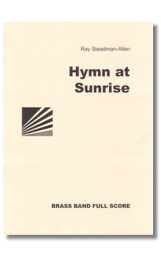
Hymn at Sunrise (Score only) - Ray Steadman-Allen
The idea for this work was prompted by a poem - Hymn Before Sunrise - which describes the majesty of a mountain in darkness, the sounds of a nearby waterfall and so on. Nothing came of the exposure to these pictures except for general thoughts about the dawn of day and a series of movements expressing a personal response to the wonder of creation in an imaginary moment in time. The movement titles, which were added later, are intended to underline a prevailing sense of worship, wonder and exaltation. The music is pure, not pictoral, though listeners may conjure their own images. An actual hymn - Tallis' Cannon - is incorporated. There are five movements: 1. Thanksgiving: A short prelude in two parts. First a brief passage of 'dawn music' before things become more vigorous: fanfare-like music ushers in the trombone section's presentation of the Tallis tune. A broad band version concludes the movement. 2. De Profundis: A slow movement shot through with anxious questionings featuring flugel and trombone. The mood lightens a little in the centre where the soprano cornet is featured and the movement ends serenely. 3. Celebration is characterised by rhythmic drive, this is buoyant with plenty of incident pointed up by the percussion. 4. Invocation: Melodic in nature and sober in mood, the first section is a series of short solos mingled with chorale-like statements. Central to the movement is a chorale-prelude style presentation of the Tallis tune. The third section reintroduces the earlier solo music by the full ensemble. Dissolving, the music enters the last movement without a break. 5. Paean: Marked allegro con spirito there is, quite rightly, a fair amount of fun in the rejoicing. Snatches of Tallis are heard, then comes a gentle passage with a cornet solo leading to fanfare music and recapitulation. Two recitatives are succeeded by a coda which brings the work to a sonorous and exultant conclusion.
Estimated dispatch 7-9 working days
-
 £52.00
Hymn at Sunrise (Parts only) - Ray Steadman-Allen
The idea for this work was prompted by a poem - Hymn Before Sunrise - which describes the majesty of a mountain in darkness, the sounds of a nearby waterfall and so on. Nothing came of the exposure to these pictures except for general thoughts about the dawn of day and a series of movements expressing a personal response to the wonder of creation in an imaginary moment in time. The movement titles, which were added later, are intended to underline a prevailing sense of worship, wonder and exaltation. The music is pure, not pictoral, though listeners may conjure their own images. An actual hymn - Tallis' Cannon - is incorporated. There are five movements: 1. Thanksgiving: A short prelude in two parts. First a brief passage of 'dawn music' before things become more vigorous: fanfare-like music ushers in the trombone section's presentation of the Tallis tune. A broad band version concludes the movement. 2. De Profundis: A slow movement shot through with anxious questionings featuring flugel and trombone. The mood lightens a little in the centre where the soprano cornet is featured and the movement ends serenely. 3. Celebration is characterised by rhythmic drive, this is buoyant with plenty of incident pointed up by the percussion. 4. Invocation: Melodic in nature and sober in mood, the first section is a series of short solos mingled with chorale-like statements. Central to the movement is a chorale-prelude style presentation of the Tallis tune. The third section reintroduces the earlier solo music by the full ensemble. Dissolving, the music enters the last movement without a break. 5. Paean: Marked allegro con spirito there is, quite rightly, a fair amount of fun in the rejoicing. Snatches of Tallis are heard, then comes a gentle passage with a cornet solo leading to fanfare music and recapitulation. Two recitatives are succeeded by a coda which brings the work to a sonorous and exultant conclusion.
Estimated dispatch 7-9 working days
-
 £49.95
Vivaldi's mission to Saturn on a dog named Bongo for Brass Band - Paul Saggers
Using material from Antonio VivaldiasThe Four Seasons, this programmatic work depicts the following story:The year is 2024, Earth has been invaded by a group of evil organists called aThe Buxtehudariansa, wiping out most of mankind. However, a secret group of highly intelligent dogs have defrosted the composer Antonio Vivaldi who was cryogenically frozen by the Vatican society of music for obedient dogs. Their chief dog leader aBongoa who over years of listening to the music of Vivaldi has gained the ability to fly, is set to undertake a mission to Saturn to obtain the golden Bassoon with which to defeat the tyrannical Buxtehuderians. With Vivaldi firmly mounted on Bongo they take off, entering full dog overdrive and breaking through the many satellites and second-hand saxophones that surround the earths atmosphere. As they fly through space, Vivaldi sadly gets distracted by a drunken trombonist and becomes separated from Bongo. Bongo now summons his musical ability to perform Vivaldias second movement of Spring from the Four Seasons on a glockenspiel stored at the international space station, enticing Antonio back on their mission. They finally arrive at Saturn and swiftly grab the golden Bassoon, returning to Earth with a thump. Their mission is complete! But can they defeat those pesky organists?Time will tell...Duration: 7a30Difficulty: 5.5/6
-
 £37.35
A Fugal Overture (Brass Band) Gustav Holst arr. Rob Bushnell
A Fugal Overture was written in 1922 by Gustav Holst. It was first performed at the Royal Opera House, Covent Garden on 14 May 1923 and was used as an opening work to Holst's one-act opera The Perfect Fool. It received its concert premiere on 11 October 1923 at one of Henry Wood's Queen's Hall Promenade Concerts. It is an early example of neoclassicism and was influenced by the counterpoint of J. S. Bach, despite its unconventional use of the fugal process. Holst began writing the piece in the summer of 1922, having hoped to develop it into a ballet. It is divided into three sections, the fugal subject with its distinct 3+3+2 pattern, a slower section with solos at the end, and a third section where the subject returns. Although reviews of the piece were mixed at the time of its premiere, the likes of Adrian Boult have said it was "an invigorating work that could effectively start any [...] concert". In more recent years, it has been compared to John Adam's A Short Ride in a Fast Machine. This arrangement is for the British-style brass band, with alternative parts for horns in F and bass-clef lower brass. A recording of the original composition can be found here: www.youtube.com/watch?v=a8xfwJyFq2E. Duration: Approx. 5.40 minutes Difficulty Level: 1st Section + PDF download includes parts and score. Sheet music available from www.brassband.co.uk Instrumentation: Soprano Cornet Eb Solo Cornet Bb Repiano Cornet Bb 2nd Cornet Bb 3rd Cornet Bb Flugel Horn Bb Solo Horn Eb 1st Horn Eb 2nd Horn Eb 1st Baritone Bb 2nd Baritone Bb 1st Trombone Bb 2nd Trombone Bb Bass Trombone Euphonium Bb Bass Eb Bass BbTimpani Percussion 1-2
In Stock: Estimated dispatch 1-3 working days
-
 £41.09
Allegro Spirito from Symphony No.2 (Brass Band) Borodin arr. Harold Burgmayer
Alexander Borodin's Second Symphony in B minor dates from the years 1869-76, a time when he was also working on his enduring opera Prince Igor. Flavors of the exotic and outdoor celebration seemed to have spilled over from the opera in this brilliant sonata movement. Borodin seldom quotes Russian folk tunes, but his graceful melodic lines are permeated with the spirit of his native song, supported by iridescent harmonies and bright colors. This arrangement for brass band was premiered by The Salvation Army's New York Staff Band, with Ronald Waiksnoris conducting, at Alice Tully Hall in New York City on 11 April 2001. This complete transcription of the Finale movement of Borodin's Second Symphony has an approximate duration of 6.40 minutes. To alternatively utilize the piece as an opener, a cut from bar 173 to 272 is indicated with Coda signs, reducing the piece to 4.30 seconds. To view a rolling score video of the work please visit www.youtube.com/watch?v=x4SqSXLopRo Difficulty Level: 2nd Section + PDF download includes parts and score. Sheet music available at www.brassband.co.uk (UK) or https://satradecentral.org (USA) Instrumentation: Soprano Cornet Eb Solo Cornet Bb Repiano Cornet Bb 2nd Cornet Bb 3rd Cornet Bb Flugel Horn Bb Solo Horn Eb 1st Horn Eb 2nd Horn Eb 1st Baritone Bb 2nd Baritone Bb 1st Trombone Bb 2nd Trombone Bb Bass Trombone Euphonium Bb Bass Eb Bass Bb Timpani Percussion 1-3
In Stock: Estimated dispatch 1-3 working days
-
 £33.62
Extinction:2100! (Brass Band) Joe Galuszka
Extinction:2100!, by Joe Galuszka, takes us on a journey to the present day and shows us the devastating impacts of climate change. With the world reaching crisis, we open with a reminder that the world has suffered in recent years from some of the most raging destruction of our plants and animal life, from wildfires. With the time left becoming smaller and smaller with each day passing, the piece reminds us next of the 'Tolling Bell of Extinction' before the conclusion takes us to a place all too familiar - the present - where with action and with a 'Call for Change', we can hopefully make a difference to our future, our children's future, and save our planet from devastation, from decimation, from extinction! To listen to an audio demo of the work please visit https://on.soundcloud.com/SjxKbnM1Q55hVXck7 Duration: approx. 4.30 mins Difficulty Level: 1st Section + PDF download includes parts and score. Sheet music available from www.brassband.co.uk (UK) or https://satradecentral.org (USA) Instrumentation: Soprano Cornet Eb Solo Cornet Bb Repiano Cornet Bb 2nd Cornet Bb 3rd Cornet Bb Flugel Horn Bb Solo Horn Eb 1st Horn Eb 2nd Horn Eb 1st Baritone Bb 2nd Baritone Bb 1st Trombone Bb 2nd Trombone Bb Bass Trombone Euphonium Bb Bass Eb Bass Bb Timpani Percussion 1-3
In Stock: Estimated dispatch 1-3 working days
 View Music
 Watch video