
Results
-
 £30.00
Leviathan - Paul Denegri
Leviathan began its evolution as a workshop work inspired by the poem written by Heathcote Williams entitled; Whale Nation. At the time of this workshop the tentet brass repertoire existed of extremely well written original or arranged works of a lighter nature but there was a shortage of works with a greater emotional depth and edge, hence Leviathan's early conception as an atmospheric and emotive work. The workshop piece explored whale sound and song and was a 25-minute work in two parts. After many years of the workshop sketches sitting dormant the new work Leviathan is a much shorter and concise work. It contains only one of the original melodic themes of the workshop work. Leviathan is driven and underpinned by melodic and rhythmic elements. It is a programmed work following the awe inspiring majestic might and beauty of whales through to a hunt scene, the chase and the ultimate demise of earth's largest mammal.
-
 £30.00
O.B.1. Fanfare - Tom Watson
Tom Watson was born into a musical family in Hertfordshire, England and showed a flare for playing the trumpet from the age of just 4. Taught by his father James Watson, the prolific international soloist, conductor, educator and session trumpeter, Tom studied at the Royal Academy of Music, where he gained a first class honours degree. Whilst still at college, Tom embarked on a varied professional freelance-playing career and was guest principal trumpet with the Mahler Chamber Orchestra performing under Claudio Abbado, Daniel Harding, and Sir Neville Marriner. Tom can be regularly found performing and recording with the London Symphony Orchestra, The BBC National Orchestra of Wales and many of the UK's finest orchestras. Commercially, Tom has played in sessions or concerts for artists such as Sir Elton John, Sir Paul McCartney, Sir Tom Jones, Dame Shirley Bassey, Ozzy Osbourne, Phil Collins, Eric Clapton, Joe Cocker, Jarvis Cocker, Pete Doherty, Nick Cave, Karl Jenkins and Victoria Wood. Some of his film session work has included recording the scores for Brave, Eragon and Stormbreaker. Tom also works as a musical director, arranging and conducting various projects such as Tony Christie's album Made in Sheffield and for renowned harpist Catrin Finch. Tom also runs his own independent recording and production company Pro Audio, part of Prozone Music, which Tom owns and runs alongside his brother William. The O.B.1. Fanfare was written for the Harper Ensemble, a brass ensemble comprising of Tom's contemporaries from his time at the Royal Academy of Music. It was written for the Leicester Square UK premiere of the film "Ali" starring Will Smith. Composed as a salute to Hollywood and the big screen, this fine pastiche of film scoring is an ideal fanfare and concert opener.
-
Paint It Black - Mick Jagger & Keith Richards - Len Jenkins
"Paint It Black" (originally released as "Paint It, Black") was written by Mick Jagger and Keith Richards, and first released as a single on 6 May 1966. It became the Rolling Stones' sixth number one in the UK and has remained influential as the first number one hit featuring a sitar. The song came at a pivotal period in The Rolling Stones' recording history, a time that saw the song-writing collaboration of Jagger and Richards assert itself as the principal composers of the band's original material. Its lyrics are for the most part meant to describe bleakness and depression and describe the extreme grief suffered by one stunned by the sudden and unexpected loss of wife, lover or partner. It famously plays during the end credits of the film Full Metal Jacket. Beginning in the style of an ironic minuet, which can be by-passed by starting at bar 54 where the heavy rock beat takes over, the piece is interesting and within the capabilities of 3rd or 4th section bands. For those bands with a drummer and one percussionist, an alternative percussion part is provided.
-
 £32.00
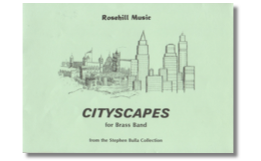
Cityscapes (Score only) - Stephen Bulla
The music of Cityscapes intends to parallel the impressions, sights, and sounds of a modern city to what a painter might convey with a landscape portrait. 'Morning Scene - Awakening': the quiet solitude of a sunrise, birdsong, and empty streets can betray the crowded jungle of city life. These are the last moments of sleep before the alarm goes off and the coffee goes on. 'Faces in Motion': The pavements come alive, streets fill with cars, office buildings open, the rush hour is on - and everyone is late! 'Museum Visit': To step into a museum is to visit another world. Looking at what we've been and where we've been, there's always a sense of awe at how much has gone before; and the realisation of how much there is yet to come... 'Nightlife': After hours is not the time to slow down, for the city never really sleeps. Nightclubs open, and the jazz circuit is alive with swinging sounds. This is the soul of the city. Duration: 12:00
Estimated dispatch 7-9 working days
-
 £42.00
Cityscapes (Parts only) - Stephen Bulla
The music of Cityscapes intends to parallel the impressions, sights, and sounds of a modern city to what a painter might convey with a landscape portrait. 'Morning Scene - Awakening': the quiet solitude of a sunrise, birdsong, and empty streets can betray the crowded jungle of city life. These are the last moments of sleep before the alarm goes off and the coffee goes on. 'Faces in Motion': The pavements come alive, streets fill with cars, office buildings open, the rush hour is on - and everyone is late! 'Museum Visit': To step into a museum is to visit another world. Looking at what we've been and where we've been, there's always a sense of awe at how much has gone before; and the realisation of how much there is yet to come... 'Nightlife': After hours is not the time to slow down, for the city never really sleeps. Nightclubs open, and the jazz circuit is alive with swinging sounds. This is the soul of the city. Duration: 12:00
Estimated dispatch 7-9 working days
-
 £42.00
Trittico (Score only) - James Curnow
Trittico was commissioned by the Swiss Brass Band Association for their national championships in 1988. A trittico is a tripych or group of three paintings or musical compositions based on a common theme and presented or performed together. The present work is a set of three extended variations on the American shaped-note hymn Consolation. The work opens in grand style with motives based on intervals of the hymn tune. The opening motif, and smaller fragments of it reappear throughout the piece and serve as an underlying element alongside the theme itself. The first variation is essentially a scherzo which echoes the minor mood of the theme. The hemiolic opposition of compound and duple time is used to good effect and, again, the main motif is never far away. This is music with energy and forward movement. The second variation gives the soloists a chance to shine. The mood is tranquil, yet there is always some activity and the musical material pre-echoes the third variation. The third variation is another scherzo-like section, the main theme accompanied by a rhythmic ostinato. Toward the conclusion there is a short aeleatoric passage - a variation within a variation allowing half the band to make their own variaitions in a cachophony of sound. An energetic coda draws together several elements to round off a work brim full of drive, energy, and self-propelled enthusiasm. Duration: 13:30
Estimated dispatch 7-9 working days
-
 £52.00
Trittico (Parts only) - James Curnow
Trittico was commissioned by the Swiss Brass Band Association for their national championships in 1988. A trittico is a tripych or group of three paintings or musical compositions based on a common theme and presented or performed together. The present work is a set of three extended variations on the American shaped-note hymn Consolation. The work opens in grand style with motives based on intervals of the hymn tune. The opening motif, and smaller fragments of it reappear throughout the piece and serve as an underlying element alongside the theme itself. The first variation is essentially a scherzo which echoes the minor mood of the theme. The hemiolic opposition of compound and duple time is used to good effect and, again, the main motif is never far away. This is music with energy and forward movement. The second variation gives the soloists a chance to shine. The mood is tranquil, yet there is always some activity and the musical material pre-echoes the third variation. The third variation is another scherzo-like section, the main theme accompanied by a rhythmic ostinato. Toward the conclusion there is a short aeleatoric passage - a variation within a variation allowing half the band to make their own variaitions in a cachophony of sound. An energetic coda draws together several elements to round off a work brim full of drive, energy, and self-propelled enthusiasm. Duration: 13:30
Estimated dispatch 7-9 working days
-
 £37.35
A Fugal Overture (Brass Band) Gustav Holst arr. Rob Bushnell
A Fugal Overture was written in 1922 by Gustav Holst. It was first performed at the Royal Opera House, Covent Garden on 14 May 1923 and was used as an opening work to Holst's one-act opera The Perfect Fool. It received its concert premiere on 11 October 1923 at one of Henry Wood's Queen's Hall Promenade Concerts. It is an early example of neoclassicism and was influenced by the counterpoint of J. S. Bach, despite its unconventional use of the fugal process. Holst began writing the piece in the summer of 1922, having hoped to develop it into a ballet. It is divided into three sections, the fugal subject with its distinct 3+3+2 pattern, a slower section with solos at the end, and a third section where the subject returns. Although reviews of the piece were mixed at the time of its premiere, the likes of Adrian Boult have said it was "an invigorating work that could effectively start any [...] concert". In more recent years, it has been compared to John Adam's A Short Ride in a Fast Machine. This arrangement is for the British-style brass band, with alternative parts for horns in F and bass-clef lower brass. A recording of the original composition can be found here: www.youtube.com/watch?v=a8xfwJyFq2E. Duration: Approx. 5.40 minutes Difficulty Level: 1st Section + PDF download includes parts and score. Sheet music available from www.brassband.co.uk Instrumentation: Soprano Cornet Eb Solo Cornet Bb Repiano Cornet Bb 2nd Cornet Bb 3rd Cornet Bb Flugel Horn Bb Solo Horn Eb 1st Horn Eb 2nd Horn Eb 1st Baritone Bb 2nd Baritone Bb 1st Trombone Bb 2nd Trombone Bb Bass Trombone Euphonium Bb Bass Eb Bass BbTimpani Percussion 1-2
In Stock: Estimated dispatch 1-3 working days
-
 £33.62
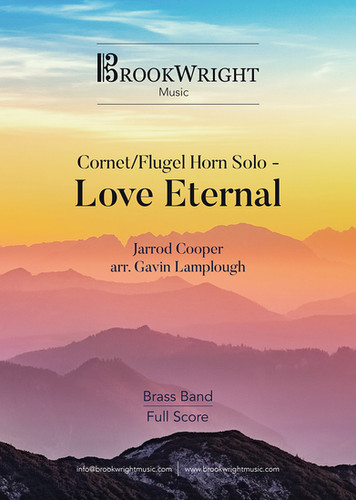
Love Eternal (Cornet/Flugel Solo with Brass Band) Jarrod Cooper arr. Lamplough
Love Eternal was written by Gavin Lamplough for Neil Blessett, who at the time of writing was the Principal Horn player of both Birmingham (UK) Citadel Band and the International Staff Band of The Salvation Army. After popular demand, it was set as a cornet or flugel horn solo, both with piano accompaniment and this version with brass band. The arranger uses Jarod Cooper's popular contemporary worship song King of Kings, Majesty as the basis for the work and the piece seeks to provide a vehicle for the rich timbres of the tenor horn to be enjoyed by the listener. The music reflects the Christian musician's desire to offer their talents to God to be used by Him, and the lyrics of the song are ones of contrast as the musical journey of this piece seeks to emulate the juxtaposition through contrasting moods. To view a video of Helen Williams performing the solo (version with piano accompaniment) please visit www.youtube.com/watch?v=ww3B06TBKMM PDF download includes score and parts. Sheet music available from: UK - www.brassband.co.uk USA - https://satradecentral.org Difficulty Level: 4th Section + Length: 5.00 minutes Instrumentation: Cornet/Flugel Horn Soloist Bb Soprano Cornet Eb 1st Cornet Bb 2nd Cornet Bb Flugel Horn Bb 1st Horn Eb 2nd Horn Eb 1st Baritone Bb 2nd Baritone Bb 1st Trombone Bb 2nd Trombone Bb Bass Trombone Euphonium Bb Bass Eb Bass Bb Percussion 1-3
In Stock: Estimated dispatch 1-3 working days
-
 £33.62
Love Eternal (Tenor Horn Solo with Brass Band) Jarrod Cooper arr.Gavin Lamplough
Love Eternal was written by Gavin Lamplough for Neil Blessett, who at the time of writing was the Principal Horn player of both Birmingham (UK) Citadel Band and the International Staff Band of The Salvation Army. The arranger uses Jarod Cooper's popular contemporary worship song King of Kings, Majesty as the basis for the work and the piece seeks to provide a vehicle for the rich timbres of the tenor horn to be enjoyed by the listener. The music reflects the Christian musician's desire to offer their talents to God to be used by Him, and the lyrics of the song are ones of contrast as the musical journey of this piece seeks to emulate the juxtaposition through contrasting moods. To view a video of Neil Blessett performing the solo with Birmingham (UK) Citadel Band please visit www.youtube.com/watch?v=Jx5G-MDpD_g This title is also available as a trombone solo with brass band here. PDF download includes score and parts. Sheet music available from: UK - www.brassband.co.uk USA - https://satradecentral.org Difficulty Level: 4th Section + Length: 5.00 minutes Instrumentation: Tenor Horn Soloist Eb Soprano Cornet Eb 1st Cornet Bb 2nd Cornet Bb Flugel Horn Bb 1st Horn Eb 2nd Horn Eb 1st Baritone Bb 2nd Baritone Bb 1st Trombone Bb 2nd Trombone Bb Bass Trombone Euphonium Bb Bass Eb Bass Bb Percussion 1-3
In Stock: Estimated dispatch 1-3 working days