
Results
-
 £43.99
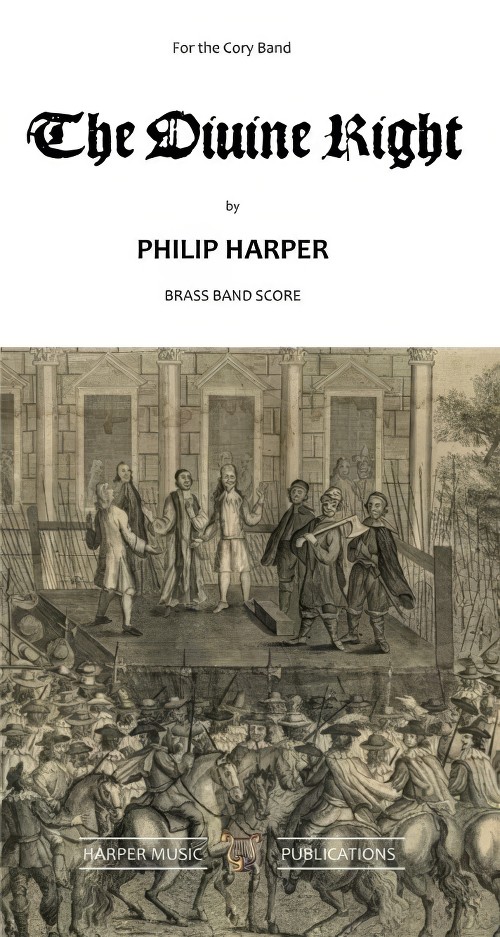
The Divine Right (Brass Band - Score only) - Harper, Philip
At the time of composing this piece, the Arab Spring was sweeping through the Middle East. It seemed that almost every week a new country's people had risen up against the regimes and dictatorships which had prevailed for generations, leaving many nations at a defining crossroads in their history. There were so many possible ways ahead: so many hopes, yet so many uncertainties.This music is a depiction of these revolutionary times, and several musical themes are in turn presented, discussed, considered, fought over, altered, rejected or accepted.Most nations have had, or probably will have, their own Arab Spring, including the United Kingdom. Events of 17th Century Britain provide the context for this piece, particularly those following the execution of the tyrant King Charles I on 30 January 1649. The regicide was in part due to Charless steadfast belief in the Divine Right of Kings, and led to a tumultuous interregnum, where England stood at its own defining crossroads. The music begins turbulently, before King Charles appears and is led to the gallows outside Banqueting House in central London where he is brutally decapitated. From the assembled crowd rose, according to one observer,a moan as I never heard before and desire I may never hear again.The music descends to emptiness.The musical argument which follows is not strictly programmatic, but a number of musical themes are all thrown into the melting pot, representing ideas such as: religion; military force; reasoned Parliamentary debate; and the chattering, irrepressible voice of the people. Additionally, there are some quotations from the music of royalist composer Thomas Tomkins (1572-1656), who was often in tune with the feeling of the times.This defining episode in England's history was brought to a close with the Restoration of the monarchy in 1660, and as the exiled King Charles II rode back into London the diarist John Evelyn wrote:Never was so joyful a day seen in this nation. I stood in the Strand and beheld it, and blessed God.At the end of the piece the bells ring out, and the musical appearance of the King has transformed from turbulent to triumphant.Duration: 17.00
Estimated dispatch 7-14 working days
-
£104.99
The Divine Right (Brass Band - Score and Parts) - Harper, Philip
At the time of composing this piece, the Arab Spring was sweeping through the Middle East. It seemed that almost every week a new country's people had risen up against the regimes and dictatorships which had prevailed for generations, leaving many nations at a defining crossroads in their history. There were so many possible ways ahead: so many hopes, yet so many uncertainties.This music is a depiction of these revolutionary times, and several musical themes are in turn presented, discussed, considered, fought over, altered, rejected or accepted.Most nations have had, or probably will have, their own Arab Spring, including the United Kingdom. Events of 17th Century Britain provide the context for this piece, particularly those following the execution of the tyrant King Charles I on 30 January 1649. The regicide was in part due to Charless steadfast belief in the Divine Right of Kings, and led to a tumultuous interregnum, where England stood at its own defining crossroads. The music begins turbulently, before King Charles appears and is led to the gallows outside Banqueting House in central London where he is brutally decapitated. From the assembled crowd rose, according to one observer,a moan as I never heard before and desire I may never hear again.The music descends to emptiness.The musical argument which follows is not strictly programmatic, but a number of musical themes are all thrown into the melting pot, representing ideas such as: religion; military force; reasoned Parliamentary debate; and the chattering, irrepressible voice of the people. Additionally, there are some quotations from the music of royalist composer Thomas Tomkins (1572-1656), who was often in tune with the feeling of the times.This defining episode in England's history was brought to a close with the Restoration of the monarchy in 1660, and as the exiled King Charles II rode back into London the diarist John Evelyn wrote:Never was so joyful a day seen in this nation. I stood in the Strand and beheld it, and blessed God.At the end of the piece the bells ring out, and the musical appearance of the King has transformed from turbulent to triumphant.Duration: 17.00
Estimated dispatch 7-14 working days
-
 £95.00
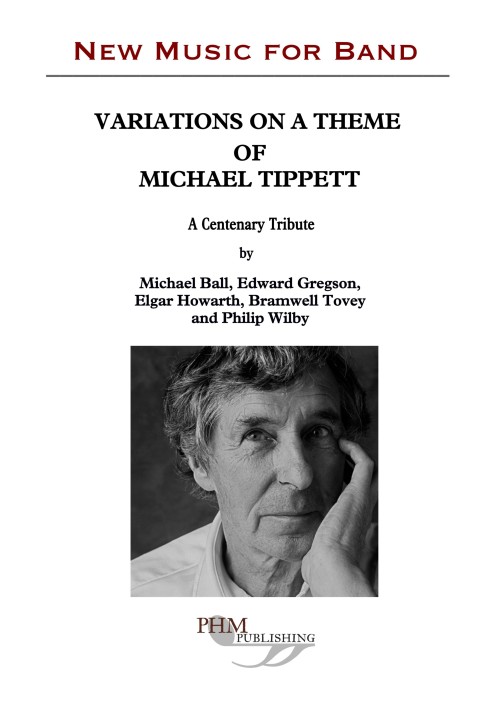
Variations on a Theme of Michael Tippett (Brass Band - Score and Parts) - Hindmarsh, Paul
A Centenary Tribute by Michael Ball, Edward Gregson, Elgar Howarth, Bramwell Tovey and Philip WilbyThis unique 'pice d'occasion' arose out of a telephone conversation in 2004 with Alan Wycherley, who was the soprano cornet player of the Foden's Richardson Band at the time. He indicated that the band would like to include an original birthday tribute for Edward Gregson (60) and Elgar Howarth (70) in its concert at the 2005 RNCM Festival of Brass in Manchester. I have been Artistic Director of Manchester's Festival of Brass since it was established in 1990 as a BBC Radio 3 series, As the centenary of the birth of Sir Michael Tippett fell on 5 January 2005, I devised this collective work as a way of embracing all three anniversaries in a novel way.The idea of joint compositions is not a new one in the classical music world. In the 1860s, Verdi was joined by a number of his contemporaries in a Requiem Mass for Rossini. In this country there have been a number of orchestral examples over the past fifty years, but never before for the brass band. Although Tippett composed only one work for brass band, Festal Brass with Blues, his orchestral works and operas are full of idiomatic brass writing. The theme I chose for this celebration is one of Tippet's most memorable miniatures featuring wind and brass. In the opera Midsummer Marriage it marks the entry of the Ancients. It is also included in the orchestral Suite in D (1948), for the Birthday of Prince Charles.I invited five of the leading contemporary voices in brass band music to add their own creative perspectives to the little Tippett theme, with it's characteristic rhythms, embellishments and modality - the Lydian mode. Each contribution was designed to fit into a tonal and formal template to give the whole work a flow and continuity. In Danse des Amis, Bramwell Tovey has composed a jazzy, humorous variation. Inspiration came from Tippett's love of jazz and, more personally, from the characteristically syncopated gait of the distinguished music critic John Amis, who Tovey once observed leaving a performance of Tippett's opera King Priam before the end. Incidentally, that performance was conducted by Elgar Howarth.We hear Edward Gregson in lyrical mode. His Midsummer Song is redolent of the sound world of Tippett's opera A Midsummer Marriage and it ends with a brief reference to a favourite of Gregson's, Tippett's Concerto for Orchestra. Michael Ball provides a brief moment of light, airy activity bringing to mind perhaps Tippett's love of Shakespearian fantasy, especially The Tempest. Elgar Howarth juxtaposes a slowed down version of the processional theme with distant recollections of fanfares from King Priam. Philip Wilby has rounded the tribute off with a spectacular fugue. During its inexorable progress Wilby ingeniously introduces the two other birthday references - the three-note musical signature that Elgar Howarth includes in much of his music and the characteristic theme which begins Edward Gregson's substantial work for brass an organ The Trumpets of the Angels. An elaborated reprise of Tippett's little theme is followed by a dynamic coda.- Paul HindmarshDuration: 13.00
Estimated dispatch 7-14 working days
-
£40.00
Variations on a Theme of Michael Tippett (Brass Band - Score only) - Hindmarsh, Paul
A Centenary Tribute by Michael Ball, Edward Gregson, Elgar Howarth, Bramwell Tovey and Philip WilbyThis unique 'pice d'occasion' arose out of a telephone conversation in 2004 with Alan Wycherley, who was the soprano cornet player of the Foden's Richardson Band at the time. He indicated that the band would like to include an original birthday tribute for Edward Gregson (60) and Elgar Howarth (70) in its concert at the 2005 RNCM Festival of Brass in Manchester. I have been Artistic Director of Manchester's Festival of Brass since it was established in 1990 as a BBC Radio 3 series, As the centenary of the birth of Sir Michael Tippett fell on 5 January 2005, I devised this collective work as a way of embracing all three anniversaries in a novel way.The idea of joint compositions is not a new one in the classical music world. In the 1860s, Verdi was joined by a number of his contemporaries in a Requiem Mass for Rossini. In this country there have been a number of orchestral examples over the past fifty years, but never before for the brass band. Although Tippett composed only one work for brass band, Festal Brass with Blues, his orchestral works and operas are full of idiomatic brass writing. The theme I chose for this celebration is one of Tippet's most memorable miniatures featuring wind and brass. In the opera Midsummer Marriage it marks the entry of the Ancients. It is also included in the orchestral Suite in D (1948), for the Birthday of Prince Charles.I invited five of the leading contemporary voices in brass band music to add their own creative perspectives to the little Tippett theme, with it's characteristic rhythms, embellishments and modality - the Lydian mode. Each contribution was designed to fit into a tonal and formal template to give the whole work a flow and continuity. In Danse des Amis, Bramwell Tovey has composed a jazzy, humorous variation. Inspiration came from Tippett's love of jazz and, more personally, from the characteristically syncopated gait of the distinguished music critic John Amis, who Tovey once observed leaving a performance of Tippett's opera King Priam before the end. Incidentally, that performance was conducted by Elgar Howarth.We hear Edward Gregson in lyrical mode. His Midsummer Song is redolent of the sound world of Tippett's opera A Midsummer Marriage and it ends with a brief reference to a favourite of Gregson's, Tippett's Concerto for Orchestra. Michael Ball provides a brief moment of light, airy activity bringing to mind perhaps Tippett's love of Shakespearian fantasy, especially The Tempest. Elgar Howarth juxtaposes a slowed down version of the processional theme with distant recollections of fanfares from King Priam. Philip Wilby has rounded the tribute off with a spectacular fugue. During its inexorable progress Wilby ingeniously introduces the two other birthday references - the three-note musical signature that Elgar Howarth includes in much of his music and the characteristic theme which begins Edward Gregson's substantial work for brass an organ The Trumpets of the Angels. An elaborated reprise of Tippett's little theme is followed by a dynamic coda.- Paul HindmarshDuration: 13.00
Estimated dispatch 7-14 working days
-
 £84.95
A Day in the Life of a Knight (Brass Band - Score and Parts) - Lawrence, Phil
Here we have a most descriptive piece of writing - a story through music. A fantastic 1st section test piece and championship concert work:The opening scene would depict standing on the battlements of a castle hearing the thundering hoofs of our brave Knight's horse miles in the distance. His arrival is expected, and his reputation is known across many lands. Today, he is to joust amongst mere mortal knights and compete for the hand of the fair (and local) Princess.He vanquishes all competitors and wins the day. The scene moves to evening and court where reception and dance is to be held for our winning knight. Both Knight and Princess become centre of attention during the dance. Their eyes only for each other.At last, the Knight has a chance to be a lone with his Princess as they steal away from the celebrations to a star lit rampart above the castle gardens, where the Knight declares his ever-lasting love and pledges his life and of honour to her. He asks her hand, meanwhile monks pray in the below chapel hoping for union. She say's yes. It is announced in court, then blown from the battlements.Day breaks; he is brought word of evil doings back in his own land. He leaves word to the Princess that he will be back soon to take her hand. The trouble back home was a rouse to get him away from the Princes so one of the vanquished, a dark knight in yesterdays joust, has summoned a dragon to kidnap the princess for his own.As the truth of the deception reaches our Knight he quickly returns to face the varlet that has taken his Lady. This time tis no joust, but a fight to the death with the dark knight and dragon. Our champion proves his best once again and wins the day and the hand of his Princess forever!- Phil LawrenceSuitable for 1st Section Bands and aboveDuration: 11.15
Estimated dispatch 7-14 working days
-
 £168.50
Music of the Spheres (Brass Band - Score and Parts) - Sparke, Philip
Music of the Spheres was commissioned by the Yorkshire Building Society Band and first performed by them at the European Brass Band Championships in Glasgow, May 2004. The piece reflects the composers fascination with the origins of the universe and deep space in general. The title comes from a theory, formulated by Pythagoras, that the cosmos was ruled by the same laws he had discovered that govern the ratios of note frequencies of the musical scale. ('Harmonia' in Ancient Greek, which means scale or tuning rather than harmony - Greek music was monophonic). He also believed that these ratios corresponded to the distances of the six known planets from the sun and thatthe planets each produced a musical note which combined to weave a continuous heavenly melody (which, unfortunately, we humans cannot hear). In this work, these six notes form the basis of the sections Music of the Spheres and Harmonia. The pieces opens with a horn solo called t = 0, a name given by some scientists to the moment of the Big Bang when time and space were created, and this is followed by a depiction of the Big Bang itself, as the entire universe bursts out from a single point. A slower section follows called The Lonely Planet which is a meditation on the incredible and unlikely set of circumstances which led to the creation of the Earth as a planet that can support life, and the constant search for other civilisations elsewhere in the universe. Asteroids and Shooting Stars depicts both the benign and dangerous objects that are flying through space and which constantly threaten our planet, and the piece ends with The Unknown, leaving in question whether our continually expanding exploration of the universe will eventually lead to enlightenment or destruction.Duration: 18:00
Estimated dispatch 7-14 working days
-
£42.50
Music of the Spheres (Brass Band - Score only) - Sparke, Philip
Music of the Spheres was commissioned by the Yorkshire Building Society Band and first performed by them at the European Brass Band Championships in Glasgow, May 2004. The piece reflects the composers fascination with the origins of the universe and deep space in general. The title comes from a theory, formulated by Pythagoras, that the cosmos was ruled by the same laws he had discovered that govern the ratios of note frequencies of the musical scale. ('Harmonia' in Ancient Greek, which means scale or tuning rather than harmony - Greek music was monophonic). He also believed that these ratios corresponded to the distances of the six known planets from the sun and thatthe planets each produced a musical note which combined to weave a continuous heavenly melody (which, unfortunately, we humans cannot hear). In this work, these six notes form the basis of the sections Music of the Spheres and Harmonia. The pieces opens with a horn solo called t = 0, a name given by some scientists to the moment of the Big Bang when time and space were created, and this is followed by a depiction of the Big Bang itself, as the entire universe bursts out from a single point. A slower section follows called The Lonely Planet which is a meditation on the incredible and unlikely set of circumstances which led to the creation of the Earth as a planet that can support life, and the constant search for other civilisations elsewhere in the universe. Asteroids and Shooting Stars depicts both the benign and dangerous objects that are flying through space and which constantly threaten our planet, and the piece ends with The Unknown, leaving in question whether our continually expanding exploration of the universe will eventually lead to enlightenment or destruction.Duration: 18:00
Estimated dispatch 7-14 working days
-
 £82.95
The Flowers of the Forest (Brass Band - Score and Parts) - Bennett, Richard Rodney - Hindmarsh, Paul
In a preface to the score, the composer explains that 'the folk song The Flowers of the Forest is believed to date from 1513, the time if the battle of Flodden, in the course of which the archers of the Forest (a part of Scotland) were killed almost to a man'. Bennett had already used the same tune in his Six Scottish Folksongs (1972) for soprano, tenor and piano, and it is the arrangement he made then that forms the starting-point for the brass-band piece. A slow introduction (Poco Adagio) presents the folk song theme three times in succession - on solo cornet, on solo cornets and tenor horns, and on muted ripieno cornets in close harmony - after which the work unfolds through five sections and a coda. Although played without a break, each of these five sections has its own identity, developing elements of the tune somewhat in the manner of variations, but with each arising from and evolving into the next. The first of these sections (Con moto, tranquillo) is marked by an abrupt shift of tonality, and makes much of the slow rises and falls characteristic of the tune itself. The tempo gradually increases, to arrive at a scherzando section (Vivo) which includes the first appearance of the theme in its inverted form. A waltz-like trio is followed by a brief return of the scherzando, leading directly to a second, more extended, scherzo (con brio) based on a lilting figure no longer directly related to the theme. As this fades, a single side drum introduces an element of more overtly martial tension (Alla Marcia) and Bennett says that, from this point on, he was thinking of Debussy's tribute to the memory of an unknown soldier (in the second movement of En Blanc et noir, for two pianos). Bennett's march gradually gathers momentum, eventually culminating in a short-lived elegiac climax (Maestoso) before the music returns full-circle to the subdued melancholy of the opening. The work ends with a haunting pianissimo statement of the original tune.
Estimated dispatch 7-14 working days
-
£44.95
The Flowers of the Forest (Brass Band - Score only) - Bennett, Richard Rodney - Hindmarsh, Paul
In a preface to the score, the composer explains that 'the folk song The Flowers of the Forest is believed to date from 1513, the time if the battle of Flodden, in the course of which the archers of the Forest (a part of Scotland) were killed almost to a man'. Bennett had already used the same tune in his Six Scottish Folksongs (1972) for soprano, tenor and piano, and it is the arrangement he made then that forms the starting-point for the brass-band piece. A slow introduction (Poco Adagio) presents the folk song theme three times in succession - on solo cornet, on solo cornets and tenor horns, and on muted ripieno cornets in close harmony - after which the work unfolds through five sections and a coda. Although played without a break, each of these five sections has its own identity, developing elements of the tune somewhat in the manner of variations, but with each arising from and evolving into the next. The first of these sections (Con moto, tranquillo) is marked by an abrupt shift of tonality, and makes much of the slow rises and falls characteristic of the tune itself. The tempo gradually increases, to arrive at a scherzando section (Vivo) which includes the first appearance of the theme in its inverted form. A waltz-like trio is followed by a brief return of the scherzando, leading directly to a second, more extended, scherzo (con brio) based on a lilting figure no longer directly related to the theme. As this fades, a single side drum introduces an element of more overtly martial tension (Alla Marcia) and Bennett says that, from this point on, he was thinking of Debussy's tribute to the memory of an unknown soldier (in the second movement of En Blanc et noir, for two pianos). Bennett's march gradually gathers momentum, eventually culminating in a short-lived elegiac climax (Maestoso) before the music returns full-circle to the subdued melancholy of the opening. The work ends with a haunting pianissimo statement of the original tune.
Estimated dispatch 7-14 working days
-
 £100.00
Journey of the Lone Wolf (Brass Band - Score and Parts) - Dobson, Simon
Championship Section Test Piece for the 2016 National Finals of the British Brass Band Championship.The Lone Wolf of the title is the great Hungarian composer and folklorist Bla Bartok. Bartok's journey took him from the hills of the Balkans to the heart of the new world. His singular vision may have meant a life out in the cold, a life without warmth and love, a life without true happiness, a death mourned by a few in a strange land.The first of the three linked movements is capturing the Peasants' Song and follows the young Bartok and fellow composer Zoltan Kolday as they embark on Summertime adventures through the Hungarian countryside to collect and catalogue the astonishing variety of Gypsy and folk music heard in the Balkan hills. The arrival of WW1 plunges Bartok's beloved Hungary into chaos.Bartok was at times a cold man, aloof and lonely. The occasional moments of tenderness he showed are portrayed in Night Music. His brief but intense affairs speak of a love he could only long for. Jazz is my night music and here there are hints of what Bartok may have heard in the USA later in his life.Having been forced by the world's evils to leave his homeland of Hungary for America Bartok, the anti-fascist, felt isolated and angry. In the finale, Flight and Fight, we hear his longing for a simpler time of Gypsy folk dances as well as his maturity and depth as a composer finally exploring deeper colours and darker themes.Duration: 15.00
Estimated dispatch 7-14 working days
 View Music