
Results
-
 £94.95
Of Men and Mountains - Edward Gregson
Of Men and Mountains was commissioned by the Netherlands Brass Band Championships for their tenth anniversary contest in Drachten in December 1990. In July the previous year, Edward Gregson and his wife took the Trans Canadian Railway from Toronto to Vancouver. The journey through the Rocky Mountains was the starting point for Of Men and Mountains. Gregson writes that: 'its high peaks and shafts of sunlight breaking through the clouds, its canyons and ferocious rapids made me understand a little more about the majesty of nature and the fragility of humanity. The eternal struggle between man and nature was personified in the building of this incredible railway... hence my title (after Blake).' The work is dedicated to the memory of Eric Ball, who died shortly before the writing of the work was commenced. Of Men and Mountains is in one continuous movement with a duration of approximately 17 minutes. Its form is difficult to describe because of its motivic and accumulative nature, but it is essentially a symphonic tone poem in search of a theme, which eventually comes in its final and complete state in the majestic ending after an ever-increasing paced scherzo. Of Men and Mountains has been selected as the test pieces for the 2023 National Brass Championships of Great Britain at the Albert Hall.
Estimated dispatch 5-14 working days
-
 £147.10
Rainforest Concerto - Saskia Apon
Rainforest Concerto has been commissioned by the Brass Band Rijnmond. This double concerto for two trombones and wind band consists of three parts with the cadenza in the slow niddle movement. Saskia Apon was inspired by the threat of the destruction of the rainforest. In the first part, Creation, we hear an accelerated reproduction of the birth of this impressive natural phenomenon. We hear the first birds, we see the growth of the mangrove trees and we witness the struggle for light and the force necessary to keep the realized equilibrium in a perpetual balance.The second part, Ode, is a tribute to the wonder and splendour of the rainforest. By means of subtle and extremely delicate sonorities we hear how nature adds an inestimable value to the rainforest. However it is also extremely fragile and this engenders a certain melancholy due to the awareness of man's impotence to respect this beautiful nature.In the last part, Contra Demolition, we hear the threatening decline, but also the revolt against this possible ruin. It is a heartfelt cry to leave nuture in peace and to work hard for the preservation of the beauty and the value of the rainforest.
Estimated dispatch 5-14 working days
-
 £69.99
Sunset Serenade - Thomas Doss
Sunset Serenade is a tribute by the composer to a music colleague, whose life was unexpectedly cut short. In spite of the sad circumstances of its creation, the music reflects overwhelmingly happy memories and thoughts of gratitude for timespent together and shared experiences. The overall peaceful nature of this composition symbolises a reconciliation with, and acceptance of, the transient nature of man.
Estimated dispatch 5-14 working days
-
 £379.99
Tranquil Abiding - Paul Mealor
An 18-minute work for brass band, written for the world renowned Foden's Band. This is a melodic work divided into three movements. All sections of the band are featured with solo parts. Each movement is headed by a line from a poem by James Agee, the American novelist and poet. 'Tranquil Abiding', often referred to as 'Shamatha' in Buddhist traditions, signifies a state of peaceful and calm mental stillness, achieved through focused meditation, where the mind rests peacefully and without agitation."The term has always resonated with me particularly during my long, regular walks into, around and along the amazingly beautiful woodlands, mountains and streams of North Wales at night lit only by the stars. It's during these walks that my meditative focus is at its most emotive and I am at one with the 'it' that surrounds us", says Paul Mealor. "Often on these walks and meditations I am reminded of the American poet, James Agee's pantheistic vision of the natural world and the stars above, 'Sure on this Shining Night' which conjures a serene and harmonious image of a summer night, illuminated by celestial bodies and bathed in kindness. The poem evokes a sense of peace and tranquillity as nature heals and the earth is rejuvenated".
Estimated dispatch 5-14 working days
-
 £134.99
Alienus - Thomas Doss
"Alienus" - a word that means more than just extraterrestrial. It speaks of the foreign, the unfamiliar, the strange. Of that which comes from beyond - and yet stirs questions deep within us.In this work, it may represent many things: an alien, an unknown being, a stranger - or a human soul we cannot understand. My fantasy for brass band, tells the story of an encounter: humans come upon a sleeping, enigmatic creature. They gaze upon it in wonder - and in fear. Hesitantly, they draw near, driven by curiosity. Their inquisitive nature drives them to explore it, gradually crossing the invisible boundaries of reverence and humility - until the creature awakens. What follows remains untold. Each listener is invited to imagine their own story - or simply to be carried away by the music. The sound world of the piece draws from ancient roots: the hymn Wachet auf, ruft uns die Stimme ("Sleepers Wake, a Voice is Calling"), written in 1599 by Philipp Nicolai and later immortalized by Johann Sebastian Bach in his famous cantata. In the finale, the chorale resounds in its full glory - performed simultaneously in two different time signatures, evoking the echo of a vast, sacred space.
Estimated dispatch 5-14 working days
-
 £134.99
Mirage - Jan de Haan
The composition Mirage takes inspiration from the legendary ghost ship "The Flying Dutchman", a story deeply rooted in maritime folklore. Cursed to wander the oceans forever, the ship often looms like a mirage on the horizon - a mysterious apparition in which reality and illusion blend intangibly.In Mirage the music tries to bring this mystical appearance to life. The piece begins with an atmosphere of mystery and wonder, creating the illusion of a mirage. The listener is taken to the vast sea, where the boundaries between the real and the unreal blur and the ghostly silhouette of the ship gradually becomes visible. Suddenly the tone changes. Powerful rhythms and stormy harmonies follow, expressing the ship's battle against the raging forces of nature. After this intense section, in which the musicians are pushed to their limits, the tranquility of the sea returns. The recurring mirages inspired the composer to create a lyrical middle section, in which various soloists tell their stories within this legend. In the final part, the sails are hoisted again, and the three-master continues its endless journey.
Estimated dispatch 5-14 working days
-
 £183.20
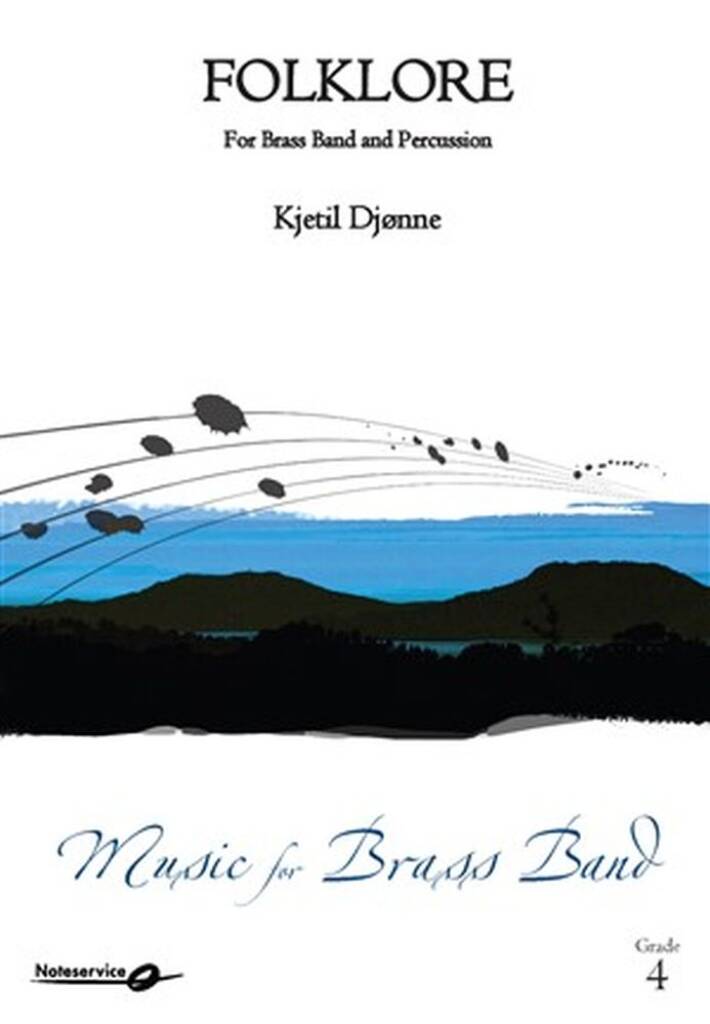
Folklore - Kjetil Djønne
"Folklore" is a work for brass band and percussion loosely based on the story of the Norwegian woman accused of witchcraft, Anne Pedersdotter. She was sentenced to be burned at the stake in Bergen in the spring of 1590 and has since been frequently highlighted as Norway's most famous and talked-about witch.The work begins with the movement "Lyderhorn," depicting the mountain outside Bergen where witches gathered to plan magical actions against the city. Here, we hear the quietness of nature and the wind blowing through the trees before a new theme appears, which will come to life in the next movement. In the distance, the witches have started their ceremony.In the next movement, "Walpurgis Night," the witches perform their rituals to afflict the city with fire, disease, and natural disasters. The ceremony becomes more and more chaotic, violent, and compelling until the darkness of the night envelops us, concluding the section.The third movement describes the women's inner struggle against the harassment they faced when the people of Bergen suspected them of being witches. Rumors often turned into formal accusations from the legal system, and many were sentenced to death after undergoing trial. "From life to death through the fire."The fourth and final movement, "The Pyre," depicts the actual death sentence. You can hear the pyre being ignited and the flames growing and intensifying. It all culminates in a chorale as a memorial to the lives that were taken.
Estimated dispatch 5-14 working days
-
 £104.99
Friendly Takeover - Oliver Waespi
Friendly Takeover was composed for the 2016 Swiss Wind Band Convention in Montreux. In this three movement piece the composer experiments with lyrical motives combined with rhythmical pulses in different meters throughout the piece. In the finale, the musical scene is taken over completely by groove-based rhythms. This takeover, however, is of a friendly nature, as the various beats are not being conceived as rivals of the lyrical motives, but are rather supposed to infuse energy and vitality to the latter. Thus, one gets the impression of an ongoing acceleration throughout the piece.
Estimated dispatch 5-14 working days
-
 £164.99
Raveling Unraveling - Philip Sparke
Winning Performance EBBC Lille 2016 Raveling, Unraveling In Search of 'La Valse' was written for the Cory Band as their own-choice test piece for the 2016 European Brass Band Championships in Lille. The piece found its genesis in Sparke's The Unknown Journey (2014) for concert band, and the use of Ravel's La Valse as a structural undercurrent to the original piece is an act of reverence. Sparke's aim was to produce a work that is organic rather than episodic in nature. The composer's view is that little in music does this better than La Valse and for this reason he uses various sections of this masterpiece, both manipulated and quoted verbatim (including much of itsstunningclosing passages) to provide the overall geography of his new work. As the music progresses, more of the Ravel appears, surfacing completely as the piece reaches its climax - a gesture of homage to the French master.
Estimated dispatch 5-14 working days
-
£60.99
Aurora Borealis - Morten J. Wallin
Aurora Borealis, more popularly known as the Northern Lights, was a source of superstition in the Middle Ages. This dazzling spectacle, which is accompanied by whispering sounds, put the fear of God into those who didn't know that this was simply one of nature's grand shows. Many heathen attributed the phenomenon to the incomprehensible ways of the gods. Today we know better. Every 11 years, the amount of particles emitted by the sun is at its highest level, as is the case this year. These particles are hurled away from the sun, beyond its magnetic field. A small percentage of these particles are able to penetrate the earth's atmosphere. Once they are here, they begin tocollide and form the beautiful patterns in the night sky which we call the Aurora Borealis.
Estimated dispatch 5-14 working days
 View Music