
Results
-
 £34.95
Sprites & Flares - Christopher Bond
Sprites & Flares (2015), refers to the uncertain activities of sprites (upper atmospheric lightening) and solar flares (solar activity from the sun which cannot penetrate the earth's atmosphere) and uses these two ideas as a basis for the kind of musical material heard within the work - dramatic, swirling motifs, often of a virtuosic nature. The work's dramatic opening ensures the first thirty seconds are high in energy and full of impact. Following this, the music dies down and presents an ethereal atmospheric section, perhaps reflecting the calm before the storm. Before long, the music takes a turn for dramatic, fast, virtuosic playing, all reflecting the theme of the work, and indeed remains in this style through to the close, gaining momentum and becoming ever- more triumphant as the work reaches its close. A huge ending is heard, full of excitement and drama, but more importantly grandeur and rich harmonic-chords. The work was commissioned by and written for Leyland Band and its conductor, Thomas Wyss, as the finale to its 2015 Brass in Concert programme, premiered at The Sage, Gateshead, on 15th November 2015.
Estimated dispatch 10-14 working days
-
£70.00
Milestone - Peter Meechan
Milestone is a concerto commissioned by Mark Wilkinson (with funds provided by the Arts Council England) to celebrate 21 years as Principal Cornet with Fodens Band. In three movements, the work is intended to not only demonstrate the soloistas virtuosic skills, but also his ability to communicate to the audience.The first movement, titled Milestone, combines sections of driving rhythms (intended to represent Markas years of continuing hard work), in the accompaniment with long legato phrases from the soloist interspersed with dexterous, virtuosic, passages.The second movement, Song, features a simple chord sequence, over which the soloist asingsa a melody, each time varying and each time becoming more expressive, leading to an emotional climax.The final movement, Twenty One, is a quasi-celebratory dance. Opening with the band clapping, the soloist weaves their way through the various textures in the band. Occasionally making both a musical and metaphorical nod to the industrious nature of the first movement, the chord sequence of the second movement also re-appears, before a brief coda takes us to the conclusion of the work.
Estimated dispatch 12-14 working days
-
£70.00
Origins - Peter Meechan
Origins is in three movements, with each movement having a different subject matter, all linked by the idea of origins: the first movement refers to musical origins; the second to the origins of life; and the final movement to the space exploration - the research of all origins. The first movement is based on a short motif, heard in the first three notes the soloist plays. These three notes cover the interval of a minor third (an interval that often plays a crucial role in my music) on which the whole concerto is built. The soloist and accompaniment interplay freely throughout the opening section, before an ostinato accompaniment appears - over which the soloist sounds a long legato melody. A short cadenza follows and a return to the opening material leads the movement to an end. The second movement, titled Harryas Song, is - as tradition dictates - a slow movement. Happy and reflective in nature, the main melody was written on the evening that my closest friend, Mark Bousie (a fine euphoniumist himself), and his wife Jayne, had their first child - Harry Bousie. It seemed only fitting that this song should be written for Harry in celebration. The final movement brings me back to a lifelong fascination with space, and in this particular movement, the Space Shuttle Discovery. Having completed 39 missions (including flying the Hubble telescope in to orbit), and spent a total of 365 days in space, SS Discovery made its final voyage in 2011 and was taken to the Smithsonian in Washington D.C. in April 2012. This final movement, titled Discovery, pays tribute to the great shuttle whose missions inspired millions across the generations. Origins was commissioned by Marco Schneider, Adrian Schneider and the Dunshan Symphonic Wind Orchestra, Beijing, China.
Estimated dispatch 12-14 working days
-
£29.95
WAR CRY (Brass Band Set) - Dorothy Gates
This work was written as the opener for the New York Staff Band's 125th anniversary concert in Carnegie Hall in March 2012. Based on the song, 'Ever is the war cry'. the music is quite militant in nature which is a direct reflection of the text. While the composer pays homage to the past in this fitting salute, the overall musical style is decidedly that of the 21st century.
Estimated dispatch 7-14 working days
-
£69.95
TRANSFORMATION (Brass Band Set) - Kenneth Downie
I believe in transformation, God can change the hearts of men, And refine the evil nature, till it glows with grace again'. So wrote John Gowans in the second verse of his great hymn, 'I believe that God the Father, can be seen in God the Son', written specifically to affirm Salvationists' beliefs. It is sung to the tune Bethany and in seeking to explore this great subject at the heart of the Christian gospel in musical terms, the composer has used this fine tune as the basis. Although it never appears in its entirety, it is seldom out of the picture and much of the work is derived from it. The other main source of material is the lovely, simple chorus, 'Some day I shall be like him, changed to heavenly beauty, when his face I see'. This chorus is especially prominent in the middle section but there are important references to it throughout. There are also brief references to Charles Wesley's hymn, 'Love Divine' and, in particular, the telling lines, 'Changed from glory into glory, till in Heaven we take our place'. The work suggests that, at times, the process of being transformed is a struggle, portrayed with many passages of fraught and demanding music. Considerable reserves of stamina and technique are required while, in contrast, the chorus, 'Some day I shall be like him' provides the warm, gentle centre of the work. The premiere of the work was given by The International Staff Band of The Salvation Army in Cadogan Hall on Friday 3rd June 2011, as part of the band's 120th anniversary celebrations.
Estimated dispatch 7-14 working days
-
£69.95
STARMAKER (Brass Band Set) - Ray Steadman-Allen
Described by the composer as one of his more ambitious works for brass band, this work is in three movements. Although each movement is capable of standing alone, the composer's own concept is totality with the three movements forming a composite whole. Starmaker presents in music the concept of God's creation of the universe. The frantic and sometimes harsh music of the first movement portrays the chaos from which the immortal and invisible wisdom of God created the order and structure of the heavens, with the stars and planets in their ordered places. An exquisite second movement, based on the benediction 'Now the day is over', brings a calm and ordered peace to the universe, also reminding listeners of the night sky, when God's amazing work is best viewed in all its awesome wonder. The final movement is celebratory in nature, with fragments of melodies like 'Praise to the Lord, the Almighty, the King of creation' appearing in various guises.
Estimated dispatch 7-14 working days
-
 £30.00
Leviathan - Paul Denegri
Leviathan began its evolution as a workshop work inspired by the poem written by Heathcote Williams entitled; Whale Nation. At the time of this workshop the tentet brass repertoire existed of extremely well written original or arranged works of a lighter nature but there was a shortage of works with a greater emotional depth and edge, hence Leviathan's early conception as an atmospheric and emotive work. The workshop piece explored whale sound and song and was a 25-minute work in two parts. After many years of the workshop sketches sitting dormant the new work Leviathan is a much shorter and concise work. It contains only one of the original melodic themes of the workshop work. Leviathan is driven and underpinned by melodic and rhythmic elements. It is a programmed work following the awe inspiring majestic might and beauty of whales through to a hunt scene, the chase and the ultimate demise of earth's largest mammal.
-
Das Boot - Klaus Doldinger - Len Jenkins
Traditionally, submarines are referred to as 'boats' rather than 'ships' and the German U- boat (Unterseeboot) was originally a craft primarily designed for surface attack that also had an underwater capability, an aspect that was subsequently developed into the submarine craft that we now know. Das Boot was a 1980's TV series/film that followed the patrol of U-96 and is reckoned by many to be the best (anti) war film produced. Authenticity was achieved by filming in a full size replica with actors who were denied washing or shaving to get the right 'atmosphere' of life in a U-boat. Despite the havoc and distress caused by attacks on Allied shipping by U-boats one cannot but be saddened by the fact that out of 40,000 who went to sea in them, 30,000 never returned. The music is characterised by a theme that has a haunting, deep, sonorous quality penetrated by the sharp, regular 'ping' of ASDIC (sonar) that was used by surface vessels to echo-locate submarines prior to attacking them with depth-charges. This 'ping' may be approximated to, at modest cost, by the percussion section using either a cymbal dome (select an appropriate beater) or a high-pitched wooden 'agogo'. Alternatively, more complex and expensive electronics may be employed. The piece needs to be played with confidence because of its discordant and intentionally sombre nature.
-
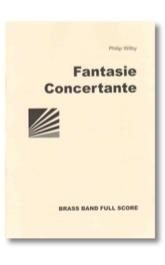 £60.00
Fantasie Concertante (Score only) - Philip Wilby
This exciting new concerto is a welcome addition to the repertoire of french and tenor horn players alike. Like the 18th-Century Serenade form there are five movements, arranged symmetrically around a slow movement - Soliloquy - which separates movements entitled Burlesque (two) and Valse Caprice (three) respectively. The first and last movements share common material of a more symphonic stature, and the concerto ends with a brisk fugato. The solo horn is (in the band version) accompanied by a quintet of solo players (two cornets, euphonium, trombone, and tuba) who provide the lion's share of the counterpoint and contrast with the main body of musicians who provide musical punctuation in the more sonorous tutti sections. The first movement, Don Quixote's Dream, contains references to Cervantes' famous hero, the Spanish nature of his stories, and the ambling gait of his horseback adventures.
Estimated dispatch 7-9 working days
-
 £74.00
Fantasie Concertante (Parts only) - Philip Wilby
This exciting new concerto is a welcome addition to the repertoire of french and tenor horn players alike. Like the 18th-Century Serenade form there are five movements, arranged symmetrically around a slow movement - Soliloquy - which separates movements entitled Burlesque (two) and Valse Caprice (three) respectively. The first and last movements share common material of a more symphonic stature, and the concerto ends with a brisk fugato. The solo horn is (in the band version) accompanied by a quintet of solo players (two cornets, euphonium, trombone, and tuba) who provide the lion's share of the counterpoint and contrast with the main body of musicians who provide musical punctuation in the more sonorous tutti sections. The first movement, Don Quixote's Dream, contains references to Cervantes' famous hero, the Spanish nature of his stories, and the ambling gait of his horseback adventures.
Estimated dispatch 7-9 working days