
Results
-
 £62.00
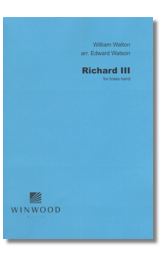
Richard III (Score only) - William Walton
It takes a special ability to compose film scores which serve the images perfectly yet translate into first class concert music. William Walton was such a talent as the continuing popularity of his brilliantly evocative film music shows. This suite presents a rich, vivid musical tapestry with all the drama of the original captured to perfection. Winwood Music are delighted to bring this music from Laurence Olivier's classic film to the brass band world in a fabulous arrangement by Edward Watson - so idiomatic that you'll think this is the original version! There are seven movements: 1. Prelude 2. Fanfare and Processional 3. Sound Drums and Trumpets & Recessional 4. Elegy 5. The Princes in the Tower 6. The Battle of Bosworth Field 7. Death of Richard and Finale
Estimated dispatch 7-9 working days
-
 £74.00
Richard III (Parts only) - William Walton
It takes a special ability to compose film scores which serve the images perfectly yet translate into first class concert music. William Walton was such a talent as the continuing popularity of his brilliantly evocative film music shows. This suite presents a rich, vivid musical tapestry with all the drama of the original captured to perfection. Winwood Music are delighted to bring this music from Laurence Olivier's classic film to the brass band world in a fabulous arrangement by Edward Watson - so idiomatic that you'll think this is the original version! There are seven movements: 1. Prelude 2. Fanfare and Processional 3. Sound Drums and Trumpets & Recessional 4. Elegy 5. The Princes in the Tower 6. The Battle of Bosworth Field 7. Death of Richard and Finale
Estimated dispatch 7-9 working days
-
 £55.00
Triumph Series Brass Band Journal, Numbers 1392 - 1395, November 2026
1392: March - Joyful Salute (Paul Drury)This march was written in 2014 to celebrate the 125th Anniversary of Rutherglen Corps and features three songs: Sweeter as the years go by; I love him better every day (S.A.S.B. 844); and The voice of Jesus.1393: The wondrous cross (Adrian Lyons)This arrangement combines two powerful melodies: Boston and The power of the Cross. The words of When I survey (S.A.S.B. 208) are woven together with the modern hymn by Keith Getty and Stuart Townend through a linking musical passage. Although particularly appropriate for Easter worship, both songs draw our attention to the central message of the Gospel and the sacrificial love revealed at Calvary, making the piece suitable for use throughout the Christian year.1394: Turn your eyes upon Jesus (Paul Sharman) This is a straightforward arrangement of Turn Your Eyes Upon Jesus (S.A.S.B. 445). Written by Helen Lemmel in 1918, the chorus was inspired by words from a tract by the missionary Lilias Trotter: "Turn your eyes upon Him, look full into His face and you will find that the things of earth will acquire a strange new dimness." Its timeless message continues to encourage Christians to look beyond earthly concerns and fix their attention upon Christ.1395: Cornet Solo - Suo Gn (Ivor Bosanko)Suo Gn is one of the best-known traditional Welsh lullabies. An anonymous folk melody, first published around 1800, it expresses a mother's love and tenderness as she gently comforts her child to sleep. Its simple beauty and lyricism have ensured its enduring popularity.
Estimated dispatch 7-14 working days
-
 £94.95
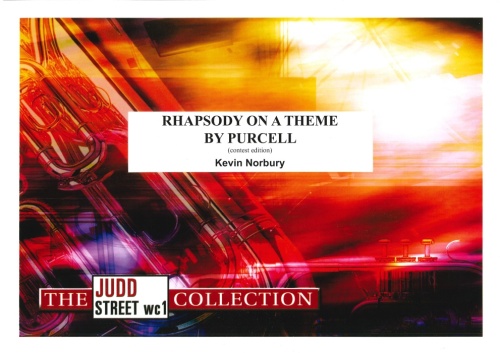
Rhapsody on a Theme by Purcell - Contest Edition (Brass Band - Score and Parts)
Contest VersionIn his relatively short lifetime, Henry Purcell (1659 -1695) achieved stellar musical success and was known and admired internationally by his contemporaries. He is justifiably considered one of England's greatest composers.I thought long and hard before using this magnificent theme as the basis for a band piece because I think that Benjamin Britten has said just about everything possible regarding it in his The Young Person's Guide to the Orchestra. Bearing this in mind, I tentatively set about working on this composition. Once started though, the job became fun because the theme still yielded possibilities - even after Britten!The piece is basically a set of linked variations, much like Rachmaninov's great Rhapsody on theme by Paginini. The music starts slowly and makes much use of crisply dotted rhythms - a Purcellian characteristic. The theme is heard twice before the music changes into a jaunty duple time variation based on the opening motif of Purcell's theme. After this, the mood changes to a waltz-like variation in which clear references to the original theme can be heard. The slow movement follows, and is based on rising and descending scalic figures. This variation is an 'A-B-A' movement with two similar passages framing a more vigorous middle section which features antiphonal fanfare-like figures. Without any preamble, the last variation launches itself - a rumbustious dance which has a distinctive feel to it.The theme eventually reappears as a counter-melody to this dance music before a final triumphant treatment of the melody featuring a somewhat athletic bass line. The music accelerates at the Coda and disappears in a 'puff of smoke'.- Kevin Norbury
Estimated dispatch 7-14 working days
-
£39.95
Rhapsody on a Theme by Purcell - Contest Edition (Brass Band - Score only)
Contest VersionIn his relatively short lifetime, Henry Purcell (1659 -1695) achieved stellar musical success and was known and admired internationally by his contemporaries. He is justifiably considered one of England's greatest composers.I thought long and hard before using this magnificent theme as the basis for a band piece because I think that Benjamin Britten has said just about everything possible regarding it in his The Young Person's Guide to the Orchestra. Bearing this in mind, I tentatively set about working on this composition. Once started though, the job became fun because the theme still yielded possibilities - even after Britten!The piece is basically a set of linked variations, much like Rachmaninov's great Rhapsody on theme by Paginini. The music starts slowly and makes much use of crisply dotted rhythms - a Purcellian characteristic. The theme is heard twice before the music changes into a jaunty duple time variation based on the opening motif of Purcell's theme. After this, the mood changes to a waltz-like variation in which clear references to the original theme can be heard. The slow movement follows, and is based on rising and descending scalic figures. This variation is an 'A-B-A' movement with two similar passages framing a more vigorous middle section which features antiphonal fanfare-like figures. Without any preamble, the last variation launches itself - a rumbustious dance which has a distinctive feel to it.The theme eventually reappears as a counter-melody to this dance music before a final triumphant treatment of the melody featuring a somewhat athletic bass line. The music accelerates at the Coda and disappears in a 'puff of smoke'.- Kevin Norbury
Estimated dispatch 7-14 working days
-
 £38.95
Unity Series Band Journal - Numbers 530 - 533, June 2024
530: Carol Arrangement - God rest you merry, gentlemen (Noel Jones)This swing arrangement of the traditional English carol also features references to O come, all ye faithful (C.C. 61) and Jingle Bells (C.C. 121). Play with imagination and a sense of style!531: Go, tell it on the mountain! (Nathanael Watchorn)Historically, the passion of enslaved people in America for singing about the Gospel of Jesus is well documented, but it was men of three generations, each named John Wesley Work, who enabled spirituals to become more widely known. John Wesley Work Sr, a church choir director in Nashville, Tennessee, wrote and arranged music for the pioneering Fisk Jubilee Singers whose early repertoire consisted largely of spirituals. This passion and knowledge of spirituals was passed down through the generations. John Work III travelled hundreds of miles to collect songs by attending church services in remote areas. In 1940, he published a collection of 230 songs which included a setting of Go, tell it on the mountain! that is still performed today.Nathanael Watchorn, a Bandsman at Regent Hall Corps in London, is a new contributor to the journals. He originally wrote this as a vocal arrangement for the group FourHymn, subsequently transcribing it for the corps' Young People's Band, while he was Band Leader.532: Carol Arrangement - They all were looking for a king (Stephen Hull)At the North American Composers Forum, Major Len Ballantine challenged participants to find an unfamiliar song in the Salvation Army Song Book and try to write an arrangement of the listed tune. Stephen Hull happened across They all were looking for a king (S.A.S.B. 128) and the tune Childhood (T.B. 421) which lead to this arrangement.533: March - Washed and healed (Eiliv Herikstad)The Christian experience of many people will have been positively impacted by the life of the late Bandmaster Eiliv Herikstad, either personally or through his musical leadership and compositions. This march is the second publication from this well-known Salvation Army composer since his Promotion to Glory last year. This march is more traditional in style that many of his compositions but contains a strong Christian message and demonstrates his compositional expertise.
Estimated dispatch 7-14 working days
-
 £34.95
Three Carols (Brass Band - Score and Parts)
Three Carols was commissioned by the New York Philharmonic as part of their Holiday Brass series and was premiered at Avery Fisher Hall by the New York Philharmonic Principal Brass and Canadian Brass. Originally for 10 players, soon after the premiere I decided to score the piece for brass band. The brass band version was first performed by the New York Staff Band.Through the years I have been intrigued by carious carols from different countries and the challenge of creating musical treatments that sound fresh and original. When commissioned to write these brass arrangements, I wanted to create contrasting movements that could be performed either as a set or individually and thought that three carols from different countries would allow the opportunity for that contrast. The featured carols are the traditional Polish carol Infant Holy (C.C. 41), What child is this? (C.C. 100) with lyrics by William Dix and set to the English folk song Greensleeves and the lesser-known Catalonian carol Cold December flies away.- Joseph Turrin
Estimated dispatch 7-14 working days
-
 £50.00
Greetings to a City (Brass Band - Score and Parts)
Sir Arthur Bliss (1891 - 1975) was a significant composer and pillar of the British musical establishment. Although Born in London, his father was from the United States and both countries were important in his life and career. A pupil of Stanford at the Royal College of Music, Bliss travelled to the United States with his father in 1923, taking a prominent part in Elizabeth Sprague Coolidge's Pittsfield Music Festival, as well as undertaking some teaching and conducting. In 1925 he married Trudy Hoffman and they returned to the UK early in 1926. Bliss's most influential scores were his ballets and film scores. In 1953 Sir Arthur was appointed Master of the Queen's Music, after which he added a steady stream of fanfares and ceremonial works to his list of works. In 1960 he was commissioned by the American Wind Symphony of Pittsburgh, which requested for festive work to feature on an extensive European tour, including a performance in London.Bliss scored Greetings to a City for antiphonal brass, a choir each of 2 trumpets, 2 horns and three trombones, with tuba and percussion. This adaptation for brass band instruments retains an element of antiphony, emphasing the contrast between the fanfare instruments (cornets and trombones) and the horns and tubas. Greetings to a City is cast in three connected sections, with extended fanfare episodes separated by a short lyrical interlude.- Paul HindmarshDuration: 6.00
Estimated dispatch 7-14 working days
-
 £89.99
Penlee (Brass Band - Score and Parts)
2013 Finals of the National Brass Band Championships of Great Britain - 3rd SectioTo some, the tragic story of the Penlee lifeboat, Solomon Browne, would need no introduction, and to some the pain felt is still very much a reality. The composer, born just a few weeks before that fateful night on the 19th December 1981, has created this work as a musical homage to the bravery of the souls who lost their lives and has dedicated it to their memory.Penlee was commissioned by the Cornwall Youth Brass Band using funds bequeathed by Michael Pickett. The first performance was given by the Cornish Youth Brass Band, conducted by Ian Porthouse, at St. Michael's Church, Newquay, on 30th December 2008.Penlee has been voted into the Classic FM Hall of Fame 2011 at No.106. Not only is it the first time a brass work has been featured in the Hall of Fame, but it was also the highest new entry.The work has subsequently been recorded by the Leyland Band, conducted by Jason Katsikaris, on the CD entitled Penlee.Suitable for Advanced Youth/3rd Section Bands and aboveDuration: 13:30
Estimated dispatch 7-14 working days
-
 £44.95
Metropolis 1927 (Brass Band - B4 Score only)
Fritz Lang's 1927 science fiction epic Metropolis is considered to be a masterpiece of cinematic vision and a high point of German Expressionist filmmaking. Set in a future dystopian world the film introduces the viewer to two contrasting communities living in the vast city of Metropolis. Those above ground live a life of privilege and pleasure serviced by the underground-dwelling drone workers whose role is to maintain and operate the banks of machines which provide the city's power.Lang's film, which can be considered a type of 20th century morality play, draws upon a range of themes and influences from Marxist ideals and social satire to overt religious symbolism.The music does not attempt to precis the plot, such as it is, but simply reflects my musical responses to Lang's noirish visual style and set designs - the brooding machine rooms, the decadent nightclubs, the gothic cathedral and so on - paradoxically a world of terrifying beauty.Metropolis 1927 was commissioned by Bramwell Tovey and The National Youth Brass Band of Great Britain with funds provided by The Arts Council of England. The first performances took place in the Winter Gardens, Weston-super-Mare on Saturday 19th April and in the Cheltenham Town Hall on Sunday 20th April 2014.This revised version was premiered by The Black Dyke Band, conductor Nicholas Childs, at the 38th European Brass Band Championships in the Konzerthaus Freiburg, Germany, on Saturday 2 May 2015.Peter Graham
Estimated dispatch 7-14 working days