
Results
-
 £59.95
Essay (Brass Band - Score and Parts) - Gregson, Edward
This work was specially commissioned as the test piece for a new brass band competition in 1971, held at the Royal Albert Hall, London. It is in three movements, the titles of which all have literary connotations. The first movement, Dialogue takes the form of 'conversations' between the instruments, based on the opening melody announced in unison on cornets and euphoniums. A second theme is introduced on the flugel horn and developed alongside this, creating a sonata form shell.The second movement, Soliloquy is dedicated to the memory of Gilbert Vinter - a composer who did so much in the 1960s to bring the brass band into the modern world. The movement is poignant in mood, which is depicted by a cornet solo announced after a brief introduction. The middle section builds to a powerful climax, at which point the opening theme of the first movement is heard again. Tranquillity returns however, with a solo trombone now playing the original theme with other instruments adding decorative accompanying patterns.The final movement, Epigram, creates strong rhythmic contrasts and exploits the more virtuoso character of the brass band. The middle section, with its changing time patterns and open expansive melody, suggests a 'big-country' style. A rhythmically charged coda concludes the work in exciting fashion.Duration: 12.00
Estimated dispatch 7-14 working days
-
£29.95
Essay (Brass Band - Score only) - Gregson, Edward
This work was specially commissioned as the test piece for a new brass band competition in 1971, held at the Royal Albert Hall, London. It is in three movements, the titles of which all have literary connotations. The first movement, Dialogue takes the form of 'conversations' between the instruments, based on the opening melody announced in unison on cornets and euphoniums. A second theme is introduced on the flugel horn and developed alongside this, creating a sonata form shell.The second movement, Soliloquy is dedicated to the memory of Gilbert Vinter - a composer who did so much in the 1960s to bring the brass band into the modern world. The movement is poignant in mood, which is depicted by a cornet solo announced after a brief introduction. The middle section builds to a powerful climax, at which point the opening theme of the first movement is heard again. Tranquillity returns however, with a solo trombone now playing the original theme with other instruments adding decorative accompanying patterns.The final movement, Epigram, creates strong rhythmic contrasts and exploits the more virtuoso character of the brass band. The middle section, with its changing time patterns and open expansive melody, suggests a 'big-country' style. A rhythmically charged coda concludes the work in exciting fashion.Duration: 12.00
Estimated dispatch 7-14 working days
-
 £159.99
Other Lives (Brass Band - Score and Parts) - Waespi, Oliver
Other Lives is works perfectly for a competition but can also be programmed as concert work. The dark chords at the beginning of the piece are derived from Der Doppelganger, one of Franz Schubert's late songs. After a short development the music begins to accelerate and find its own shape, gradually moving away from the introduction. The entire first part, Rage, has an intensely agitated character. The ensuing Reflection turns back to the initial chord progression, before a series of interspersing solos explore time and space at a slower pace. After another musical surge, the music is brought close to silence and then gives way to the third part, Redemption. Here, a widely spaced sound field contains a remote allusion to another work by Schubert, Ruckblick. After this farewell, an abstract musical transformation triggers an emotional change, as the initial motifs are now presented in their inversed form in order to create a much brighter harmonic landscape. Moreover, in the last part of the piece, Renewal, the grim, tense atmosphere of the first part is transformed into a great energy.Duration: 18.00
Estimated dispatch 7-14 working days
-
 £26.95
Flanders' Poppies (Brass Band - Score and Parts) - Wiffin, Rob
A setting of the well-known Great War poem In Flanders Fields, written during the First World War by Canadian physician Lieutenant Colonel John McCrae (1872-1918). I first set some of the words to music for the Royal British Legion Festival of Remembrance during my time in the RAF but returned to them in 2014, setting the whole poem to mark the centenary of the commencement of the Great War.- Rob WiffinDuration: 3.30
Estimated dispatch 7-14 working days
-
 £40.00
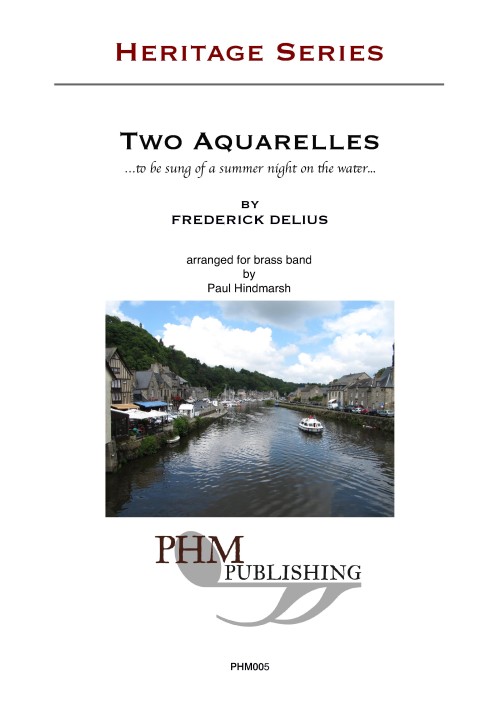
Two Aquarelles (Euphonium Feature with Brass Band - Score and Parts) - Delius, Frederick - Hindmarsh, Paul
In the late spring of 1917, the Bradford born composer, Frederick Delius (1856 - 1934) composed two short part-songs at his home in Grez-sur-Loing. The river ran along the bottom of his garden and he called the two miniatures To be sung of a summer night on the water. The First World War was at its height, but one would never guess that from the languid and serene quality of these richly textured nocturnes. The songs were first heard in London on 28 June, sung by the Oriana Madrigal Society, conducted by Charles Kennedy Scott. In 1932 Delius's amanuensis, Eric Fenby, arranged them for string orchestra as Two Aquarelles. While I have taken Fenby's title, my arrangement is a note-for-note transcription of the choral original. It was prepared in early in 1993 for Besses o' th' Barn Band, of which I was Musical Director at the time. In the second song, the prominent tenor solo has been given to the solo euphonium, who should stand apart from the band in performance.- Paul HindmarshDuration: 5.00
Estimated dispatch 7-14 working days
-
 £69.99
Suite Symetrique (Brass Band - Score and Parts) - De Haan, Jacob - Haantjes, Menno
This playful three-part suite is largely based on symmetry. This of course is largely due to the relations of the arrangement of the themes; however, on the other hand, to the larger structures in form. The first part, (Prelude et Scherzo) has a solemn opening. Followed by it a related scherzo with many changes in time, this too is composed in a symmetrical form. In the second movement, Choral Dorian, the theme of the prelude is reversed and used in chorale in Dorian tonality. The suite comes to a close with Rondo d'Avignon. An annual theatre festival in a French city on the Rhone inspired this suite. It is a lively movement, symmetrically bought to a finish with a repeat of the prelude from the first movement.Duration: 5:15
Estimated dispatch 7-14 working days
-
 £44.95
Intrada (Brass Band - Score and Parts - Gregson, Edward
This work was commissioned by the London Borough of Redbridge with funds provided by the Arts Council of Great Britain, and was first performed at the London Festival of 1972 by the Redbridge Youth Band, conducted by John Ridgeon.Intrada is in three sections, the first and last being similar. The middle section unfolds an expansive chromatic melody, heard initially on the horns, but later in canon between cornets and trombones. The work is lively throughout and has strong rhythmic elements as its chief characteristic, including changing time patterns and syncopations.Duration: 6.00
Estimated dispatch 7-14 working days
-
 £44.95
Glorified (Brass Band - Score and Parts) - Wainwright, Andrew
Glorified was composed for the Canadian Staff Band's 50th Anniversary celebrations. This work is based on two tunes, Lord, be glorified and Great is thy faithfulness. This song celebrates and signifies the faithfulness to all associated with the Canadian Staff Band, and the commitment shown by its members through the years.The first half of the work harkens back to those members of the band who tragically perished in the early days on RMS Empress of Ireland, which was en route to England for the 1914 International Congress when it was struck by another vessel and sank. The rhythmic ostinatos heard represent the passing of time over the years. After the somewhat dark introduction, the music settles into a reflective rendition of In my life, Lord, be glorified, before bursting into a rhythmic and jagged mixed-metre section. A yearning elegy pays tribute to those who lost their lives.The second half of the piece is celebratory in nature and commemorates the reformation of the band and the rich history which has ensued in the subsequent years. The rhythmic energy found in this section builds to a majestic presentation of the tune Lord, be glorified, which leads into the return of Great is thy faithfulness but in an optimistic fashion.
Estimated dispatch 7-14 working days
-
 £40.00
Trittico (Brass Band - Score only) - Curnow, James
Trittico was commissioned by the Swiss Brass Band Association for their national championships in 1988.A trittico is a triptych or group of three paintings or musical compositions based on a common theme and presented or performed together. The present work is a set of three extended variations on the American shaped-note hymn Consolation.The work opens in grand style with motives based on intervals of the hymn tune. The opening motif, and smaller fragments of it reappear throughout the piece and serve as an underlying element alongside the theme itself.The first variation is essentially a scherzo which echoes the minor mood of the theme. The hemiolic opposition of compound and duple time is used to good effect and, again, the main motif is never far away. This is music with energy and forward movement.The second variation gives the soloists a chance to shine. The mood is tranquil, yet there is always some activity and the musical material pre-echoes the third variation.The third variation is another scherzo-like section, the main theme accompanied by a rhythmic ostinato. Toward the conclusion there is a short aleatoric passage - a variation within a variation allowing half the band to make their own variations in a cacophony of sound. An energetic coda draws together several elements to round off a work brim full of drive, energy, and self-propelled enthusiasm.Recorded on Polyphonic QPRL044D Brass from the ValleysDuration: 13:30
Estimated dispatch 7-14 working days
-
£90.00
Trittico (Brass Band - Score and Parts) - Curnow, James
Trittico was commissioned by the Swiss Brass Band Association for their national championships in 1988.A trittico is a triptych or group of three paintings or musical compositions based on a common theme and presented or performed together. The present work is a set of three extended variations on the American shaped-note hymn Consolation.The work opens in grand style with motives based on intervals of the hymn tune. The opening motif, and smaller fragments of it reappear throughout the piece and serve as an underlying element alongside the theme itself.The first variation is essentially a scherzo which echoes the minor mood of the theme. The hemiolic opposition of compound and duple time is used to good effect and, again, the main motif is never far away. This is music with energy and forward movement.The second variation gives the soloists a chance to shine. The mood is tranquil, yet there is always some activity and the musical material pre-echoes the third variation.The third variation is another scherzo-like section, the main theme accompanied by a rhythmic ostinato. Toward the conclusion there is a short aleatoric passage - a variation within a variation allowing half the band to make their own variations in a cacophony of sound. An energetic coda draws together several elements to round off a work brim full of drive, energy, and self-propelled enthusiasm.Recorded on Polyphonic QPRL044D Brass from the ValleysDuration: 13:30
Estimated dispatch 7-14 working days
 View Music