
Results
-
 £84.95
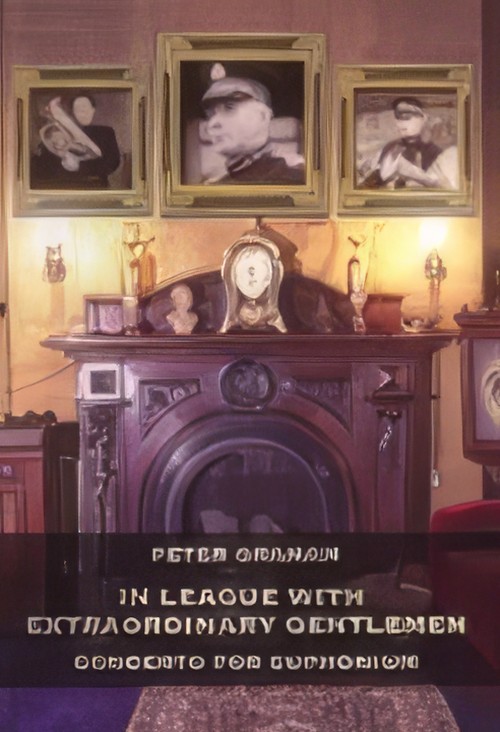
In League with Extraordinary Gentlemen (Euphonium Solo with Brass Band - Score and Parts) - Graham, Peter
Concerto for EuphoniumIn League with Extraordinary Gentlemen combines two of composer Peter Graham's life interests - composition and 19th century popular fiction. Each of the concerto's three movements takes its musical inspiration from extraordinary characters who have transcended the original genre and have subsequently found mass audiences through film, television and comic book adaptations.The first movement follows a traditional sonata form outline with one slight modification. The order of themes in the recapitulation is reversed, mirroring a plot climax in the H.G. Wells novella The Time Machine (where the protagonist, known only as The Time Traveller, puts his machine into reverse bringing the story back full circle).The Adventure of the Final Problem is the title of a short story published in The Memoirs of Sherlock Holmes by Arthur Conan Doyle. This is an account of the great detective's final struggle with his long-time adversary Professor Moriarty at the Reichenbach Falls in Switzerland. The music takes the form of a slowed down lndler (a Swiss/Austrian folk dance) and various acoustic and electronic echo effects call to mind the alpine landscape. The final bars pose a question paralleling that of Conan Doyle in the story - have we really seen the last of Sherlock Holmes?The final movement, The Great Race, (available separately) follows Phileas Fogg on the last stage of his epic journey "Around the World in Eighty Days" (from the novel by Jules Verne). The moto perpetuo nature of the music gives full rein to the soloist's technical virtuosity. As the work draws to a conclusion, the frantic scramble by Fogg to meet his deadline at the Reform Club in Pall Mall, London, is echoed by the soloist's increasingly demanding ascending figuration, set against the background of Big Ben clock chimes.In League with Extraordinary Gentlemen was first performed in the brass band version by David Thornton and the Black Dyke Band, conductor Nicholas Childs, at the RNCM Concert Hall Manchester on January 30, 2009.
Estimated dispatch 7-14 working days
-
 £74.95
Radio City (Trombone Solo with Brass Band - Score and Parts) - Graham, Peter
As youngsters growing up on the west coast of Scotland, my brother and I fell heir to an old valved radiogram which provided us with our first experiences of radio broadcasts. On the short wave signal, and through the static, we could pick up a whole range of programmes from across the Atlantic. I particularly recall the baseball games, the American accents of the announcers providing a window to a evocative world far removed from our small Ayrshire town. These memories form the basis of Radio City.The work is set in three movements, each introduced by a pastiche radio announcer narrative written by Philip Coutts. The first, City Noir, is a nod towards Raymond Chandler's eponymous private eye Philip Marlow and the dark cityscape of 1940s California.Movement two, Cafe Rouge, takes its title from the main restaurant in New York's famous Hotel Pennsylvania. Two of the most famous band leaders of the 1940s, trombonists Glenn Miller and Tommy Dorsey, broadcast live from the cafe on numerous occasions and the movement echoes with a collage of imagined sounds from the period.The finale, Two-Minute Mile, derives from an event dubbed in the USA as "the most exciting two minutes in sport", namely the Kentucky Derby. The virtuoso soloist figurations have their roots in Kentucky bluegrass fiddle music, with the galloping bluegrass clog-dancing rhythms providing the backdrop.- Peter Graham, Cheshire, January 2013
Estimated dispatch 7-14 working days
-
 £154.99
Spiriti (Brass Band - Score and Parts)
A Bach chorale stands at the centre of this work (F?r deinen Thron tret? ich hiermit).Anton Bruckner was one of Johann Sebastian Bach's great admirers. His work is full of the spirit of that musical genius. For Thomas Doss, it was Bruckner's spirit that always seemed to be with him while working on Spiriti. Bruckner's spirit is captured in this composition by a quote from the chorale of his Fifth Symphony at the end of the piece.The introduction, written in the style of a funeral march, already displays the first fragments of the chorale. Like splinters they are strewn throughout the first Allegro, combining and recombining in turbulent, powerful tutti passages. As the music becomes more rambunctious, the Bach-like fragments begin to swirl around each other, only to be scattered once more.The middle-section is of a more pensive nature. The Religioso character gives the audience time to reflect. The music is meditative and the quarter-note (or crotchet) elements mimic a soul that is yearning and crying out.The third part of the piece finally leads, by way of minimalist elements and the fragments mentioned earlier, to a magnificent presentation of the Bach chorale. As the church bells ring out, one can almost hear the great masters presiding at the organ. 17:00
Estimated dispatch 7-14 working days
-
 £59.95
Essay (Brass Band - Score and Parts) - Gregson, Edward
This work was specially commissioned as the test piece for a new brass band competition in 1971, held at the Royal Albert Hall, London. It is in three movements, the titles of which all have literary connotations. The first movement, Dialogue takes the form of 'conversations' between the instruments, based on the opening melody announced in unison on cornets and euphoniums. A second theme is introduced on the flugel horn and developed alongside this, creating a sonata form shell.The second movement, Soliloquy is dedicated to the memory of Gilbert Vinter - a composer who did so much in the 1960s to bring the brass band into the modern world. The movement is poignant in mood, which is depicted by a cornet solo announced after a brief introduction. The middle section builds to a powerful climax, at which point the opening theme of the first movement is heard again. Tranquillity returns however, with a solo trombone now playing the original theme with other instruments adding decorative accompanying patterns.The final movement, Epigram, creates strong rhythmic contrasts and exploits the more virtuoso character of the brass band. The middle section, with its changing time patterns and open expansive melody, suggests a 'big-country' style. A rhythmically charged coda concludes the work in exciting fashion.Duration: 12.00
Estimated dispatch 7-14 working days
-
£29.95
Essay (Brass Band - Score only) - Gregson, Edward
This work was specially commissioned as the test piece for a new brass band competition in 1971, held at the Royal Albert Hall, London. It is in three movements, the titles of which all have literary connotations. The first movement, Dialogue takes the form of 'conversations' between the instruments, based on the opening melody announced in unison on cornets and euphoniums. A second theme is introduced on the flugel horn and developed alongside this, creating a sonata form shell.The second movement, Soliloquy is dedicated to the memory of Gilbert Vinter - a composer who did so much in the 1960s to bring the brass band into the modern world. The movement is poignant in mood, which is depicted by a cornet solo announced after a brief introduction. The middle section builds to a powerful climax, at which point the opening theme of the first movement is heard again. Tranquillity returns however, with a solo trombone now playing the original theme with other instruments adding decorative accompanying patterns.The final movement, Epigram, creates strong rhythmic contrasts and exploits the more virtuoso character of the brass band. The middle section, with its changing time patterns and open expansive melody, suggests a 'big-country' style. A rhythmically charged coda concludes the work in exciting fashion.Duration: 12.00
Estimated dispatch 7-14 working days
-
 £44.95
Powerhouse (Brass Band - Score and Parts) - Downie, Kenneth
Spirit divine, come as of old. So begins the song by Brindley Boon, and that phrase becomes the message of this piece, and an important motif in the music. It appears at the very beginning of the work and recurs at important points during the piece. The theme of the need for spiritual power is further underlined by the use of the hymns Show your power, Wonder-working power and the very old chorus Send a new touch of power on my soul, Lord.The composer first heard Boon's song Spirit Divine when it was sung by Parkhead Songsters in the Sunday morning meeting at his home Corps of Greenock Citadel. They were visiting for the weekend from Glasgow, and were conducted by Songster Leader Walter Chalmers, himself a beautiful lyric tenor soloist. They sang it in a moving fashion, unaccompanied, and such was the impact that, at the conclusion, many people went to the mercy seat. It made a huge impression on the young composer. It was the first time that Downie discovered the enormous power of music in worship. It also serves as a reminder to us all that young people of a tender age are very capable of grasping deeply significant events happening around them. This music was written for the 2020 UK Territorial Youth Band course.
Estimated dispatch 7-14 working days
-
 £54.99
Hypernikon (Brass Band - Score and Parts) - Van der Roost, Jan
The Greek word hypernikon roughly translates as More Than Conquerors, the motto of Gordon College in Wenham, Massachusetts, the commissioner of this piece. The work is inspired by David Rox's very own name, the first two letters of his name, D and A, sets the first theme is in D major, with these notes being the tonic and dominant of the scale. After the stately intrada, the tempo accelerates and the festive feel of the march emerges. The trio melody serves as a beautiful contrast before finally ending with the opening theme in a grand tutti.Duration: 3.45
Estimated dispatch 7-14 working days
-
 £159.99
Other Lives (Brass Band - Score and Parts) - Waespi, Oliver
Other Lives is works perfectly for a competition but can also be programmed as concert work. The dark chords at the beginning of the piece are derived from Der Doppelganger, one of Franz Schubert's late songs. After a short development the music begins to accelerate and find its own shape, gradually moving away from the introduction. The entire first part, Rage, has an intensely agitated character. The ensuing Reflection turns back to the initial chord progression, before a series of interspersing solos explore time and space at a slower pace. After another musical surge, the music is brought close to silence and then gives way to the third part, Redemption. Here, a widely spaced sound field contains a remote allusion to another work by Schubert, Ruckblick. After this farewell, an abstract musical transformation triggers an emotional change, as the initial motifs are now presented in their inversed form in order to create a much brighter harmonic landscape. Moreover, in the last part of the piece, Renewal, the grim, tense atmosphere of the first part is transformed into a great energy.Duration: 18.00
Estimated dispatch 7-14 working days
-
 £72.99
English Dances, Set 1, Op.27: No.1, Andantino (Brass Band - Score and Parts) - Arnold, Malcolm - Farr, Ray
English Dances, Set I, opus 27, is a light classic composition that was written for orchestra by the British composer Malcolm Arnold in 1950. The set contains four dances that continue without pause: the individual movements are indicated by the tempo markings. The work came about at the request of Bernard de Nevers, at the time the head of publisher Alfred Lengnick & Co., who asked Arnold to write a suite of dances as an English counterpart to Dvovk's Slavonic Dances and Bartk's Romanian Folk Dances. The premire took place in the spring of 1951, played by the London Philharmonic Orchestra, conducted by Sir Adrian Boult. Following the success of the first set, DeNevers asked the composer to write a second one, which Arnold completed the next year (Op. 33). The Andantino from the first set has been skilfully arranged and orchestrated for brass band by Ray Farr.Duration: 2.45
Estimated dispatch 7-14 working days
-
 £35.00
Good King Wenceslas (Brass Band - Score and Parts) - McKenzie, Jock
This popular Christmas carol tells the story of a Bohemian King who braved harsh winter weather to give alms to a poor peasant. This takes place on the Feast of Stephen, the first day of Christmas (December 26th). This legend is based on the life of the historical Saint Wenceslas 1, Duke of Bohemia (907 - 935). In 1853 the English hymn writer John Mason Neale wrote his own version of this tale, setting his words to the melody of a 13th century spring carol "Tempus adest floridum" which had first been published in Piae Cantiones (1582). It is this version that has endured to become the popular carol of today. Duration: 4.30
Estimated dispatch 7-14 working days
 View Music