
Results
-
 £44.95
Trombone Concerto (Trombone Solo with Brass Band - Score only) - Wiffin, Rob
My Trombone Concerto was commissioned by Brett Baker following an earlier piece I had written for him called Shout! It was composed in Spain in the summer of 2010. Once I started writing I realised that this concerto was inevitably going to draw on my own experiences as a trombone player. The first movement was really a matter of getting the right thematic ideas and balancing the tutti and solo passages so, for formal structure, I studied the Gordon Jacob Trombone Concerto. There is a lyrical section preceding the first Allegro that owes much in spirit (but not in the actual music) to The Eternal Quest, Ray Steadman-Allen's Salvation Army solo. The slow movement seemed determined to come out in the vein of a Richard Strauss song. I wanted to write something ineluctably 'cantabile' as we trombone players rarely get a chance to play the melody. There is a brief allusion to that wonderful moment when the trombone gets to sing above the orchestra in Sibelius' seventh symphony. Arthur Wilson, that great exponent of the singing style in trombone-playing and my teacher at college died in the summer of 2010 so it seemed appropriate to dedicate this movement to him. The last movement is the lightest of the three in style and is slightly jazz-inflected, hopefully providing some fun for the soloist. While wanting to test the instrument I did not set out with the intention of making the concerto difficult but there are undoubtedly challenges of technique, range and style to be met by the soloist.- Rob Wiffin
Estimated dispatch 7-14 working days
-
£87.95
Trombone Concerto (Trombone Solo with Brass Band - Score and Parts) - Wiffin, Rob
My Trombone Concerto was commissioned by Brett Baker following an earlier piece I had written for him called Shout! It was composed in Spain in the summer of 2010. Once I started writing I realised that this concerto was inevitably going to draw on my own experiences as a trombone player.The first movement was really a matter of getting the right thematic ideas and balancing the tutti and solo passages so, for formal structure, I studied the Gordon Jacob Trombone Concerto. There is a lyrical section preceding the first Allegro that owes much in spirit (but not in the actual music) to The Eternal Quest, Ray Steadman-Allen's Salvation Army solo.The slow movement seemed determined to come out in the vein of a Richard Strauss song. I wanted to write something ineluctably 'cantabile' as we trombone players rarely get a chance to play the melody. There is a brief allusion to that wonderful moment when the trombone gets to sing above the orchestra in Sibelius' seventh symphony. Arthur Wilson, that great exponent of the singing style in trombone-playing and my teacher at college died in the summer of 2010 so it seemed appropriate to dedicate this movement to him.The last movement is the lightest of the three in style and is slightly jazz-inflected, hopefully providing some fun for the soloist.While wanting to test the instrument I did not set out with the intention of making the concerto difficult but there are undoubtedly challenges of technique, range and style to be met by the soloist.- Rob Wiffin
Estimated dispatch 7-14 working days
-
 £89.95
Trombone Concerto (Trombone Solo with Brass Band - Score and Parts) - Gregson, Edward
The Gregson Trombone Concerto was originally written in 1979 to a commission from Bedfordshire Education Service, for a new work for Michael Hext, winner of the first BBC Young Musician of the Year competition. This version for brass band was commissioned by Nicholas Childs, Music Director of the Black Dyke Band, specially for Brett Baker, the then principal trombone of the band. He has recorded it on the Doyen label with the Black Dyke Band.The work falls into three main sections, played without a break, but conforming to the traditional pattern of concerto structure. After a slow introduction, containing most of the motivic and rhythmic ideas used in the work, there follows the main fast section which is itself divided into three parts and concludes with a fierce climax (timpani and gong). The slow and rather intense middle section is linked to a cadenza for the soloist, at first unaccompanied but leading to accompanied references to earlier material. The final section is a scherzo which ends dramatically with a re-statement of the opening slow introduction. A brisk coda concludes the work. The interval of a fourth (and its augmented form) provides melodic and harmonic unity for the work, whilst the tonal juxtaposition between E minor and B flat major throughout the concerto is an important element of the structure.The writing for trombone is virtuosic, encompassing the whole range of the instrument, but it also exploits the rather beautiful lyrical sound of which this instrument is capable.
Estimated dispatch 7-14 working days
-
 £44.95
Trombone Concerto (Trombone Solo with Brass Band - Score only) - Gregson, Edward
The Gregson Trombone Concerto was originally written in 1979 to a commission from Bedfordshire Education Service, for a new work for Michael Hext, winner of the first BBC Young Musician of the Year competition. This version for brass band was commissioned by Nicholas Childs, Music Director of the Black Dyke Band, specially for Brett Baker, the then principal trombone of the band. He has recorded it on the Doyen label with the Black Dyke Band.The work falls into three main sections, played without a break, but conforming to the traditional pattern of concerto structure. After a slow introduction, containing most of the motivic and rhythmic ideas used in the work, there follows the main fast section which is itself divided into three parts and concludes with a fierce climax (timpani and gong). The slow and rather intense middle section is linked to a cadenza for the soloist, at first unaccompanied but leading to accompanied references to earlier material. The final section is a scherzo which ends dramatically with a re-statement of the opening slow introduction. A brisk coda concludes the work. The interval of a fourth (and its augmented form) provides melodic and harmonic unity for the work, whilst the tonal juxtaposition between E minor and B flat major throughout the concerto is an important element of the structure.The writing for trombone is virtuosic, encompassing the whole range of the instrument, but it also exploits the rather beautiful lyrical sound of which this instrument is capable.Duration: 16.00
Estimated dispatch 7-14 working days
-
 £45.00
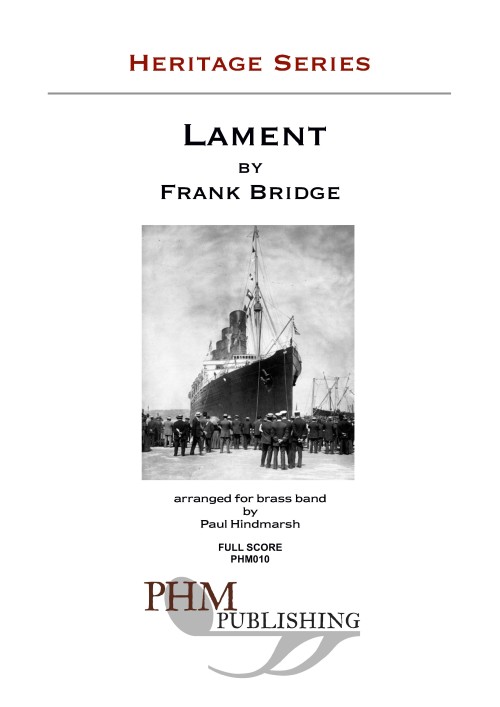
Lament (Brass Band - Score and Parts) - Bridge, Frank - Hindmarsh, Paul
The English composer Frank Bridge (1879 - 1941) did not take an active part in the First World War. However, he was devastated by the slaughter on the western and the eastern fronts, especially the loss of so many of his musicians friends and colleagues. Writing in 1963, his former pupil Benjamin Britten confessed that 'a lot of my feelings about the First World War which people seemed to see in the War Requiem came from Bridge. He had written a piano sonata in memory of a friend killed in France and though he didn't encourage me to take a stand for the sake of a stand, he did make me argue and argue and argue. His own pacifism was not aggressive, but typically gentle'.Bridge composed this Lament for string orchestra on 14 June 1915, in memory of Catherine Crompton, who drowned when the Cunard liner Lusitania was torpedoed by a German submarine on 7 May, 1915. According to figures researched by Liverpool historian Kevin Roach (www.lusitania.net), 1201 men, women and children lost their lives out of the 1962 people aboard. Ninety-four children died, including Catherine, her twin brother Paul and four other siblings. Paul Crompton, Snr. (44), a British businessman working in Philadelphia, his wife Gladys (40) and the family nanny were also drowned. How Bridge's dedication came about is uncertain. The music critic Edwin Evans, who knew Bridge well, has written that the Catherine was a young friend. It is also possible that he came across the family photograph which was published in many newspapers in the wake of the tragedy. By that time, Bridge was greatly distressed by the war as a whole. It seems perfectly in keeping with his pacifist leanings and the strength of his reaction, that this poignant and deeply touching 'war memorial' should mourn a child who he did not know, rather than one of the thousands of young men who fell in battle.Through the musical tears of this melancholy lullaby, Bridge may have regarded the death of young Catherine Crompton as symbolic of the loss of so many innocent lives in wartime. His response to this personal tragedy was characteristically spontaneous and utterly sincere. It is one of his most effective miniatures, poignant yet restrained in its lyrical beauty, with a compelling directness and simplicity of construction.This brass band transcription is pitched one tone lower than the original for string orchestra.- Paul HindmarshDuration: 5.00
Estimated dispatch 7-14 working days
-
 £44.95
Trailblazers (Brass Band - Score and Parts) - Mackereth, Andrew
This overture draws its inspiration from the story of the first Household Troops Band. It tells the story of the 1887 band, the subsequent lull of nearly a hundred years and the re-awakening of the Troops phenomenon in 1985. It was originally written in 1995 and featured prominently by the band on its North American tour of 2002. Given the history of the Household Troops Band, it is fitting that this composition is preoccupied with marching. It begins with a marching song played by a solitary muted cornet, symbolic not only of the call to bandsmen to join the evangelical effort but also a muso-dramatic device to indicate the steady increase in members and technical ability! The music quickly develops into stirring versions of 'A robe of white' and 'Storm the forts of darkness' with two early day Salvation Army tunes crucially adding to the narrative; 'Marching on in the light of God' and 'Soldiers of our God, arise!' The second section is a reflective setting of the Herbert Booth song, 'The penitent's plea'. This song serves to represent the many people who were 'saved' during those early day campaigns. The expressive music transports the listener through a period of uncertainty and angst until finally reaching the song, 'There is a message, a simple message, and it's a message for us all'. The final section deals first with the emergence from the annals of history with the muted cornet figure again before, symbolically, the present day band bursts forth with an emphatic statement of 'Would you be free from your burden of sin? There's power in the blood'. The stirring climax represents a fitting tribute to those gallant pioneering musicians and their equally impressive and dedicated contemporaries.
Estimated dispatch 7-14 working days
-
£22.50
Trailblazers (Brass Band - Score only) - Mackereth, Andrew
This overture draws its inspiration from the story of the first Household Troops Band. It tells the story of the 1887 band, the subsequent lull of nearly a hundred years and the re-awakening of the Troops phenomenon in 1985. It was originally written in 1995 and featured prominently by the band on its North American tour of 2002. Given the history of the Household Troops Band, it is fitting that this composition is preoccupied with marching. It begins with a marching song played by a solitary muted cornet, symbolic not only of the call to bandsmen to join the evangelical effort but also a muso-dramatic device to indicate the steady increase in members and technical ability! The music quickly develops into stirring versions of 'A robe of white' and 'Storm the forts of darkness' with two early day Salvation Army tunes crucially adding to the narrative; 'Marching on in the light of God' and 'Soldiers of our God, arise!' The second section is a reflective setting of the Herbert Booth song, 'The penitent's plea'. This song serves to represent the many people who were 'saved' during those early day campaigns. The expressive music transports the listener through a period of uncertainty and angst until finally reaching the song, 'There is a message, a simple message, and it's a message for us all'. The final section deals first with the emergence from the annals of history with the muted cornet figure again before, symbolically, the present day band bursts forth with an emphatic statement of 'Would you be free from your burden of sin? There's power in the blood'. The stirring climax represents a fitting tribute to those gallant pioneering musicians and their equally impressive and dedicated contemporaries.
Estimated dispatch 7-14 working days
-
 £44.95
Princethorpe Variations (Brass Band - Score and Parts) - Downie, Kenneth
Colourful harmony, rhythmic flair and melodic invention are the hallmarks of this excellent set of variations by Kenneth Downie, based on the well known church tune, Princethorpe.This major work demonstrates the well-known characteristics of the composer: colourful harmony, rhythmic flair and melodic invention, all encapsulated in scoring which is engulfing both to players and listeners alike. Following a presentation of the theme there are five variations culminating in what can be described as either a finale or coda.Theme. The composer shows his originality in the harmonic sense of this introduction. Perhaps it could be suggested that over-indulgence of rubato may be a temptation to be avoided.Sections A to F. Relentless rhythmic drive is of paramount importance in this first variation. Conscientious observance of dynamics is of course an essential requirement in conveying the exciting quality of the music; there are moments of sudden contrast of which all will need to be aware. Moving between the time-signatures of 5/4 and 6/4 these sections are built from strong easily-identifiable fragments of the theme. These is a significant increase in temp at letter F which will further the exciting impact of the music.Sections G & H. In a pastorale style this short, gentle variation affords a contrast in style between the previous and succeeding ones. The gentle undulating character of the melodic lines is governed by the Allegretto grazioso directive.Sections I to M. Commencing two bars before letter I the music is now exuberant and the tempo and style is that of a march in compound time. In this exhilarating movement there are moments of contrast and indeed of delicacy which are a foil to the more energetic moments. Rhythmic control will be essential to maintain a consistent tempo. As elsewhere in the work, the percussion section will contribute much to the success of the performance there are bars where this section alone is heard and there are important entries for glockenspiel.Sections N & O. With emotional content this Adagio variation has the first two notes of the melody as its melodic impetus. Apart from just over two bars at O (where there is an interpolatory phrase from Cornets and Trombones), the melodic line is entrusted to the plaintive sounds of the horn section. Cornets and Trombones provide a change of tone colour at the beginning of section O. Under a poco rall, this very expressive variation is concluded; there is an important link supplied by Eb Bass.Sections P & Q. A lively march-tempo is launched immediately and these sections are in the nature of an introduction to the final variations. There is a quickening of pace at Q which assists the generation of excitement which should be an essential part of the performance. Solo Cornets introduce a melodic line at Q which anticipates the compound time of the following section.Sections R & S. The Solo Cornet theme of the previous section is now a contrapuntal line accompanying the theme tune. With an elongation of the notes in the melody, the conductor will need to call on the sustaining powers of the band and at no time should the interesting accompanying lines be allowed to detract from the sonorous presentation of the basic theme.Sections T, U & V. Following a poco rit, the finale begins at letter T with the directive, molto vivace. There is much detail to be rehearsed, not least being the dynamic contrasts which are encountered. As throughout the work, the listener should have no difficulty in identifying the thematic sources of the composer's music.
Estimated dispatch 7-14 working days
-
£22.50
Princethorpe Variations (Brass Band - Score only) - Downie, Kenneth
Colourful harmony, rhythmic flair and melodic invention are the hallmarks of this excellent set of variations by Kenneth Downie, based on the well known church tune, Princethorpe.This major work demonstrates the well-known characteristics of the composer: colourful harmony, rhythmic flair and melodic invention, all encapsulated in scoring which is engulfing both to players and listeners alike. Following a presentation of the theme there are five variations culminating in what can be described as either a finale or coda.Theme. The composer shows his originality in the harmonic sense of this introduction. Perhaps it could be suggested that over-indulgence of rubato may be a temptation to be avoided.Sections A to F. Relentless rhythmic drive is of paramount importance in this first variation. Conscientious observance of dynamics is of course an essential requirement in conveying the exciting quality of the music; there are moments of sudden contrast of which all will need to be aware. Moving between the time-signatures of 5/4 and 6/4 these sections are built from strong easily-identifiable fragments of the theme. These is a significant increase in temp at letter F which will further the exciting impact of the music.Sections G & H. In a pastorale style this short, gentle variation affords a contrast in style between the previous and succeeding ones. The gentle undulating character of the melodic lines is governed by the Allegretto grazioso directive.Sections I to M. Commencing two bars before letter I the music is now exuberant and the tempo and style is that of a march in compound time. In this exhilarating movement there are moments of contrast and indeed of delicacy which are a foil to the more energetic moments. Rhythmic control will be essential to maintain a consistent tempo. As elsewhere in the work, the percussion section will contribute much to the success of the performance there are bars where this section alone is heard and there are important entries for glockenspiel.Sections N & O. With emotional content this Adagio variation has the first two notes of the melody as its melodic impetus. Apart from just over two bars at O (where there is an interpolatory phrase from Cornets and Trombones), the melodic line is entrusted to the plaintive sounds of the horn section. Cornets and Trombones provide a change of tone colour at the beginning of section O. Under a poco rall, this very expressive variation is concluded; there is an important link supplied by Eb Bass.Sections P & Q. A lively march-tempo is launched immediately and these sections are in the nature of an introduction to the final variations. There is a quickening of pace at Q which assists the generation of excitement which should be an essential part of the performance. Solo Cornets introduce a melodic line at Q which anticipates the compound time of the following section.Sections R & S. The Solo Cornet theme of the previous section is now a contrapuntal line accompanying the theme tune. With an elongation of the notes in the melody, the conductor will need to call on the sustaining powers of the band and at no time should the interesting accompanying lines be allowed to detract from the sonorous presentation of the basic theme.Sections T, U & V. Following a poco rit, the finale begins at letter T with the directive, molto vivace. There is much detail to be rehearsed, not least being the dynamic contrasts which are encountered. As throughout the work, the listener should have no difficulty in identifying the thematic sources of the composer's music.
Estimated dispatch 7-14 working days
-
 £94.95
An Age of Kings (Mezzo-Soprano Solo with Brass Band and optional choir - Score and Parts) - Gregson, Edward
The origins of this work date back to 1988, when I was commissioned by the Royal Shakespeare Company to write the music for The Plantagenets trilogy, directed by Adrian Noble in Stratford-upon-Avon. These plays take us from the death of Henry V to the death of Richard III. Later, in 1991, I wrote the music for Henry IV parts 1 and 2, again in Stratford. All of these plays are concerned with the struggle for the throne, and they portray one of the most turbulent periods in the history of the British monarchy.Much of the music used in these productions was adapted into two large symphonic suites for wind band - The Sword and the Crown (1991) and The Kings Go Forth (1996). An Age of Kings is a new version for brass band incorporating music from both the symphonic suites for wind band. It was specially composed for a recording made by the Black Dyke Band, conducted by Nicholas Childs, in 2004.An Age of Kings is music on a large-scale canvas, scored for augmented brass band, with the addition of harp, piano, mezzo-soprano solo, male chorus, as well as two off-stage trumpets. The music is also organized on a large-scale structure, in three movements, which play without a break - "Church and State", "At the Welsh Court", and "Battle Music and Hymn of Thanksgiving".The first movement, "Church and State", opens with a brief fanfare for two antiphonal trumpets (off-stage), but this only acts as a preface to a Requiem aeternam (the death of Henry V) before changing mood to the English army on the march to France; this subsides into a French victory march, but with the English army music returning in counterpoint. A brief reminder of the Requiem music leads to the triumphal music for Richard Plantagenet, Duke of York, father of Edward IV and Richard III (the opening fanfare transformed). However, the mood changes dramatically once again, with the horrors of war being portrayed in the darkly-drawn Dies Irae and Dance of Death, leading to the final section of the first movement, a funeral march for Henry VI.The second movement, "At the Welsh Court", takes music from the Welsh Court in Henry IV part 1 with a simple Welsh folk tune sung by mezzo-soprano to the inevitable accompaniment of a harp. This love song is interrupted by distant fanfares, forewarning of battles to come. However, the folk song returns with variation in the musical fabric. The movement ends as it began with off-stage horn and gentle percussion.The final movement, "Battle Music and Hymn of Thanksgiving", starts with two sets of antiphonally placed timpani, drums and tam-tam, portraying the 'war machine' and savagery of battle. Trumpet fanfares and horn calls herald an heroic battle theme which, by the end of the movement, transforms itself into a triumphant hymn for Henry IV's defeat of the rebellious forces.- Edward GregsonDuration - 22'00"Optional TTBB available separately.
Estimated dispatch 7-14 working days
 View Music