
Results
-
£44.95
EUPHONY (Euphonium Solo with Brass Band Set) - Robert Redhead
Previously only available in manuscript form, this euphonium solo with brass band accompaniment is now available in printed format. Euphony (meaning a pleasant, sweet sound) is based on the tunes of Sidney Cox with material taken from the songs; 'He found me', 'This one thing I know', 'You can tell out the sweet story' and 'Deep and wide'. At the time of writing, the composer remarked; 'The euphonium is often associated with melodies and harmonies that lend themselves to pleasing sounds'. That is true of this solo but it also presents considerable technical challenges for the soloist in terms of range and technique.
Estimated dispatch 7-14 working days
-
 £67.24
Pyrenean Carol Suite (Brass Band) David Taylor
This attractive suite for brass band by David Taylor features five traditional carols from the Pyrenees region of Spain, as follows: i. Nadal Tindaire (Jingling Christmas) - Occitan traditional This Occitan Christmas song tells of musical instruments used to celebrate the Nativity - 'fifes and trumpets, timpani and pipes, or you, clear little bells, along with the angels' choir.' ii. Gabriel's Message (Birjina Gaztetto Bat Zegoen) - Basque traditional The most widely-known of the chosen carols, honouring Jesus's mother Mary, this is often sung in its English version, but the melody came from the Basque country. The Basque words were adapted from the Mediaeval song Angelus ad Virginem. Here, we feature the flugel horn. This movement was originally written on its own, with organ accompaniment, for the composer's wife, Diane Scott. iii. El Noi de la Mare (The Child of the Mother) - Catalan traditional A beautiful Catalan carol celebrating the birth of Jesus, telling of the tasty gifts that the singer would bring - 'Raisins and figs and nuts and olives; Raisins and figs and honey and mato [a Catalan dessert cheese traditionally served with honey.]' Here we feature the euphonium. The tune was made famous by guitarist Andres Segovia, who used it as a favourite encore, and by John Rutter, who made a widely-used setting for choir. iv. Paure Satan (Poor Satan) - Occitan traditional This rather unusual carol tells of the pain that Satan is put to by the arrival of the infant Jesus. Its mocking and sarcastic tone is reflected here, where the tuba soloist (as Satan) is given musical trouble throughout by the other parts. At first they conflict with the soloist, then the soloist makes overtures of friendship, which are treated with suspicion followed by contempt. The soloist finally gives in to their accompaniment (or do they?). There are plenty of opportunities for little theatrical touches here, if the tuba player is so inclined! The tuba part in this movement is notably more difficult than the rest of the music, and a number of optional changes have been marked to make the part easier to play, if so desired. The player is also welcome to add suitable extra embellishments to taste if they wish, within the character of the music. v. Fum, Fum, Fum! - Catalan traditional A favourite Catalan Christmas song for centuries, this rousing melody provides a fitting way to round off the suite, with its repeated rhythmic refrain of the nonsense title phrase. It tells of the Nativity, and then it tells of the celebratory feasting and good times that the singers look forward to to honour it. Although the suite is intended to be performed whole, it is also intended for usage with a selection of movements on occasions where a shorter piece is wanted. Suggested formats include a single movement alone (2, 3, and 5 are likely most appropriate), a pair of movements (any of the first four, plus 5), and a suite of three or four movements (1 and 5, plus one or two of 2, 3, or 4 in the middle). It is suggested that a good way to design a 'pick-your-own-suite' from the movements is to think of the earlier movements as introductory to the final movement. To view a rolling score video featuring Kidlington Concert Brass please visit www.youtube.com/watch?v=QIGdul-yxxg PDF download includes score and parts. Sheet music available from: UK - www.brassband.co.uk USA - https://satradecentral.org Difficulty Level: 3rd Section + Length: 9.45 minutes Instrumentation: Soprano Cornet Eb Solo Cornet Bb Repiano Cornet Bb 2nd Cornet Bb 3rd Cornet Bb Flugel Horn Bb Solo Horn Eb 1st Horn Eb 2nd Horn Eb 1st Baritone Bb 2nd Baritone Bb 1st Trombone Bb 2nd Trombone Bb Bass Trombone Euphonium Bb Bass Eb Bass Bb Timpani Percussion 1-2
In Stock: Estimated dispatch 1-3 working days
-
 £33.62
A Christmas Canon (Brass Band) Traditional arr. William Gordon
Seamlessly merging the traditional English carol The First Nowell with Johann Pachelbel's beloved Canon in D, A Christmas Canon is a captivating arrangement designed to bring rich texture and emotional depth to your band's winter concert repertoire. Suitable for intermediate to advanced bands, the piece opens Adagio sostenuto with a gently rolling, scalic ostinato in the euphonium and lower brass, establishing the unmistakable harmonic ground bass of Pachelbel's masterpiece. Over this foundation, expressive solo lines in the flugel and horns gracefully weave the familiar melody of The First Nowell into the texture. As the arrangement unfolds, the scoring gradually builds density and counterpoint. Intricate muted cornet passages give way to flowing arpeggios, bell-like glockenspiel accents, and cascading lines across the band, driving a gradual crescendo into a rich, full-ensemble statement of the carol theme. The work reaches its dramatic climax at an expanded Allargando section, where the full band, supported by percussion, delivers a majestic, fortissimo declaration of the melody before resolving into a warm, lingering final chord. To view a rolling score video of the Amsterdam Staff Band performing this piece please visit: www.youtube.com/watch?v=dr9hMLhAvRM Difficulty Level: 3rd Section + Duration: 3.30 minutes This PDF download includes the full score and parts. Sheet music available at www.brassband.co.uk (UK) or https://satradecentral.org (USA) Instrumentation: Soprano Cornet Eb Solo Cornet Bb 1st Cornet Bb 2nd Cornet Bb Flugel Horn Bb Solo Horn Eb 1st Horn Eb 2nd Horn Eb 1st Baritone Bb 2nd Baritone Bb 1st Trombone Bb 2nd Trombone Bb Bass Trombone Euphonium Bb Bass Eb Bass Bb Timpani Percussion 1-2
In Stock: Estimated dispatch 1-3 working days
-
 £33.62
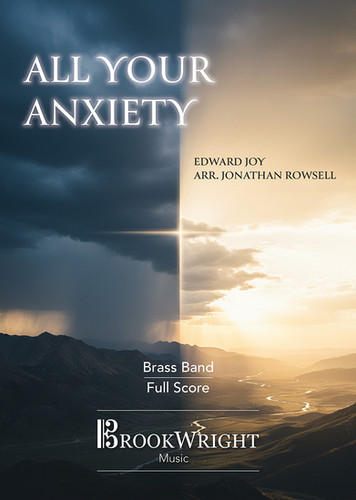
All Your Anxiety (Brass Band) Edward Joy arr. Jonathan Rowsell
All Your Anxiety is a reflective and expressive work for brass band inspired by Edward Joy's sacred song of the same name. Drawing deeply from the hymn's text and message, the piece explores the tension between human unease and the promise of peace found in faith. The work opens with a distinctive eighth-note figure in the euphonium that immediately establishes an unsettled character. Wide intervallic leaps and atypical slur groupings evoke a sense of fragility and uncertainty, musically portraying the weight of sorrow and care described in the opening verse of the hymn. This motivic material becomes the foundation of the entire arrangement, reappearing in varied forms as counter-melody, accompaniment, and featured solo lines across the ensemble. As the piece unfolds, the music gradually broadens and warms, reflecting the invitation of the text to "come to the cross" and leave one's burdens behind. Moments of lyricism and calm contrast with the earlier unease, leading toward a more settled and hopeful conclusion that mirrors the refrain's assurance: "Never a burden He cannot bear, never a friend like Jesus." To view a video of the Canadian Staff Band playing the piece please visit https://www.youtube.com/watch?v=5Ms8ubug4yA Sheet music available from www.brassband.co.uk or https://satradecentral.org Difficulty Level: 3rd Section + Length: 3.30 minutes Instrumentation: Soprano Cornet Eb Solo Cornet Bb 1st Cornet Bb 2nd Cornet Bb Flugel Horn Bb Solo Horn Eb 1st Horn Eb 2nd Horn Eb 1st Baritone Bb 2nd Baritone Bb 1st Trombone Bb 2nd Trombone Bb Bass Trombone Euphonium Bb Bass Eb Bass Bb Timpani Percussion
In Stock: Estimated dispatch 1-3 working days
-
 £33.62
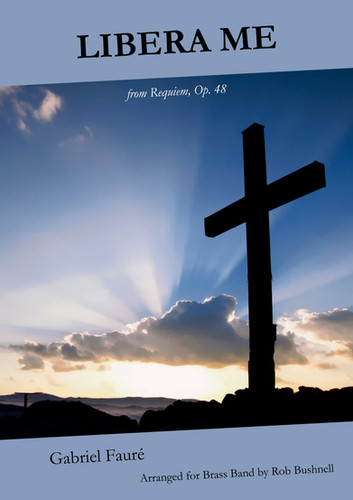
Libera Me from 'Requiem' (Brass Band) Faure arr. Rob Bushnell
Composed between 1887 and 1890, Gabriel Faure's Requiem is not only one of his best-known works but one of the most popular piece of choral music in the Classical repertoire, coming 23rd in the Classic FM's Hall of Fame 2024. Believed to be a tribute to his father (who died in 1885), Faure himself said "My Requiem wasn't written for anything - for pleasure, if I may call it that!" It started life as a five-movement work but was later expanded to be the final seven-movement work we know today. The first version (which Faure called "un petit Requiem") was first performed on 16 January 1888, with Faure conducting, a second version premiered on 21 January 1893 before the final version (reworked for full orchestra) was played on 12 July 1900; the Requiem was performed at the composer's own funeral in 1924.The Libera Me, or Deliver Me, was actually written in 1877 and is the sixth part of the Requiem.Faure once said of the work, "Everything I managed to entertain by way of religious illusion I put into my Requiem, which moreover is dominated from beginning to end by a very human feeling of faith in eternal rest." Upon interview, he also said, "It has been said that my Requiem does not express the fear of death and someone has called it a lullaby of death. But it is thus that I see death: as a happy deliverance, an aspiration towards happiness above, rather than as a painful experience. The music of Gounod has been criticised for its inclination towards human tenderness. But his nature predisposed him to feel this way: religious emotion took this form inside him. Is it not necessary to accept the artist's nature? As to my Requiem, perhaps I have also instinctively sought to escape from what is thought right and proper, after all the years of accompanying burial services on the organ! I know it all by heart. I wanted to write something different."This arrangement is for the British-style brass band, with alternative parts for horns in F and bass-clef lower brass. The tenor solo is featured on the euphonium. A recording of the original composition can be found here: www.youtube.com/watch?v=fXwFNoBHCf0 Duration: 4.20 minutes approx. Difficulty Level: 4th Section + PDF download includes parts and score. Sheet music available from www.brassband.co.uk Instrumentation: Soprano Cornet Eb Solo Cornet Bb Repiano Cornet Bb 2nd Cornet Bb 3rd Cornet Bb Flugel Horn Bb Solo Horn Eb 1st Horn Eb 2nd Horn Eb 1st Baritone Bb 2nd Baritone Bb 1st Trombone Bb 2nd Trombone Bb Bass Trombone Euphonium Bb Bass Eb Bass BbTimpani
In Stock: Estimated dispatch 1-3 working days
-
 £33.62
The Red Kite (Euphonium Solo with Brass Band) Rob Wiffin
At one time the Red Kite was close to national extinction in the UK, but now it is possible to admire this distinctive bird of prey with its red colouring and forked tail, gracefully soaring through the sky. This solo, composed for Martin Smith, captures that feeling, with the euphonium gliding solitary and effortlessly, occasionally swooping down before reclaiming its high altitude. To create the desired atmosphere, root position chords are kept to a minimum, with added notes enhancing the feeling of floating and giving the harmony subtle colour. The harmonic rhythm is slow, but the movement shifts in the way the Red Kite makes slight changes of direction with minor adjustments of its tail, leaving the soloist free to sing with a sense of grace and freedom above the accompaniment. Audio demo: https://soundcloud.com/user-565396545/the-red-kite-euphonium-solo Duration: Approx. 3.45 minutes Difficulty Level (Band): Easy Soloist: Medium This PDF download includes the full score and parts. Sheet music available at www.brassband.co.uk (UK) or https://satradecentral.org (USA)
In Stock: Estimated dispatch 1-3 working days
-
 £84.95
Euphonium Concerto - Anthony Ritchie
This concerto was commissioned by euphonium soloist Byron Newton to perform with the Wellington Brass Band and the Royal Air Force Band in 2015, with financial assistance from Creative New Zealand. It is in four movements, but can be performed...
Estimated dispatch 5-7 working days
-
 £33.62
Les Chasseresses from 'Sylvia' (Brass Band) Delibes arr. Rob Bushnell
Clement Philibert Leo Delibes was a French composer, best known for his ballets and operas, including works such as Lakme (with its famous "Flower Duet"), Coppelia and Sylvia (both key works in the development of modern ballet). The latter started as a play, Aminta, by the Italian poet Torquato Tasso, which Delibes set to music. It was then adapted for the Paris Opera with rehearsals starting in August 1875. The premiere took place on 14 June 1876 and was the first ballet to be shown at the newly-built Opera Garnier. Whilst the scenery and costumes were created by top artists and designers (Cheret and Lacoste), it was Delibes's music that shown thrown, being said to have saved the production, preventing the ballet from drifting into obscurity.Sylvia is said to be one of the first modern ballets, with Tchaikovsky remarking to composer Sergei Taneyev upon its ingenuity: "... the first ballet, where the music constitutes not only the main, but the only interest. What charm, what elegance, what richness of melody, rhythm, harmony." Although Swan Lake, a contemporary to Sylvia, is considered one of the best ballets there is, Tchaikovsky preferred Sylvia to his own work, saying Swan Lake was "poor stuff in comparison". Tchaikovsky said to Taneyev, "I was ashamed. If I had known this music early then, of course, I would not have written Swan Lake". The music to Sylvia, rather than setting only the mood, also sets the action and is noted for its use of leitmotifs - Delibes was an admirer of Wagner - and more dominant use of brass and wind. The most famous piece from this ballet is the Pizzicati in the third act.Act I of the ballet takes place in sacred wood, where creatures are worshipping before Eros when Sylvia arrives with her huntresses to mock the god of love. Aminta, a lowly shepherd and infatuated with Sylvia, protects the deity and Sylvia is wounded by Eros's arrow. The hunter Orion kidnaps Sylvia, whilst Eros revives Aminta. Act II takes place in Orion's Island cave, where Sylvia tries to bribe Orion with jewels and wine. Unsuccessful, she appeals to Eros for help, who arrives and takes her to the temple of Diana (where the final act takes place). Orion and Aminta fight, Sylvia and Orion cause the goddess of the hunt, Diana, to be outraged, smiting Orion and denying the love of Aminta and Sylvia. Eros shows Diana a vision, which changes her mind and the couple finally come together.This brilliant and lively fanfare that introduces the huntresses in the first act is arranged here for the UK-style brass band, with alternative parts for horns in F and bass-clef lower brass. The piece has been lowered by a tone compared to the original. A recording of the original composition can be found here https://youtu.be/6yoGrUH38PI?si=0L0bFa1qXnYNvkR3 Duration: Approx. 3.10 minutes Difficulty Level: 1st Section + This PDF download includes the full score and parts. Includes alternative parts for soloist in Eb, horns in F and lower brass in bass clef. Sheet music available at www.brassband.co.uk (UK) or https://satradecentral.org (USA) Instrumentation: Soprano Cornet Eb Solo Cornet Bb Repiano Cornet Bb 2nd Cornet Bb 3rd Cornet Bb Flugel Horn Bb Solo Horn Eb 1st Horn Eb 2nd Horn Eb 1st Baritone Bb 2nd Baritone Bb 1st Trombone Bb 2nd Trombone Bb Bass Trombone Euphonium Bb Bass Eb Bass Bb Timpani Percussion - Triangle, Cymbal & Bass Drum
In Stock: Estimated dispatch 1-3 working days
-
£59.95
PLANTAGENETS, The (Brass Band Set) - Edward Gregson
The Plantagenets was composed for the Championship Section of the Regional contests of the National Brass Band Championships of Great Britain 1973. The work is not intended to be programme music but rather it tries to portray the mood and feelings of an age, that of the House of Plantagenet, which lasted from the middle of the 12th century to the end of the 14th century. To many, it conjures up an Age of Chivalry and this is represented by fanfare motifs which occur throughout the work in varied form. The opening thematic figure, rising through the band in thirds and followed by the fanfares, is important as nearly all the subsequent material is based upon it. There follows two themes, the second of which is lyrical and introduced by horns. In the long, slow middle section, a new theme is introduced by a solo horn (recurring on cornet and euphonium in canon) and is developed at some length. A lively fugato scherzino, however, leads to a recapitulation of the opening section music and the work ends with a maestoso statement of the slow movement theme. A final reference to the fanfares ends the work.
Estimated dispatch 7-14 working days
-
 £82.19
'Odyssey' Variations (Brass Band) Kevin Norbury
'Odyssey' Variations was composed as a result of a commission in May 2020 from Five Lakes Silver Band and its musical director, Christopher Ward. This music is based on an original theme that I first used in an earlier composition, Odyssey, which was the test piece for the European Brass Band Championships, held at Munich, Germany, in April 1999. I distinctly remember getting into my hotel room and turning on the television to be greeted by news coverage of the Columbine High School shooting, so that piece has always held some significance for me, though because of a very sad coincidence. The melody was originally a cornet solo in the central slow section of Odyssey and pitched deliberately to test the soloist. I have, more recently attempted a straightforward choral setting of the melody, and the harmonies I use in the three chorale-style settings at the start of these variations are loosely based on that setting. The melody is a setting of the familiar words of Be Thou My Vision, an old Irish hymn, translated by Mary E. Byrne, and versified by Eleanor H. Hull. The form of the work is as follows: Theme - three presentations Variation 1 - Allegro Variation 2 - Moderato (featuring the horns, baritones, euphoniums and basses) Variation 3 - Maestoso (featuring the cornets, flugel horn, and trombones) Variation 4 - Adagio Variation 5 - Allegretto Variation 6 - Largo - Moderato Variation 7 - Allegro molto Theme - Maestoso e sostenuto Finale - Allegro vivace - Adagio e allargando To view a video of Five Lakes Silver Band performing the work please visit: www.youtube.com/watch?v=vfLnld3bCw8 Sheet music available from: UK - www.brassband.co.uk USA - www.solidbrassmusic.com Difficulty Level: 1st Section + Instrumentation: Soprano Cornet Eb Solo Cornet Bb Repiano Cornet Bb 2nd Cornet Bb 3rd Cornet Bb Flugel Horn Bb Solo Horn Eb 1st Horn Eb 2nd Horn Eb 1st Baritone Bb 2nd Baritone Bb 1st Trombone Bb 2nd Trombone Bb Bass Trombone Euphonium Bb Bass Eb Bass Bb Timpani Percussion 1-3
In Stock: Estimated dispatch 1-3 working days