
Results
-
£67.00
Vise ved vintersolkverv - Bruvoll/Stangnes - Haakon Esplo
The beautiful song "Song at Winter Solstice" has within short time been highly loved by listeners all around Norway. It's performed by folk-rock band "Hekla Stalstrenga" who released their first album "Hekla Stalstrenga" in 2008. This album was nominated for "Spellemansprisen" (the Norwegian equivalent to Grammy) in the folk music / traditional music category."Song at Winter Solstice" was released as single record in 2013.To the conductor:In this band arrangement you can choose whether to perform with or without repetition of the melody. If you want to use a song soloist, play the piece as is with all the verses that belong. As instrumental you can choose to go straight in the 2nd house to make the song shorter.
Publisher Closed for Holidays. Est Delivery 13-14th Aug
-
£72.00
Eventyr-Suite - Oystein Sjovaag Heimdal
Fairytale-Suite is an original work for beginning band. The name of the movements are taken from well-known themes from Norwegian fairytales.The music may not tell a story itselv, but it may be a good base for an exciting fairytale on a concert?This piece gives challenging parts to every player and it's a good choice to showcase the entire band.To the conductor:It's several doublings of the voices. This makes it possible to omit certain instruments or parts. The Drum Set part may be split and played by several players.
Publisher Closed for Holidays. Est Delivery 13-14th Aug
-
£72.00
Ave Maria - Vocal or Instrumental Solo - Bach-Gounod - Bjorn Mellemberg
This great piece is a result of two outstanding composers creative ability. The French composer Charles Gounod (1818-1893) used the Prelude No. 1 from "Das Wohltemperierte Klavier" by Johann Sebasian Bach (1685-1750) and added a beautiful melody to the original piece. The composition has the occurred in several versions both with and without lyrics and for many kinds of instrumentations.To the Conductor:It's important to take well care of the long phrases of the melody and it's warm and soft character.Make shure that the band balance the three elements of melody, harmony and the rhythmic (played by the clarinets) well. All these three is of equial importance and depend of each other.
Publisher Closed for Holidays. Est Delivery 13-14th Aug
-
£50.00
Sing Praise - Geert Jan Kroon
Sing praise is an upbeat opener or concert piece that is based on the Old Hundredth. It was a commission by Flevo Brass Emmeloord to praise the conductor/teacher Klaas de Jong. I know Klaas as a high-spirited teacher who always devotes his time to guiding young players and developing music ensembles by investing in youth bands and music education. The title is a reference to the hymn tune Old Hundredth and a message to ensembles to sing praise to teachers and youth.
-
£60.00
Sing Praise (Bra) - Geert Jan Kroon
Sing Praise is an upbeat opener or concert piece that is based on the Old Hundredth. It was a commission by Flevo Brass Emmeloord to praise the conductor/teacher Klaas de Jong. I know Klaas as a high-spirited teacher who always devotes his time to guiding young players and developing music ensembles by investing in youth bands and music education.
Estimated dispatch 7-14 working days
-
£29.50
Baking Day - Naomi Styles
Baking Day is a fast, foot-tapping duet which will challenge your Euphonium and Eb bass players. It also features 'kitchen percussion' - the percussion section is invited to raid the kitchen for things that thud and clang, although parts for ordinary instruments are provided! There are opportunities for your percussion section to ad-lib in the middle section between E and F, to show off their capabilities. There are also places where banter between conductor and players can take place, making this a fun-filled entertainment piece that both shows off your duetists' talents and raises a smile.This work forms part of a series inspired by Christopher Lloyd's book 'What on earth Evolved?' which ranks the species that have had the biggest impact on the history of Earth and humankind. The series thus makes up a modern 'Carnival of the Animals'. Baking Day celebrates Yeast, a microscopic fungus which brings us bread, buns, wine, Marmite and even biofuel.
In Stock: Estimated dispatch 1-3 working days
-
 £102.99
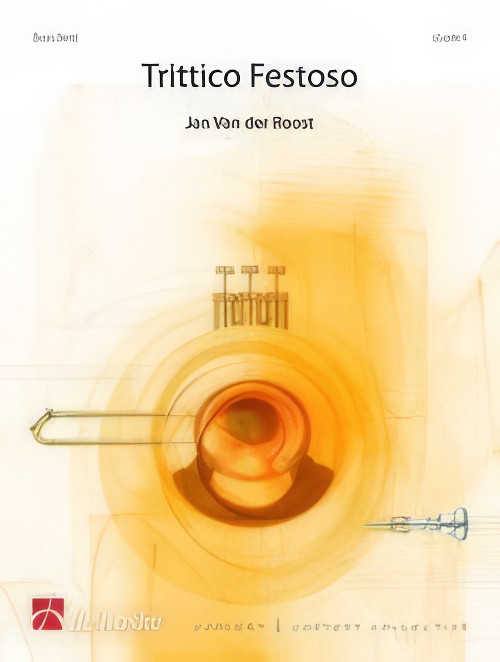
Trittico Festoso (Brass Band - Score and Parts) - Van der Roost, Jan
Trittico Festoso is a festive three-part composition that is dedicated to the conductor of a brass band. Each of the three movements reflects a different aspect of his character: in the opening fanfare, his personality is presented; then his work as manager, organiser and conductor is depicted in the dynamic Daily Life; while in The Artist, the sensitive, creative man himself is portrayed. An elegant tribute to the man with the baton!Duration: 12:00
Estimated dispatch 7-14 working days
-
 £54.99
Hymnus Antverpiae (Brass Band - Score and Parts) - Van der Roost, Jan
This hymn was commissioned by "Antwerpen 93". And this city, on the banks of the river Schelde has been nominated "Cultural Capital of Europe" for 1993. The work-group "animatie" took the initiative and commissioned a hymn, which -as the finale to a grand open-air event on 27th March- was premired by hundreds of musicians from all over Europe. Philippe Langlet (France) was the conductor at this majestic occasion. Musically speaking the piece can no doubt be labelled easy. Indeed it is meant to represent a hymn, playable by all in different instrumental combinations. Consequently a variable instrumentation was chosen and a type of music, which by native is easily accessible and uncomplicated. The conductor is free -in the instrumentation- to score this piece according to his own taste. It is perhaps advisable to use the sharp brass in the forte parts, in order to make the range in the sound of the orchestra as colourful as possible. The percussion parts are not absolutely essential, so that the hymn can also be performed without percussion.Duration: 4:00
Estimated dispatch 7-14 working days
-
 £44.95
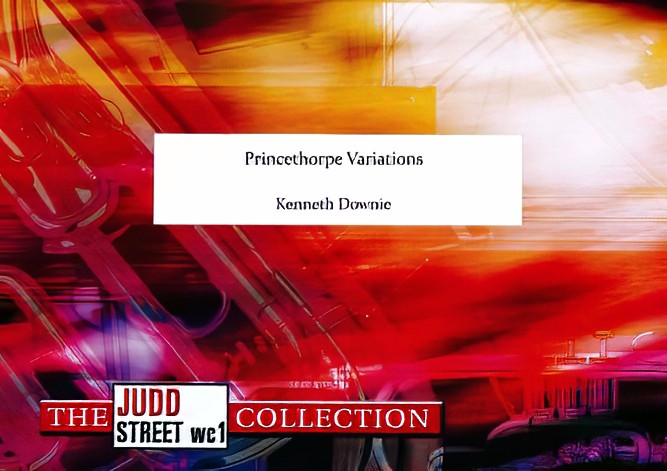
Princethorpe Variations (Brass Band - Score and Parts) - Downie, Kenneth
Colourful harmony, rhythmic flair and melodic invention are the hallmarks of this excellent set of variations by Kenneth Downie, based on the well known church tune, Princethorpe.This major work demonstrates the well-known characteristics of the composer: colourful harmony, rhythmic flair and melodic invention, all encapsulated in scoring which is engulfing both to players and listeners alike. Following a presentation of the theme there are five variations culminating in what can be described as either a finale or coda.Theme. The composer shows his originality in the harmonic sense of this introduction. Perhaps it could be suggested that over-indulgence of rubato may be a temptation to be avoided.Sections A to F. Relentless rhythmic drive is of paramount importance in this first variation. Conscientious observance of dynamics is of course an essential requirement in conveying the exciting quality of the music; there are moments of sudden contrast of which all will need to be aware. Moving between the time-signatures of 5/4 and 6/4 these sections are built from strong easily-identifiable fragments of the theme. These is a significant increase in temp at letter F which will further the exciting impact of the music.Sections G & H. In a pastorale style this short, gentle variation affords a contrast in style between the previous and succeeding ones. The gentle undulating character of the melodic lines is governed by the Allegretto grazioso directive.Sections I to M. Commencing two bars before letter I the music is now exuberant and the tempo and style is that of a march in compound time. In this exhilarating movement there are moments of contrast and indeed of delicacy which are a foil to the more energetic moments. Rhythmic control will be essential to maintain a consistent tempo. As elsewhere in the work, the percussion section will contribute much to the success of the performance there are bars where this section alone is heard and there are important entries for glockenspiel.Sections N & O. With emotional content this Adagio variation has the first two notes of the melody as its melodic impetus. Apart from just over two bars at O (where there is an interpolatory phrase from Cornets and Trombones), the melodic line is entrusted to the plaintive sounds of the horn section. Cornets and Trombones provide a change of tone colour at the beginning of section O. Under a poco rall, this very expressive variation is concluded; there is an important link supplied by Eb Bass.Sections P & Q. A lively march-tempo is launched immediately and these sections are in the nature of an introduction to the final variations. There is a quickening of pace at Q which assists the generation of excitement which should be an essential part of the performance. Solo Cornets introduce a melodic line at Q which anticipates the compound time of the following section.Sections R & S. The Solo Cornet theme of the previous section is now a contrapuntal line accompanying the theme tune. With an elongation of the notes in the melody, the conductor will need to call on the sustaining powers of the band and at no time should the interesting accompanying lines be allowed to detract from the sonorous presentation of the basic theme.Sections T, U & V. Following a poco rit, the finale begins at letter T with the directive, molto vivace. There is much detail to be rehearsed, not least being the dynamic contrasts which are encountered. As throughout the work, the listener should have no difficulty in identifying the thematic sources of the composer's music.
Estimated dispatch 7-14 working days
-
£22.50
Princethorpe Variations (Brass Band - Score only) - Downie, Kenneth
Colourful harmony, rhythmic flair and melodic invention are the hallmarks of this excellent set of variations by Kenneth Downie, based on the well known church tune, Princethorpe.This major work demonstrates the well-known characteristics of the composer: colourful harmony, rhythmic flair and melodic invention, all encapsulated in scoring which is engulfing both to players and listeners alike. Following a presentation of the theme there are five variations culminating in what can be described as either a finale or coda.Theme. The composer shows his originality in the harmonic sense of this introduction. Perhaps it could be suggested that over-indulgence of rubato may be a temptation to be avoided.Sections A to F. Relentless rhythmic drive is of paramount importance in this first variation. Conscientious observance of dynamics is of course an essential requirement in conveying the exciting quality of the music; there are moments of sudden contrast of which all will need to be aware. Moving between the time-signatures of 5/4 and 6/4 these sections are built from strong easily-identifiable fragments of the theme. These is a significant increase in temp at letter F which will further the exciting impact of the music.Sections G & H. In a pastorale style this short, gentle variation affords a contrast in style between the previous and succeeding ones. The gentle undulating character of the melodic lines is governed by the Allegretto grazioso directive.Sections I to M. Commencing two bars before letter I the music is now exuberant and the tempo and style is that of a march in compound time. In this exhilarating movement there are moments of contrast and indeed of delicacy which are a foil to the more energetic moments. Rhythmic control will be essential to maintain a consistent tempo. As elsewhere in the work, the percussion section will contribute much to the success of the performance there are bars where this section alone is heard and there are important entries for glockenspiel.Sections N & O. With emotional content this Adagio variation has the first two notes of the melody as its melodic impetus. Apart from just over two bars at O (where there is an interpolatory phrase from Cornets and Trombones), the melodic line is entrusted to the plaintive sounds of the horn section. Cornets and Trombones provide a change of tone colour at the beginning of section O. Under a poco rall, this very expressive variation is concluded; there is an important link supplied by Eb Bass.Sections P & Q. A lively march-tempo is launched immediately and these sections are in the nature of an introduction to the final variations. There is a quickening of pace at Q which assists the generation of excitement which should be an essential part of the performance. Solo Cornets introduce a melodic line at Q which anticipates the compound time of the following section.Sections R & S. The Solo Cornet theme of the previous section is now a contrapuntal line accompanying the theme tune. With an elongation of the notes in the melody, the conductor will need to call on the sustaining powers of the band and at no time should the interesting accompanying lines be allowed to detract from the sonorous presentation of the basic theme.Sections T, U & V. Following a poco rit, the finale begins at letter T with the directive, molto vivace. There is much detail to be rehearsed, not least being the dynamic contrasts which are encountered. As throughout the work, the listener should have no difficulty in identifying the thematic sources of the composer's music.
Estimated dispatch 7-14 working days
 View Music
 Listen to MP3