
Results
-
Diamonds - Jerry Lordan - Len Jenkins
In November 1962, ex-Shadows members Jet Harris and Tony Meehan decided to work as a duo and went to No 1 with a Jerry Lordan composition, "Diamonds". Harris, a bass player, took an ordinary Fender guitar and detuned every string a whole tone to enable him to hit notes which were lower than an ordinary guitar. However, it was apparently difficult to work with on stage since once the strings were slackened they would go out of tune very easily. The duo went on to have a second Top 10 hit with "Scarlett O'Hara" which is also available from Wobbleco Music in an arrangement for brass band. Both arrangements seek to capture the characteristic style of 60's rock music and retain the signature drum solos for which they are rightly remembered. But in addition, both pieces also appeal to a younger generation who may not have heard the originals. Our young kit drummer in Woburn Sands 'A' Band commented "...the (drum) part has the slightest shuffle feel to it, which improves the groove of the song, and to replicate the vintage snare-drum sound, I have heard that you can place a towel or a cloth over the head of the drum. I think it would work well...(otherwise) the drum part stays relatively simple and repetitive"...Chance to re-create the sound of the 60's.....Go for it!
-
 £15.99
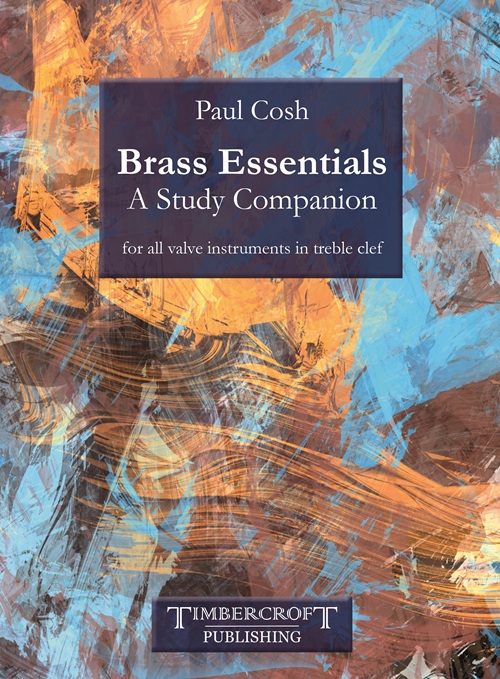
Brass Essentials - An Study Companion (for all valve instruments in treble clef)
This book of 32 studies has been drawn from those Paul Cosh used as a student at the Royal Academy of Music, throughout his years as a professional player and as a teacher at the Guildhall School of Music & Drama.The studies are divided into four main sections: Articulation, Finger Technique, Lyrical & Flexibility and Stamina & Technique and are drawn from those written by Arban, Charlier, Boehme, Brandt, Kopprasch and Sachse. Some of the studies have been re-imagined and edited to include new tempi and expression.There are helpful tips at the start of each section with most of the studies given suggested practice and performance tempi, although these are just a guide. Slow practise of the highly technical passages is vital to adhere to the overriding principle that every note counts.The Brass Essentials Study Companion can also work in conjunction with both the Brass Essentials: Arban Companion and the Brass Essentials: Practice Companion to vary your practice diet.
Estimated dispatch 7-14 working days
-
 £34.99
Shackleton's Cross (Cornet Solo with Brass Band - Score and Parts)
Shackleton's Cross was inspired by a painting created in 1957 by the English artist Edward Seago (1910 1974). The title refers to a cross which was erected to the memory of Sir Ernest Shackleton, who led a number of explorations to the Antarctic. Shackleton died in 1922 whilst on a Polar expedition, and the cross can be found on a promontory at the entrance to the bay at Grytviken Whaling Station in South Georgia. The painting is owned by HRH The Duke of Edinburgh, and was part of an exhibition at Buckingham Palace from October 2011 to April 2012. Originally scored for oboe, trumpet and small orchestra, Daniel Hall's sensitive arrangement for trumpet or cornet and brass band follows the composer's alternative version for solo trumpet and organ, created for Crispian Steele-Perkins (trumpet) and David Goode (organ). Duration: 5.00
Estimated dispatch 7-14 working days
-
 £34.95
Judd: Almighty - Roger Trigg
'Almighty' was written for Bandmaster Ross Johnson and Camberwell Citadel Band (Australia) for use on the band's 2009 tour of New Zealand. This energetic work takes its title from the opening line of the well-loved hymn, 'Praise to the Lord, the Almighty, the King of creation' (S.A.S.B. 19). It is based on the hymn tune 'Lobe den Herren' (T.B. 721) and whilst the tune is only heard in its entirety once, fragments of the tune can be heard throughout the music. The music is a shout of acclamation to the King of Kings.
Estimated dispatch 7-14 working days
-
 £45.00
Dreamtime
Commissioned by Philip Harper for the Cory Bands 2013 tour to Australia, Dreamtime draws inspiration from Australian Aboriginal mythology. The Dreamtime is a sacred era in which the Aborigines believe ancestral totemic (symbolic) spirits created the world. The work is heavily percussive, including narration and a pseudo-didgeridoo, created with multi-phonics in euphoniums and tubas. The work can still be performed without multi-phonics, narration and reduced percussion. Duration: 00:07:30 (with narration) Grade: 5 Listen:
Estimated dispatch 5-7 working days
-
£120.00
Fantasia on a Flemish Sea Song (Bra) - Simon Van Hoecke
'Fantasia on a Flemish Sea Song' was commissioned by Jeroen Berwaerts and VLAMO for the gala concert of the European Brass Band Championships 2017. These took place in the Belgian seaside town of Ostend, which explains the choice to make a fantasy on the sailor's song "Al die willen te kap'ren varen". A first reference to the song can be found in a Ghent song collection from 1856 by E. de Coussemaker: "Chants populaires des Flamands de France". The fantasia is faithful to tradition composed in a free form with variation elements and allows the soloist to showcase virtuosity and narrative power.
Estimated dispatch 7-14 working days
-
 £71.00
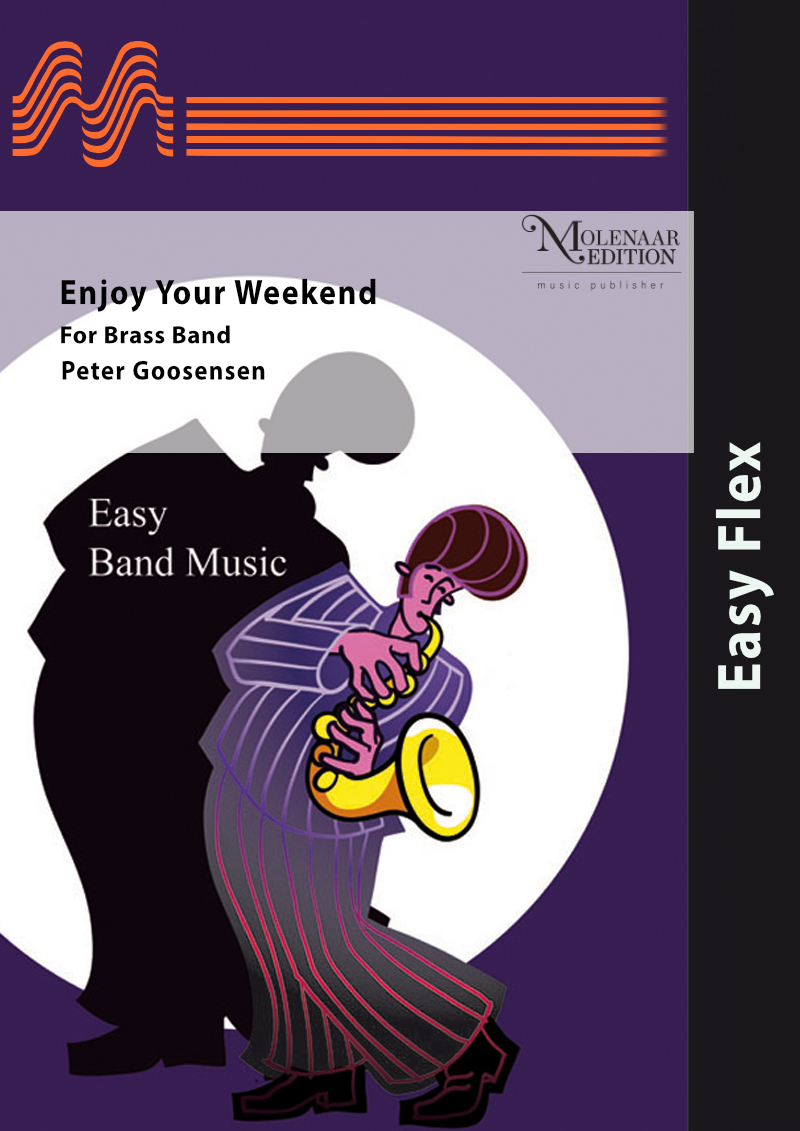
Enjoy Your Weekend! - Peter Goosensen
Enjoy your Weekend! is a fun and varied composition that offers lots of playing pleasure for both youth and smaller bands. The composition is based on a simple and pretty theme. The first part, Lazy Sunday, is built around a relaxed swinging tune. The second part, Close Friends, is more melodic and serious in nature. In Party Rock, the third part, the drummer plays a central role and the band can play their hearts out. Enjoy your Weekend!
Estimated dispatch 10-14 working days
-
£20.00
Hybrid - Geert Jan Kroon
Hybrid is a solo work for euphonium and track. The musical material is taken from the name of client. Hybrid means as much as a close mixing of disparate things. In this case, a cross between live euphonium/performer and recorded sounds of a euphonium/performer. The emphasis lies on various forms of breathing and other sounds the euphonium can produce.
-
 £61.99
The Lion King (Can You Feel The Love Tonight) - Elton John & Tim Rice - Frank Bernaerts
Estimated dispatch 10-14 working days
-
£61.99
We Can Leave The World - Michael Kersting, Stephan Bader & Pete Smith - Jan van Kraeydonck
Estimated dispatch 10-14 working days
 Listen to MP3
 View Music