
Results
-
£100.00
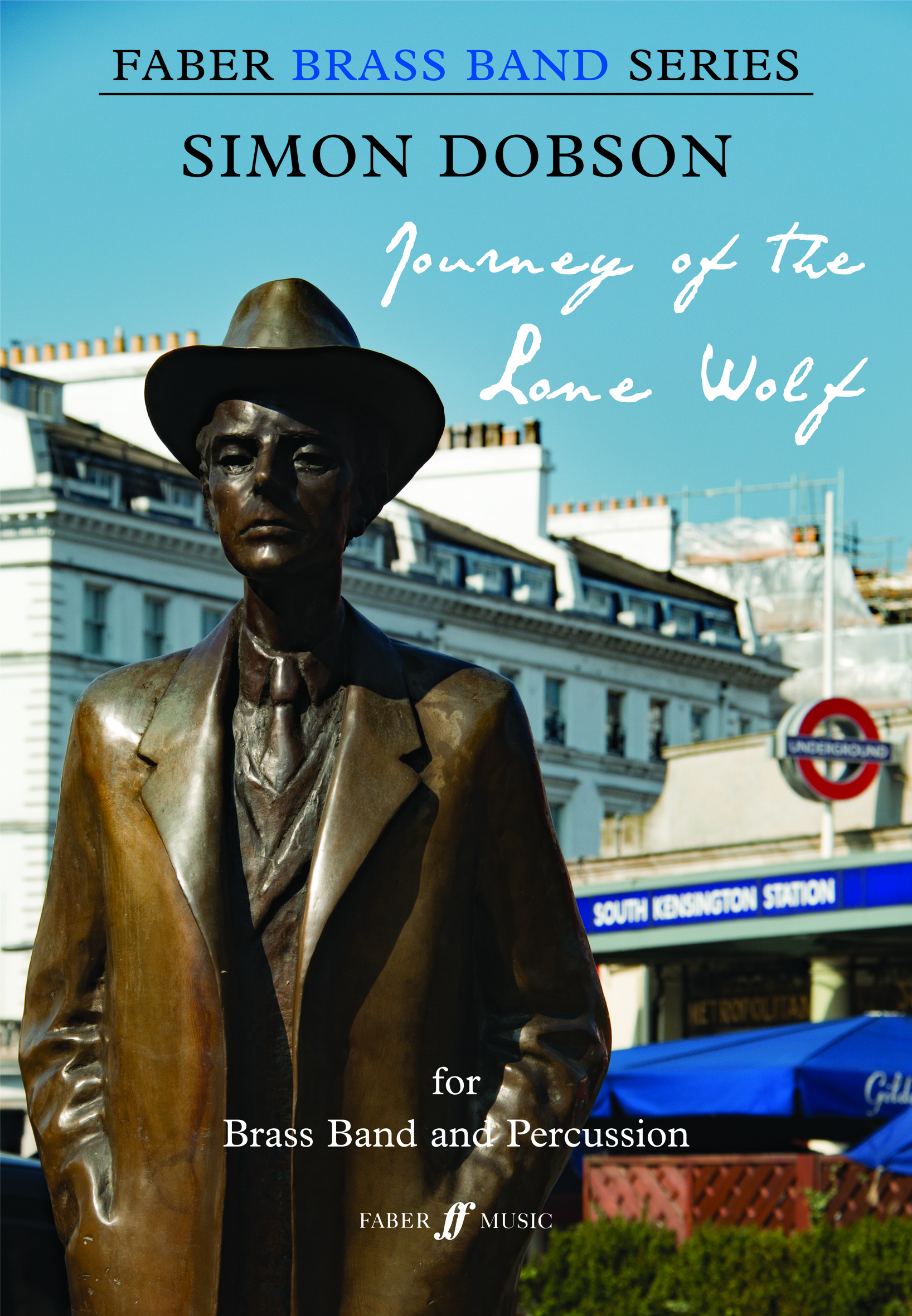
Journey of the Lone Wolf (score & parts) - Simon Dobson
Journey of the Lone Wolf tells the story of the hungarian composer Bla Bartk. It was commissioned by Dr. Nicholas Childs for Black Dyke Band, who gave the first performance on Sunday 26 January 2014 at the Bridgewater Hall, Manchester as part of the Royal Northern College of Music Festival of Brass.The composer's programme notes for each movement: 1. Capturing the Peasants' SongAfter the upheaval of moving to Budapest the young Bla Bartk meets Zoltn Kodly and the pair embark on summertime adventures throughout the Hungarian countryside to collect and catalogue the astonishing variety (both harmonically and rhythmically) of gypsy and folk music heard in the Balkans. The arrival of WW1 plunges Bartk's beloved Hungary into chaos.2. Night MusicBartk was at times a cold man, aloof and lonely. The odd moments of tenderness he showed are portrayed here in a series of evocative solos. His brief but intense affairs speak of a love he could only long for. Jazz is my night music and here there are hints of what Bartk may have heard in the USA later in his life.3. Flight and FightHaving been forced by the world's evils to leave his homeland of Hungary for America, Bartk, the anti-fascist, felt isolated and angry. In this movement we hear his longing for a simpler time of gypsy folk dances as well as his maturity and depth as a composer finally exploring deeper colours and darker themes. Duration: 15 minutes.Level: Championship
In Stock: Estimated dispatch 1-3 working days
-
 £34.95
Charles Dickens Christmas, A - Jonathan Bates
DURATION: 4'00". DIFFICULTY: 4th+. Composed for Strata Brass in 2020 as part of their COVID-19 induced, virtually recorded 'A Christmas Carol' (a new suite for brass band lasting around 30 minutes in total), 'A Charles Dickens Christmas' was used as the opening number for the event. The work utilises a number of instantly recognisable fragments of much-loved Christmas carols but acts more as a quasi-premonition into the original Charles Dickens novel which follows. Each section is marked with the point in the story which the music refers to and ends in a celebratory manner. .
In Stock: Estimated dispatch 1-3 working days
-
 £19.95
As A Cloud... - Jonathan Bates
'As A Cloud..' is a work for Solo Baritone and Piano composed for Nick Wilson in 2021. The inspiration for the work comes from the words of the poet William Wordsworth and his much loved text "I wandered lonely as a cloud". In the process of writing this work, the dedicatee's desire was to have a work to reflect his passion for the Lake District - a part of Northern England which Wordworth (and several other renowned poets of the time) became synonymous with; the group of writers becoming known as 'The Lake Poets'. Musically, this programmtic work reflects the words from Wordsworth's text, painting each line of the first stanza in a variety of settings and moods before the work floats away with an audio extract from the poem itself.
In Stock: Estimated dispatch 1-3 working days
-
 £30.00
A Floral Christmas - Brass Band Sheet Music Full Score & Parts - LM264
COMPOSER: VariousARRANGER: Chris CobonISMN : 9790570002641A superb new collection of Christmas carols carefully crafted into a medley, with a hint of the Katy Moss classic "Floral Dance", ready for your Christmas concerts.Christmas Carols include :The Holly & The IvyJingle BellsHark!, The Herald Angels SingThe Twelve Days of ChristmasIt Came Upon A Midnight ClearDeck The HallsCarol of The BellsAway In A MangerSilent NightFloral DanceO Holy NightO Come, O Come EmmanuelThe Twelve Days of ChristmasJoy To The WorldO Come, All Ye FaithfulThe Twelve Days of ChristmasLM264 - ISMN : 9790570002641
In Stock: Estimated dispatch 3-5 working days
-
 £57.00
A Hairy, Scary Spider - Thomas Geerts
A Hairy Scary Spider is the second part of the musical theatre piece Welcome to Halloween. This piece can be ordered separately or as part of the complete set. The piece describes a day in the life of a hairy, scary spider. In the beginning you aren't really sure what you are looking at. Is it a ball of wool or a big shadow? It turns out to be a spider sitting happily in his web. At a certain point while the whole band is watching him carefully, he jumps which leads to an inevitable scream.
Estimated dispatch 10-14 working days
-
 £143.00
Poem a la Carte - Manfred Schneider/Anton Weeren
As a French horn player, the successful German composer Manfred Schneider is familiar with brass instruments, so he took on the challenge of writing at a real Concerto for Trombone and Wind Band, which he called 'Poem a la carte'. The composition was commissioned by the JBK Sonthofen wind band. Though the 'misterioso' introduction already features some virtuoso passages for the soloist, the latter really takes off in the energetic allegro. Then comes a lyrical largo and the work ends with a sparkling allegro allowing the soloist to demonstrate true virtuosity.
Estimated dispatch 10-14 working days
-
 £35.00
Ascend the Brightest Heaven...
DescriptionThe band's uniform badges feature a significant local landmark, a transmission tower officially known as The Arqiva Tower but known more colloquially to locals as 'Emley Moor mast'. The current elegantly tapered concrete sculpture, the tallest freestanding structure in the UK at 1084 feet, is the third mast on this site and was built between 1969 and 1971 after the catastrophic collapse of the previous structure.On 19 March 1969 a combination of extreme icing and strong winds caused the tubular mast to collapse across Jagger Lane and the chapel opposite - fortunately, despite the fact that the organist was in the chapel practising, nobody was injured. Several million people lost their BBC2 and ITV signals, until the Independent Television Authority managed to set up a temporary transmitter nearby!Just over two years later the new mast was operational, and despite initial opposition from some locals who feared another, potentially worse, collapse, Emley Moor Mast is now a popular local landmark and a grade II listed building. In 2015 the mast was illuminated with coloured lights at night to mark the 'Grand Depart' of the Tour de France coming to Yorkshire.You can listen and follow the score in the video below:
Estimated dispatch 7-14 working days
-
£59.95
PLANTAGENETS, The (Brass Band Set) - Edward Gregson
The Plantagenets was composed for the Championship Section of the Regional contests of the National Brass Band Championships of Great Britain 1973. The work is not intended to be programme music but rather it tries to portray the mood and feelings of an age, that of the House of Plantagenet, which lasted from the middle of the 12th century to the end of the 14th century. To many, it conjures up an Age of Chivalry and this is represented by fanfare motifs which occur throughout the work in varied form. The opening thematic figure, rising through the band in thirds and followed by the fanfares, is important as nearly all the subsequent material is based upon it. There follows two themes, the second of which is lyrical and introduced by horns. In the long, slow middle section, a new theme is introduced by a solo horn (recurring on cornet and euphonium in canon) and is developed at some length. A lively fugato scherzino, however, leads to a recapitulation of the opening section music and the work ends with a maestoso statement of the slow movement theme. A final reference to the fanfares ends the work.
Estimated dispatch 7-14 working days
-
£35.00
The Pohutukawa Stands - Peter Meechan
The earthquake that hit Christchurch in February 2011 took the lives of 181 people. Being asked to write this work in their memory was an honour, but I didnat want it to simply be performed as a memorial. I wanted to compose a work that conveyed the sadness and grief for those lost - a work of remembrance - but also a piece of music that represented peace, hope and strength.The title and dedication come direct from the commissioners of the work, Woolston Brass Band. The Pohutukawa Trees stay standing and secure, defiant of the earthquake, in Christchurchas aGarden Citya, and the Pohutukawa tree also has special significance beyond their physical appearance.According to Maori mythology, the spirits of the dead travel to Cape Reinga on their journey to the afterlife to leap off the headland and climb the roots of the 800 year old Pohutukawa tree and descend to the underworld to return to their traditional homeland of Hawaiiki-a-nui, using the Te Ara Wairua, the 'Spirits' pathway'.The Pohutukawa Stands is dedicated to the lives lost in the Christchurch earthquake.
Estimated dispatch 12-14 working days
-
 £30.00
A Redbridge Raga - Chris Wilcox
Put simply, a 'Raga' is a scale used in Indian music, but aside from being a series of ascending and descending notes, ragas are also associated with different moods and with particular times of the day or year. A Redbridge Raga is influenced by the use of the 'Raga Bhairav' (a morning raga) which is clearly outlined in the mysterious opening of the piece. The following section is much more lively, incorporating elements of Bhangra (a musical style emanating from the fusion of Indian folk music with British pop culture). The title reflects the location of the first performance that took place at Redbridge Town Hall, East London.
 View Music