
Results
-
 £34.95
A New Dawn (Tenor Horn Solo with Brass Band - Score and Parts)
Tenor Horn Solo with Brass BandA New Dawn (2013) was commissioned by and written for British tenor horn virtuoso Owen Farr in late 2013, to provide the title track of his new CD album. With a specific brief, the work was to include a bold ear-catching fanfare-esque opening to bring maximum impact to the opening of the album, before settling in a rhythmic groove which allows the new tempo and reduced texture to settle before the entry of the tenor horn, who's initial four bar motif is what forms the basis of much of the work. Following this, structurally, the work follows with a set of variations, carefully demonstrating the capabilities of the instrument and indeed the player. Bar 90 sees the return of the bold opening gestures, this time followed with a harmonic transformation, before a recapitulation at bar 120 which sees a return to the original tenor horn material and an increase in intensity, volume and virtuosity through to the close.A New Dawn was premiered by Owen Farr and the Cornwall Youth Brass Band on 30th December 2013, and was recorded by Owen and the Cory Band in March 2014, featuring as the title track on his CD release of the same name.
Estimated dispatch 7-14 working days
-
£49.95
Bestowal of a Century (Tenor Horn Solo)
Tenor Horn Solo with Brass BandBestowal of a Century (2014) was commissioned by Lowenna Taylor, and funded through her Harry Mortimer Trust award which she was presented with at the 2013 British Open Championship following the completion of her studies at the Royal Welsh College of Music in Cardiff. The 15-minute work received its world premiere at the Cornwall Youth Brass Band Christmas concert in 2014 with solosit, Lowenna, working alongside the band under the baton of Les Neish.The Bestowal refers to the presentation of the Royal Trophy by the then Prince of Wales to the famous West of England Bandsman's Festival in Bugle in 1913. Over the years it has been won by some of the greatest names in brass banding, including Black Dyke and Munn & Feltons - although more recently it has become a wonderful open festival that includes sections for local bands as well as visitors from all over the banding globe. 2014 marked the one-hundredth anniversary of the presentation of the trophy, which is the only brass band trophy to have the official seal of royal patronage.The work, in three distinct sections, opens in a mysterious way, building progressively with interjections from the horn. The composer notes its as though one can imagine different part of the trophy being put together, piece by piece, until the trophy is complete and a climax is reached. Following this, a playful theme is presented which is developed throughout the first section and interacting between soloist and band.The second movement, in complete contrast, is a lyrical melody; heart-wrenching throughout, and sits well both as part of the concerto and also as a stand-alone solo item. The third movement is light-hearted and virtuosic, demonstrating the technical capabilities of the instrument with fast and virtuosic playing, and a cadenza towards the end of the work.
Estimated dispatch 7-14 working days
-
£19.95
Islands in the Sky (Brass Quartet)
Islands in the Sky (2012) is a three-movement work for Euphonium Quartet. Written in June 2012, the title is a metaphor of mountains, suggesting that they're so tall they're islands in the sky. The sublime Euphony Euphonium Quartet who the work was commissioned by were successful in gaining a place in the International Tuba & Euphonium Conference Ensemble Competition, held in Linz, Austria; a country particularly noted for its fair share of the Alps which proved the basis of the work.The first movement is a fierce journey on a glacier's edge - the drama of the music and constant rhythmic drive throughout suggests danger and the unknown. The second movement is calm and reflective, inspired by a beautiful Alpine Sunset, slowly going down between mountains and pine trees. Finally, the third movement takes the listener on a journey up the mountain to the peak, upon which a grandioso section is heard with the soaring melody that has been building up throughout the movement played in its entirety.
Estimated dispatch 7-14 working days
-
£29.95
The Land of the Long White Cloud (Score Only)
Dating from 1979, The Land of the Long White Cloud (Aotearoa) was Philip Sparke's first test-piece. It was commissioned by the New Zealand Brass Band Association for their 1980 National Championships (their centenary year) and set for the European Brass Band Championships, the same year, at the Royal Albert Hall in London. Aotearoa was the name given to New Zealand by its Polynesian settlers whose first sight of the islands was a long, flat cloud lying low over the land. The work has no specific programme although many have seen pictures of the surging ocean in the opening bars. A faster dance-like section leads to a slow, haunting solo for soprano cornet; this is taken up by the whole band before earlier material returns. The dance-like tune is, this time, given a fugal treatment and the opening bars return to close the work.Philip Sparke was born in London and studied composition, trumpet and piano at the Royal College of Music, where he gained an ARCM. It was at the College that his interest in bands arose. He played in the College wind orchestra and also formed a brass band among the students, writing several works for both ensembles.At that time, his first published works appeared - Concert Prelude (brass band) and Gaudium (wind band). A growing interest in his music led to several commissions, his first major one being this featured piece for the Centennial Brass Band Championships in New Zealand - The Land of the Long White Cloud. He has written for brass band championships in New Zealand, Switzerland, Holland, Australia and the UK, including three times for the National Finals at the Royal Albert Hall.In September 2000, he was awarded the Iles Medal of the Worshipful Company of Musicians for his services to brass bands and in 2005 Music of the Spheres won the National Band Association/William D. Revelli Memorial Band Composition Contest. In 2011, he received the BUMA International Brass Award for his contribution to brass music.His conducting and adjudicating activities have taken him to most European countries, Scandinavia, Australia, New Zealand, Japan, Taiwan, South Korea, Canada and the USA. In May 2000, he took the major step of becoming a full-time composer by founding his own publishing company, Anglo Music Press. The company is devoted to publishing his brass band, concert band, fanfare band and instrumental publications as well as recordings dedicated to his latest works.
Estimated dispatch 7-14 working days
-
 £33.09
Bagatelle No.25 in A Minor - Fur Elise (Brass Band) Beethoven arr. Olaf Ritman
Perhaps the most well-known piano piece by Ludwig van Beethoven, Bagatelle No. 25 in A Minor (written around 1810) is better known under its subtitle 'Fur Elise'. Even to this day it is still unknown who Elise was, with at least four theories claiming to tell the story. It might have been one of Beethoven's students or Therese Malfatti, a young lady who got much attention from him. The theory is that Beethoven's autograph Ludwig Nohl could not decipher his handwriting and might have read Elise instead of Therese. Nevertheless the piece has become extremely popular over the last two centuries and is often the very first real classical piece a beginner pianist goes to. Many classical pieces have been transcribed in contemporary fashion for brass bands in recent times, with Toccata in D Minor by J.S. Bach arranged by Ray Farr being the most popular and more recently Vivaldi's first part of Winter from The Four Seasons arranged by Philip Harper. This arrangement of Fur Elise fits in this series perfectly and seeks to bring a smile to its listeners. The last two bars are a direct tribute to Ray Farr's aforementioned arrangement of Toccata. To view a video of the Amsterdam Staff Band performing the work please visit https://www.youtube.com/watch?v=sdLI7U-aplw Duration: 3.15 minutes approx. Difficulty Level: 2nd Section + PDF download includes parts and score. Sheet music available from www.brassband.co.uk Instrumentation: Soprano Cornet Eb Solo Cornet Bb Repiano Cornet Bb 2nd Cornet Bb 3rd Cornet Bb Flugel Horn Bb Solo Horn Eb 1st Horn Eb 2nd Horn Eb 1st Baritone Bb 2nd Baritone Bb 1st Trombone Bb 2nd Trombone Bb Bass Trombone Euphonium Bb Bass Eb Bass BbTimpani Percussion 1-3
In Stock: Estimated dispatch 1-3 working days
-
 £29.41
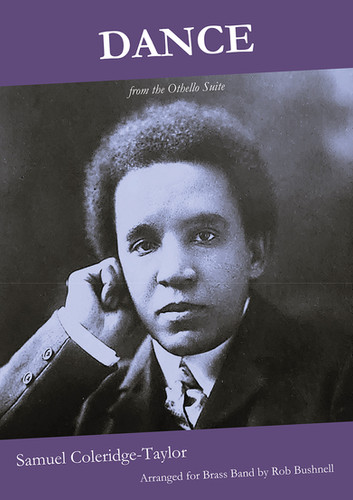
Dance from the Othello Suite (Brass Band) Coleridge-Taylor arr. Bushnell
Samuel Coleridge-Taylor is a British composer, who, from a young age, showed talent on the violin and entered the Royal College of Music, studying with Charles Villers Standford. His music become so popular that his Hiawatha trilogy was the second most performed choral piece (joint with Mendelssohn's Elijah, and only beaten by Handel's Messiah) with choral societies up and down the British Isles. In fact, Hiawatha was arranged by Charles Godfrey as a test-piece for the 1902 National Brass Band Championship of Great Britain, held at Crystal Palace.Commissioned by the theatre impresario Herbert Beerbohm, Coleridge-Taylor composed incidental music for His Majesty's Theatre London production of the Shakespeare play, Othello, in the West End, in 1909. In 1912, the play opened to the public, with a suite of five movements put together soon afterwards. The Dance, arranged here by Rob Bushnell, makes a great concert opener.This arrangement is for the British-style brass band, with alternative parts for horns in F and bass-clef lower brass. A recording of the original composition can be found at www.youtube.com/watch?v=OQeO_Ij9CV8 Duration: approx. 2.30 minutes Difficulty Level: 3rd Section + PDF download includes parts and score. Sheet music available at www.brassband.co.uk (UK) or https://satradecentral.org (USA) Instrumentation: Soprano Cornet Eb Solo Cornet Bb Repiano Cornet Bb 2nd Cornet Bb 3rd Cornet Bb Flugel Horn Bb Solo Horn Eb 1st Horn Eb 2nd Horn Eb 1st Baritone Bb 2nd Baritone Bb 1st Trombone Bb 2nd Trombone Bb Bass Trombone Euphonium Bb Bass Eb Bass Bb Timpani Percussion - Triangle, Cymbal & Bass Drum
In Stock: Estimated dispatch 1-3 working days
-
 £33.09
King Lily of the Valley (Euphonium & Baritone Feature w/Brass Band) Espen Haukas
Based on a poem by Gustaf Froding, King Lily of the Valley is a poetic and regal musical tribute to the delicate flower that, in Froding's verse, appears as a young king surrounded by both sorrow and beauty. Originally composed by David Wikander and arranged for male choir (TTBB) by Rasmus Krigstrom, this evocative work has been masterfully reimagined for brass band by Norwegian arranger and composer Espen Wallacher Haukas and created for Bjorsvik Brass's performance at Siddis Brass 2025. The brass band version retains the choral character and emotional depth of the original, weaving lush harmonies and lyrical phrasing into a rich soundscape. A deeply expressive addition to any brass band repertoire - blending Nordic choral tradition with the grandeur and warmth of the brass band sound. Scoring: Standard brass band instrumentation.(Note: Solo Cornets are marked TACET, providing a welcome opportunity for rest in longer programmes.) To view a rolling score video of the work please visit https://www.youtube.com/watch?v=AK5YPW4t3Oo Duration: Approx. 3.30 minutes Difficulty Level: 3rd Section + This PDF download includes the full score and parts. Sheet music available at www.brassband.co.uk (UK) or https://satradecentral.org (USA) Instrumentation: 1st Baritone Bb 1st Euphonium Bb 2nd Baritone Bb 2nd Euphonium Bb Soprano Cornet Eb Repiano Cornet Bb 2nd Cornet Bb 3rd Cornet Bb Flugel Horn Bb Solo Horn Eb 1st Horn Eb 2nd Horn Eb 1st Trombone Bb 2nd Trombone Bb Bass Trombone Bass Eb Bass Bb Timpani Percussion 1-2
In Stock: Estimated dispatch 1-3 working days
-
 £29.41
March from 'The Love for Three Oranges (Brass Band) Prokofiev arr. Wilkinson
This thrilling brass band arrangement of the March from 'The Love for Three Oranges' by Prokofiev has been skillfully arranged by Keith M. Wilkinson. This setting captures the essence of the original orchestral work, while showcasing the power and brilliance of the brass band. In 1918, Sergei Prokofiev undertook his first visit to the United States. A number of concerts of his works were held in Chicago, which were received very favourably. As a result, the director of the Chicago Opera Association, Cleofonte Campanini, commissioned Prokofiev to write an opera. It just so happened that, during his trip, he had written a draft of a libretto, based on the Italian play by Gozzi, L'amore delle tre melarance, adding some additional surrealism to the text. Given Prokofiev's poor English, and Americans unlikely to accept an opera in Russian, French was his final choice. The result, L'amour des trois oranges (or The Love for Three Oranges), which premiered at the Auditorium Theatre in Chicago on 30 December 1921, conducted by Prokofiev himself. The March from this opera is probably the most familiar part and has been used by CBS in the radio-drama series The FBI in Peace and War. It was also used in films such as The Brink's Job and Prokofiev quoted it in the second act of his ballet Cinderella. To view a rolling score video of the work please visit www.youtube.com/watch?v=I136sf8hxlU Duration: Approx. 2.10 minutes Difficulty Level: 3rd Section + PDF download includes parts and score. Sheet music available from www.brassband.co.uk Instrumentation: Soprano Cornet Eb Solo Cornet Bb Repiano Cornet Bb 2nd Cornet Bb 3rd Cornet Bb Flugel Horn Bb Solo Horn Eb 1st Horn Eb 2nd Horn Eb 1st Baritone Bb 2nd Baritone Bb 1st Trombone Bb 2nd Trombone Bb Bass Trombone Euphonium Bb Bass Eb Bass BbTimpani Percussion 1-2
In Stock: Estimated dispatch 1-3 working days
-
 £34.95
Over The Horizon - Christopher Bond
Over the Horizon (2017), whilst both harmonically and compositionally a simple endeavour, is a spine-tingling beautiful melody for soprano cornet. Based on the painting seen in the sleeve notes of Steve Stewart's album of the same name, the work takes its inspiration from the open expansiveness of the ocean, glistening in the moonlight as four people sit quietly - two parents, a boy, and a girl. A feeling of heartfelt longing throughout the work which is developed both melodically and texturally by soloist and accompaniment; perhaps reflecting the desire to know indeed what is over the horizon. The longing intensifies with a climatic section of grandeur - a feeling of longing which arguably isn't resolved until that all-important - and high - last note. Over The Horizon was written for and commissioned by Steve Stewart and Cory Band in Spring 2017.
Estimated dispatch 10-14 working days
-
 £45.00
God Put a Smile Upon Your Face
ABOUT THIS PIECE: 'God Put a Smile Upon Your Face' was written by all members of the band Coldplay for their second studio album 'A Rush of Blood to the Head'. Coldplay vocalist Chris Martin said: "The song came out of playing live and wanting to have something with a bit more bounce". The chart was originally released in 2003 to critical acclaim. In 2007 Mark Ronson covered the song on his album 'Version' - it is this version this arrangement is based upon. The following arrangement was devised as a concert opener - written as such to allow different sections of the band to make their way to the stage one at a time. The suggested stage entry directions for this arrangement are: Percussion > Basses > Trombones > Horns & Baritones > Cornets & Euphonium. Kit and percussion parts are written as a guide - please feel free to add and subtract as the MD sees fit. DUE TO COPYRIGHT LAW THIS WORK IS NOT AVAILABLE IN AUSTRALIA OR NEW ZEALAND ENSEMBLE: Standard British Brass Band WHEN YOU BUY THIS PRODUCT, YOU GET: High-quality printed score and parts LEVEL: 2 LISTEN: Click here DURATION: 3-mins 30 secondEXAMPLE SCORE: Click here LEVEL GUIDE: Level 1- Accessible to all Level 2 - c. UK third section and higher Level 3 - c. UK second section and higher Level 4 - c. UK first section and higher Level 5 - c. UK championship section level
Estimated dispatch 5-7 working days