
Results
-
 £95.00
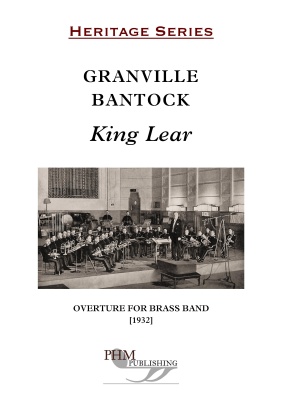
King Lear (Brass Band - Score and Parts)
Sir Granville Bantock (1868 - 1946) composed the second of his five major brass band work for Callender's Cableworks Band, completing the commission on 30 November 1932. Based in the Thames-side district of Belvedere near Erith, the band was active between 1898 and 1961. The works band of the Callender Cable & Construction Co. Ltd, it was at the peak of its popularity during the 1930s and was a frequent broadcaster on the radio. The band employed an in-house arranger and played saxophones in its lighter material. King Lear was one of the band's major commissions and was not published in Bantock's lifetime. The manuscript score and parts were thought to be lost for decades, but were found in the library of the Haydock Band (Lancashire), which had inherited part of Callender's library of manuscripts material and bespoke arrangements after it has been transferred to nearby Prescott Cables Band after Callender's Cable Works closed.King Lear is a substantial work, in essence a dramatic tone poem in the romantic Tchaikovskian manner, presenting a series of character portraits of the foolish old king and his three daughters, Goneril, Regan and Cordelia. The music is dramatic and lyrical by turns, with the most generous lyrical episode revealing perhaps the warm-hearted Cordelia. An expansive melody that flows from this is brought back towards the end as the main climax of the work.In 2001, Bantock's score was recorded by the University of Salford Brass Band, conducted by Dr. Roy Newsome. The original is serviceable, but in comparison with the orchestral version he made in 1936 (part of which was recorded on a Paxton 78 rpm) and later brass band scores, performing editions of which were prepared by others, it lacks colour and range typical of Bantock's orchestral work. Above all it lacks percussion, which can be heard on the recorded extract. With the kind permission of the Bantock Estate, I have prepared a performing edition for publication that incorporates percussion, derived from the orchestral recording and added editorially in similar manner elsewhere. I have revoiced some of the low- lying instrumental parts to present the material in more comfortable ranges. Editorial interventions more elaborate than revoicing the original text have been identified as cue notes.- Paul HindmarshDuration: 15.00
Estimated dispatch 7-14 working days
-
£40.00
King Lear (Brass Band - Score only)
Sir Granville Bantock (1868 - 1946) composed the second of his five major brass band work for Callender's Cableworks Band, completing the commission on 30 November 1932. Based in the Thames-side district of Belvedere near Erith, the band was active between 1898 and 1961. The works band of the Callender Cable & Construction Co. Ltd, it was at the peak of its popularity during the 1930s and was a frequent broadcaster on the radio. The band employed an in-house arranger and played saxophones in its lighter material. King Lear was one of the band's major commissions and was not published in Bantock's lifetime. The manuscript score and parts were thought to be lost for decades, but were found in the library of the Haydock Band (Lancashire), which had inherited part of Callender's library of manuscripts material and bespoke arrangements after it has been transferred to nearby Prescott Cables Band after Callender's Cable Works closed.King Lear is a substantial work, in essence a dramatic tone poem in the romantic Tchaikovskian manner, presenting a series of character portraits of the foolish old king and his three daughters, Goneril, Regan and Cordelia. The music is dramatic and lyrical by turns, with the most generous lyrical episode revealing perhaps the warm-hearted Cordelia. An expansive melody that flows from this is brought back towards the end as the main climax of the work.In 2001, Bantock's score was recorded by the University of Salford Brass Band, conducted by Dr. Roy Newsome. The original is serviceable, but in comparison with the orchestral version he made in 1936 (part of which was recorded on a Paxton 78 rpm) and later brass band scores, performing editions of which were prepared by others, it lacks colour and range typical of Bantock's orchestral work. Above all it lacks percussion, which can be heard on the recorded extract. With the kind permission of the Bantock Estate, I have prepared a performing edition for publication that incorporates percussion, derived from the orchestral recording and added editorially in similar manner elsewhere. I have revoiced some of the low- lying instrumental parts to present the material in more comfortable ranges. Editorial interventions more elaborate than revoicing the original text have been identified as cue notes.- Paul HindmarshDuration: 15.00
Estimated dispatch 7-14 working days
-
 £50.00
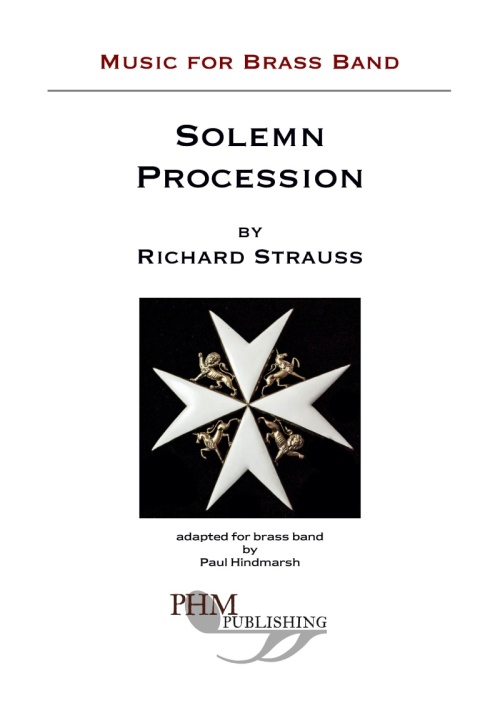
Solemn Procession (Brass Band - Score and Parts)
Richard Strauss (1864 - 1949) was a famous conductor and composer when he wrote Feierlicher Einzug der Ritter des Johanniter-Ordens (Solemn Entrance of the Knights of the Order of Saint John) in 1909. One of only a handful of his works written exclusively for winds, Strauss composed Feierlicher Einzug for the investiture ceremonies of the Order of St. John, a Christian military order that was founded in Jerusalem in 1023 to care for poor, sick, or injured pilgrims journeying to the Holy Land.Strauss scored Feierlicher Einzug (TrV 224) for a large ensemble of fifteen trumpets, four horns, four trombones, two tubas and timpani. He saw enough potential in its stately character and majestic conclusion to produce a version for symphony orchestra with organ and it has been arranged for a variety of brass ensembles with or without organ since then.This version for British style brass band was adapted from the original in 1990 by Paul Hindmarsh for the exclusive use of Besses o' th' Barn Band, of which he was then the musical director. Now that the music of Richard Strauss published in his lifetime is in the public domain, Solemn Procession, as it has been rendered in English, can be enjoyed by all brass bands and their audiences.- Paul HindmarshDuration: 6.00
Estimated dispatch 7-14 working days
-
 £35.00
The Very Best Time of Year (Euphonium Solo with Brass Band - Score and Parts)
This new arrangement for Solo Euphonium & brass band by David Griffiths, truly evokes that feeling of nostalgia and longing anticipation of the joyous season and is a true celebration of all that we love about Christmas time! Suitable for 4th Section Bands and above
Estimated dispatch 7-14 working days
-
 £79.95
Corineus (Brass Band - Score and Parts)
Premiered by Cory Band at the 2018 Festival of Brass, Manchester. Selected as the set-work for the Championship Section at the 2019 National Youth Championships of Great Britain.Corineus, in medieval British legend, was a prodigious warrior, a fighter of giants, and the eponymous founder of Cornwall. The first of the legendary rulers of Cornwall, he is described as a character of strength and power. It is on the medieval ruler that this new work, Corineus, is based, presented in three contrasting sections. The work opens with heraldic fanfares and a sense of jubilance before presenting musical material which changes and develops organically, portraying the journey taken by Corineus, Brutus, and the Trojans from modern-day mainland Europe to Britain. The central section of the work is slower, creating a feeling of longing. Brutus' son, Locrinus, had agreed to marry Corineus' daughter, Gwendolen, but instead fell in love with a German princess. In writing this part of the work, the composer portrays the longing of Gwendolen for her husband, knowing he is in love with somebody else. After Corineus died, Locrinus divorced Gwendolen, who responded by raising an army in Cornwall and making war against her ex-husband. Locrinus was killed in battle, and legend suggests that Gwendolen threw Locrinus' lover into the River Severn. This dramatic battle provides the inspiration for the final part of the work. In writing this work, the composer hopes to flare the imagination of young brass players around the country, in an engaging new take on a firm fixture in British folklore.Duration: 11.00
Estimated dispatch 7-14 working days
-
 £95.00
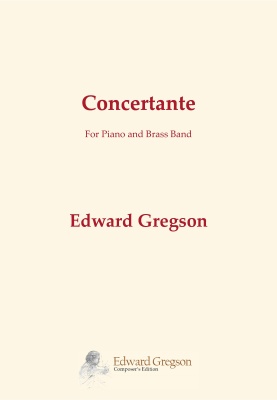
Concertante (Piano Solo with Brass Band - Score and Parts)
This work was written in 1966, when I was a student at the Royal Academy of Music in London. It was the first major work to be written for this combination. The Concertante is unashamedly romantic in idiom and is cast in three movements: Prelude, Nocturne and Rondo.The Prelude is in sonata form with a contracted recapitulation. There are two main themes, the first announced after the opening flourish on piano. The second theme is lyrical in character and the interplay between these two themes forms the main focus of the movement.The pensive Nocturne opens with an introduction from the band which contains hints of the two main ideas to follow. The solo piano announces the main theme, which has a slightly 'blues' character in its flattened third and seventh notes of the scale. The band enters with the chorale theme already heard in the introduction. Eventually the first theme returns, this time from piano and band and building to a powerful climax before subsiding to a peaceful ending.The Rondo is full of energetic rhythms and changing time patterns. The main theme is 'giocoso' in character and in the first episode there is more than a hint of the tune 'Onward Christian Soldiers' in what amounts to a good humoured parody. Before the final coda there is a long piano cadenza underlying the virtuoso element of the work.The work had a number of public performances leading up to a memorable one in the Royal Albert Hall in 1989 as part of the Gala Concert that used to be held after the National Brass Band Championship in the Royal Albert Hall. That year, the 'centre band' in the massed bands concert were the GUS Band (then known for sponsorship reasons as 'Rigid Containers Group Band'!) conducted by my great friend and champion, Bramwell Tovey, with myself as the soloist.- Edward GregsonDuration: 18.00
Estimated dispatch 7-14 working days
-
 £100.99
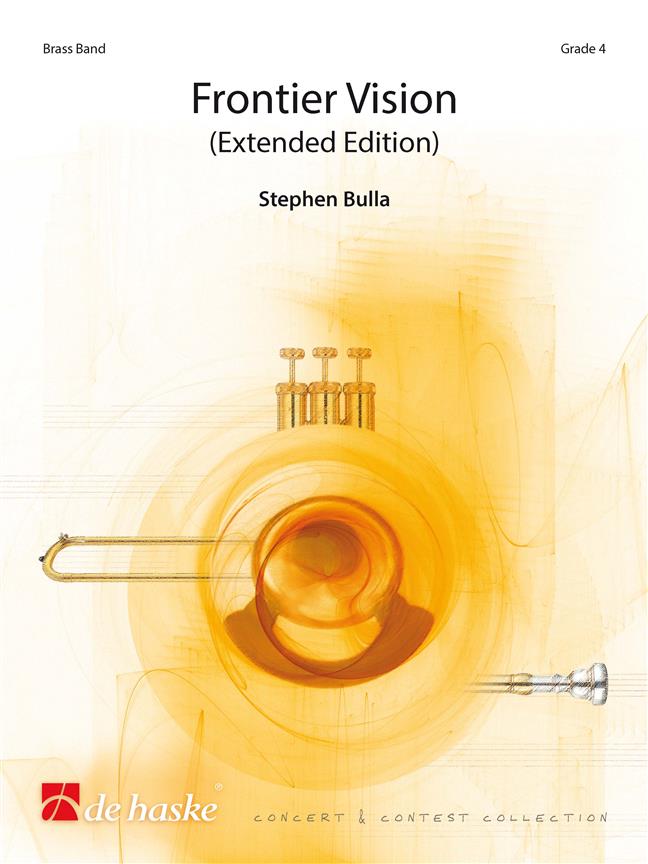
Frontier Vision (Brass Band - Score and Parts)
Frontier Vision is a concert or contest piece based on three elements: the commemoration of the 500th anniversary of Reformation Day, the Martin Luther melody, A Mighty Fortress Is Our God (Ein Feste Burg ist unser Gott) on which this composition is based, and thirdly the spreading of the evangelical movement in the late 19th century, of which the analogous storyline forms the structural basis of this work. Multi-cultural ethnic influences, along with the driving rhythms that reflect the perseverance and hard work of those mission-minded pioneers, are both important components that make Frontier Vision an outstanding choice for your concert or contest. Frontier Vision was the test piece for the second division in the Dutch National Brass Band Championships 2017. Duration: 12.00
Estimated dispatch 7-14 working days
-
 £154.99
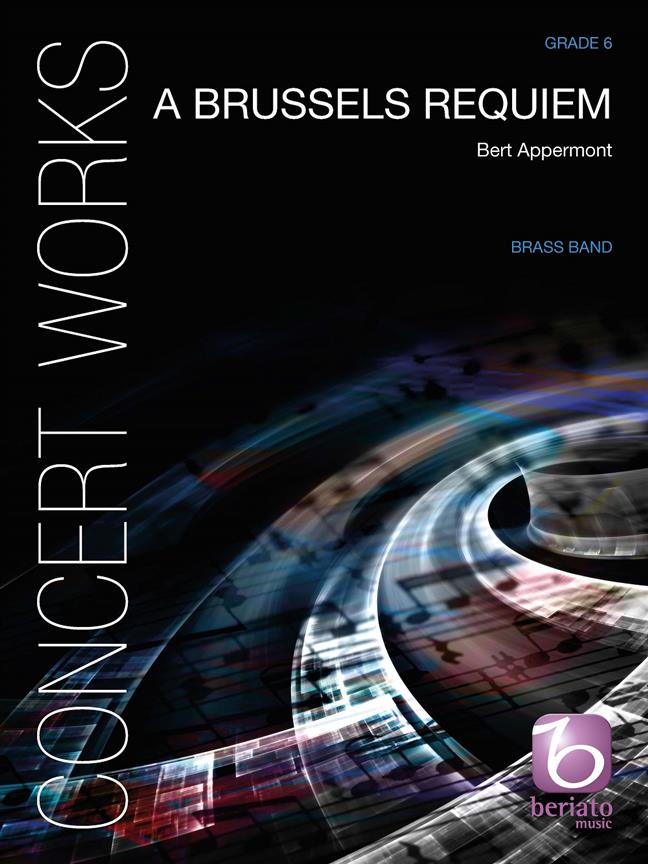
A Brussels Requiem (Brass Band - Score and Parts)
The attacks in Brussels on 22 March 2016 created a shockwave throughout Belgium and the rest of the world. Equally, the attacks in Paris and Nice led to great public indignation, fear and disbelief. What has happened to the western world? Have our cultures grown apart to such an extent that we do not understand each other anymore? Bert Appermont's intention was to voice certain emotions that these acts of terror have caused: particularly fear, grief, anger, and helplessness. He uses the French children's song Au Claire de la Lune as a connecting thread throughout the work. This piece is also about hope and faith in another world, and is meant to pay homage to all victims, resulting in a dignified remembrance. The musical development is presented in four through-composed parts, titled Innocence, In Cold Blood, In Memoriam - We Shall Rise Again and A New Day. This work was commissioned by the Brassband Oberosterreich (Brass Band Upper Austria) to be played at the European Brass Band Championships 2017.Duration: 16.30
Estimated dispatch 7-14 working days
-
.jpg) £64.95
£64.95Partita (Brass Band - Score and Parts)
Selected as the Section 4 test piece for the National Brass Band Championships of Great Britain 2025Partita dates from 1971, when it was commissioned by the Redbridge Youth Band. The musical thread that runs through the work is the 13th century plainsong Dies Irae from the Requiem Mass. This gives the work a rather sombre tone which is audible right from the start of its first movement Intrada. The initial hammer-like chords of the opening and conclusion are only interrupted momentarily by a more lyrical modal tune. Even here, on its repetition, it is surrounded by more insistent textural patterns.The second movement, Chorale and Variations, uses the Dies Irae as the basis for an extended melody in the manner of a baroque sarabande. The five variations that follow are varied in texture, tempi, and dynamics. The final March is more optimistic in mood and presents as its main idea a rather jaunty theme which gets developed throughout the movement. However, the ominous presence of the Dies Irae has the last say with a final statement to round off the work.Duration: 11.00
Estimated dispatch 7-14 working days
-
£32.50
Partita (Brass Band - Score only)
Selected as the Section 4 test piece for the National Brass Band Championships of Great Britain 2025Partita dates from 1971, when it was commissioned by the Redbridge Youth Band. The musical thread that runs through the work is the 13th century plainsong Dies Irae from the Requiem Mass. This gives the work a rather sombre tone which is audible right from the start of its first movement Intrada. The initial hammer-like chords of the opening and conclusion are only interrupted momentarily by a more lyrical modal tune. Even here, on its repetition, it is surrounded by more insistent textural patterns.The second movement, Chorale and Variations, uses the Dies Irae as the basis for an extended melody in the manner of a baroque sarabande. The five variations that follow are varied in texture, tempi, and dynamics. The final March is more optimistic in mood and presents as its main idea a rather jaunty theme which gets developed throughout the movement. However, the ominous presence of the Dies Irae has the last say with a final statement to round off the work.Duration: 11.00
Estimated dispatch 7-14 working days