
Results
-
 £40.00
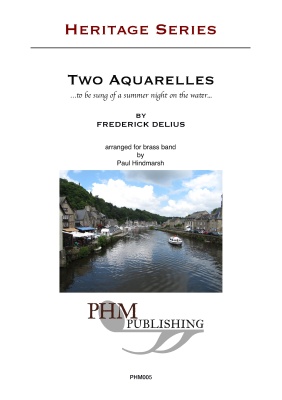
Two Aquarelles (Euphonium Feature with Brass Band - Score and Parts)
In the late spring of 1917, the Bradford born composer, Frederick Delius (1856 - 1934) composed two short part-songs at his home in Grez-sur-Loing. The river ran along the bottom of his garden and he called the two miniatures To be sung of a summer night on the water. The First World War was at its height, but one would never guess that from the languid and serene quality of these richly textured nocturnes. The songs were first heard in London on 28 June, sung by the Oriana Madrigal Society, conducted by Charles Kennedy Scott. In 1932 Delius's amanuensis, Eric Fenby, arranged them for string orchestra as Two Aquarelles. While I have taken Fenby's title, my arrangement is a note-for-note transcription of the choral original. It was prepared in early in 1993 for Besses o' th' Barn Band, of which I was Musical Director at the time. In the second song, the prominent tenor solo has been given to the solo euphonium, who should stand apart from the band in performance.- Paul HindmarshDuration: 5.00
Estimated dispatch 7-14 working days
-
 £34.95
Judd: Concert Etude
Although firmly established in the trumpet repertoire, this exciting work has also been featured by cornet, tenor horn, trombone and even tuba players!
Estimated dispatch 7-14 working days
-
 £34.95
Judd: Gymnopedie
This is a transcription for brass band of the first, and most well-known, of Erik Satie's three Gymnopedies for piano which were composed in 1888. All three are similar melodically and pianistically. However, the first and last are more well-known, partly due to the later orchestrations by Debussy. Tenor Horn and Eb Bass mutes are requested by the arranger and will enhance the transcription if available.
Estimated dispatch 7-14 working days
-
 £34.95
Judd: His Eye is on the Sparrow
A traditional gospel spiritual originally written in 1905 by Civilla D. Martin and Charles H. Gabriel, the song is most associated with actress-singer Ethel Waters. The song, now in the public domain, has been covered extensively in gospel music, with notable versions by Shirley Caesar, Marvin Gaye, Kirk Franklin and the Family, Lauryn Hill and Tanya Blount (from Sister Act 2), Mahalia Jackson, Sister Rosetta Tharpe, Dottie West, Barbara Mandrell and Jessica Simpson. This version is for tenor horn soloist with brass band accompaniment.
Estimated dispatch 7-14 working days
-
 £37.95
Benvenuto Cellini (Brass Band - Score only)
Berliozs opera Benvenuto Cellini was first produced in Paris in 1838 but was withdrawn as a failure, and it was not until the production in Dresden in 1888 that it was finally acclaimed by the Germans as a triumph. Adapted from certain episodes recorded in the memoirs of Benvenuto Cellini, Tuscan sculptor and goldsmith, the story, laid in Rome during the mid-sixteenth century, is not strictly historical. The short opening Allegro, marked deciso con impeto, is conceived in the most brilliant Berlioz manner, utilising full instrumentation. In the Larghetto we meet at once the first of the opera themes " the Cardinals aria (from the last act) introduced in the bass, quasi pizzicato. A second melody leads to a resumption of the Allegro, the contrasting second subject in the tenor horns being an adaptation of Teresas aria (Act I). Towards the end the Cardinal theme is re-introduced by trombones, fortissimo against an energetic cornet and euphonium passage (senza stringendo " without hurry, says the score). After a unison passage storming skywards, there is a sudden, dramatic three-bar silent pause broken by Eb basses alone, again stating the Cardinal theme. A simple molto crescendo on the dominant, begun piano, leads to the long, resounding chord.
Estimated dispatch 7-14 working days
-
 £82.95
Benvenuto Cellini (Brass Band - Score and Parts)
Berliozs opera Benvenuto Cellini was first produced in Paris in 1838 but was withdrawn as a failure, and it was not until the production in Dresden in 1888 that it was finally acclaimed by the Germans as a triumph. Adapted from certain episodes recorded in the memoirs of Benvenuto Cellini, Tuscan sculptor and goldsmith, the story, laid in Rome during the mid-sixteenth century, is not strictly historical. The short opening Allegro, marked deciso con impeto, is conceived in the most brilliant Berlioz manner, utilising full instrumentation. In the Larghetto we meet at once the first of the opera themes " the Cardinals aria (from the last act) introduced in the bass, quasi pizzicato. A second melody leads to a resumption of the Allegro, the contrasting second subject in the tenor horns being an adaptation of Teresas aria (Act I). Towards the end the Cardinal theme is re-introduced by trombones, fortissimo against an energetic cornet and euphonium passage (senza stringendo " without hurry, says the score). After a unison passage storming skywards, there is a sudden, dramatic three-bar silent pause broken by Eb basses alone, again stating the Cardinal theme. A simple molto crescendo on the dominant, begun piano, leads to the long, resounding chord.
Estimated dispatch 7-14 working days
-
 £44.95
Brass Band Sketches
Includes: Romance (for Soprano Cornet); Polka (for Bb Cornets); Lullaby (for Flugel Horn); Barcarolle (for Tenor Horns); Rondo (for Baritones or Euphoniums); Humoreske (for Trombones); Melody (for Eb or BBb Basses); March (for the Full Band).
Estimated dispatch 7-14 working days
-
£8.95
Diversions on Gwahoddiad
This intermediate piece celebrates the lyrical side of tenor horn as well the virtuosic technical ability of many of today's leading horn players, all through exploring Jon Roberts beautiful Welsh hymn tune, Gwahoddiad.
Estimated dispatch 7-14 working days
-
 £40.00
La Fiesta (Score and Parts)
Chick Corea is an American pianist and composer of Sicilian and Spanish descent, whose long career in jazz music continues to this day. A member of Miles Davis's band in the 1960s, he formed his own band Return to Forever in the 1970s before establishing himself as one of the greats of modern jazz.La Fiesta was composed in 1972 and included on Return to Forever's debut album. The music is in one-in-a-bar waltz time and switches between Latin carnival-style and jazz waltz, with stand-up solos for cornet, baritone and tenor horn. This arrangement was performed as part of the Cory Band's winning Brass in Concertprogramme in 2012.
Estimated dispatch 7-14 working days
-
 £40.00
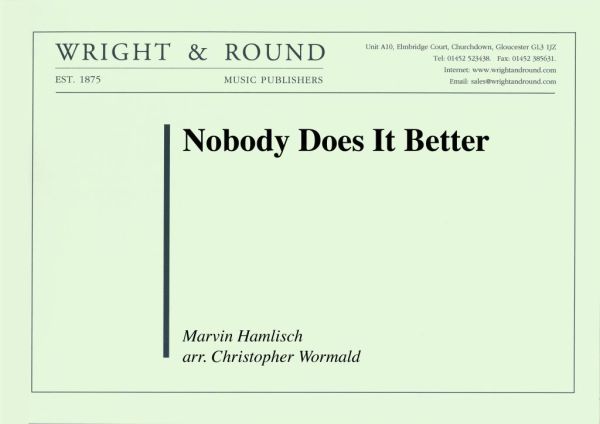
Nobody Does It Better (Score and Parts)
Featuring trombone, flugel, tenor horn and baritone, this arrangement is faithful to the 1977 hit from the James Bond film The Spy Who Loved Me, and playable by all grades of band.
Estimated dispatch 7-14 working days