
Results
-
 £24.50
Swanee River - Stephen Foster - Alan Beaumont
The song "Old Folks At Home" over the years has become better known by the lyrics of its first line (Way Down Upon The) Swanee River. The composer Stephen Foster (also known for songs such as "Oh! Suzanna" & "Jeanie With The Light Brown Hair") struggled to find the perfect river to fit his melody, until his brother suggested the "Suwannee" river in Southern Georgia/Northern Florida, although, Foster misspelled the name intentionally to fit the melody line. The song has been the official state song of Florida since 1935. This rousing arrangement by Alan Beaumont will take your audience on a foot tapping, lighthearted journey. With the melody featured in a variety of different styles, the comedy sounds of duck calls, car horns, sirens & other surprises will keep the audience (& players) on their toes. A wonderful addition to any bands library, not to be missed.
In Stock: Estimated dispatch 1-3 working days
-
£44.50
Marianne - Martin Bunce
Written in 1974, Marianne is a beautifully lyrical flugelhorn ballad by Martin Bunce, now newly arranged by the composer for brass band.Originally written during a particularly romantic period in Bunce's life, the piece was first performed on the BBC Two television programme In Concert by the National Youth Jazz Orchestra, with Martin himself featured as the flugelhorn soloist. A recording was subsequently released by RCA on 45rpm, and Marianne gradually became an established and much-loved part of the NYJO repertoire. It has since appeared on several of the orchestra's recordings, including the four-CD collection The Very Best of NYJO.The melody has also found a home in the brass band world, notably through Maurice Murphy's recording with the Leyland Band on The Lighter Side of Maurice Murphy. This new brass band arrangement places the flugelhorn's distinctive warm and mellow tone firmly at the heart of the music, supported by sympathetic and accessible scoring throughout the band.Neither the solo part nor the accompaniment is excessively demanding, making Marianne an excellent choice for a wide range of bands and an ideal contrast item for concert programmes. Warm, expressive and immediately appealing, it offers the flugelhorn soloist an opportunity to shine while giving audiences a memorable melody to take away.A charming addition to any brass band library, Marianne is particularly well suited to concerts, solo features and lighter programmes.
In Stock: Estimated dispatch 1-3 working days
-
 £25.50
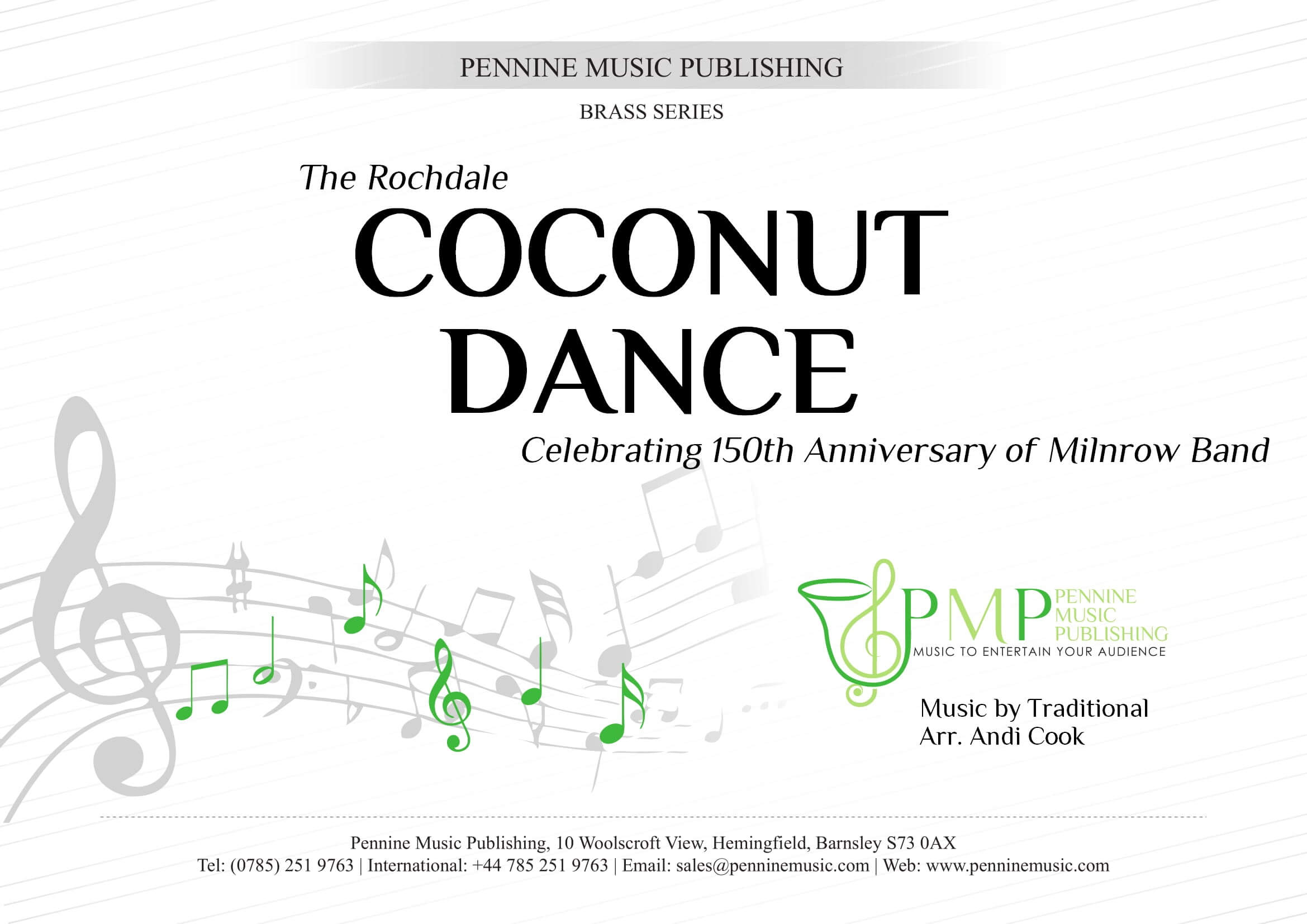
Coconut Dance - Traditional - Andi Cook
The Rochdale coconut dance is a traditional Morris dance, often used by the dancers who accompany the rush-cart during the Rochdale rushbearing festival. It probably dates from the 1850s, and though the dancers were said to have half a coconut shell on each knee and in each hand, the term 'coconut' is also used as local slang for the wooden end of a wool bobbin, so nobody can be sure if they were always real coconuts. Written for the Milnrow band's 150th birthday celebrations (1869-2019) this arrangement uses a combination of Caribbean rhythms and a disco groove for a modern take on an old favourite that's impossible to sit still to. Enormously catchy, great fun to play and with something for everyone to enjoy, your audiences will be whistling this one all the way home.
In Stock: Estimated dispatch 1-3 working days
-
 £37.50
Festive Frenzy - Various - Gavin Somerset
This new release is the perfect all-rounder Christmas item, perfect for your festive program. From "Troika" to "Frosty The Snowman", this piece contains several well-known Christmas songs (& a couple, not so well known). The middle section of the work is the calm stunning melody from Chris De Burgh's "A Spaceman Came Travelling". This reflective section is the perfect middle movement to this festive selection that is sure to wow audiences as you take them on a trip though the music of Christmas. This is a must for all bands that like to entertain.
In Stock: Estimated dispatch 1-3 working days
-
 £37.50
Ghost of Christmas Past - Trad - Jon Kenyon
This effective new arrangement creates a haunting atmosphere for your concerts, as some of the most well-loved Christmas carols are scored in a way unheard of before. Opening with God Rest Ye Merry Gentlemen in a cinematic scene, the work wouldn't feel out of place on the set of a Tim Burton film score. Carols of the minor key drift though the composition and take your audience on a journey to give them something completely different and fresh for your concerts this year. At 7 mins duration, the work is a perfect Overture alternative of the Macabre kind.
In Stock: Estimated dispatch 1-3 working days
-
 £37.50
Italien Euphoniem - Gavin Somerset
Occasionally, a solo comes along that allows the performer to show off their skill, whilst allowing the band a licence to enjoy themselves too. From the pen of Gavin Somerset comes a solo that takes all the 'bravissimo' of the great Italian composers and delivers a piece that both the audience and performers can enjoy. This original work is written with tongue placed firmly in cheek in this playful, light-hearted take on Italian music with a built in fun factor. The work is a must for both Euphonium soloists and bands looking to add a playful item to their programme To download the playback audio to play along to, please RIGHT CLICK HERE & Save As .
In Stock: Estimated dispatch 1-3 working days
-
 £29.50
A Muppet Christmas Carol - Paul Williams - David Hollings
The Muppets certainly need no introduction and their take upon the famous Charles Dickens classic novel was of course, a huge success. Released in 1992, the film was the first from the Muppets to be created following the death of their creator Jim Henson and fellow puppeteer, Richard Hunt. Now, arranged by David Hollings, the fun filled overture from the movie is now available for brass band for the first time. A welcome addition to a festive programme for bands that are looking for something different this Christmas.
In Stock: Estimated dispatch 1-3 working days
-
 £24.50
A Yorkshire Manger - William Kirtpatrick - Stephen Tighe
A new take on an old favorite. Based on the Carol "Away In A Manger", this arrangement adds a hint of Yorkshire flavour to it with, coupling it with the accompaniments from "Last Of The Summer Wine". A melodious opening from the horn section, with gentle sleigh bells to help us move along. This is sure to warm the hearts of all the listeners this Christmas. For Christmas 2020, we have made backing tracks of this title for you to download. These can be used either for personal playback use, or to create a virtual performance of the piece with your full band. To download the backing track, please RIGHT CLICK HERE & Save As .
In Stock: Estimated dispatch 1-3 working days
-
£29.50
Baking Day - Naomi Styles
Baking Day is a fast, foot-tapping duet which will challenge your Euphonium and Eb bass players. It also features 'kitchen percussion' - the percussion section is invited to raid the kitchen for things that thud and clang, although parts for ordinary instruments are provided! There are opportunities for your percussion section to ad-lib in the middle section between E and F, to show off their capabilities. There are also places where banter between conductor and players can take place, making this a fun-filled entertainment piece that both shows off your duetists' talents and raises a smile.This work forms part of a series inspired by Christopher Lloyd's book 'What on earth Evolved?' which ranks the species that have had the biggest impact on the history of Earth and humankind. The series thus makes up a modern 'Carnival of the Animals'. Baking Day celebrates Yeast, a microscopic fungus which brings us bread, buns, wine, Marmite and even biofuel.
In Stock: Estimated dispatch 1-3 working days
-
 £24.50
Christmas Jig - Naomi Styles
With a different take on the traditional Christmas medley, this jolly selection takes several well-known Christmas carols written in 6/8 time and puts them in the style of a gleeful jig. Featuring In Dulci Jubilo, On Christmas Night, I Saw Three Ships, Christ was Born on Christmas Day & Here we Come a-Wassailing, the piece is a great workout for the band, whilst audiences will struggle to remain still throughout in this lively piece.
In Stock: Estimated dispatch 1-3 working days
 View Music
 Listen to MP3