
Results
-
 £76.99
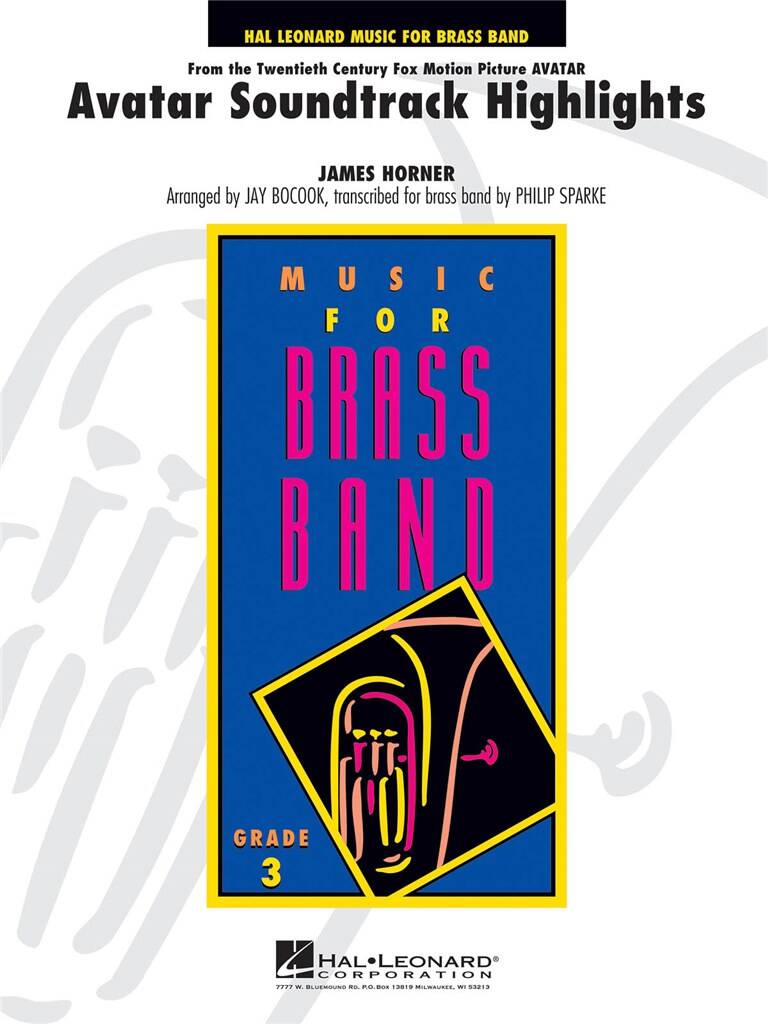
Avatar Soundtrack Highlights - James Horner - Jay Bocook
James Horner composed the soundtrack to the stunning science-fiction film Avatar, which millions of enthusiastic movie-goers have already seen. Jay Bocook combines all the action, adventure, drama, and romance Horner wrote into his music and has created a medley, adapted for brass band by Philip Sparke, that will take your audience on an exciting voyage.
Estimated dispatch 5-14 working days
-
 £54.99
Peche Melba - Peter Martin
A delicacy for the eye, ear, and taste buds that was originally created by a Parisian cook in London. A musical haven of peace as a dessert and a romantic highlight of a diner a la carte. The melodic lines are relaxed and smooth and will definitely take you to another dimension for a while.
Estimated dispatch 5-14 working days
-
 £54.99
Peking Duck - Peter Martin
If there is one country whose music everyone can recognize, it is China. Both the pentatonic patterns and the atmosphere will take you there. And Peking Duck is a delicacy that you simply must try!
Estimated dispatch 5-14 working days
-
 £60.99
Playing Together - John DeBee
Playing Together is and remains the motto of wind music, but also enjoying it should take a prominent place. Playing Together a composition (in 8 parts) for beginning youth bands, combines these two features very pleasantly.
Estimated dispatch 5-14 working days
-
 £39.95
When Thunder Calls (Brass Band - Score and Parts)
When Thunder Calls was commissioned by Dr Nicholas Childs and the Black Dyke Band for their performance at the Gala Concert of the Swiss Open Championships in September 2011. When composing this piece, I decided to focus on both the music and the stage presentation. The way the piece has been composed and designed makes it a very effective way of starting a concert or a second half of a concert.At the start of the piece, the percussion enter the stage and take their positions in their usual place behind the band. They begin playing the piece without a conductor. They keep repeating the opening section while the Basses, Horns, Baritones and Euphoniums march onto the stage.This group of musicians take their seats with the Horns, Baritones and Euphoniums sitting where they usually sit in the band but the Basses sit where the solo cornets usually sit, forming an inner semi-circle of lower brass. When seated and when the music gets to the end of bar 4 the piece continues onto section A. All performers keep repeating this next 4-bar phrase until the trombones march onto stage and stand at the front of the stage with the Bass Trombone standing in between the other two trombones.All performers then play from figure B to C with the trombones taking the lead at the front. When the performers get to rehearsal figure C they repeat this section (the same as section A) while the trombones move from the front of the stage and take their positions where the Basses would normally sit (between the horns and the percussion) and remain standing. Meanwhile, the flugel enters the stage and stands at the front of the stage (standing where the trombones did). When in position the flugel soloist picks up into rehearsal figure D.When the flugel soloist finishes playing, just before rehearsal figure F they then move to their normal seat in the band. At figure F the cornets march onto the stage from either side, they turn and stand side by side each other facing outward towards the audience forming two 'fanfare' lines either side of the lower brass. The conductor follows the cornets on stage and on cue they lift their instruments at the same time and perform when the piece gets to figure G.There is no more moving around from this point on other than the solo cornet to move forward with the solo euphonium and perform their duet at letter H. Also the horns are required to stand and play at letter I and then sit just before J.When performed with all the choreography, this piece makes for an exciting addition to any concert repertoire both for the performer and the audience.Suitable for 3rd Section Bands and Above
Estimated dispatch 7-14 working days
-
 £229.00
A Poem Against War - Harrie Janssen
A Poem against War A Poem against War was commissioned by Psalm 150, Dinxperlo for the project Leven in Vrijheid!.Starting point of the composition of this piece was the poem A Poem against War from the American poet Karen Kapowich. The poem tells of young lives that are broken in their start because of war.A monument - founded in memory of the soldiers who gave their lives - is hardly noticed and even ignored. Children find the tree-sheltered memorial place rather scary and even the narrator speeds up his stride when passing. Underlying theme is the otiosity of war.The musical piece is composed of two parts that are being played without interruption. The first part explains the drama of the battle. The second part is based on the poem of Karen Karpowich in which we look back on the sacrifices that have been made. The text is sung by a Mezzo Soprano and emphasizes the bloodshed that comes along with every war. The opening theme returns at the end of the piece but in a complete metamorphosis, wherein optimism and vigor take place for resignation knowing that history repeats itself time and time again. A Poem against War had its premiere on 25th November 2012 in de DRU Cultuurfabriek in Ulft by Fanfare-orchestra Psalm 150, Dinxperlo led by Tijmen Botma. The Mezzo Soprano was Elske ter Lindert.commissioned by Psalm 150, Dinxperlo for the project Leven in Vrijheid!.Starting point of the composition of this piece was the poem A Poem against War from the American poet Karen Kapowich. The poem tells of young lives that are broken in their start because of war.A monument - founded in memory of the soldiers who gave their lives - is hardly noticed and even ignored. Children find the tree-sheltered memorial place rather scary and even the narrator speeds up his stride when passing. Underlying theme is the otiosity of war.The musical piece is composed of two parts that are being played without interruption. The first part explains the drama of the battle. The second part is based on the poem of Karen Karpowich in which we look back on the sacrifices that have been made. The text is sung by a Mezzo Soprano and emphasizes the bloodshed that comes along with every war. The opening theme returns at the end of the piece but in a complete metamorphosis, wherein optimism and vigor take place for resignation knowing that history repeats itself time and time again. A Poem against War had its premiere on 25th November 2012 in de DRU Cultuurfabriek in Ulft by Fanfare-orchestra Psalm 150, Dinxperlo led by Tijmen Botma. The Mezzo Soprano was Elske ter Lindert.
Estimated dispatch 10-14 working days
-
Off Duty - John Dankworth - Len Jenkins
The late John Dankworth (1927-2010) made a string of recordings in the 1960s that have since come to be regarded as some of the finest British jazz of their time. Amongst these is his composition 'Off Duty' which was recorded in the 1960s when the influence of pop and rock on jazz was at its height and instruments such as the bass guitar were beginning to be incorporated into jazz's vocabulary. At this time and almost subconsciously, a Dankworth 'pop' style also evolved. This was a balanced marriage between jazz and pop which is here demonstrated in 'Off Duty' thanks to the ingenious and original orchestration by John Dankworth, and the faithful arrangement for Brass Band by one of his fans, Len Jenkins. The title is interesting as John loved to play with words. 'Off Duty' could mean relaxing away from work, but could also carry the implication of something not attracting taxation.... a sort of 'duty-free'. About the same time, the Dave Brubeck Quartet produced the seminal 'Take Five'... so could this be John's take on that title, suggesting a short break? Which meaning fits best for you? The piece would best suit the capabilities of a brass band playing at the standard of Third Section or above.
-
 £50.00
Triumph Series Band Journal March 2015 Numbers 1259 - 1262
No. 1259 March - Divine Care (Eiliv Herikstad)The message of this march is 'God will take care of you!' The introduction reflects the beginning of the song, God will take care of you (T.B.C.S. 124), which is presented in full at sections C and D.No. 1260 (1) Cornet Solo - Become aware of him (Michael Davis)A setting for Cornet and band of Colonel Robert Redhead's song, Become aware of him, which was originally published in The Musical Salvationist.No. 1260 (2) Hymn Tune Arrangement - St Peter (David Rowsell)An arrangement of the tune, St Peter, associated with the song, In Christ there is no east or west.No. 1261 Song Arrangement - The deep love of Jesus (Andrew Blyth)The strong hymn tune of Ebenezer (T.B. 433) was composed by Welshman, Thomas John Williams (1869-1944), who served as organist and choir director at various churches in and around Llanelli. This arrangement is more relaxed in style than the original and attempts to convey the freedom of the verses mostly associated witht he tune by Samuel T. Francis (1835-1925) O deep, deep love of Jesus, vast, unmeasured, boundless, free.No. 1262 Everybody praise his holy name (Nicholas King)A bright arrangement by Nicholas King of Remco Hakkert's song, Praise his holy name.
Estimated dispatch 7-14 working days
-
 £45.00
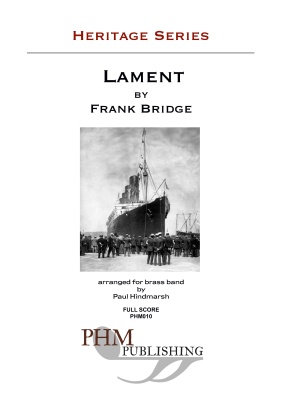
Lament (Brass Band - Score and Parts)
The English composer Frank Bridge (1879 - 1941) did not take an active part in the First World War. However, he was devastated by the slaughter on the western and the eastern fronts, especially the loss of so many of his musicians friends and colleagues. Writing in 1963, his former pupil Benjamin Britten confessed that 'a lot of my feelings about the First World War which people seemed to see in the War Requiem came from Bridge. He had written a piano sonata in memory of a friend killed in France and though he didn't encourage me to take a stand for the sake of a stand, he did make me argue and argue and argue. His own pacifism was not aggressive, but typically gentle'.Bridge composed this Lament for string orchestra on 14 June 1915, in memory of Catherine Crompton, who drowned when the Cunard liner Lusitania was torpedoed by a German submarine on 7 May, 1915. According to figures researched by Liverpool historian Kevin Roach (www.lusitania.net), 1201 men, women and children lost their lives out of the 1962 people aboard. Ninety-four children died, including Catherine, her twin brother Paul and four other siblings. Paul Crompton, Snr. (44), a British businessman working in Philadelphia, his wife Gladys (40) and the family nanny were also drowned. How Bridge's dedication came about is uncertain. The music critic Edwin Evans, who knew Bridge well, has written that the Catherine was a young friend. It is also possible that he came across the family photograph which was published in many newspapers in the wake of the tragedy. By that time, Bridge was greatly distressed by the war as a whole. It seems perfectly in keeping with his pacifist leanings and the strength of his reaction, that this poignant and deeply touching 'war memorial' should mourn a child who he did not know, rather than one of the thousands of young men who fell in battle.Through the musical tears of this melancholy lullaby, Bridge may have regarded the death of young Catherine Crompton as symbolic of the loss of so many innocent lives in wartime. His response to this personal tragedy was characteristically spontaneous and utterly sincere. It is one of his most effective miniatures, poignant yet restrained in its lyrical beauty, with a compelling directness and simplicity of construction.This brass band transcription is pitched one tone lower than the original for string orchestra.- Paul HindmarshDuration: 5.00
Estimated dispatch 7-14 working days
-
 £49.95
Vivaldi's mission to Saturn on a dog named Bongo for Brass Band - Paul Saggers
Using material from Antonio VivaldiasThe Four Seasons, this programmatic work depicts the following story:The year is 2024, Earth has been invaded by a group of evil organists called aThe Buxtehudariansa, wiping out most of mankind. However, a secret group of highly intelligent dogs have defrosted the composer Antonio Vivaldi who was cryogenically frozen by the Vatican society of music for obedient dogs. Their chief dog leader aBongoa who over years of listening to the music of Vivaldi has gained the ability to fly, is set to undertake a mission to Saturn to obtain the golden Bassoon with which to defeat the tyrannical Buxtehuderians. With Vivaldi firmly mounted on Bongo they take off, entering full dog overdrive and breaking through the many satellites and second-hand saxophones that surround the earths atmosphere. As they fly through space, Vivaldi sadly gets distracted by a drunken trombonist and becomes separated from Bongo. Bongo now summons his musical ability to perform Vivaldias second movement of Spring from the Four Seasons on a glockenspiel stored at the international space station, enticing Antonio back on their mission. They finally arrive at Saturn and swiftly grab the golden Bassoon, returning to Earth with a thump. Their mission is complete! But can they defeat those pesky organists?Time will tell...Duration: 7a30Difficulty: 5.5/6
 View Music
 Listen to MP3