
Results
-
 £35.00
Ascension - Lucy Pankhurst
A major work written for the RNCM Brass Festival Competition 2005, and inspired by the nature of Ascension - creating a Musical depiction of the spiritual journey towards enlightenment, sanctuary and ultimate inner peace.As aninitial muse for this work, the 'Tibetan Singing Bowl' is utilised with the Brass Band in order to represent this path to Serenity, together withBaoding Balls(Chinese Health Balls) to mark the point of Final Ascension.Programme notes from the composer, Lucy Pankhurst:Ascension is a Musical depiction of the Spiritual Journey towards enlightenment, sanctuary and ultimate inner peace.As my initial muse for this work, the Singing Bowl is utilised with the Brass Band in order to represent this path to Serenity. "Tibetan" Singing Bowls date back to the 8th Century A.D., originating in the pre-Buddhist shamanic Bon Po culture in the Himalayas and are still used in modern Monasteries. The original purpose of them still remains a mystery, with accounts stating that it is forbidden to disclose the true function of the Bowls, as the "secrets of sound" yield so much Power, that they must be kept hidden.Listening to the tones created by the Singing Bowl effectively silences the internal dialogue of the listener, making it an excellent tool for Meditation, Centering and entering trance-like states. In Buddhism, as with many cultures, sound is an important part of Spiritual Practice. There are 9 methods to reach Enlightenment in the Buddhist Doctrine ; the seventh is SOUND.These Bowls are used by Healers in a similar way to help balance the body's residual energies. The Bowls are usually made from seven different sacred metals, intended to correlate directly to the seven sacred "Planets" : GOLD (Sun), SILVER (Moon), MERCURY (Mercury), COPPER (Venus), IRON (Mars), TIN (Jupiter), ANTIMONY (Saturn). Any one Bowl can create up to seven different frequencies (tones) simultaneously. In Healing, the Singing Bowl is played whilst balanced on the palm of the hand, struck three times to stabilise the surrounding energies, before rotating the wooden "beater" around the outer circumference of the Bowl to create the "singing" effect.I have included an optional Vibraphone part (to be played with a Double Bass Bow) with Tubular Bells, to be used only in performances where a Singing Bowl cannot be acquired. However, a traditional Bowl should be used whenever possible, to create this specific and unique sound.Baoding Balls or Chinese Health Balls are also utilised in this work. Their appearance in the Music here, however, is to mark the point of Final Ascension, where the music reaches its ultimate goal. These delicate cloisonne iron Balls are said to stimulate the acupressure points on the hand, thus improving the Chi and Energy Paths (Life Force) throughout the entire body. The delicate "tinkle" produced by these spheres is hypnotic and captivating. For this reason, where no Baoding Balls are obtainable for performance, only delicate metallic percussion should be used in replacement (i.e. Crotales, Antique Cymbals or (liberal) single strikes on a Triangle etc.). Bell Trees, Wind Chimes and Cow Bells should not be used.As in many cultures, the number three is important in Ascension, as it represents not only the purification from the Singing Bowl, but also it is a number of confirmation, reiterated throughout the music in the metallic percussion in addition to the Brass, re-affirming the correct path to Enlightenment.
In Stock: Estimated dispatch 3-5 working days
-
 £95.00
Tenor Horn Concerto 'Three Gods' (Tenor Horn Solo with Brass Band - Score and Parts)
Edward Gregson's Tenor Horn Concerto (Three Gods) was commissioned by the Belgian tenor horn soloist Tim de Maeseneer for a recording of commissioned works he made in 2024 with his own band, Brass Band Willebroek.The subtitle of 'Three Gods' refers to three mythological Greek Gods: Zeus, Hermes and Apollo. The idea for this came from Gregson's Viola Concerto, which he composed in 2023 and which was similarly subtitled 'Three Goddesses'. Indeed, the first movement of the horn concerto shares some common material with the viola concerto, although the other movements are newly composed.The concerto exploits the noble character of the horn, but the writing is also virtuosic in character as well as lyrical and melodic, demanding an extended playing range of nearly four octaves with a variety of colouration in its sonorities. The unifying motif of the whole concerto is the interval of a rising 5th, heard at the outset. The opening also has some other surprises (both seen and heard).The musical ideas, cast in three separate movements, take their starting point from the characters of the Three Gods in the title:Zeus, ruled as King of the Gods on Mount Olympus, and was the God of Thunder and Lightning and of War. His music is often threatening and violent, but also has a more tender side as portrayed in the lyrical second subject. However, the dominant mood is one of foreboding.Hermes was the great messenger to the Gods who could travel between realms on his winged sandals. Thus, his music is fast, fleet of foot, and mercurial - a dashing scherzo, but with lyrical and expressive moments.Apollo, the God of Music and Dance (and the Sun), symbolises virtue and beauty. This final movement, 'Hymn to Apollo', is mainly slow and hymn-like and cast in a continuous stream of melody passed between soloist and band. Brief fanfares herald a triumphant march, before the music returns to its quiet opening, gradually rising to a triumphant climax with glittering melodic percussion leading the way. The music ends in a blaze of glory!Duration: 17.00
Estimated dispatch 7-14 working days
-
 £45.00
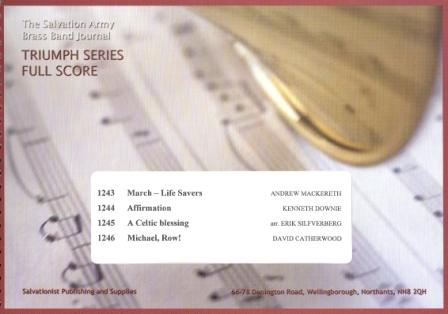
Triumph Series Band Journal November 2013 Numbers 1243-1246
No. 1243 March - Life Savers (Andrew Mackareth)This march was written for the band weekend at Belfast Citadel and incorporates the tune Jesus Saves (T.B. 703)No. 1244 Affirmation (Kenneth Downie)The title comes from the affirming tone of the chorus on which the music is built, He is the Lord, which itself is inspired by Phillippians, chapter 2. The chorus does not appear in its entirety at any point, but is obvious to a greater or lesser extent, in the texture of the music.No. 1245 A Celtic Blessing (arr. Erik Silfverberg)This is a simple arrangement of c Celtic traditional tune used to the lyrics of the familiar blessing:May the road rise to meet you,May the wind be always at your back,May the sun shine warm upon your face,The rain fall soft upon your fields,Until we meet again,May God hold you in the palm of his hand.No. 1246 Michael, Row! (David Catherwood)This arrangement of the traditional chous, 'Michael, row the boat ashore' (T.B. 285), is in a light swing style and also incorporates the tunes, 'Love lifted me' (T.B. 725) and 'Will uour anchor hold?' (T.B. 60).
Estimated dispatch 7-14 working days
-
 £33.08
March - Helping Hands (Rob Bushnell) Brass Band
Helping Hands was written for the British Bandsman March Composition Contest, entered into category 2 (marches for 3rd/4th section bands). The piece is loosely programmatic in nature: The introductio is fanfare-like, announcing the date of the next Whit Friday Contests and the bands' anticipation of and preparation for the event. The first section is the march of the volunteers, as they descend upon the many venues, ready to run the contests. The second section (bars 35 to 52) sees the contests start. The bands strike up, march, finish and go from place to place, whilst the volunteers manage them, the audiences, and all manner of issues and problems thrown at them. The third section (bars 53 to 69) represents the bad weather which has, at times, presented itself on that particular Friday. But everyone carries on (possibly the sun comes out) and we enjoy the day. The trio uses the hymn St. Vincent by Sigismund Neukomm: St. Vincent de Paul is the patron saint of charities and volunteering, hence its use here. The piece is influenced by marches that are commonly heard during the Whit Friday March Contests, using motifs, rhythms and harmonic progressions (sparingly) throughout the piece. March-card sized parts included, with alternatives for horns in F and lower brass in bass clef. To view a rolling score video of the piece please visit www.youtube.com/watch?v=diqDoe0XpcA PDF download includes score and parts. Sheet music available from: UK - www.brassband.co.uk USA - https://satradecentral.org Difficulty Level: 3rd Section + Length: 3.50 minutes Instrumentation: Soprano Cornet Eb Solo Cornet Bb Repiano Cornet Bb 2nd Cornet Bb 3rd Cornet Bb Flugel Horn Bb Solo Horn Eb 1st Horn Eb 2nd Horn Eb 1st Baritone Bb 2nd Baritone Bb 1st Trombone Bb 2nd Trombone Bb Bass Trombone Euphonium Bb Bass Eb Bass Bb Drums
In Stock: Estimated dispatch 1-3 working days
-
Aldebaran - Maurice Forslund - Maurice Forslund
We are pleased to offer this new piece from our colleague, Maurice Forslund, in Sweden. "Aldebaran" is a traditional-style brass band march, named after one of the brightest and largest stars in the Northern sky. (The star is a red giant over 40 times the size of our Sun). The music starts off in a sombre minor key that turns progressively brighter step by step. This sequence is arrested by a brief section featuring a setting of the hymn tune 'Bangor' which dramatically puts the march firmly back into the minor key before setting it up for progression to the finale. This piece is graded in the range 'easy' to 'intermediate' and is well within the capabilities of most bands.
-
£50.00
Vectis Isle - Broadbent, D
VECTIS ISLE is the Roman name for the Isle of WrightSTATELY OSBORNEOsborne House was the summer residence of Queen Victoria. Music of fanfares and pageantry in 3/4 time, with a central delicate minuet section, before returning to the original fanfares and stately themes.PICTURESQUE CALBOURNECalbourne is a pretty, tiny country village with its feature of an old water mill. The music is pastorale in style. 6/8 rhythms with a free and easy waltz section.THE OLD CHURCH AT GODSHILLThis movement links directly from the second, but may be played on its own if desired. Godshill is a quaint but beautiful village of thatched cottages by an old church.SANDOWN HOLIDAYSThis final movement is intended to portray the happy atmosphere of this pleasant seaside resort, with just a moment or two to laze on the fine beaches under an afternoon sun before the final allegro concludes this suite.Duration 14 and a half mins
In Stock: Estimated dispatch 1-3 working days
-
 £24.95
First Light (Score and Parts)
First Light was written for Kirsty Abbotts and Carlton Main Frickley Colliery Band. A slow lilting melody is presented in the cornet solo and passed between the band and the soloist to create images of the tranquil night before the piece reaches a climactic moment which is meant to represent the beams of light emerging as the sun rises. The theme is then presented in a tutti forte section before arriving at a tranquil finish. First Light is featured on the Kirsty Abbotts and Carlton Main Frickley Colliery Bands CD, A Search for Peace.
Estimated dispatch 7-14 working days
-
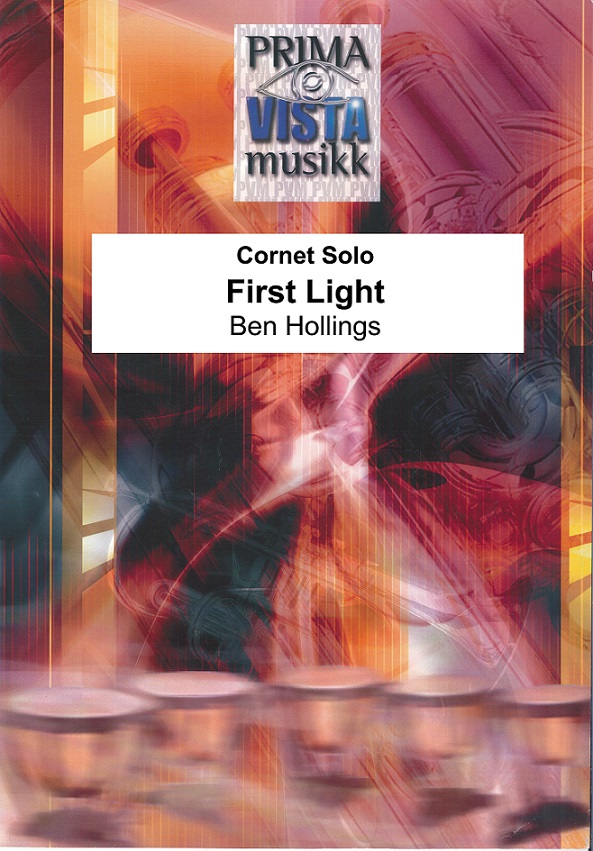 £14.95
First Light (Score Only)
First Light was written for Kirsty Abbotts and Carlton Main Frickley Colliery Band. A slow lilting melody is presented in the cornet solo and passed between the band and the soloist to create images of the tranquil night before the piece reaches a climactic moment which is meant to represent the beams of light emerging as the sun rises. The theme is then presented in a tutti forte section before arriving at a tranquil finish. First Light is featured on the Kirsty Abbotts and Carlton Main Frickley Colliery Bands CD, A Search for Peace.
Estimated dispatch 7-14 working days
-
 £25.00
Ring'd with the Azure World
DescriptionRing'd with the Azure World was commissioned by the Harmonia Brass quintet for their final recital at the University of Huddersfield in 2016.He clasps the crag with crooked hands; Close to the sun in lonely lands, Ring'd with the azure world, he stands.The wrinkled sea beneath him crawls; He watches from his mountain walls, And like a thunderbolt he falls.- The Eagle by Alfred, Lord TennysonThe music was inspired by Tennyson's poem reproduced above; it seeks simply to reflect the spirit of the poem. It opens in sparse, lonely mood as the eagle surveys the world beneath. The work quickens in three bursts using metrical modulation to disguise the actual moment of acceleration, reflecting the lazy energy stored in the circling raptor before concluding dramatically in a fall 'like a thunderbolt'. Tennyson's poem, although brief, has inspired much analysis and writing, and is notable for being written in the (then somewhat unfashionable) iambic tetrameter, indicating a foursquare emphasis reflected in the main theme of the music. This is heard first in an octatonic version and later in a purely tonal (if somewhat modal) version. The instrumentation reflects that of Harmonia Brass, a quintet composed of brass band instruments (two B flat cornets, an E flat tenor horn, tenor trombone and E flat tuba). However the music is also available for the more conventional brass quintet of two trumpets, french horn, trombone and tuba.To listen to an audio export preview and follow the music, click play on the video below!Performance Notes1st cornet/trumpet requires a cup mute, ideally with an adjustable cup (the marking "tight" denotes that the cup should be adjusted closer to the bell), and a harmon mute with the tube removed (denoted by "TR" in the score). 2nd cornet/trumpet requires a fibre straight mute and a harmon mute with the tube removed. Tenor horn require a fibre straight mute and a practice mute (any sort) - in the orchestral brass version the french horn requires a stop mute. Trombone requires a cup mute (only). Tuba requires a fibre straight mute and a practice mute (of any sort).Metronome marks should be closely observed - starting either too fast or too slow will have a disproportionate effect on the tempi later in the piece due to the metrically controlled tempo changes.
Estimated dispatch 7-14 working days
-
Wild Flower Variations - Traditional - Len Jenkins
The theme for this delightful piece is believed to be Spanish and was originally heard in a Mediterranean church over 30 years ago, sung by the local choir accompanied by local musicians. The theme is not stated separately, and the piece begins directly with the First Variation. The following Variations are subtly different from the First, yet both retain the essential warmth of the Mediterranean sun in their harmonic progression. A short Coda rounds off this relaxing and escapist siesta. Time to wake up...The piece is scored to be playable by most Third or Fourth Section bands.
 View Music