
Results
-
£76.99
Elton John in Concert - Elton John - Don Campbell
The songs of Elton John have been in the charts for over 30 years and are still as fresh and entertaining as when he released his first record. Today he is reaching a new generation of fans with his music for many hit films. The combination of up-tempo songs and love songs makes this medley an ideal light interlude that will be adored by your entire audience.
Estimated dispatch 5-14 working days
-
 £105.20
Our Last Summer - Benny Andersson - Bjørn Morten Kjærnes
An exciting arrangement where almost all players have a bit of the melody line. There are many opportunities to give individual musicians soloistic challenges. Any bandmember should find something interesting in this piece. It will be possible to add vocals to the arrangement. A lovely melody with great expressions.Our Last Summer" is a song by the Swedish pop group ABBA from their seventh studio album, "Super Trouper," released in 1980. The song is indeed featured in the musical "Mamma Mia!", a little bit shortened and with small changes in the lyrics. The musical premiered in London's West End in 1999 and is a duet performed by the characters Harry Bright and Donna Sheridan, reflecting on their past romance during a summer spent in Paris.The song is primarily sung by Bjorn Ulvaeus, with backing vocals provided by Agnetha Faltskog and Anni-Frid Lyngstad, the female members of ABBA. Their harmonies contribute to the song's nostalgic and wistful atmosphere. The lyrics vividly describe the memories of the summer spent together, including scenes of walking along the Seine River in Paris and listening to French songs. The song also touches on the passage of time and the realization that the summer romance has ended.While not released as an official single in most countries, "Our Last Summer" still received considerable airplay and became a fan favorite. It charted in some European countries and has remained popular among ABBA fans over the years.
Estimated dispatch 5-14 working days
-
 £105.20
Your Song - Elton John - John Philip Hannevik
Your Song written by the duo Elton John / Bernie Taupin, was first released in 1970 on Elton Johns second studio album. It has become one of his most popular songs, and was ranked as number 137 on Rolling Stones list of "The 500 greatest Songs of All Time". The song is also inducted into "The Grammy Hall of Fame".
Estimated dispatch 5-14 working days
-
 £105.20
Optimist - John Teigen - Øystein Sjøvaag Heimdal
"Optimist" is one of the most well-known songs by Norwegian singer and composer Jahn Teigen. It was written for the Norwegian Eurovision in 1989. It did not win this competition, but is still one of the greatest Norwegian songs from the late 1980's. This arrangement is very close to the original in form, rhythmic- and melodic lines. The repeat at bar 65 may be played as many times as one wish, or it can be omitted.
Estimated dispatch 5-14 working days
-
 £105.20
Ei hand a holde i - Trygve Hoff - Haakon Esplo
Norwegian artist Jorn Hoel made his breakthrough with his album Varme ut av is released in 1987. The songs "Have a Dream" and "Hold My Hand" became big hits and still stand out as some of the most played songs even today. The music was written by Svein Gundersen and lyrics by Trygve Hoff on both of them. Jorn Hoel was awarded "Singer/songwriter of the year" for this release.
Estimated dispatch 5-14 working days
-
 £127.30
God morgen, min kjaere - Benny Borg - Haakon Esplo
Most Scandinavian people know Benny Borg. As a guitarist, composer, lyric writer and a show actor, he has been producing great music for many decades. His most famous songs are probably "Balladen om Morgan Kane", "En spennende dag for Josefine" and "Den store dagen". When Benny Borg made his comeback with the new album, "Den storste reisen" in 2016, he wrote some of the strongest songs of his career. Maybe the strongest one is "Good morning, my dear", that he wrote to his wife after she died.
Estimated dispatch 5-14 working days
-
 £60.99
Hallelujah - Christopher Bond
The songs of Leonard Cohen are difficult to categorize. His songs are sometimes more like poems to music. 'Hallelujah' is probably the most widely known Cohen composition and has been covered many times, most notably by Jeff Buckley. This is a beautiful addition to the brass band repertoire and is suitable for young bands working on phrasing, intonation and musicality.
Estimated dispatch 5-14 working days
-
 £104.99
Kefas - Rob Goorhuis
The composition Kefas was written for the brass band 'Apollo' from Grou (The Netherlands), by order of the Unisono Foundation, the organisation for wind music in The Netherlands.The assignment was given on account of earning the Champions Title during the Dutch Brass Band Championships in the year 2001 (4th division). The theme of the composition links the tradition of the village Grou, not to celebrate Sint Nicolaas but Sint Pieter.By this typical Dutch festivity (in December) the holy Nicolaas gives presents to the children. It is a popular custom where young and old participate. Grou is the only place where this is not done by Sint Nicolaas but by Sint Pieter.Apart from that, on the 22th of Februari, a lot of festivities that take place,resemble those of the Sinterklaas celebration. In the composition two Sint Pieter songs are processed, set through bible scenes, wherein in among others the visit of Christ to the house of Peter's Mother-in-law and the calling of Peter are depicted. The title refers to the pronouncement of Christ, where he named Peter the rock on which he shall build his church. The Hebrew word for rock is Kephas. Kefas was premiered in 2003.
Estimated dispatch 5-14 working days
-
 £109.99
Nordic Moods - Tom Brevik
The composer:1st movement: Reflections by the Fjord.Overlooking one of the mighty fjords of Norway, my mind and thoughts are with an old religious Norwegian folk-tune, with words by the famous parson Peter Dass.The majestic fanfare-likeopening reflects the power of God our Father, the choral itself heard for the first time on flugelhorn. The choral is repeated a few times, separated only by some short variations. The movement ends in thriumph, with fanfares and the choral broughttogether.2nd movement: Reflections in the Old Church.In this movement my associations of a summer day, finding myself alone in an old deserted stone church. From the old walls I hear folk songs, perhaps like the ones sung in the church bypoor fishermen and farmers in days gone by. Suddenly the light from the sun breakes through the small circular window above the altar, and a lovely melody is heard, before the original figures take us to the end of the movement.3rd movement:Festive Reflections.Any festive occasion can be reflected in this movement. from the bonfire at midsummer-night to the children celebrating the return of the sun in the northern part of Norway. from the traditional sleigh-riding at Christmas tothe Celebrations of the National Day on the 17th of May each year.
Estimated dispatch 5-14 working days
-
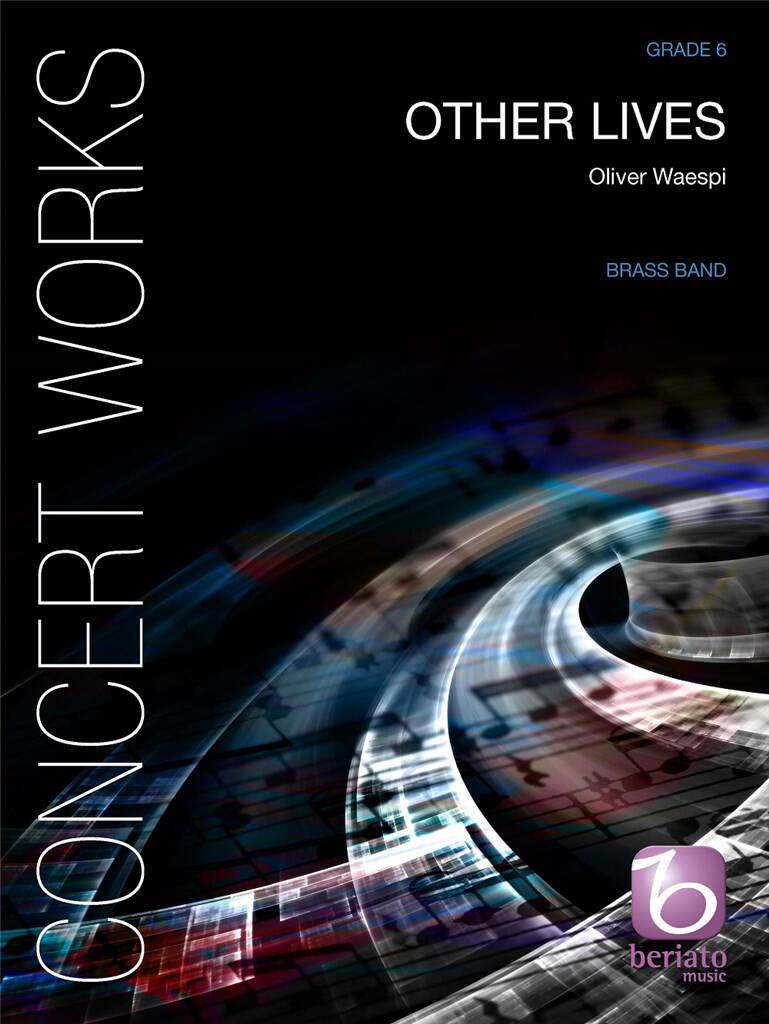 £159.99
Other Lives - Oliver Waespi
Other Lives is works perfectly for a competition but can also be programmed as concert work. The dark chords at the beginning of the piece are derived from "Der Doppelganger", one of Franz Schubert's late songs. After a short development the music begins to accelerate and find its own shape, gradually moving away from the introduction. The entire first part, "Rage", has an intensely agitated character. The ensuing "Reflection" turns back to the initial chord progression, before a series of interspersing solos explore time and space at a slower pace. After another musical surge, the music is brought close to silence and then gives way to the third part, "Redemption".Here, a widely spaced sound field contains a remote allusion to another work by Schubert "Ruckblick". After this farewell, an abstract musical transformation triggers an emotional change, as the initial motifs are now presented in their inversed form in order to create a much brighter harmonic landscape. Moreover, in the last part of the piece, "Renewal", the grim, tense atmosphere of the first part is transformed into a great energy. Other Lives was commissioned by the Valaisia Brass Band.
Estimated dispatch 5-14 working days
 View Music