
Results
-
 £91.99
Fanfares, Songs & Dances (Brass Band - Score and Parts) - Sparke, Philip
Fanfares, Songs & Dances was commissioned by Brass Bands England, the Lithuanian Brass Band Association and the Dutch National Brass Band Championships (NBK), and first performed at the 43rd 'NBK' in October 2024.The work is played in three linked movements:FANFARES opens in robust fashion with a sequence of fanfare-like statements, initially featuring the horns, whose modal theme includes a figure that will reappear throughout the work. Euphoniums and then cornets introduce a second theme, which is followed by a third, again initiated by the horns. Baritones then change the mood with a more-lyrical theme, which builds to a climax, eventually leading back to a recall of the initial fanfare theme. This gradually dissolves to introduce the second movement.SONGS continues to relax the fanfare feel with a long introduction to the movement's main theme, first appearing on solo cornet. A change of key introduces a bridge passage which leads to a sonorous chorale, which builds to a triumphal return of the cornet theme. A peaceful coda leads to the final movement of the work.DANCES is a scherzo-like movement based around a series of rhythmic melodies in triple time, which lead to a majestic return of the 2nd movement's chorale theme under cornet figuration. The opening dance theme returns and heralds a joyous coda.Duration: 11.00
Estimated dispatch 7-14 working days
-
 £44.95
Bravura (A Fantasy on British Folk Songs) (Euphonium Solo with Brass Band - Score and Parts) - Graham, Peter
Bravura is a companion piece to the composer's earlier euphonium display piece Brillante, utilising the same traditional 19th century "fantasy variation" structure, familiar to generations of brass soloists. Folk songs from the four corners of Great Britain are featured; Oranges and Lemons, (England), The Blue Bells of Scotland, The Minstrel Boy (Ireland) and the famous Welsh anthem Men of Harlech.The solo is a conflation of the original version, written for the 2002 Royal Albert Hall Gala Concert, which followed the National Brass Band Championships of Great Britain. On that occasion the combined talents of virtuosi David Childs, Derick Kane, Steven Mead and David Thornton (with guests Robert and Nicholas Childs) were on display, each personalising the cadenza section towards the end. This version incorporates a published cadenza, though soloists should feel free to improvise their own material at this point.
Estimated dispatch 7-14 working days
-
 £69.99
Fanfares and Love Songs (Brass Band - Score and Parts) - Higgins, Gavin
Fanfares and Love Songs was commissioned by the National Children's Brass Band of Great Britain for performance on 25th July 2009. Its three movements contrast the extrovert and lyrical qualities of the traditional brass band. The fanfare with which the work opens involves the whole cornet section. The second movement is reflective in mood, beginning somewhat pensively on muted brass, and building to an emotional climax before subsiding back to a distant pianissimo chord. The finale is a fast dance, which with a final recapitulation of the opening fanfare drives on to a breathless close.Suitable for Advanced Youth/3rd Section Bands and aboveDuration: 12.00
Estimated dispatch 7-14 working days
-
£14.99
Fanfares and Love Songs (Brass Band - Score only) - Higgins, Gavin
Fanfares and Love Songs was commissioned by the National Children's Brass Band of Great Britain for performance on 25th July 2009. Its three movements contrast the extrovert and lyrical qualities of the traditional brass band. The fanfare with which the work opens involves the whole cornet section. The second movement is reflective in mood, beginning somewhat pensively on muted brass, and building to an emotional climax before subsiding back to a distant pianissimo chord. The finale is a fast dance, which with a final recapitulation of the opening fanfare drives on to a breathless close.Suitable for Advanced Youth/3rd Section Bands and aboveDuration: 12.00
Estimated dispatch 7-14 working days
-
 £54.99
Song of Praise (Brass Band - Score and Parts) - De Haan, Jacob
Songs of Praise is a beautiful adaptation of a Netherlands church melody to Psalm 150. The composer Jacob de Haan shows his deft hand at arranging by setting the melody in creative and varied instrumentations. His Songs of Praise is perfectly suited to worship or indeed as a concert intermezzo.Duration: 2:00
Estimated dispatch 7-14 working days
-
 £74.95
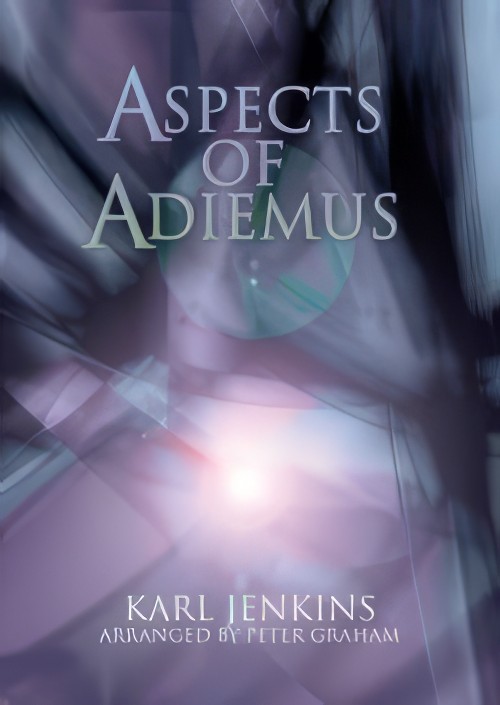
Aspects of Adiemus (Brass Band - Score and Parts) - Jenkins, Karl - Graham, Peter
Aspects of Adiemus is a collection from one of the world's most popular composers, Karl Jenkins. Adiemus, literally translated, means 'we will draw near' and represents a musical language which can be heard on five award winning albums from the composer.Since Adiemus has risen in popularity around the world, it has become a growing entity meaning many different things to many different people. Vocally, the spread of influence grows wider all the time, taking in Arabic and African sounds as well as Celtic and ecclesiastical ones. The percussion too has expanded using Indian, Middle Eastern, Japanese, Chinese and even Australian instrumentation.The evolving nature of Adiemus has meant that it has been difficult to categorise. New age, classical crossover, world music, even pop. Karl sees this as a good sign: To me, Adiemus transcends labels. The fact that it reaches people of different backgrounds, faiths and cultures gives it a universal appeal which is special. The compositions can be spiritual, religious, meditative - it's open to move people in any away they choose to experience.Ironically, the Adiemus project got off the ground initially due to a television commercial for an airline. Karl Jenkins explains, I'd been toying with a new idea, completely separate to my work in advertising, but at this time, Jenkins Ratledge were commissioned to come up with the music for an airline commercial. We presented the client with a demonstration tape of one of my completed compositions and they loved it.That composition became known as Adiemus. The music for the airline commercial was aired and immediately drew interest from the public. Karl: It's ironic that a piece of music not originally intended for a TV commercial should end up on a TV commercial, and that this music became the springboard for the success of the Adiemus project.Expertly arranged by Peter Graham, Aspects of Adiemus features the eponymous Adiemus, an uplifting and instantly recognisable opener. Chorale - Za Ma Ba and Chorale - Vocalise are songs of sanctuary, the latter featuring a chamber group from within the band. The vibrant Song of the Spirit is a cornet feature, and the finale, Song of the Plains combines intense rhythmic energy with tribal harmonies. Duration is variable depending on movement selection and optional cuts.Duration: 20.00
Estimated dispatch 7-14 working days
-
 £44.95
The Great Salvation War (Brass Band - Score and Parts) - Curnow, James
James Curnow was inspired to compose this work after reading 'Marching to Glory', a history of The Salvation Army in the USA. The writer of the book, Dr. Edward H. McKinley, was a colleague of Curnow on the faculty of Asbury College and a member of The Salvation Army Student Fellowship Band. The work was written for this band and premiered by them at the Centennial National Congress in 1980 which was held at Asbury College. Curnow has endeavoured to capture the spirit of early day Salvationists as they gave themselves completely to the great salvation war. Three songs support the three-part structure; 1) Stand like the brave 2) In Thee, O Lord, do I put my trust 3) Rescue the perishing.
Estimated dispatch 7-14 working days
-
£22.50
The Great Salvation War (Brass Band - Score only) - Curnow, James
James Curnow was inspired to compose this work after reading 'Marching to Glory', a history of The Salvation Army in the USA. The writer of the book, Dr. Edward H. McKinley, was a colleague of Curnow on the faculty of Asbury College and a member of The Salvation Army Student Fellowship Band. The work was written for this band and premiered by them at the Centennial National Congress in 1980 which was held at Asbury College. Curnow has endeavoured to capture the spirit of early day Salvationists as they gave themselves completely to the great salvation war. Three songs support the three-part structure; 1) Stand like the brave 2) In Thee, O Lord, do I put my trust 3) Rescue the perishing.
Estimated dispatch 7-14 working days
-
 £60.99
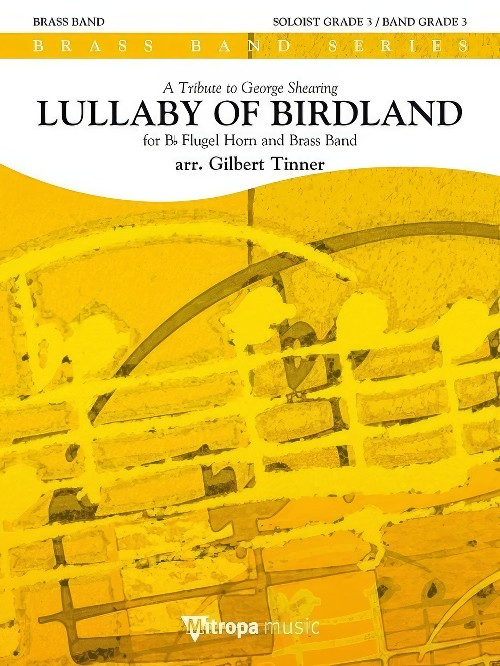
Lullaby of Birdland (Flugel Horn Solo with Brass Band - Score & Parts) - Tinner, Gilbert
"I've been arguably credited with having written some 300 songs, 299 of which enjoyed a rather bumpy ride from relative obscurity to total oblivion. Here's the other one." These are the words of the great Jazz pianist and composer George Shearing about his hit of the century Lullaby of Birdland. The list of famous artists who performed this Jazz standard runs from From Ella Fitzgerald to Amy Winehouse. Gilbert Tinner wrote this arrangement for Brass Band preserving the distinctive George Shearing Sound.Duration: 3.00
Estimated dispatch 7-14 working days
-
 £76.99
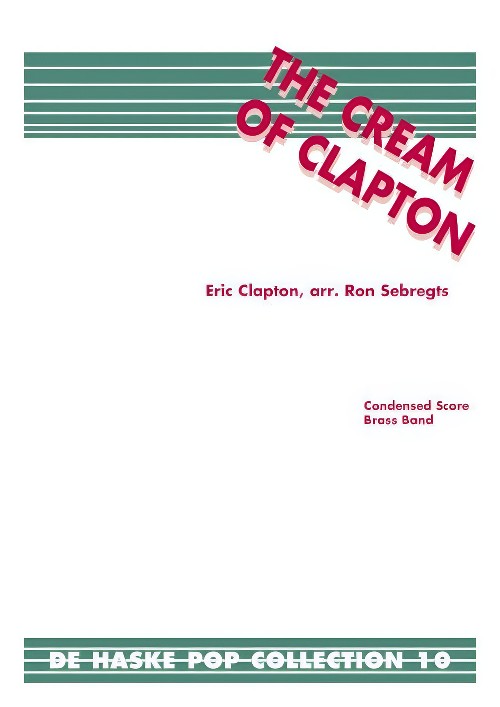
The Cream of Clapton (Brass Band - Score and Parts) - Clapton, Eric - Sebregts, Ron
Eric Clapton's CD Unplugged is one of the top-selling albums of all time. The collection of hits inspired Ron Sebregts to create the medley The Cream of Clapton. It consists of Sebregts favourite songs by this legendary blues and rock guitarrist, singer and songwriter. This medley is guaranteed to be an audience and band favorite for many years to come!Duration: 8.00
Estimated dispatch 7-14 working days
 View Music