
Results
-
£59.95
DEVON FANTASY (Brass Band Set) - Eric Ball
About the lovely county of Devon are songs and stories galore, for it has 'the best of both worlds' in its seascapes and inland scenery. This suite will perhaps bring to remembrance a few aspects of its beauty. The fantasy is in four easily distinguished parts; I. Moorland Songs; here is loneliness as well as beauty. II. The Fair; containing a reference to the song, Widdicombe Fair. III. Quiet Village; little disturbs the even tenor of life, and the 'echo' of music from the church serves to deepen the peace all around. IV. Seafarers; swashbuckling music with reminiscences of half-forgotten shanties.
Estimated dispatch 7-14 working days
-
 £30.00
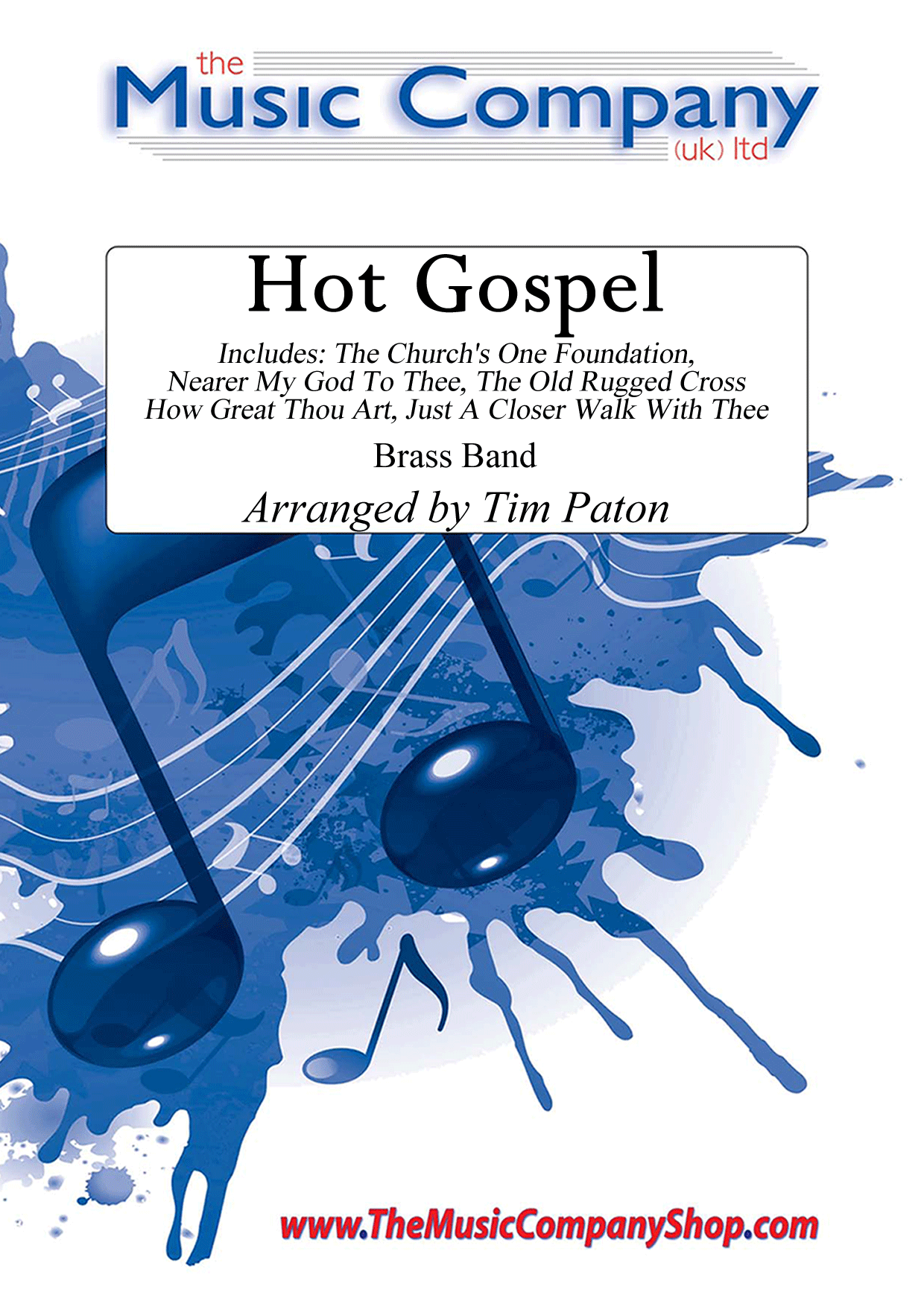
Hot Gospel - Various
Tim Paton has creatively arranged for brass band this selection of familiar hymns/religious songs to create a 5-movement, gospel-styled work. With features for soloists across the band and a great mix of styles including swing, traditional jazz, blues, and calypso, this makes for a versatile concert feature either as a complete piece piece (9 minutes); using the alternative optional cuts (4.5 minutes); or simply by cherry-picking the individual movements in order to spotlight the different styles/melodies/soloists of your choice.With solo features in each section, the piece includes:The Church's One Foundation - Swing version with Tenor Horn soloNearer My God To Thee - Traditional jazz style with Cornet soloThe Old Rugged Cross - Bluesy with Flugel soloHow Great Thou Art - Calypso with Euphonium soloJust A Closer Walk With Thee - Finale with jazzy Trombone soloTim comments:The community gospel choir sound has become very popular in recent years. "Hot Gospel" is my attempt to capture this charismatic experience in a medley of well known sacred music. Each of the five songs chosen follows a similar pattern - a verse for full band followed by a solo, and all solos are intended to sound like improvisation.I've included Optional Cuts which would reduce the play length from c. 9 minutes, down to approximately 4.5 mintues, should your concert programming not allow for the full version. The optional cuts simply side-step the solo section of each song.However you wish to perform Hot Gospel, it will definitely bring variety to programme choice.Also available for wind/concert band.
In Stock: Estimated dispatch 3-5 working days
-
 £38.95
Unity Series Band Journal - Numbers 530 - 533, June 2024
530: Carol Arrangement - God rest you merry, gentlemen (Noel Jones)This swing arrangement of the traditional English carol also features references to O come, all ye faithful (C.C. 61) and Jingle Bells (C.C. 121). Play with imagination and a sense of style!531: Go, tell it on the mountain! (Nathanael Watchorn)Historically, the passion of enslaved people in America for singing about the Gospel of Jesus is well documented, but it was men of three generations, each named John Wesley Work, who enabled spirituals to become more widely known. John Wesley Work Sr, a church choir director in Nashville, Tennessee, wrote and arranged music for the pioneering Fisk Jubilee Singers whose early repertoire consisted largely of spirituals. This passion and knowledge of spirituals was passed down through the generations. John Work III travelled hundreds of miles to collect songs by attending church services in remote areas. In 1940, he published a collection of 230 songs which included a setting of Go, tell it on the mountain! that is still performed today.Nathanael Watchorn, a Bandsman at Regent Hall Corps in London, is a new contributor to the journals. He originally wrote this as a vocal arrangement for the group FourHymn, subsequently transcribing it for the corps' Young People's Band, while he was Band Leader.532: Carol Arrangement - They all were looking for a king (Stephen Hull)At the North American Composers Forum, Major Len Ballantine challenged participants to find an unfamiliar song in the Salvation Army Song Book and try to write an arrangement of the listed tune. Stephen Hull happened across They all were looking for a king (S.A.S.B. 128) and the tune Childhood (T.B. 421) which lead to this arrangement.533: March - Washed and healed (Eiliv Herikstad)The Christian experience of many people will have been positively impacted by the life of the late Bandmaster Eiliv Herikstad, either personally or through his musical leadership and compositions. This march is the second publication from this well-known Salvation Army composer since his Promotion to Glory last year. This march is more traditional in style that many of his compositions but contains a strong Christian message and demonstrates his compositional expertise.
Estimated dispatch 7-14 working days
-
 £60.00
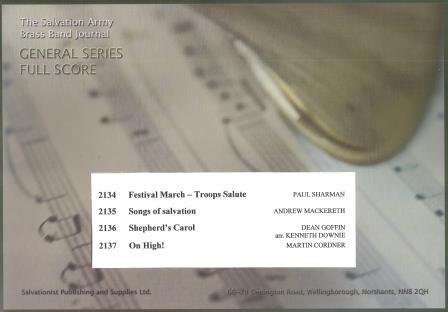
General Series Band Journal August 2014 Numbers 2134-2137
No. 2134 Festival March - Troops Salute (Paul Sharman)Written to mark the retirement of Major John Mott as Bandmaster of the Household Troops Band in 2010, this march features the tunes 'Are you washed?' and 'There's only one flag for me'. No. 2135 Songs of Salvation (Andrew Mackereth)This piece was written for Haaglanden Band in the Netherlands and contains some old Salvation Army Songs; 'Ring the bell, watchman' (T.B. 776), 'Make no delay' (T.B.730), 'Room for Jesus' (T.B. 395), 'Tell me the old, old story' (T.B. 265) and 'Praise God, I'm saved' (T.B. 770).No. 2136 Shepherd's Carol (Dean Jones arr. Kenneth Downie)Originally published in November 1955, this lovely carol was written by father and son, Dean and Henry Goffin, both of whom were Salvation Army officers. Commissioner Sir Dean Goffin was awarded his kinghthood in the Queen's Honours list of 1983No. 2137 On High! (Martin Cordner)Taking its inspiration from the world of rock music, this piece features the song, 'Lord, I lift your name on high'.
Estimated dispatch 7-14 working days
-
£35.00
Match Day - Peter Meechan
Match Day takes itas inspiration from a night in May 2005, when the team I have supported from my childhood, Liverpool FC, won the European Cup in what was considered by many to be one of the greatest football matches of all time.The piece is not only inspired by a football match, but also takes its musical material from chants and songs that you will hear at 3PM on a Saturday afternoon at any football ground in the country.Match Day was written as a result of a commission from the National Youth Brass Band of Great Britain, and their Musical Director, Bramwell Tovey, to whom the piece is dedicated.First performance:National Youth Brass Band of Great BritainBramwell Tovey - Conductor
Estimated dispatch 12-14 working days
-
 £74.95
Aspects of Adiemus (Brass Band - Score and Parts)
Aspects of Adiemus is a collection from one of the world's most popular composers, Karl Jenkins. Adiemus, literally translated, means 'we will draw near' and represents a musical language which can be heard on five award winning albums from the composer.Since Adiemus has risen in popularity around the world, it has become a growing entity meaning many different things to many different people. Vocally, the spread of influence grows wider all the time, taking in Arabic and African sounds as well as "Celtic" and ecclesiastical ones. The percussion too has expanded using Indian, Middle Eastern, Japanese, Chinese and even Australian instrumentation.The evolving nature of Adiemus has meant that it has been difficult to categorise. New age, classical crossover, world music, even pop. Karl sees this as a good sign: "To me, Adiemus transcends labels. The fact that it reaches people of different backgrounds, faiths and cultures gives it a universal appeal which is special. The compositions can be spiritual, religious, meditative - it's open to 'move' people in any away they choose to experience."Ironically, the Adiemus project 'got off the ground' initially due to a television commercial for an airline. Karl Jenkins explains, "I'd been toying with a new idea, completely separate to my work in advertising, but at this time, Jenkins Ratledge were commissioned to come up with the music for an airline commercial. We presented the client with a demonstration tape of one of my completed compositions and they loved it."That composition became known as Adiemus. The music for the airline commercial was aired and immediately drew interest from the public. Karl: "It's ironic that a piece of music not originally intended for a TV commercial should end up on a TV commercial, and that this music became the springboard for the success of the Adiemus project."Expertly arranged by Peter Graham, Aspects of Adiemus features the eponymous 'Adiemus', an uplifting and instantly recognisable opener. 'Chorale - Za Ma Ba' and 'Chorale - Vocalise' are songs of sanctuary, the latter featuring a chamber group from within the band. The vibrant 'Song of the Spirit' is a cornet feature, and the finale, 'Song of the Plains' combines intense rhythmic energy with tribal harmonies. Duration is variable depending on movement selection and optional cuts.Duration: 20.00
Estimated dispatch 7-14 working days
-
 £51.00
La Bamba - Traditional/Henk Ummels
This single from Ritchie Valens from 1958 is originally a Spanish song from Mexican folklore. Years later it was picked by Rolling Stone magazine as the only non-English song in their 500 Greatest Songs of All Time list at number 345. In 1987 it was covered by the American band Los Lobos, for the film La Bamba, about the life of Ritchie Valens. This arrangement has been made for flexible setting, and is suitable for a developed student band.
Estimated dispatch 10-14 working days
-
£34.95
TRAVELLING ALONG (Euphonium Solo with Brass Band Set) - Chris Mallett
This cheerful and energetic solo includes two Salvation Army songs, 'Travel along in the sunshine' and 'Sunshine', the composer having emigrated from the UK to 'sunny' California. (Look out for musical quotes from 'California, here I come')! The solo was written for himself to play during a return visit to the UK hence the witty quote from 'Raindrops keep falling on my head'.
Estimated dispatch 7-14 working days
-
 £34.95
Judd: Travelling Along
This cheerful and energetic solo includes two Salvation Army songs, 'Travel along in the sunshine' and 'Sunshine', the composer having emigrated from the UK to 'sunny' California. (Look out for musical quotes from 'California, here I come'!) The solo was written for himself to play during a return visit to the UK hence the witty quote from 'Raindrops keep falling on my head'.
Estimated dispatch 7-14 working days
-
 £54.95
Fire in the Blood (Brass Band - Score and Parts)
Fire in the Blood was commissioned by Dr Stephen Cobb for the 120th anniversary of the International Staff Band of the Salvation Army. The piece was composed for the celebration concert where the ISB were joined by several other staff bands from around the world to perform independently to a sell-out capacity crowd at Britain's most famous concert hall The Royal Albert Hall. Fire in the Blood received its world premier at the 'ISB 120' concert at the Royal Albert Hall on June 4th 2011.With this piece I wanted to acknowledge music that had an impact on me through my Salvation Army upbringing. When thinking of a title for this piece I had no hesitation than to reflect and re-word the Salvation Army's motto under their famous crest 'Blood and Fire'.When composing Fire in the Blood I wanted to use three songs of worship that have been prevalent in the Salvation Army's services over a number of years. Opening with Richard Phillips' setting of Psalm 95, 'Sing for Joy', the music is vibrant and full of energy, I wanted to capture the spirit of the well known words of Scripture. The music then moves into a more reflective section that includes Howard Davies' emotive song melody 'Lord, you know that we love you' and Laurie Klein's worship song 'I love you Lord'.A re-statement of the opening Psalm setting follows and this, in turn, leads into a dramatic and powerful finale that combines two pivotal statements drawn from the slower, reflective section: I love you lord, and I lift my voice to worship you, O my soul rejoice and Lord, you know that we love you with a final flourish from Psalm 95: Come let us sing joy to the Lord!Paul Lovatt-Cooper
Estimated dispatch 7-14 working days
 View Music