
Results
-
 £14.95
Silver Star (Brass Band - Score only) - Steadman-Allen, Ray
The title of this march, published in 1962, refers to the pin originally given to the mothers, but now also the fathers, of cadets entering The Salvation Army's Schools for Officer Training. It includes the song, 'Mothers of the Silver Star' (words by Arch. R Wiggins, music by George Marshall) which was specially written for the first occasion at which Silver Stars were presented. Also included is a Salvation Army flag song, 'Yellow star, and red and blue' also written by the aforementioned Wiggins and Marshall.
Estimated dispatch 7-14 working days
-
£34.95
Flourish (Trumpet Solo with Brass Band - Score and Parts) - Sharman, Paul
This solo was written for Philip Cobb and takes its inspiration from Virtuosity, a trumpet solo by Kenny Baker. The song Hand me down my silver trumpet is referred to in the two outer sections while the laid-back, jazzy central section features the song When the roll is called up yonder. The reason for including this song is the first line of the first verse which reads When the trumpet of the Lord shall sound.
Estimated dispatch 7-14 working days
-
£17.50
Flourish (Trumpet Solo with Brass Band - Score only) - Sharman, Paul
This solo was written for Philip Cobb and takes its inspiration from Virtuosity, a trumpet solo by Kenny Baker. The song Hand me down my silver trumpet is referred to in the two outer sections while the laid-back, jazzy central section features the song When the roll is called up yonder. The reason for including this song is the first line of the first verse which reads When the trumpet of the Lord shall sound.
Estimated dispatch 7-14 working days
-
 £44.95
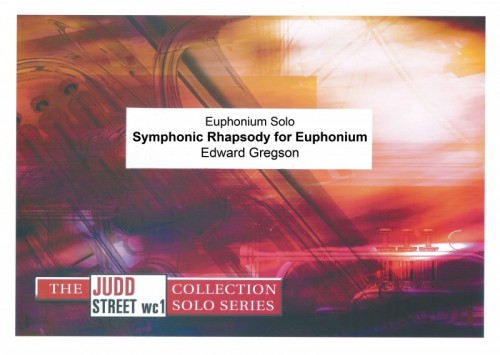
Symphonic Rhapsody for Euphonium (Brass Band - Score and Parts) - Gregson, Edward
The Symphonic Rhapsody was published in 1976, although the genesis of the piece dates back to the early '60s when I was a teenager and played the euphonium in a Salvation Army band. The work incorporates an old gospel song - 'So we'll roll the old chariot along' - into a symphonically structured form. Motifs from the gospel song permeate the rest of the musical material so that the work hopefully has a unified whole. The 'variations' are less actual variations on the tune itself, but more a comment on certain melodic aspects.Although the writing is naturally virtuosic in a way which is obvious for such a solo instrument within the brass band, it never the less unfolds many more lyrical aspects of the instrument's capabilities. Towards the end of the piece the tune is heard once again in its full version, leading to a coda where the euphonium takes centre stage in a bravura manner.- Edward GregsonDuration: 10.00
Estimated dispatch 7-14 working days
-
 £44.95
Trombone Concerto (Trombone Solo with Brass Band - Score only) - Wiffin, Rob
My Trombone Concerto was commissioned by Brett Baker following an earlier piece I had written for him called Shout! It was composed in Spain in the summer of 2010. Once I started writing I realised that this concerto was inevitably going to draw on my own experiences as a trombone player. The first movement was really a matter of getting the right thematic ideas and balancing the tutti and solo passages so, for formal structure, I studied the Gordon Jacob Trombone Concerto. There is a lyrical section preceding the first Allegro that owes much in spirit (but not in the actual music) to The Eternal Quest, Ray Steadman-Allen's Salvation Army solo. The slow movement seemed determined to come out in the vein of a Richard Strauss song. I wanted to write something ineluctably 'cantabile' as we trombone players rarely get a chance to play the melody. There is a brief allusion to that wonderful moment when the trombone gets to sing above the orchestra in Sibelius' seventh symphony. Arthur Wilson, that great exponent of the singing style in trombone-playing and my teacher at college died in the summer of 2010 so it seemed appropriate to dedicate this movement to him. The last movement is the lightest of the three in style and is slightly jazz-inflected, hopefully providing some fun for the soloist. While wanting to test the instrument I did not set out with the intention of making the concerto difficult but there are undoubtedly challenges of technique, range and style to be met by the soloist.- Rob Wiffin
Estimated dispatch 7-14 working days
-
£87.95
Trombone Concerto (Trombone Solo with Brass Band - Score and Parts) - Wiffin, Rob
My Trombone Concerto was commissioned by Brett Baker following an earlier piece I had written for him called Shout! It was composed in Spain in the summer of 2010. Once I started writing I realised that this concerto was inevitably going to draw on my own experiences as a trombone player.The first movement was really a matter of getting the right thematic ideas and balancing the tutti and solo passages so, for formal structure, I studied the Gordon Jacob Trombone Concerto. There is a lyrical section preceding the first Allegro that owes much in spirit (but not in the actual music) to The Eternal Quest, Ray Steadman-Allen's Salvation Army solo.The slow movement seemed determined to come out in the vein of a Richard Strauss song. I wanted to write something ineluctably 'cantabile' as we trombone players rarely get a chance to play the melody. There is a brief allusion to that wonderful moment when the trombone gets to sing above the orchestra in Sibelius' seventh symphony. Arthur Wilson, that great exponent of the singing style in trombone-playing and my teacher at college died in the summer of 2010 so it seemed appropriate to dedicate this movement to him.The last movement is the lightest of the three in style and is slightly jazz-inflected, hopefully providing some fun for the soloist.While wanting to test the instrument I did not set out with the intention of making the concerto difficult but there are undoubtedly challenges of technique, range and style to be met by the soloist.- Rob Wiffin
Estimated dispatch 7-14 working days
-
 £74.99
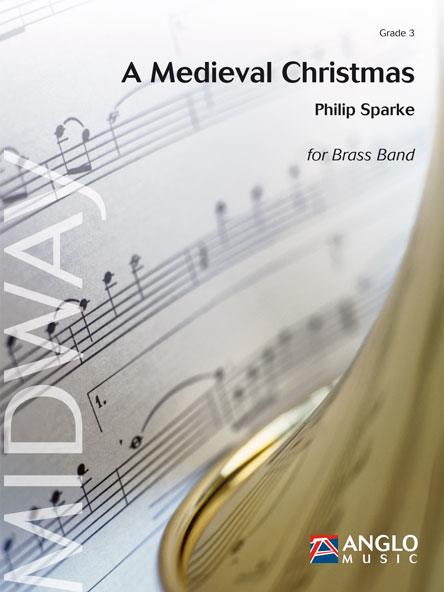
A Medieval Christmas (Brass Band - Score and Parts) - Sparke, Philip
Christmas is full of customs and traditions, both old and new. This is especially evident in Christmas songs, some of which have been part of Christian worship for centuries. A Medieval Christmas combines three ancient melodies that are still popular around the world today. Philip Sparke chose Gaudete, a song of praise from the middle ages, Coventry Carol, an English song from the 14th century, and In dulci jubilo, which can also be traced back to the 14th century, to form this joyous suite.Duration: 6:45
Estimated dispatch 7-14 working days
-
 £54.99
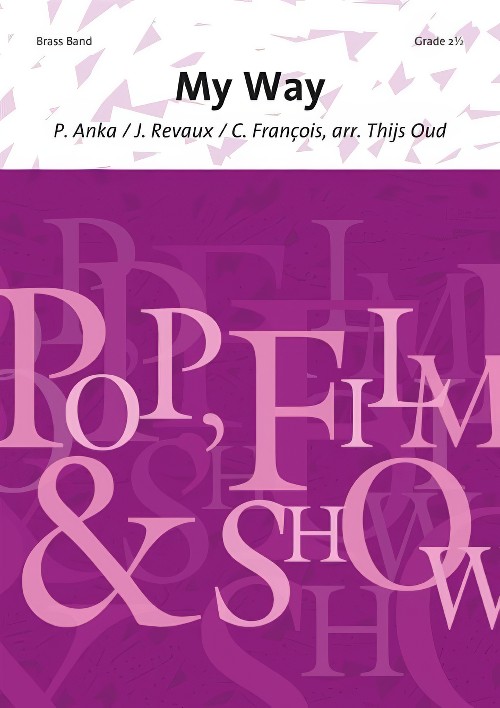
My Way (Brass Band - Score and Parts) - Oud, Thijs
The evergreen My Way, originally a French chanson (Comme d'Habitude), was written by Jacques Revaux and Gillies Thibault and first released by Claude Francois in 1967. Paul Anka wrote the English lyrics which were used by Frank Sinatra who made it in to the American charts with his world famous interpretation in 1969. Since then the song has been covered by a variety of pop stars, including Elvis Presley. This arrangement is based on the Elvis version and within it the chorus appears in a swinging blues style. This popular song will be ideal for that spectacular ending to your concert.Duration: 3:45
Estimated dispatch 7-14 working days
-
 £110.00
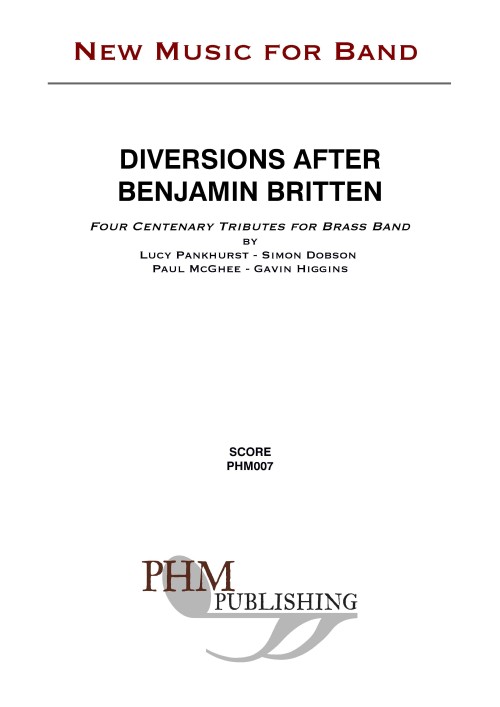
Diversions after Benjamin Britten (Brass Band - Score and Parts)
Suite by Lucy Pankhurst, Simon Dobson, Paul McGhee and Gavin HigginsHaving devised a collective centenary tribute for Michael Tippett at the 2006 RNCM Festival of Brass (Variations on a Theme of Michael Tippett by five eminent composers of brass band music, PHM002), I commissioned this companion piece as a Benjamin Britten tribute for the 2013 festival. In the late 1970s, while researching a book about the English composer, and Britten's first teacher, Frank Bridge (1879 - 1941), I came across a copy of the printed score of Benjamin Britten's Variations on a Theme of Frank Bridge (Op.10) for string orchestra, in which Britten had written descriptive titles for each of the variations suggesting appropriate character traits of his much loved mentor and guide. The character variations are cast in march, song and dance forms.Taking inspiration from Britten's youthful tribute, I invited four award-winning composers, who have all made significant contributions to the brass band medium, to create their own personal reflections on four aspects of Britten's character and music, designed to form a suite of Diversions after Benjamin Britten, but which can also be played separately.Lucy Pankhurst's hauntingly lyrical Prelude: His Depth refers to the emotional and symbolic subtexts that underpin Britten's operas, taking its musical cue from Britten's many arrangements of folk songs. The flugel horn takes a prominent role throughout.Simon Dobson's breathless Scherzo: His Vitality reminds us with its rapid passage work and leaping bass 'groove' that Britten loved tennis and fast cars in his younger days.Paul McGhee's evocative interpretation of the March: His Sympathy represents Benjamin Britten's pacifism, as the composer writes: 'We view the music through the eyes of a pacifist. Whilst war and violence surround us, we do not engage in it and though it continues to happen around us. With the use of muted effects in most of the band throughout the piece, the flugel horn is the lone voice of reason, standing firm against the mechanical and destructive society in which it is forced to live. As the machine of war continues around the lone voice, the voice is gradually dismissed and mocked as the war machine rumbles on into the distance.'In an extended finale, entitled Toccata: His Skill, Gavin Higgins celebrates Benjamin Britten's consummate creativity. For the RNCM Festival of Brass premiere, the four contrasting movements were framed and connected by Britten's Fanfare for St. Edmundsbury for three trumpets, with the trumpet soloists spaced round the hall. I am grateful to the Britten Estate and publishers Boosey & Hawkes for giving permission for the elements of Britten's fanfare to be incorporated in the collective work.- Paul HindmarshDuration: 19.30
Estimated dispatch 7-14 working days
-
£45.00
Diversions after Benjamin Britten (Brass Band - Score only)
Suite by Lucy Pankhurst, Simon Dobson, Paul McGhee and Gavin HigginsHaving devised a collective centenary tribute for Michael Tippett at the 2006 RNCM Festival of Brass (Variations on a Theme of Michael Tippett by five eminent composers of brass band music, PHM002), I commissioned this companion piece as a Benjamin Britten tribute for the 2013 festival. In the late 1970s, while researching a book about the English composer, and Britten's first teacher, Frank Bridge (1879 - 1941), I came across a copy of the printed score of Benjamin Britten's Variations on a Theme of Frank Bridge (Op.10) for string orchestra, in which Britten had written descriptive titles for each of the variations suggesting appropriate character traits of his much loved mentor and guide. The character variations are cast in march, song and dance forms.Taking inspiration from Britten's youthful tribute, I invited four award-winning composers, who have all made significant contributions to the brass band medium, to create their own personal reflections on four aspects of Britten's character and music, designed to form a suite of Diversions after Benjamin Britten, but which can also be played separately.Lucy Pankhurst's hauntingly lyrical Prelude: His Depth refers to the emotional and symbolic subtexts that underpin Britten's operas, taking its musical cue from Britten's many arrangements of folk songs. The flugel horn takes a prominent role throughout.Simon Dobson's breathless Scherzo: His Vitality reminds us with its rapid passage work and leaping bass 'groove' that Britten loved tennis and fast cars in his younger days.Paul McGhee's evocative interpretation of the March: His Sympathy represents Benjamin Britten's pacifism, as the composer writes: 'We view the music through the eyes of a pacifist. Whilst war and violence surround us, we do not engage in it and though it continues to happen around us. With the use of muted effects in most of the band throughout the piece, the flugel horn is the lone voice of reason, standing firm against the mechanical and destructive society in which it is forced to live. As the machine of war continues around the lone voice, the voice is gradually dismissed and mocked as the war machine rumbles on into the distance.'In an extended finale, entitled Toccata: His Skill, Gavin Higgins celebrates Benjamin Britten's consummate creativity. For the RNCM Festival of Brass premiere, the four contrasting movements were framed and connected by Britten's Fanfare for St. Edmundsbury for three trumpets, with the trumpet soloists spaced round the hall. I am grateful to the Britten Estate and publishers Boosey & Hawkes for giving permission for the elements of Britten's fanfare to be incorporated in the collective work.- Paul HindmarshDuration: 19.30
Estimated dispatch 7-14 working days
 View Music