
Results
-
 £22.50
Edward Gregson: Concertante for Piano and Brass Band
DescriptionProgramme NoteThe Concertante for Piano and Brass Band was written in 1966, when the composer was an undergraduate student at the Royal Academy of Music in London. It received its first public concert performance in 1967 at the Royal Festival Hall, London, when the composer was the soloist with the International Band of the Salvation Army, conducted by Bernard Adams. It was one of the first major works to be written for this particular combination.The Concertante is unashamedly romantic in idiom and is in three movements: Prelude, Nocturne and Rondo. The Prelude is cast in sonata form and opens with a short cadenza-like flourish from the soloist, followed by two main ideas - the first sweepingly dramatic, the second highly lyrical. The interplay between these two themes forms the main focus of the movement, and after a return to the opening theme, an exuberant codetta brings the music to a close, albeit a quiet one. https://morthanveld.com/wp-content/uploads/2017/09/Gregson-Concertante-1st-movt-clip.mp3The tender Nocturne opens with an introduction from the band that contains precursors of the two main ideas to follow. The solo piano announces the main theme, which has a slightly 'bluesy' character with its flattened third and seventh notes of the scale, and is a love song dedicated to the composer's wife-to-be. The band enters with phrases of a chorale already hinted at in the introduction - Ray Steadman-Allen's hymn tune 'Esher' - but never quite presented in its complete state. Both ideas are developed alongside each other, with eventually the first theme returning, this time with piano and band together, and building to a majestic climax, before subsiding to a peaceful coda - a return to the very opening of the movement. https://morthanveld.com/wp-content/uploads/2017/09/Gregson-Concertante-movt-2-clip.mp3The final Rondo is full of energetic rhythms and changing time patterns. The main theme is playful in character, with much interplay between soloist and band, whilst the middle section presents a new theme, and one that has more than a hint of the hymn tune 'Onward Christian Soldiers', in what amounts to a good humoured parody. The opening Rondo theme returns, this time leading to a powerful and dissonant climax from the band. This is followed by an extended piano cadenza, underlying the virtuoso aspect of the work, and leading to an energetic and life-affirming coda, which brings the work to a triumphant conclusion. https://morthanveld.com/wp-content/uploads/2017/09/Gregson-Concertante-movt-3-clip.mp3Duration: 18 minutesInstrumentation:Please note that there is no 1st/Repiano Cornet part in this work. The 1st/Repiano Cornet player should join the Solo Cornet bench. As such an extra Solo Cornet part is provided in the set of parts.Version for two pianosA version of the Concertante for two pianos is available for rehearsal purposes. Piano 1 is the solo part and Piano 2 the band reduction. However, for those pianists not needing to rehearse the work in this way, a solo piano part is also provided with the main set of band parts.To view a preview of the solo part for the first movement click here.The youthful Gregson (his work was written as a third year undergraduate) was seemingly a bit of a musical magpie - but one heck of a skilful one at that.These were shiny baubles of poise, panache and pastiche, with affectionate, remarkably mature nods of appreciation towards Gershwin, Rachmaninov, Ireland and even Elmer as well as Leonard Bernstein.The rich colour palette and flowing lines (with the tenderest of central Nocturnes) were a joy - as were the little buds of motifs that dotted the score like seeds ready to be planted on a future fertile brass band compositional field. - Iwan Fox, 4Barsrest.com, June 2019For more information on Edward Gregson's music please visit the composer's website: www.edwardgregson.com
Estimated dispatch 7-14 working days
-
 £33.62
E lucevan le stelle (Cornet/Euphonium Duet with Brass Band) Puccini arr.Bushnell
Tosca is an opera in three acts by the Italian composer Giacomo Puccini. The opera is set in June 1800 in Rome, and tells the story of the Kingdom of Naples and the threat to its control of Rome by Napoleon's invasion of Italy. Some of Puccini's best-known arias can be found in Tosca. The opera is based on Victorien Sardou's dramatic play of the same name (La Tosca). Puccini saw the play at least twice in 1889 and begged his publisher, Giulio Ricordi, to obtain the rights to turn it into an opera, which were secured in 1891 - although Puccini relinquished the rights to Alberto Franchetti before being recommissioned in 1895. Puccini wrote "I see in this Tosca the opera I need, with no overblown proportions, no elaborate spectacle, nor will it call for the usual excessive amount of music." It took four years to write, with Puccini arguing with his librettists (Luigi Illica and Giuseppe Giacosa) and his publisher. Although the first performance was delayed by a day due to the unrest in Rome at the time, the opera was premiered on 14 January 1900 at the Teatro Costanzi in Rome. The critics reviews were indifferent, but it was an immediate success with the public. The opera is through-composed, with the different musical elements weaved from piece to piece. Puccini used the Wagner's leitmotif concept to identity different parts of the opera. Taken from Act 3, E lucevan le stelle is sung by Cavaradossi, a painter, who has fallen for the singer Tosca. The corrupt Chief of Police, Baron Scarpia, longs for Tosca himself and, upon suspecting Cavaradossi of helping a political prisoner escape, he takes the opportunity to get rid of Cavaradossi and blackmail Tosca into being with him. The guards lead Cavaradossi to the roof of Castel Sant'Angelo, where he is told he has 1 hour to live before being executed. He asks to write a letter to Tosca, overcome by memories, he sings E lucevan le stelle (And the stars shone). It was selected by the tenor Wynne Evans as one of the most romantic songs for his top ten arias for Classic FM. He described it as "another tenor classic, both tragic and beautiful." This arrangement (for cornet and euphonium duet with brass band) includes alternative parts for horns in F and lower brass in bass clef. A recording of the original song can be found here: www.youtube.com/watch?v=EAqHQMX7GHY
In Stock: Estimated dispatch 1-3 working days
" frameborder="0" allowfullscreen> -
 £76.00
Thrift Shop - Ben Haggerty/Henk Ummels
Thrift Shop is a song by the American rapper Macklemore and his producer Ryan Lewis. The single was released on 3 September 2012. The song is about buying cheap clothing in thrift shops, and contempt for designer clothes and trends. There is plenty of room in this arrangement to feature many soloists. "This is f&#@ing awesome!"
Estimated dispatch 10-14 working days
-
 £34.95
Nocturne - Rolf Lovland - Ray Farr
As Norway's entry to the 1995 Eurovision Song Contest, the group Secret Garden made history by winning with Nocturne, an entry that was more an instrumental piece than a song. In the 40-year history of this prestigious pan-European television extravaganza,...
Estimated dispatch 5-7 working days
-
£70.00
Apophenia - Peter Meechan
aApophenia is the experience of seeing patterns or connections in random or meaningless data.aApophenia is a trumpet concerto in three movements written for American trumpet virtuoso Rex Richardson. Each of the three movements features a different instrument; Movement 1 is for the Bb trumpet, the second is for flugel horn and trumpet, and the third is for trumpet and piccolo trumpet.Each of the three movements of Apophenia relate to the phenomenon of viewing Dark Side of the Rainbow - a name used to refer to the act of listening to the 1973 Pink Floyd album The Dark Side of the Moon whilst watching the 1939 film The Wizard of Oz, where moments where the film and the album appear to correspond with each other.Movement 1 is a fast a furious movement. Solo and ensemble interact at high tempo, swapping and creating new ideas, leading each other in new directions. Aside from the trumpet soloist, the kit player also acts as a quasi soloist.The second movement takes its musical inspiration from the Pink Floyd song Us and Them. It is during this segment of the film that some of the most amazing moments of connection happen.The final movement is a dance - and a tour de force for the soloist who begins on the Bb trumpet, before switching to the piccolo trumpet (or Eb trumpet) for the fast and furious finale. Many of the coincidences from Dark Side of the Rainbow relate to dancing, however, as long as a piece of music is the same tempo as the original, and the time signature is a regular one, this could be the case across most films. So the composer chose to write a dance that wouldn't synchronise to too many existing dance scenes!The soloist is free to improvise their own cadenza.Apophenia is dedicated to Rex Richardson.
Estimated dispatch 12-14 working days
-
 £48.56
My soul, rejoice (Cornet Solo with Brass Band) Andrew Wainwright
My soul, rejoice (Andrew Wainwright) was commissioned in 2022 by Elizabeth Malovance, principal cornet of the Chicago Staff Band. A spirited and celebratory work, it is designed to showcase the dual nature of the cornet: its sparkling technical agility and its rich, vocal lyricism. The music begins in meditative fashion before transitioning into a joyful caprice featuring playful syncopations which are handed around the band. This is followed by a reflective section based on the much-loved worship song I love you Lord by Laurie Klein. The work concludes with a reprise of the original theme, building in momentum and intensity. Through a series of brilliant runs and virtuosic flourishes, the soloist leads the charge toward a majestic and triumphant finale, bringing the work to a ringing, glorious close. The solo was recorded by Richard Marshall on the 2026 CD Gothique Fantasy - The Music of Andrew Wainwright, which was his last solo recording of his 20-year tenure as principal cornet of Black Dyke Band. Technical Requirements & Electroacoustic Integration This work features an optional digital delay effect for the soloist, indicated in the score by "pedal on" and "pedal off" markings. If the required equipment is unavailable, the piece can be performed entirely acoustically. To listen to Beth Malovance performing the work with the Chicago Staff Band please visit https://on.soundcloud.com/c8IoU3CF3srTD4z0wX Duration: approx. 8 minutes Difficulty Level (Band): 2nd Section + Soloist: Advanced This PDF download includes the full score and parts. Sheet music available at www.brassband.co.uk (UK) or https://satradecentral.org (USA) Instrumentation: Soprano Cornet Eb Solo Cornet Bb 1st Cornet Bb 2nd Cornet Bb Flugel Horn Bb Solo Horn Eb 1st Horn Eb 2nd Horn Eb 1st Baritone Bb 2nd Baritone Bb 1st Trombone Bb 2nd Trombone Bb Bass Trombone Euphonium Bb Bass Eb Bass Bb Timpani & Bass Drum Percussion 1-3
In Stock: Estimated dispatch 1-3 working days
-
£70.00
A Tallis Anthem - Geert Jan Kroon
A Tallis Anthem is based on If Ye Love Me by Thomas Tallis (1505-1585). He was one of the first who set English words to the Rites of the Church of England. If Ye Love Me is a classic example of the new English anthems: mainly homophonic, but with brief moments of imitation. The opening is a triumphant version of the first homophonic phrases of the song, interrupted by a calm melody build with material from a motive from the original. The anthem is played by a quartet placed in front of the band or of stage for efect. This is followed by a more modern anthem leading to a triumphant finale.
-
 £74.95
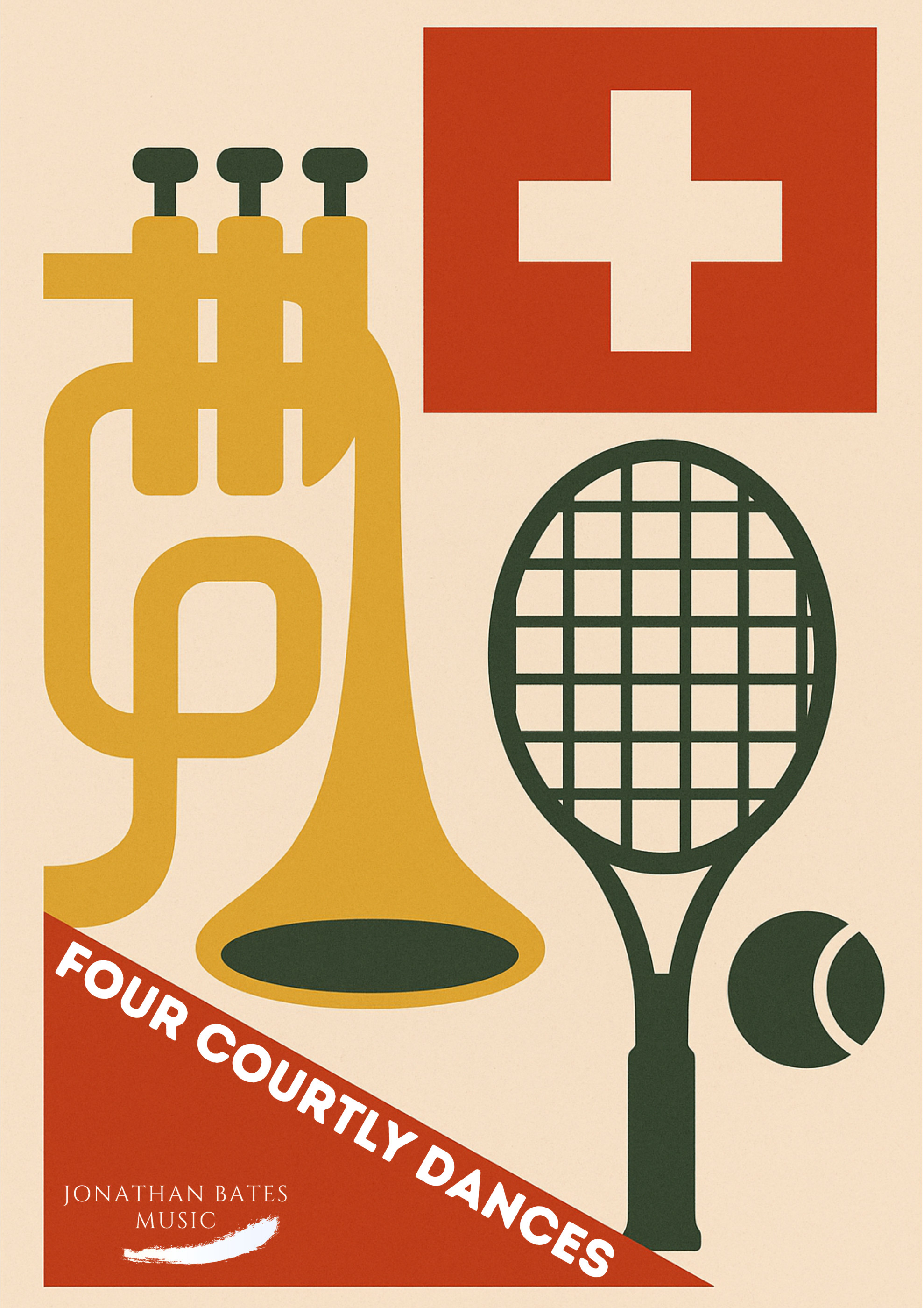
Four Courtly Dances - Jonathan Bates
DURATION: 12'00". DIFFICULTY: 1st+. 'Four Courtly Dances' was composed for Brass Band Burgermusik Luzern in 2025 for their Brass & Sport Gala Concert in the KKL Luzern. The work is a tribute to career of Swiss Tennis great Roger Federer with each movement giving a musical 'nod' to the story of his life and career. Each movement is inspired by a traditional 'courtly' (not in a tennis sense, but that was the idea!) dance:. 1. Inspiration (Almain) . The opening movement is subtitled 'Elegance on Court', backed by a deep-rooted sense of Swiss nationlism, featuring a prelude based upon the traditional Swiss song 'Guggisberglied'. . 2. Success & Failure (Galliard) . A movement centred around the trials and tribulations of an elite sportsperson, with antiphonal cornet & tambourine groups playing avirtuosic musical tennis match across the band. . 3. Rivalry (Sarabande & Canario) . An upbeat movement fused with Spanish and Balkan influences, inspired by Federer's long-running rivalries with Rafael Nadal and Novak Djokovic. . 4. Legacy (Pavane) . A final reflective and uplifting homage to the legacy leftby one of the greatest sportspeople of all time, culminating in a coda whichbrings together all the previous 'ingredients' which made Federer the icon he is. . .
In Stock: Estimated dispatch 1-3 working days
-
 £30.00
Amazing Grace (W. Walker arr. by Paul Pennicotte-Henrie) - Brass Band Sheet Music Full Score and Parts - LM642
COMPOSER: W. WalkerARRANGER: Paul Pennicotte-Henrie"Amazing Grace" is a Christian hymn published in 1779 by English Anglican clergyman, abolitionist, and poet John Newton. It is possibly the most sung and most recorded hymn in the world and is especially popular in the United States, where it is used for both religious and secular purposes. Newton wrote the words from personal experience; he grew up without any particular religious conviction, but his life's path was formed by a variety of twists and coincidences that were often put into motion by others' reactions to what they took as his recalcitrant insubordination. He was pressed into service with the Royal Navy, and after leaving the service, he became involved in the Atlantic slave trade.In 1748, a violent storm battered his vessel off the coast of County Donegal, Ireland, so severely that he called out to God for mercy. While this moment marked his spiritual conversion, he continued slave trading until 1754 or 1755, when he ended his seafaring altogether. Newton began studying Christian theology and later became an abolitionist.Ordained in the Church of England in 1764, Newton became the curate of Olney, Buckinghamshire, where he began to write hymns with poet William Cowper. "Amazing Grace" was written to illustrate a sermon on New Year's Day of 1773. It is unknown if there was any music accompanying the verses; it may have been chanted by the congregation. It debuted in print in 1779 in Newton's and Cowper's Olney Hymns, but settled into relative obscurity in England. In the United States, "Amazing Grace" became a popular song used by Baptist and Methodist preachers as part of their evangelizing, especially in the American South, during the Second Great Awakening of the early 19th century. It has been associated with more than 20 melodies. In 1835, American composer William Walker set it to the tune known as "New Britain" in a shape note format; this is the version most frequently sung today.
In Stock: Estimated dispatch 3-5 working days
-
£44.95
LIFE ABUNDANT (Cornet Solo with Brass Band Set) - Robert Redhead
Life Abundant is a cornet solo written as a musical biography of the search of soul to find the meaning of life. The music begins with the dawning of life, then the abundant joy of childhood ('My cup is full and running over'), followed by the uncertainty of the youth who longs to say 'I want to live right' but doesn't know how. The answer comes in a meditative setting of the composer's own song 'One life to live, O may I live for Thee', after which the music confidently builds to a climax which expresses the joy of abundant life found in Jesus".
Estimated dispatch 7-14 working days
 View Music