
Results
-
£24.50
Sang Til Juletraeet (Song to the Christmas Tree) - Edvard Grieg - Zillah Day-Smith
Sang Til Juletraeet (Song to the Christmas Tree)A short concert arrangement of Edvard Grieg's song no.2 from Seven Children's Songs, Op. 61. Its gentle lilting melody and expressive harmony suits brass instruments beautifully. This piece deserves its place as a Christmas time favourite!B flat and E flat bass parts included to suit the requirements of the individual ensemble.
In Stock: Estimated dispatch 1-3 working days
-
 £41.09
Allegro Spirito from Symphony No.2 (Brass Band) Borodin arr. Harold Burgmayer
Alexander Borodin's Second Symphony in B minor dates from the years 1869-76, a time when he was also working on his enduring opera Prince Igor. Flavors of the exotic and outdoor celebration seemed to have spilled over from the opera in this brilliant sonata movement. Borodin seldom quotes Russian folk tunes, but his graceful melodic lines are permeated with the spirit of his native song, supported by iridescent harmonies and bright colors. This arrangement for brass band was premiered by The Salvation Army's New York Staff Band, with Ronald Waiksnoris conducting, at Alice Tully Hall in New York City on 11 April 2001. This complete transcription of the Finale movement of Borodin's Second Symphony has an approximate duration of 6.40 minutes. To alternatively utilize the piece as an opener, a cut from bar 173 to 272 is indicated with Coda signs, reducing the piece to 4.30 seconds. To view a rolling score video of the work please visit www.youtube.com/watch?v=x4SqSXLopRo Difficulty Level: 2nd Section + PDF download includes parts and score. Sheet music available at www.brassband.co.uk (UK) or https://satradecentral.org (USA) Instrumentation: Soprano Cornet Eb Solo Cornet Bb Repiano Cornet Bb 2nd Cornet Bb 3rd Cornet Bb Flugel Horn Bb Solo Horn Eb 1st Horn Eb 2nd Horn Eb 1st Baritone Bb 2nd Baritone Bb 1st Trombone Bb 2nd Trombone Bb Bass Trombone Euphonium Bb Bass Eb Bass Bb Timpani Percussion 1-3
In Stock: Estimated dispatch 1-3 working days
-
 £29.50
All By Myself - Eric Carmen - Gavin Somerset
This famous power ballad was composed by Eric Carmen in 1975. The verse of the song borrows heavily from the 2nd movement of Sergei Rachmaninoff's Piano Concerto No.2. At the time of composition, Carmen believed that the Rachmainoff work was copyright free and in the public domain. It was only after the record had been issued that his mistake came to light. Carmen quickly came to an agreement with Rachmaninoff's estate to legalise the song so as not to infringe copyright. Rachmaninoff is now also creditied as the co-writer of the work, even though he died 32 years before the song was written! This moving piece, covered by greats such as Celine Dion & Frank Sinatra, lends itself perfectly for brass band and would fit into any concert program.
In Stock: Estimated dispatch 1-3 working days
-
 £29.50
I Believe In Father Christmas - Greg Lake - Gavin Somerset
Released in 1975, this well loved song was written intentionally by as a protest about the commercialisation of Christmas. The release saw it shoot to No.2 in the charts and remains Greg Lake's only hit solo release. The instrumental riff used between verses is the tune from "Troika" by Sergei Prokofiev that has aided its popularity. This piece is familiar to all audiences, perfect to get them in the mood for your Christmas concerts & get them singing along.
In Stock: Estimated dispatch 1-3 working days
-
 £115.60
Chanson de Matin - Edward Elgar - Svein H. Giske
Chanson de Matin ("Morning Song") (Op. 15, No. 2) was likely written by Edward Elgar around 1889, originally for violin and piano. He later created an orchestral version. The premiere of this version in 1901 was conducted by none other than Henry Wood. Wood conducted the Promenade Concerts in London for almost 50 years and is considered the "father" of The Proms.The English composer Edward Elgar is perhaps best known for his Enigma Variations and Pomp and Circumstance marches.This arrangement was written during the COVID-19 pandemic for Askoy Brass Band's album "Gjensyn", available on Spotify and other streaming services.
Estimated dispatch 5-14 working days
-
 £79.95
Grieg Variations - Jonathan Bates
DURATION: 12'30". DIFFICULTY: 2nd+. . 'Grieg Variations' is a through-composed work in the traditional style of a 'theme & variations'. The work opens with the main melodic fragment featured throughout Grieg Variations which comes from Grieg's Peer Gynt Suite No.2; the final movement - 'Solveig's Song'. . This theme is followed by a set of 9 variations, each taking inspiration from various melodies and styles found within the Peer Gynt Suite. The first variation, a light-footed scherzo based upon the tonal line of Solveig's Song is followed by an 'Alla marcia' variation - in which the music is inspired by the 2nd movement - 'Arab Dance' - of the original suite. The 3rd variation takes a far darker and more aggressive turn in a variation set around the music of the 1st movement of the Peer Gynt Suite before a relaxation into a solemne revisiting of the original theme. Opening with a sombre and longing solo for Flugel horn, the focal point of this 4th variation is an extended solo for the Solo Euphonium, marked 'molto espressivo'. The new material here is used as a theme throughout this variation, being reprised by the full band immediately after as the music builds to a climax point at the top of the musical line. . Following this, there are 2 cadenzas for the Solo Horn and Solo Cornet respectively; the former inspired by the thematic material of Solveig's Song, and the latter from the Oboe cadenza at the beginning of Grieg's '2 Lyric Pieces, Op.68'. These cadenzas lead swiftly into the 7th variation, a bustling rhyhm-driven movement set in complex time. The 3rd movement of the Peer Gynt Suite No.2 - 'Peer Gynt's Homecoming' - makes it's first appearance in variation 8 in a triumphant battle-like setting before a combination of both this material and the Solveig's Song combine to bring Grieg Variations to it's close -not without a little nod to potentially Grieg's most famous work - In The Hall of the Mountain King. . .
In Stock: Estimated dispatch 1-3 working days
-
 £38.95
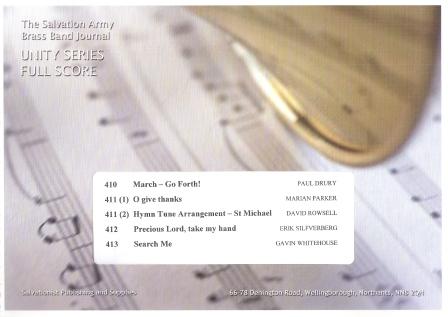
Unity Series Band Journal October 2013 Numbers 410 - 413
No. 410 March - Go Forth! (Paul Drury)This march was written as a tribute to Bandmaster Jack Spowart and the Bo'ness Salvation Army Band. The composer lives in the twon of Bo'ness and has had numerous opportunities to share with the band and the wider corps at various events. This march serves as recognition of the faithful service given in the Lord's name in the town by The Salvation Army for over 100 years. Two tunes are featured, both well-known and instantly recognisable, namely, Forward! be our watchword and We're marching on.No.411 (1) O give thanks (Marian Parker)The composer, Marian Parker, is a new contributor and is the Recruiting Sergeant at Leicester South Corps. This simple, yet rhythmic piece should not pose any technical problems for most bands and features the attractive arrangement of Joanne Pond's contemporary song, 'O give thanks'.No.411 (2) Hymn Tune Arrangement - St Michael (David Rowsell)The hymn tune 'St Michael' was composed in 1551 by French composer Louis Bourgeois and the composer provides a very useful arrangement of this historic hymn.No. 412 Precious Lord, take my hand (Erik Silfverberg O.F.)This well-known Gospel Song is a favourite of many. It has been recorded by many great artists, including Rosetta Tharpe, Elvis Presley and Aretha Franklin. The words were written by Reverend Thomas A. Dorsey, who is often known as the 'Father of Gospel song'.No. 413 Search Me (Gavin Whitehouse)The second new contributor to this journal is Gavin Whitehouse. gavin is the Assistant Music Director for the Greater New York Division and is also the USA Eastern Territorial Songster Leader. This piece combines two songs - one old and one new - which speak of a God who knows us intimately. 'Search me, O God and know my heart today' (associated with the beautiful Maori melody, 'Now is the hour') is woven with a contemporary setting of Psalm 139 by Rebecca St James, the first line of which says, 'You searchme, you know me'.
Estimated dispatch 7-14 working days
-
 £105.20
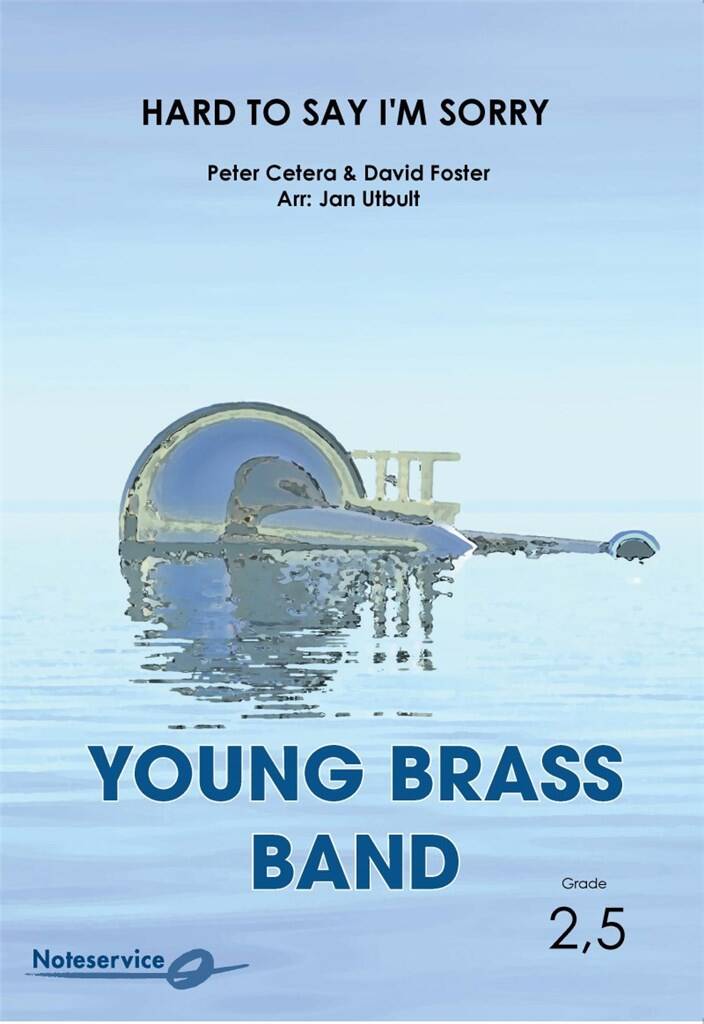
Hard to Say I'm Sorry - Peter Cetera - Jan Utbult
"Hard to Say I'm Sorry" is one of the greatest hits by US rock band Chicago. It was the first single record from the "Chicago 16"-album (1982). The song went to no. 1 on the Billboard charts and stayed there for two weeks. Produced by David Foster, the song was given a typical early 80's sound with synthesizers and heavy guitars dominating the sound. The album-version of the song included a part two of the song, "Get Away", a up-tempo song featuring the famous horn-section of the band.
Estimated dispatch 5-14 working days
-
 £105.20
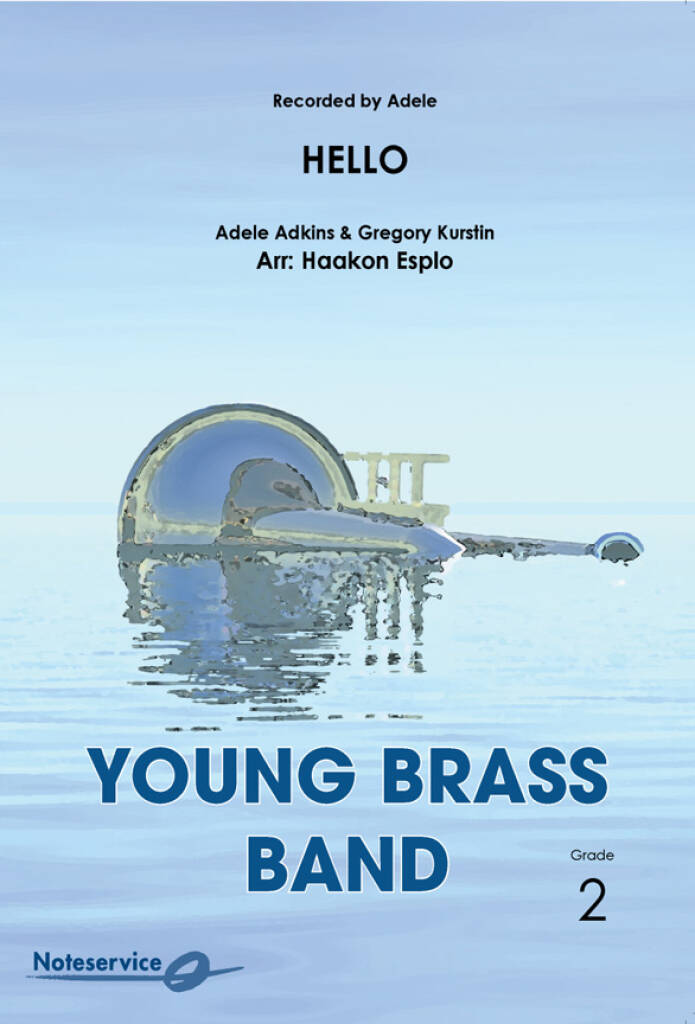
Hello - Haakon Esplo
Hello is a song by English singer Adele. It was released October 2015 as the first single from her third studio album, 25. Adele co-wrote the song with her producer, Greg Kurstin. "Hello" has achived great success wordwide, reaching no. 1 on almost every chart.
Estimated dispatch 5-14 working days
-
 £50.00
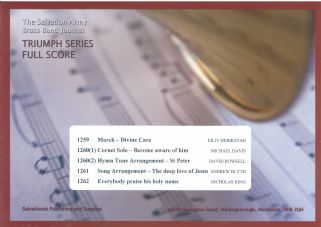
Triumph Series Band Journal March 2015 Numbers 1259 - 1262
No. 1259 March - Divine Care (Eiliv Herikstad)The message of this march is 'God will take care of you!' The introduction reflects the beginning of the song, God will take care of you (T.B.C.S. 124), which is presented in full at sections C and D.No. 1260 (1) Cornet Solo - Become aware of him (Michael Davis)A setting for Cornet and band of Colonel Robert Redhead's song, Become aware of him, which was originally published in The Musical Salvationist.No. 1260 (2) Hymn Tune Arrangement - St Peter (David Rowsell)An arrangement of the tune, St Peter, associated with the song, In Christ there is no east or west.No. 1261 Song Arrangement - The deep love of Jesus (Andrew Blyth)The strong hymn tune of Ebenezer (T.B. 433) was composed by Welshman, Thomas John Williams (1869-1944), who served as organist and choir director at various churches in and around Llanelli. This arrangement is more relaxed in style than the original and attempts to convey the freedom of the verses mostly associated witht he tune by Samuel T. Francis (1835-1925) O deep, deep love of Jesus, vast, unmeasured, boundless, free.No. 1262 Everybody praise his holy name (Nicholas King)A bright arrangement by Nicholas King of Remco Hakkert's song, Praise his holy name.
Estimated dispatch 7-14 working days
 Listen to MP3
 View Music