
Results
-
 £73.80
Yellow (from Coldplay) - Coldplay - Dean Jones
This popular song written by Chris Martin and his group Coldplay, was recently given a very new lease of life with an orchestral arrangement. The music brings new meaning and sentiments to the already successful song, and it is hoped this is version for Band will provide great rewards for both player and listener alike.
Estimated dispatch 5-14 working days
-
 £115.60
Griffenfeldt - John Philip Hannevik
Here we present "Griffenfeldt, a folk-dance in the style of a Norwegian reinlender.This arrangement can be used as the first item in a concert, or after an interval.The musicians can come on stage as they join in. That is why two of the measures are notated "repeat till ready", here you have to wait until everyone is in place! If everyone is ready from the start, the repetition can be omitted.Be sure to play with a bouncy but singing style, not with short and harsh articulations.Do the trills on the beat, but these can also be omitted if it makes it too difficult.To bring out the folk music style a little extra, you can ask the musicians to play on the "backbeat", i.e. emphasize the last half of each quarter-note.In addition, the music will really come to life if all "solo" places are done standing up.The musician Anon Egeland tells this story:This song got its name from a party where it all just got a bit too lively: one of the party-goers started shooting into the ceiling with a gun just as this reinlender was being played. The fiddler - or was it the man with the gun? - was called Griffenfeldt, and that gave the name for the song.
Estimated dispatch 5-14 working days
-
 £115.60
Mil etter mil - Kai Eide - Øystein S. Heimdal
This song performed by Jahn Teigen represented Norway at the Eurovision final in 1978. The result was zero points, but after that, the song soon became very popular in Norway and is one of the biggest hits of his career.This arrangement may easily be a hit on your next concert and will for sure receive more than zero points from you audience. Feel free to invite the audience on a sing-along!
Estimated dispatch 5-14 working days
-
 £49.99
Singin' in the Rain - Michael Brown
Who isn't familiar with the famous scene where Gene Kelly dances and sings around a lamppost, splashing into puddles with an umbrella in his hand? The song he sings is just as iconic and has made its reputation as a song known by both young and old! This arrangement has been made accessible and easy to play for brass band. Are you singin' in the rain?
Estimated dispatch 5-14 working days
-
 £115.60
Gudda - Roger Tallroth - John Philip Hannevik
"Vasen" ("commotion", "fuss", "ado") is a Swedish acoustic band consisting of three outstanding instrumentalists playing viola, 12-string guitar and nyckelharpa ("key-harp"). They have been touring together since 1989. The song "Gudda" is from a CD they released in 2017, and it is composed by guitar-player Roger Tallroth. The title refers to the song being (originally) in G-major and in "udda" (Swedish for "odd") time-signatures. Please, maintain a singing, legato style throughout.
Estimated dispatch 5-14 working days
-
 £105.20
Ompa til du dor - Janove Ottesen - Øystein Sjøvaag Heimdal
This song is taken from the first record album by Norwegian band Kaizers Orchestra. The song is one of the most well-known from this band. Kaizers Orchestra was famous in Norway for it's energic style, both on record and stage, a style that this arrangement tries to capture. The guitar and electric bass parts are optional.
Estimated dispatch 5-14 working days
-
 £59.99
When you wish upon a Star - Sammy Nestico
Out of all Disney productions, 'Pinocchio' may be the most famous. The beautiful song When you wish upon a Star is not only popular from the animation film itself, but also as a separate song. It has been covered by many big artists throughout the years. It is perfect for brass band. Will your nose grow whilst playing?
Estimated dispatch 5-14 working days
-
 £54.99
Away in a Manger - Andrew R. Mackereth
In English-speaking countries 'Away in a Manger' is one of the first Christmas songs to be taught to little children. It is a moving song with simple words, which makes it easy to understand. The song is also known as 'Luther's Cradle Hymn'. This suggests that Martin Luther was the author of the lyrics. According to researchers, however, this is a misconception the author is unknown. In England 'Away in a Manger' is sung to a different melody than in the USA, for example. The 'English' melody was composed by W.J. Kirkpatrick. Andrew Mackereth made a touching arrangement of the 'English' melody, which suits the tender lyrics perfectly.
Estimated dispatch 5-14 working days
-
 £41.30
Spanish Harlem - J. Lieber - P. Spector
During the seventies Jerry Leiber was a member of several popular groups such as The Coasters and The Drifters. He composed some film music, such as the hit song 'Jailhouse Rock' for Elvis Presley. His popular song 'Spanish Harlem' has been recorded by many famous orchestras. Thanks to Willy Hautvast's arrangement it is now also part of the wind band repertoire.
Estimated dispatch 5-14 working days
-
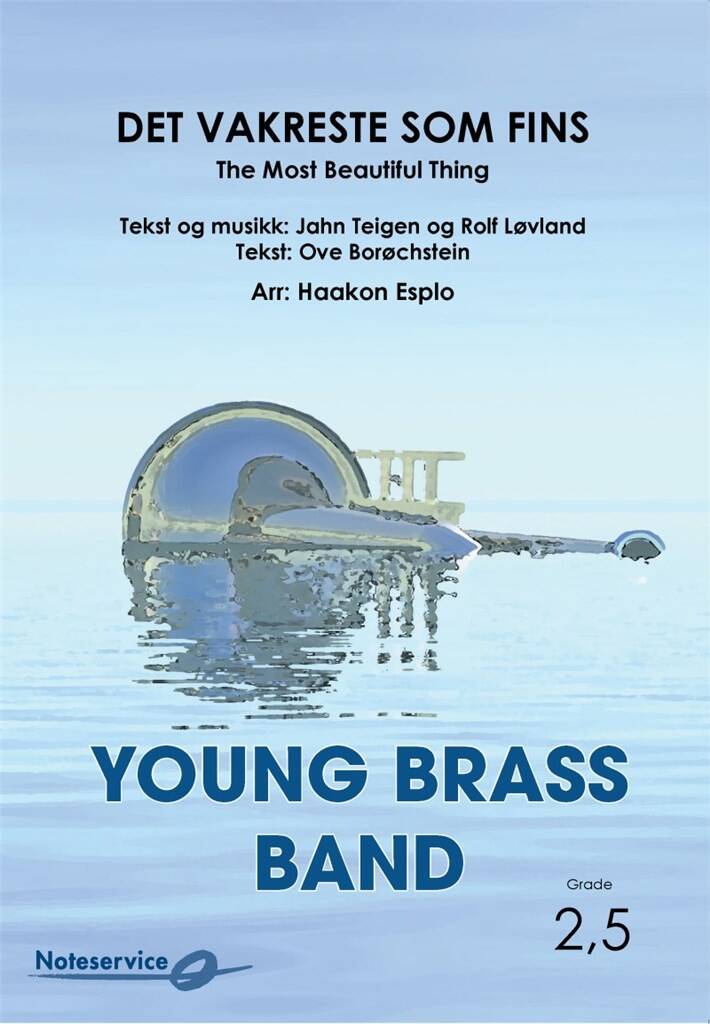 £105.20
Det vakreste som fins - Teigen Teigen - Haakon Esplo
The most beautiful thing is one of Jahn Teigens most popular pop ballads. It was written in 1988 together with Rolf Lovland and Ove Borochstein and went straight to the top of the Norwegian hitlists. Even 20 years after its release, in 2008, it reached the hitlists after Teigen performed it during the Eurovision Song Contest. The song is often played on Norwegian radio and was the 70th most played in the period 1993-2013 on the radio channel P4. Now it's finally arranged for band in the popular Young Band series with adaptation of key that fit young musicians. It will definitely be a popular number in your next concert.
Estimated dispatch 5-14 working days
 View Music