
Results
-
Bad Moon Rising - John Fogerty - Len Jenkins
"Bad Moon Rising" is a song written by John Fogerty and performed by Creedence Clearwater Revival. It was the lead single from their album Green River and was released in April 1969, four months before the album. It reached No. 1 on the UK Singles Chart for three weeks in September 1969 and has been recorded by at least 20 different artists, in styles ranging from folk to reggae to psychedelic rock. The last line of the chorus, "there's a bad moon on the rise", is sometimes misheard as "there's a bathroom on the right" and Fogerty occasionally sings the misheard lyric in concert. The song has become notably popular in Argentina as a football chant and in the 2014 FIFA World Cup, a modified version, titled "Brasil, decime que se siente" ("Brazil, Tell Me How It Feels") was sung with Spanish lyrics that taunted Brazil, their traditional rival. It went viral and became very popular (in Argentina).
-
 £58.00
Henry V (Score only) - William Walton
It takes a special ability to compose film scores which serve the images perfectly yet translate into first class concert music. William Walton was such a talent as the continuing popularity of his brilliantly evocative film music shows. Included are the poignant Death of Falstaff, the victorious Agincourt Song and Touch her soft lips and part - one of the most tender miniatures in all music. Winwood Music are delighted to bring this music from Laurence Olivier's classic film to the brass band world in a fabulous arrangement, including optional narrator, by Edward Watson - so idiomatic that you'll think this is the original version! Full Movement Listing: Fanfare Prologue: O For a Muse of Fire Interlude at the Boar's Head Inn The Death of Falstaff Touch Her Soft Lips Fanfare Fanfare The Battle of Agincourt Bailero Interlude at the French Court The Agincourt Song
Estimated dispatch 7-9 working days
-
 £74.00
Henry V (Parts only) - William Walton
It takes a special ability to compose film scores which serve the images perfectly yet translate into first class concert music. William Walton was such a talent as the continuing popularity of his brilliantly evocative film music shows. Included are the poignant Death of Falstaff, the victorious Agincourt Song and Touch her soft lips and part - one of the most tender miniatures in all music. Winwood Music are delighted to bring this music from Laurence Olivier's classic film to the brass band world in a fabulous arrangement, including optional narrator, by Edward Watson - so idiomatic that you'll think this is the original version! Full Movement Listing: Fanfare Prologue: O For a Muse of Fire Interlude at the Boar's Head Inn The Death of Falstaff Touch Her Soft Lips Fanfare Fanfare The Battle of Agincourt Bailero Interlude at the French Court The Agincourt Song
Estimated dispatch 7-9 working days
-
 £77.00
General Series Brass Band Journal, Numbers 2230 - 2233, April 2023
2230: Prelude on 'Ascalon' (Geoffrey Nobes)This prelude was written for the Band of the Free Evangelical Church of Geisweid in Germany. The beautiful hymn tune Ascalon is heard in two complete statement, a free-flowing lyrical section followed by a contrasting section using the phrases of the melody to build to a full final working of the hymn.2231: Salt and light (Mark Feltwell)This original work follows the journey of someone who is finding their way through faith. Using inspiration from Shine, Jesus, Shine and Matthew 5:14, the journey ends with a triumphant fanfare.2232: Hymn Tune Arrangement - Esher (Dudley Bright)A two verse setting of the well know benediction, God be in my head.2233: Song Arrangement - The heart of worship (David Mills)The song The heart of worship (S.A.S.B. 635) speaks of the need to worship without any barriers or obstacles.
Estimated dispatch 7-14 working days
-
 £29.95
Judd: The Fruit of the Spirit
The song 'The fruit of the Spirit' first appeared in the 1973 musical 'Spirit', which became one of the most popular musicals by the celebratedpartnership of General John Gowans and General John Larsson. The musical tells how the Spirit-led disciples established the church after Pentecostand this song appears as the disciples are imprisoned for preaching about Jesus. They are understandably worried but comfort each other by remindingthemselves of the apostle Paul's words to the Galatians; 'But the fruit of the Spirit is love, joy, peace, forbearance, kindness, goodness,faithfulness, gentleness and self-control.' (Galatians 5:22-23)
Estimated dispatch 7-14 working days
-
 £38.95
Unity Series Band Journal - Numbers 482 - 485, October 2019
482: Euphonium Solo - The Spirit withinThis accessible solo for Euphonium is based on the popular song Move, Holy Spirit! (S.A.S.B. 323).483: Waltz - I love to Sing (David Edmonds)A light and simple waltz based on Gsta Blomberg's song I love to sing (S.A.S.B. 845).484: Walking in faith and victory (Daniel Elson)A relaxed arrangement of the well-known chorus Be bold, be strong.485: Unto Thee (Ruben Schmidt)This piece is based on the old hymn Unto thee, O Saviour-King (S.A.S.B. 686).
Estimated dispatch 7-14 working days
-
 £54.20
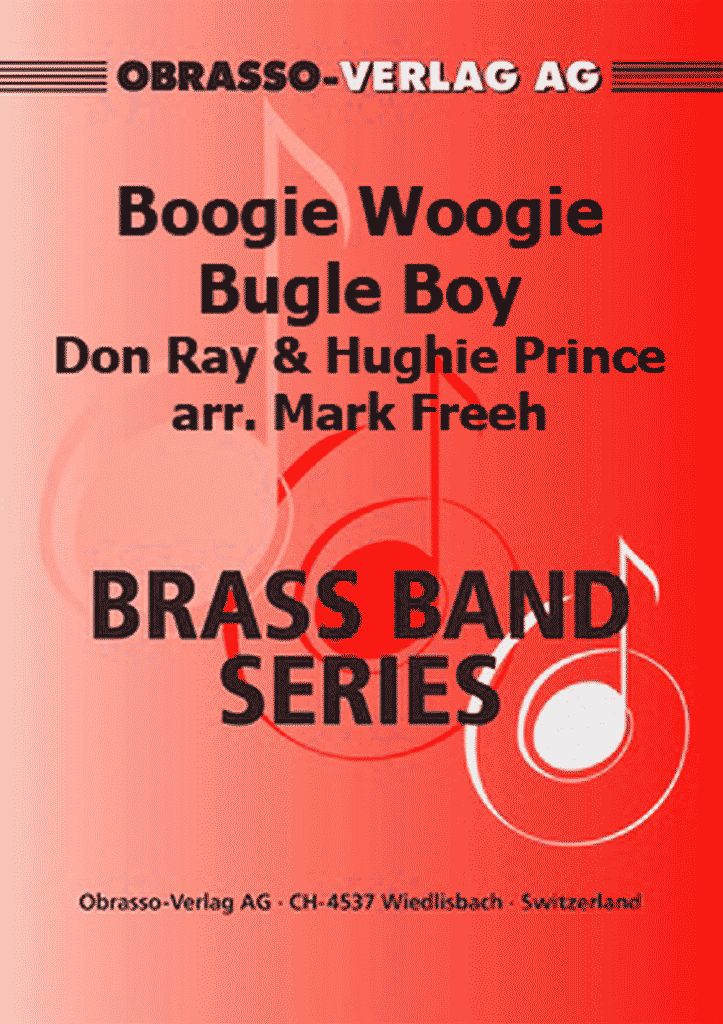
Boogie Woogie Bugle Boy
Closely based on an earlier Raye-Prince hit, 'Beat me daddy, eight to the bar', this song was a major hit for the Andrews Sisters becoming an iconic song of the Second World War.
Estimated dispatch 7-14 working days
-
 £45.00
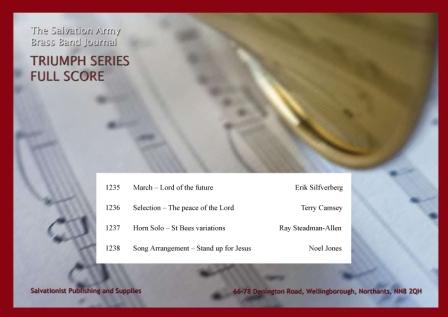
Triumph Series Band Journal March 2013 Numbers 1235 - 1238
No. 1235 March - Lord of the future (Erik Silfverberg)The title of this short, lively march is connected to the tune 'With Christ into the future' which appears in its second half.No. 1236 Selection - The peace of the Lord (Terry Camsey)This selection seeks to portray the peace that is found in Jesus, both in its style and the tunes used; 'Peace, peace, sweet peace', 'O the peace' and 'Brahms' Lullaby'.No. 1237 Horn Solo - St Bees variations (Ray Steadman-Allen)St Bees is a simple melody and this treatment is compatible with its character. Florid and meditative passages conclude with a brisk finale.No. 1238 Song Arrangement - Stand up for Jesus (Noel Jones)The old well-known gospel song appears here in a swing style.
Estimated dispatch 7-14 working days
-
 £34.95
Judd: His Eye is on the Sparrow
A traditional gospel spiritual originally written in 1905 by Civilla D. Martin and Charles H. Gabriel, the song is most associated with actress-singer Ethel Waters. The song, now in the public domain, has been covered extensively in gospel music, with notable versions by Shirley Caesar, Marvin Gaye, Kirk Franklin and the Family, Lauryn Hill and Tanya Blount (from Sister Act 2), Mahalia Jackson, Sister Rosetta Tharpe, Dottie West, Barbara Mandrell and Jessica Simpson. This version is for tenor horn soloist with brass band accompaniment.
Estimated dispatch 7-14 working days
-
 £24.95
Judd: Spirit of Life
The song 'Spirit of life' was written in the 1980s for the Ireland Divisional summer music school at which Derick Kane was the Musical Director. The song was later arranged as this sensitive euphonium solo with brass band accompaniment.
Estimated dispatch 7-14 working days