
Results
-
 £35.00
A Suffolk Prelude - Andrew Duncan
Written for the Ipswich & Norwich Co-Op Band, A Suffolk Prelude is based around five traditional tunes from Suffolk:'Nutting Time','Blackberry Fold','Cupid's Garden','A Seaman's Life''The Bold Richard'The piece begins on the percussion and timpani alone leading through a crescendo into the first statement of the fanfare which is derived from a motif from the tune 'Nutting Time'. This leads into a playing of the 'Nutting Time' tune which is then developed as the tune is passed around the band.'Nutting Time' is a jolly lighthearted tune about a 'fair maid' who meets a handsome young farmer called 'Johnny' when out gathering nuts in the wood. After a pause on the tubular bells the slow tune 'Blackberry Fold' is presented as a solo for Flugel Horn, then as a full band version.'Blackberry Fold' is a touching song about a Suffolk squire who gets married well below his station to a beautiful milkmaid, simply because he loves her! They live happily ever after.The next tune to be heard is the juanty 'Cupid's Garden' played firstly as a solo on the Euphonium, and again this is about the subject of love. This song is sung from a sailors prospective and he tells how he met a lovely maiden and has promised to marry her when he returns from duty at sea.The trombones then play the noble tune 'A Seaman's Life'. This tune seems to serve as a warning to young girls about the fickle nature and the total unsuitability of marrying a sailor! 'Oh a seaman's life is a merry merry life, they'll rob young girls of their heart's delight, they will leave them behind for to sail one morn, but they never know when they'll return'. Despite this it is a fine tune!The last tune featured is 'The Bold Richard' which is played by all the bass instruments in the band. This is a song telling how the Royal Navy friggate 'The Bold Richard' went to battle against a French friggate destroying her and taking her crew as prisoners.Suffolk Prelude goes on to feature a slow version of the tune 'A Seaman's Life' played alongside a fast version of the tune 'Cupid's Garden'. The opening fanfare then returns leading into a final coda section.
In Stock: Estimated dispatch 3-5 working days
-
 £70.00
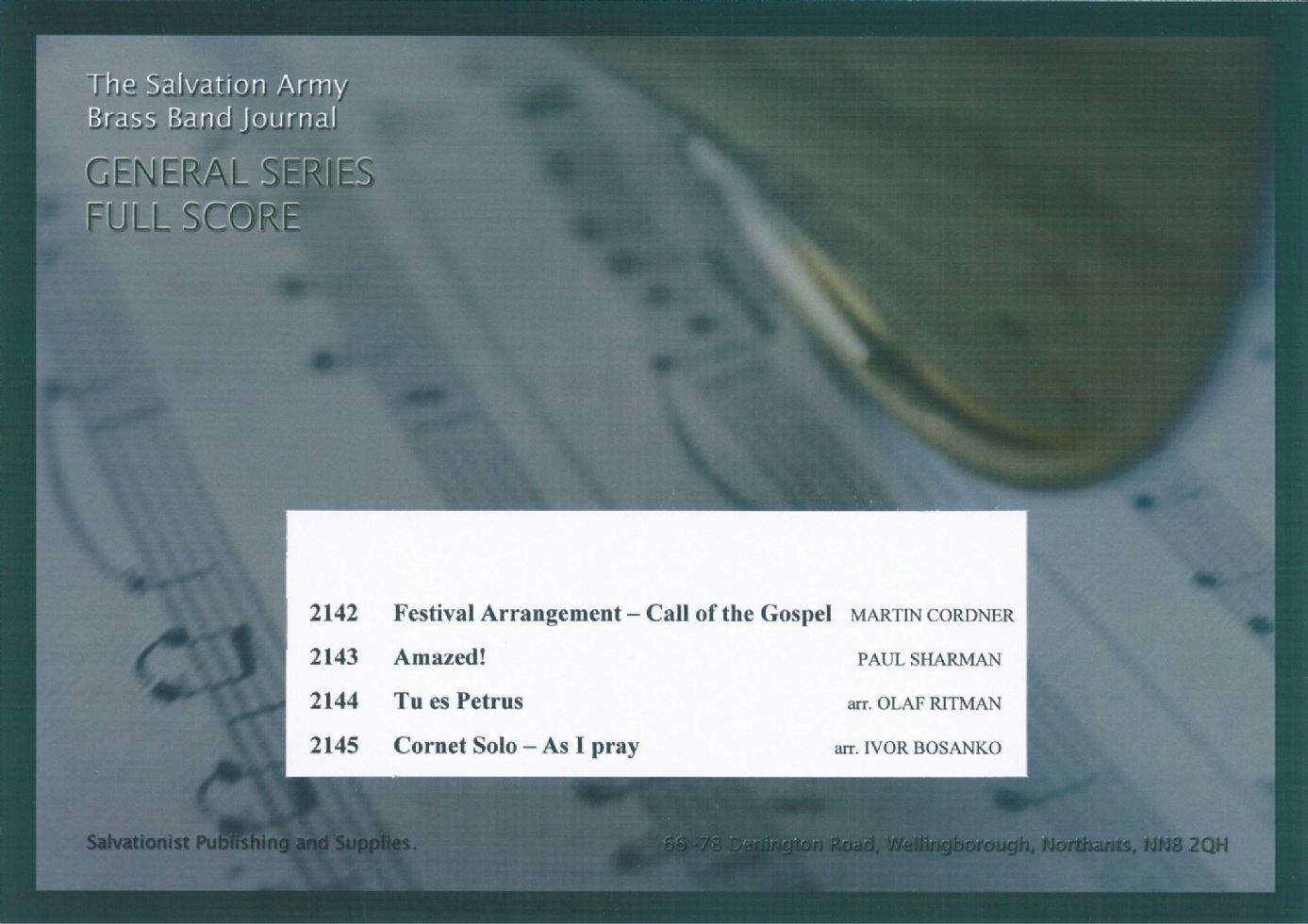
General Series Band Journal April 2015 Numbers 2142-2145
No. 2142 Festival Arrangement - Call of the Gospel (Martin Cordner)Written for the London Central Fellowship band, this foot-tapping festival arrangement treats the chorus, 'We have a gospel' in a bright, showy style.No. 2143 Amazed! (Paul Sharman)A setting of Charles Hutchison Gabriel's song, 'My Saviour's love', to which we sing his words, 'I stand amazed in the presence' (S.A.S.B. 179). Originally written for Birmingham Citadel Band, the piece aims to follow the four verses of text and is mainly up-tempo in style, depicting the amazing fact that God loves us.No. 2144 Tu es Petrus (arr. Olaf Ritman)A setting of a madrigal by Robert Pearsall. Originally entitled 'Lay a garland', the original text was swapped for the religious Latin text, 'Tu es Petrus' (You are Peter).No. 2145 Cornet Solo - As I pray (arr. Ivor Bosanko)Major Joy Webb's song, 'As I pray' (STTL Vol. 2, part 2), is arranged here as a beautiful solo for Cornet.
Estimated dispatch 7-14 working days
-
 £38.95
Unity Series Band Journal - Numbers 482 - 485, October 2019
482: Euphonium Solo - The Spirit withinThis accessible solo for Euphonium is based on the popular song Move, Holy Spirit! (S.A.S.B. 323).483: Waltz - I love to Sing (David Edmonds)A light and simple waltz based on Gsta Blomberg's song I love to sing (S.A.S.B. 845).484: Walking in faith and victory (Daniel Elson)A relaxed arrangement of the well-known chorus Be bold, be strong.485: Unto Thee (Ruben Schmidt)This piece is based on the old hymn Unto thee, O Saviour-King (S.A.S.B. 686).
Estimated dispatch 7-14 working days
-
 £54.00
The Goodbye - Paul Voet
We sail the ocean with stubborn, hardworking but weak hearted Flemish fishermen to the Northern parts of the Atlantic. A sailor is leaving his wife or girlfriend not knowing if he is going to come back soon. Leaving for good fishing grounds around Iceland. This sad song(the first line of the text says; The wind that blows from the east, my love, is not going to blow for ever) is a solo for flugelhorn accompanied by the whole lower brass section. In a certain way of counterpoint tenorhorns, baritones and euphoniums are woven around thesoloist. The warmth from these saxhorn section is coloured by some chords from trombones and a quite virtuosi marimba line.
Estimated dispatch 10-14 working days
-
 £7.50
£7.50gemini
Descriptiongeminiis a virtuosicsolo for unaccompanied cornet or trumpet, inspired by the constellation of the same name and one of a small sequence of works inspired by the composer's love of astronomy.Gemini is a constellation visible in the night sky overhead in January and February, between Taurus, Cancer and Auriga. Gemini is latin for "twins", as the constellation's two brightest stars represent the mythological twins Castor and Pollux. Bizarrely, despite being twins, Castor and Pollux had two different fathers and hence two different fates and personalities. This work is dedicated to the composer's friend Lizzy Tonge. The opening melody takes its outline from the song 'Thank You' by Dido.Listen to an audio preview while following the music below:
Estimated dispatch 7-14 working days
-
£67.00
En bitte liten funklende stjerne - Numme-Borg - Oystein S. Heimdal
This song written by Yngvar Numme and Benny Borg was made popular by Norwegian group Dizzie Tunes on one of their Christmas-albums.This arrangement is based on the Dizzie Tunes version and features the original solo for trumpet or cornet.The Drum Set part is optional so one can perform the arrangement without this part.
Estimated dispatch 7-14 working days
-
 £24.95
Serenade - Rodney Newton
Underscored with rich harmonies, Serenade is a beautifully lyrical solo for soprano cornet. The composer writes, 'this is a simple song in which the soloist should float effortlessly above the band'.
Estimated dispatch 5-7 working days
-
£33.00
Frosty the Snowman - Nelson & Rollins - Smith, S
This joyful Christmas song tells the story of a snowman brought to life by a magical hat. Frosty the Snowman has inspired countless recordings, animated specials, and generations of festive cheer around the world.Frosty the Snowman is a solo for either Bass Trombone or E Bass2nd section +
In Stock: Estimated dispatch 1-3 working days
-
 £24.95
Judd: Now is the Hour
This romantic Maori song of farewell was arranged as a cornet solo for David Daws. Within The Salvation Army, the words 'Search me, O God, and know my heart today' are now associated with this beautiful tune.
Estimated dispatch 7-14 working days
-
£24.50
Fakenham Fair - Traditional - A. Cook
The origins of the song Fakenham Fair are somewhat obscure. It was collected by Peter Bellamy, who performed it unaccompanied on his first solo LP, "Mainly Norfolk" in 1968, giving credit to a Peter Bullen of Norwich from whom he had learned it, Bullen in turn giving credit to his grandfather. But beyond that, other than it definitely being a Norfolk folk song, the rest is a mystery.Over the years, Fakenham Fair has become a firm favourite among folk audiences, probably the most famous version being the 2008 recording by folk supergroup 'Bellowhead' which this setting for brass band pays tribute to. A bright, quirky, and bouncy 5:4/10:8 waltz, the band parts dance back and forth from simple time to compound time and back again, giving a constant flow that somehow always feels natural despite the irregular rhythm... but which will also keep your audience guessing where the beat will land next! With solos and features for principal chairs around the band, nobody is left out of the fun. Engaging to listen to and even more so to play, Fakenham Fair is a perfect light concert item for the band that likes to show off their rhythmic and lyrical sides at the same time.
In Stock: Estimated dispatch 1-3 working days
 View Music
 Listen to MP3