
Results
-
 £32.00
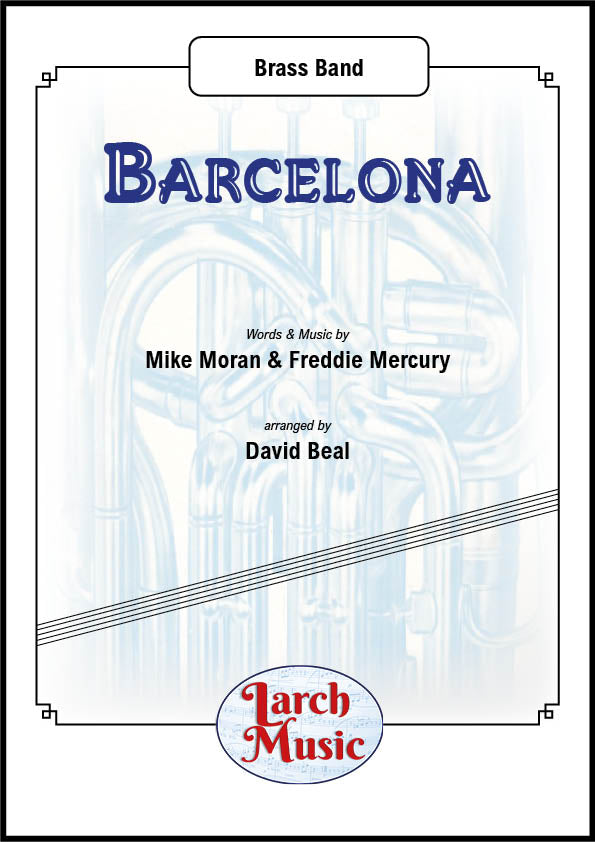
Barcelona - Vocal Duet or Cornet & Euphonium - Brass Band Sheet Music Full Score & Parts - LMAM054
COMPOSER: Mike Moran & Freddie MercuryARRANGER: David Beal"Barcelona" is a single released by Queen vocalist Freddie Mercury and operatic soprano Montserrat Caballe. A part of their collaborative album Barcelona, it also appeared on Queen's Greatest Hits III. The song reflects Mercury's love of opera with his high notes and Caballe's operatic vocals, backed by a full orchestra. Originally released in 1987, it was one of the biggest hits of Mercury's solo career, reaching number eight in the UK singles chart. After Mercury's death in 1991, it was featured at the 1992 Summer Olympics. The single was re-issued on 20 July 1992, after which the track climbed even higher, peaking at number two in the UK, the Netherlands and New Zealand. In 2004, BBC Radio 2 listed Barcelona at number 41 in its Sold On Song Top 100.Scored here for British Brass Band.
In Stock: Estimated dispatch 3-5 working days
-
 £44.49
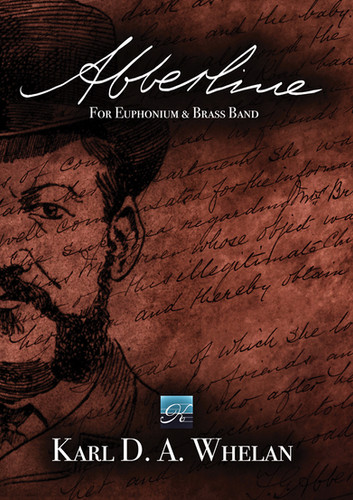
Abberline (Euphonium Solo with Brass Band) Karl Whelan
Inspired by the infamous investigation into Jack the Ripper, Abberline follows Detective Inspector Frederick Abberline through the mist-shrouded streets of Victorian London in his desperate pursuit of a killer who remains forever just out of reach. Scored for brass band and solo euphonium, the piece blends atmospheric textures, shifting musical identities, and virtuosic demands to capture a narrative that is as haunting as it is unresolved. The piece opens in a world of shadows - the foggy alleys of Whitechapel - where tension simmers beneath the surface. The euphonium enters cautiously, as if stalking unseen figures, echoing the danger and uncertainty that cloaked the city in fear. This eerie calm is broken suddenly: the Ripper strikes. The moment is brief but brutal, leaving only silence and horror in its wake. From here, the music shifts into an uneasy, angular waltz: the figure of Abberline takes center stage, portrayed by the soloist as he investigates the aftermath. The waltz is melodically off-kilter and harmonically unstable, capturing both the grotesque nature of the crime and the detective's mental burden. The scene then returns to the streets - but this time, the musical material is more intricate, fragmented, and tense. The threat has deepened, and again the silence is shattered by violence. A second, slightly altered waltz follows, further reflecting Abberline's obsessive descent into the case. In the final section, the chase begins in earnest. Themes from earlier return in quick succession, intensified and overlapping as time runs out. The ancient Dies Irae chant is woven into the texture, evoking fate and judgment. In a final, erratic surge, the euphonium and band race toward an ending that is breathless and unresolved - a reflection of history's unanswered questions and the ghost that always stayed one step ahead. To view a rolling score video of the work please visit https://www.youtube.com/watch?v=i59xYzJRMaI Duration: approx. 7.30 minutes This PDF download includes parts and score. Sheet music available at www.brassband.co.uk (UK) or https://satradecentral.org (USA) Instrumentation: Euphonium Soloist Bb Soprano Cornet Eb Solo Cornet 1-2 & 3-4 Bb Repiano Cornet Bb 2nd Cornet Bb 3rd Cornet Bb Flugel Horn Bb Solo Horn Eb 1st Horn Eb 2nd Horn Eb 1st Baritone Bb 2nd Baritone Bb 1st Trombone Bb 2nd Trombone Bb Bass Trombone Euphonium (tutti) Bb Bass Eb Bass Bb Timpani Percussion 1-3
In Stock: Estimated dispatch 1-3 working days
-
 £37.08
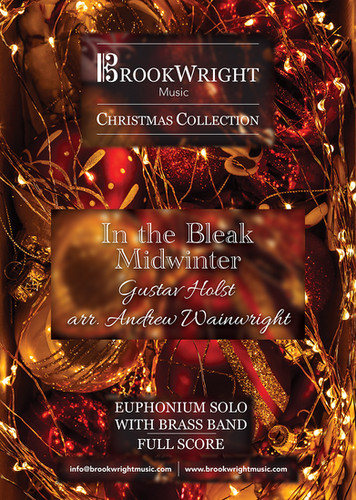
In the Bleak Midwinter (Euphonium Solo with Brass Band) Holst arr. Wainwright
Crafted especially for Philip Broome (euphonium soloist with "The President's Own" United States Marine Band) and the Dallas Brass Band, this stunning arrangement by Andrew Wainwright was premiered at the 2024 Christmas with The Salvation Army concert in Dallas, Texas. Originally written for the Elgin Symphony Orchestra, Wainwright's setting has been beautifully adapted for euphonium solo and brass band. Featuring ethereal textures, shimmering harmonies, and a gently contemplative tone, this arrangement brings new life to Gustav Holst's classic setting of Christina Rossetti's In the Bleak Midwinter. Ideal for Christmas performances or sacred concerts, this piece showcases the euphonium's lyrical expressiveness while painting a vivid musical portrait of snowy landscapes and the quiet awe of the nativity. To view a video of Philip Broome and Dallas Brass Band performing the work please visit https://www.youtube.com/watch?v=waUkONoMPjc Difficulty Level: 3rd Section + PDF download includes parts and score. Sheet music available at www.brassband.co.uk (UK) or https://satradecentral.org (USA) Instrumentation: Euphonium Soloist Bb Soprano Cornet Eb Solo Cornet Bb 1st Cornet Bb 2nd Cornet Bb Flugel Horn Bb Solo Horn Eb 1st Horn Eb 2nd Horn Eb 1st Baritone Bb 2nd Baritone Bb 1st Trombone Bb 2nd Trombone Bb Bass Trombone 2nd Euphonium Bb Bass Eb Bass Bb Timpani Percussion 1-3
In Stock: Estimated dispatch 1-3 working days
-
 £29.66
How Shall I Woo Thee (Cornet Solo with Brass Band) Coleridge-Taylor arr.Bushnell
The 7 African Romances, Op. 17 for voice and piano has words by Paul Laurence Dunbar and music by Samuel Coleridge-Taylor. Published in 1897, it comprises of 7 songs, "An African Love Song", "A Prayer", "A Starry Night", "Dawn", "Ballad", "Over the Hills" and "How Shall I Woo Thee?", of which the last is arranged here.This arrangement was requested by Besses o' th' Barn Band for the The Samuel Coleridge-Taylor Festival held in Liverpool on 11 October 2025. The song is wonderfully lilting with moments to indulge in the music.This arrangement is for the UK-style brass band and either solo B-flat cornet, solo E-flat soprano cornet or soprano singer. It also has alternative parts for horns in F and bass-clef lower brass. A recording of the original song can be found here: https://www.youtube.com/watch?v=tglGpaBsWOo Duration: Approx. 3.10 minutes Difficulty Level: 4th Section + This PDF download includes the full score and parts. Includes alternative parts for soloist in Eb, horns in F and lower brass in bass clef. Sheet music available at www.brassband.co.uk (UK) or https://satradecentral.org (USA) Instrumentation: Cornet Soloist Bb Soprano Cornet Eb Solo Cornet Bb Repiano Cornet Bb 2nd Cornet Bb 3rd Cornet Bb Flugel Horn Bb Solo Horn Eb 1st Horn Eb 2nd Horn Eb 1st Baritone Bb 2nd Baritone Bb 1st Trombone Bb 2nd Trombone Bb Bass Trombone Euphonium Bb Bass Eb Bass Bb Timpani Percussion 1-2
In Stock: Estimated dispatch 1-3 working days
-
 £74.95
Eden (Score and Parts)
This work was commissioned by the Brass Band Heritage Trust as the test piece for the final of the 2005 Besson National Brass Band Championship, held at the Royal Albert Hall, London.The score is prefaced by the final lines from Milton's epic poem Paradise Lost (completed in 1663), in which Adam and Eve, expelled from Paradise, make their uncertain way into the outside world:"...The world was all before them, where to chooseTheir place of rest, and providence their guide:They hand in hand with wandering steps and slow,Through Eden took their solitary way."My work is in three linked sections. In the first, the characters of Adam, Eve and the serpent guarding the Tree of Knowledge are respectively represented by solo euphonium, cornet and trombone. The music opens in an idyllic and tranquil mood and leads into a duet between euphonium and cornet. Throughout this passage the prevailing mood darkens, though the soloists seem to remain oblivious to the increasingly fraught atmosphere. A whip-crack announces the malevolent appearance of the solo trombone who proceeds to engage the solo cornet in a sinister dialogue.The second section interprets the Eden story as a modern metaphor for the havoc mankind has inflicted upon the world, exploiting and abusing its resources in the pursuit of wealth. Though certainly intended here as a comment on the present-day, it is by no means a new idea: Milton himself had an almost prescient awareness of it in Book I of his poem, where men, led on by Mammon:"...Ransacked the centre and with impious handsRifled the bowels of their mother earthFor treasures better hid. Soon had his crewOpened into the hill a spacious woundAnd digged out ribs of gold."So this section is fast and violent, at times almost manic in its destructive energy. At length a furious climax subsides and a tolling bell ushers in the third and final section.This final part is slow, beginning with an intense lament featuring solos for tenor-horn, flgel-horn and repiano cornet and joined later by solo baritone, soprano cornet, Eb-bass and Bb-bass.At one stage in the planning of the work it seemed likely that the music would end here - in despair. Then, mid-way through writing it, I visited the extraordinary Eden Project in Cornwall. Here, in a disused quarry - a huge man-made wound in the earth - immense biomes, containing an abundance of plant species from every region of the globe, together with an inspirational education programme, perhaps offer a small ray of hope for the future. This is the image behind the work's conclusion and the optimism it aims to express is real enough, though it is hard-won and challenged to the last.John Pickard 2005
Estimated dispatch 7-14 working days
-
 £37.08
El Camino A Belen - Trumpet Solo with Brass Band (Nick Simmons-Smith)
VIEW SCORE PDF This trumpet solo was written by Nick Simmons-Smith at the request of Dallas Brass Band for a Christmas concert featuring Elmer Churampi, international trumpet soloist. The solo features three Christmas songs: i. Mi Burrito Sabanero voy camino de Belen (With my donkey of the Savannah, I'm going to Bethlehem) ii. Noche de paz (Silent night) iii. Campana Sobre Campana (Bell above bells, O bells of Bethlehem) These songs are all very popular in Central and South America - including Peru, where Elmer Churampi is originally from. Each tune has been given a different Latin treatment producing a fast-slow-fast festive concert solo. The solo is not long, but each movement could be played individually. To view a video of Elmer Churampi performing the solo with Dallas Brass Band, please visit: www.youtube.com/watch?v=cpQCFXReEJg PDF download includes score and full set of parts. Sheet music available from: UK - www.brassband.co.uk USA - www.solidbrassmusic.com Instrumentation: Trumpet Soloist Bb Soprano Cornet Eb Solo Cornet Bb Repiano Cornet Bb 2nd Cornet Bb 3rd Cornet Bb Flugel Horn Bb Solo Horn Eb 1st Horn Eb 2nd Horn Eb 1st Baritone Bb 2nd Baritone Bb 1st Trombone Bb 2nd Trombone Bb Bass Trombone Euphonium Bb Bass Eb Bass Bb Percussion 1-3
In Stock: Estimated dispatch 1-3 working days
-
 £29.66
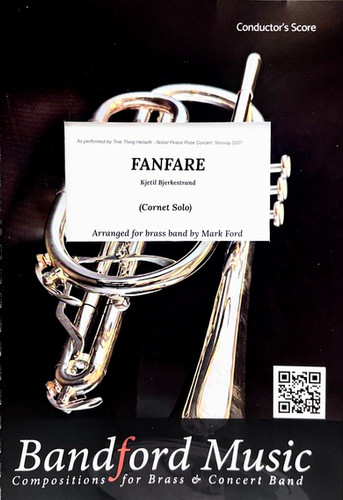
Fanfare (Cornet Solo with Brass Band) Kjetil Bjerkestrand arr. Mark Ford
Capture the prestige and grandeur of one of the world's most celebrated stages. Originally composed by Kjetil Bjerkestrand, this stirring fanfare opened the 2007 Nobel Peace Prize Concert at the Oslo Spektrum. The piece was famously premiered by the acclaimed Norwegian trumpeter Tine Thing Helseth, marking a historic moment broadcast to millions. This arrangement brings that same professional brilliance to the brass band concert stage, featuring a soaring solo cornet part that embodies the spirit of peace and international honor. To view a rolling score video of the work please visit www.youtube.com/watch?v=aMfjKLu8BjA Duration: 1.30 minutes Difficulty Level: 4th Section + This PDF download includes the full score and parts. Sheet music available at www.brassband.co.uk (UK) or https://satradecentral.org (USA) Instrumentation: Cornet Soloist Bb Soprano Cornet Eb Solo Cornet Bb Repiano Cornet Bb 2nd Cornet Bb 3rd Cornet Bb Flugel Horn Bb Solo Horn Eb 1st Horn Eb 2nd Horn Eb 1st Baritone Bb 2nd Baritone Bb 1st Trombone Bb 2nd Trombone Bb Bass Trombone Euphonium Bb Bass Eb Bass Bb Timpani Sus. Cymbal Marimba
In Stock: Estimated dispatch 1-3 working days
-
 £33.37
Have Yourself a Merry Little Christmas (Vocal or Flugel/Cornet Solo with Band)
This attractive Bossa Nova-style arrangement for vocal or flugel/cornet soloist with brass band has been made by Australian composer Sam Creamer. The key is suitable for male or female vocalists, or in the absence of a vocal soloist a part has been supplied for flugel horn or cornet soloist. A piano accompaniment that matches this band arrangement is also available here and may be used as an alternate accompaniment in the absence of a full band, or can be used simultaneously by a rhythm section alongside the brass band. Have Yourself a Merry Little Christmas has been a Christmas favourite to many since its first release, extensively featuring in Christmas movies, broadcasts and programming. It has also been recorded numerous times by artists including Judy Garland, Frank Sinatra, Tori Amos, Michael Buble, Christina Aguilera, and Chicago. To view a rolling score video of this piece please visit www.youtube.com/watch?v=sSZHxzsJheg Duration: Approx. 3.00 minutes Difficulty Level: Medium Easy PDF download includes parts and score. Sheet music available from www.brassband.co.uk or www.durhammusicshop.co.uk (UK) or https://satradecentral.org (US) Instrumentation: Vocal Soloist Cornet/Flugel Horn Soloist Bb Soprano Cornet Eb Solo Cornet Bb Repiano Cornet Bb 2nd Cornet Bb 3rd Cornet Bb Flugel Horn Bb Solo Horn Eb 1st Horn Eb 2nd Horn Eb 1st Baritone Bb 2nd Baritone Bb 1st Trombone Bb 2nd Trombone Bb Bass Trombone Euphonium Bb Bass Eb Bass BbPercussion I (Timpani, Vibraphone, Glockenspiel) Percussion II (Bongos, Shaker, Triangle) Percussion III(Drum Set)
In Stock: Estimated dispatch 1-3 working days
-
 £48.20
Angel Voices (Rhapsody for Soprano Cornet & Band) Brian Bowen
This solo for soprano cornet and brass band was written by the late Brian Bowen for the New York Staff Band in 1989 when Gordon Ward was its very fine soprano cornetist. The title comes from a song by Ernest Rance (music) and Reginald Woods (lyrics) published by The Salvation Army in 1955. In this rhapsody Rance's melody is first alluded to by the horns at the pick-up to bars 19-21, then more fully with the soloist's entry to bar 51 (but in minor mode until bar 55). Much of the original music is ethereal in nature, maybe reflecting the angelic hosts. Published by BrookWright Music in 2023, the score now carries the inscription 'To the memory of Linda Ward' - Gordon Ward's wife who very sadly died in November 2021. The first commercial recording of the rhapsody was released in 1990, performed by Gordon Ward and the New York Staff Band on its Music Makers CD (TRCD 1049), available to listen to here: https://on.soundcloud.com/nHch1 PDF download includes score and parts. Sheet music available from: UK - www.brassband.co.uk USA - www.solidbrassmusic.com Difficulty Level: 2nd Section + Instrumentation: Soprano Cornet Soloist Eb Solo Cornet Bb Repiano Cornet Bb 2nd Cornet Bb 3rd Cornet Bb Flugel Horn Bb Solo Horn Eb 1st Horn Eb 2nd Horn Eb 1st Baritone Bb 2nd Baritone Bb 1st Trombone Bb 2nd Trombone Bb Bass Trombone Euphonium Bb Bass Eb Bass Bb Percussion
In Stock: Estimated dispatch 1-3 working days
-
 £44.49
Hero (Tenor Horn Solo with Brass Band) Fendall Hill
This piece was written as a full length virtuosic solo based on an earlier work called Humble Hero, which is also available from BrookWright Music. It is an extension of that work and still dedicated to Ken Bradley, designed to provide a reflection of his technical skills and a platform to emulate musicianship for which he was renowned. Ken Bradley (1962 - 2022) was one of Australia's best-known, well-loved, and talented brass musicians. The solo is also available from this website with piano accompaniment. To view a rolling score video of the work please visit https://www.youtube.com/watch?v=WIqS9xak_Es Duration: approx. 7.30 minutes Difficulty Level: 2nd Section + PDF download includes parts and score. Sheet music available at www.brassband.co.uk (UK) or https://satradecentral.org (USA) Instrumentation: Tenor Horn Soloist Eb Soprano Cornet Eb Solo Cornet Bb Repiano Cornet Bb 2nd Cornet Bb 3rd Cornet Bb Flugel Horn Bb 1st Horn Eb 2nd Horn Eb 1st Baritone Bb 2nd Baritone Bb 1st Trombone Bb 2nd Trombone Bb Bass Trombone Euphonium Bb Bass Eb Bass Bb Timpani Percussion 1-3
In Stock: Estimated dispatch 1-3 working days
