
Results
-
£29.50
So Amazing - Traditional - Jonathan Mead
'So Amazing', is a beautiful new hymn tune arrangement from the pen of Welsh Composer Jonathan Mead. The music would create a lovely moment in a concert, where the audience would have time for reflection. The title comes from the words that are often associated with this tune, 'Love so amazing, so divine,'. The tune used, is also well known in the brass band world as, 'The Water is wide'. The music is lovely to play as well as listen to. A must for any Concert Programme.
In Stock: Estimated dispatch 1-3 working days
-
 £60.99
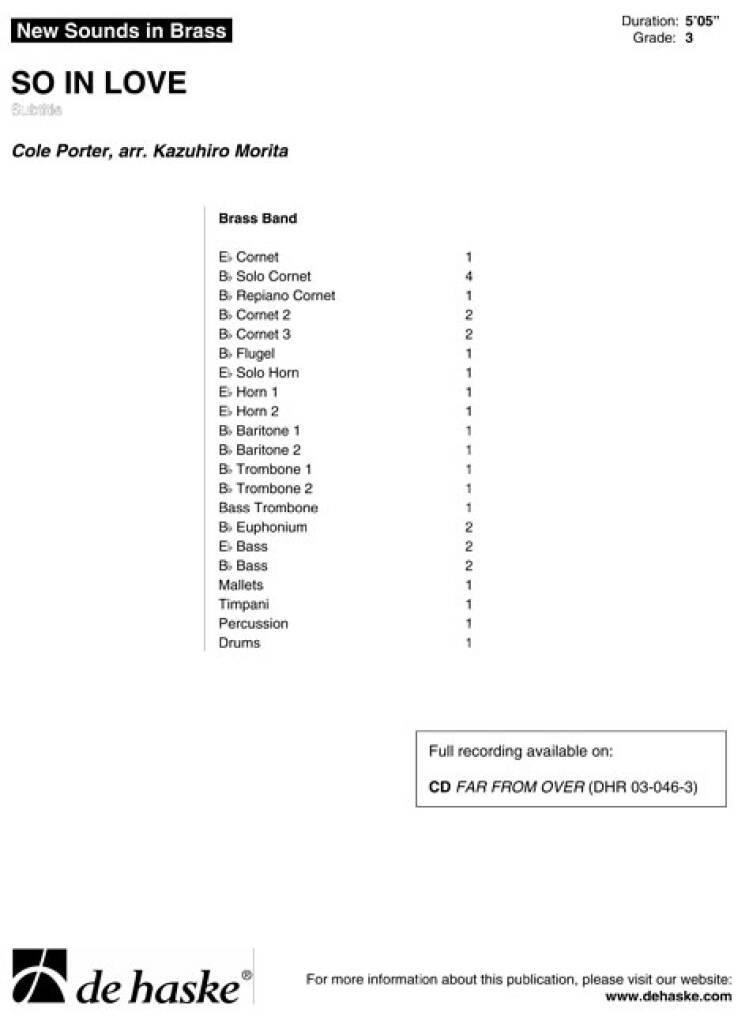
So in Love - Cole Porter - Kazuhiro Morita
Cole Porter was one of the great masters of Broadway musicals during the thirties, forties and fifties, with So in Love, from the musical Kiss Me Kate, being one of his best loved works. It has been recorded by many artists including Bing Crosby, Lulu, Shirley Bassey and Julie Andrews, however it is the Ella Fitzgerald version that is best known. This jazzy musical classic can now be enjoyed by your brass band with this excellent new arrangement.
Estimated dispatch 5-14 working days
-
 £36.30
A Million Love Songs - Gary Barlow
Made famous by the boy band 'Take That', this fantastic new angle on the song from Lucy Pankhurst, creatively features the flugel and tenor horn section with full support from the accompanying band.Take That's Gary Barlow wrote 'A Million Love Songs' when he was 15. He also recorded a rough demo of the track, and was one of the songs he gave to music manager Nigel Martin-Smith on a cassette tape as part of his audition to join a boy-band.In his autobiography A Better Me, Gary revealed that Martin-Smith was so impressed by the tape, that he didn't realise it was Gary singing. As legend has it, the conversation went like this:Martin-Smith: "This tape, who has written the songs?"Barlow: "Me"Martin-Smith: "Who wrote the words, then?"Barlow: "Me. And the music and the backing track."Martin-Smith: "Wow, you'd better come back and see me tomorrow."The ballad became one of the group's most popular songs, and is often voted among the greatest love songs of all time. It peaked at No. 7 in the UK charts, and remains a firm favourite, not just for its sentiment, but for the beautiful melody Barlow created.Lucy's arrangement for brass band brings a whole new dynamic to the music and offers the flugelhorn and tenor horns a golden opportunity to shine.
In Stock: Estimated dispatch 3-5 working days
-
 £29.88
March from 'The Love for Three Oranges (Brass Band) Prokofiev arr. Wilkinson
This thrilling brass band arrangement of the March from 'The Love for Three Oranges' by Prokofiev has been skillfully arranged by Keith M. Wilkinson. This setting captures the essence of the original orchestral work, while showcasing the power and brilliance of the brass band. In 1918, Sergei Prokofiev undertook his first visit to the United States. A number of concerts of his works were held in Chicago, which were received very favourably. As a result, the director of the Chicago Opera Association, Cleofonte Campanini, commissioned Prokofiev to write an opera. It just so happened that, during his trip, he had written a draft of a libretto, based on the Italian play by Gozzi, L'amore delle tre melarance, adding some additional surrealism to the text. Given Prokofiev's poor English, and Americans unlikely to accept an opera in Russian, French was his final choice. The result, L'amour des trois oranges (or The Love for Three Oranges), which premiered at the Auditorium Theatre in Chicago on 30 December 1921, conducted by Prokofiev himself. The March from this opera is probably the most familiar part and has been used by CBS in the radio-drama series The FBI in Peace and War. It was also used in films such as The Brink's Job and Prokofiev quoted it in the second act of his ballet Cinderella. To view a rolling score video of the work please visit www.youtube.com/watch?v=I136sf8hxlU Duration: Approx. 2.10 minutes Difficulty Level: 3rd Section + PDF download includes parts and score. Sheet music available from www.brassband.co.uk Instrumentation: Soprano Cornet Eb Solo Cornet Bb Repiano Cornet Bb 2nd Cornet Bb 3rd Cornet Bb Flugel Horn Bb Solo Horn Eb 1st Horn Eb 2nd Horn Eb 1st Baritone Bb 2nd Baritone Bb 1st Trombone Bb 2nd Trombone Bb Bass Trombone Euphonium Bb Bass Eb Bass BbTimpani Percussion 1-2
In Stock: Estimated dispatch 1-3 working days
-
 £36.30
Will You Love Me Tomorrow
This haunting song from the early 1960's was sung by The Shirrelles, and is better remembered as "Will you still love me tomorrow".Tim Paton writes:This arrangement features the Tenor Horns and Baritones, although there is still plenty to do for the rest of the band. Also, I have made sure that, if your band were unfortunately missing a 2nd Horn or/and 2nd Baritone, I have cued any important parts elsewhere so that they are covered.
In Stock: Estimated dispatch 3-5 working days
-
Anyone Who Had A Heart - Burt Bacharach and Hal David - Len Jenkins
"Anyone Who Had A Heart" is a song written by Burt Bacharach (music) and Hal David (lyrics) originally for Dionne Warwick in 1963. However, in the UK, Ireland and New Zealand, the cover version by Cilla Black was, and is still, the best loved. Championed by her friends The Beatles, she began her career as a singer in 1963, and her singles "Anyone Who Had A Heart" and "You're My World" both reached number one in the UK in 1964. From the first line, the song has a certain frisson: "Anyone who ever loved, could look at me, and know that I love you." Sadly, Cilla passed away on 1 August 2015 so this is our tribute to a well-loved lady and singer. Our objective has been to interpret the style of the original performance by Cilla, and whilst the time signatures may not be familiar, experience has shown that these are easier to read and play than the alternative using triplets.
-
 £60.99
So in Love (Brass Band - Score and Parts) - Porter, Cole - Morita, Kazuhiro
Cole Porter was one of the great masters of Broadway musicals during the thirties, forties and fifties, with So in Love, from the musical Kiss Me Kate, being one of his best loved works. It has been recorded by many artists including Bing Crosby, Lulu, Shirley Bassey and Julie Andrews, however it is the Ella Fitzgerald version that is best known. This jazzy musical classic can now be enjoyed by your brass band with this excellent new arrangement.Duration: 5:00
Estimated dispatch 7-14 working days
-
 £127.30
Haven't Met You Yet - Michael Bublé - Bjørn Morten Kjærnes
"Haven't Met You Yet" is the first single from Canadian singer Michael Buble's sixth album, Crazy Love, released on August 31, 2009. According to Buble, the single and its official music video are "about everyone's dream of finding a relationship and love." Buble co-wrote "Haven't Met You Yet" with Alan Chang and Amy Foster-Gillies and dedicated it to his then fiancee and now wife, Luisana Lopilato (who appears as his love interest in the music video).2012, Nick Jonas covered the song in the TV series Smash, so this music can also be used in a TV/Movie theme concert.Soloist options:Attached is a vocal lead that can be used with the arrangement. It is then recommended to dampen the melody in the ensemble, especially on the verses. (See list below)There are some performers or groups that can have these bars as solos:9-17 Flugelhorn17-24 Euphonium/Horn37-45 Euphonium45-52 Baritone/Trombone61-69 Horn/ Flugelhorn78-85 Euphonium/Baritone86-95 Flugelhorn107-end Flugelhorn/EuphoniumIf you want to use an instrumental soloist throughout the piece, they can use the vocal lead and transpose it to their instrument. Then the conductor should dampen or remove the above solos in the band.
Estimated dispatch 5-14 working days
-
 £89.99
Ross Roy - Jacob de Haan
In this composition, Jacob de Haan sees the "Ross Roy" as a metaphor for the years spent at school (a monument in time), where one's personality is formed. So, the opening theme the artist calls the Ross Roy theme initially has monumental characteristics.The rhythmic motion, which strides along in the lower register and percussion at the beginning of the next section is typical of "Tempo di Marcia". This movement, accompanied by repetitions of sound, is a metaphor for the structure and discipline in school. This is the introduction to a march theme, symbolic of "passing through" the classes up to the final examinations.Then, the Ross Roy theme is dealt with again, now in aplayful, humorous variation. As if the composer is saying there should also be time for a smile in school. The same theme can be heard in major key and a slower tempo in the following section, expressing pride and self-confidence. This is also the introduction to the expressive middle section that represents love, friendship and understanding.We then return to the march theme in a slightly altered construction. The oriental sounds, constituting the modulation to the final theme, are symbols of the diversity of cultures in the school. The characteristic final theme first sounds solemn, but turns into a festive apotheosis. It is no coincidence that the final cadence is reminiscent of the close to a traditional overture, for the school years can be considered the "overture" to the rest of one's life.
Estimated dispatch 5-14 working days
-
 £159.99
Omaggio - Philip Sparke
Omaggio was commissioned by Steven Mead in celebration of his 60th birthday and in memory of his father, Rex. He gave the premiere of the brass band version in Rome in March 2022, accompanied by the Italian Brass Band conducted by Filippo Cangiamilla. The concert band premiere took place on 6th July that year as part of the 2022 Spanish International Tuba Euphonium Conference, accompanied by the Banda municipal de musica de Malaga. The concerto is set in 3 continuous movements, which are united by a recurring syncopated interval of a fifth. The first movement, FANTASIA, opens with this motive accompanying an extended monologue for the soloist. This is followed by a lengthy bridge passage by the band (piano), which is eventually joined by the soloist, who guides the music back to the opening soliloquy, leading to an energetic central section. This develops until the opening material again returns to introduce the second movement, BALLAD, which revolves around an expressive melody for the soloist, interspersed by accompanied cadenzas. The third movement, THE KING TRIUMPHANT, pays homage to Steven's late father, Rex, and its title alludes both to Rex's name ('Rex' being Latin for 'king') as well as his love of Eric Ball's Salvationist masterpiece, The Kingdom Triumphant. The finale is an energetic tour-de-force featuring an acrobatic 6/8 melody, which is interrupted twice by the magnificent hymn tune, Helmsley, which Ball uses so effectively in The Kingdom Triumphant. A galloping coda brings the work to a close.
Estimated dispatch 5-14 working days
 Listen to MP3
 View Music